My prediction for the first day of the quarter finals of the African Cup of Nations was right on: Ghana did beat Cape-Verde by a 2-0, and Mali edged out the host country South Africa 1-1 by penalty shoot out (3-1), and advanced to the semi-finals.
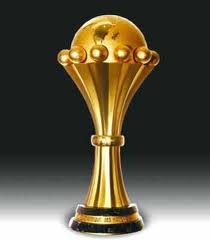
The Africa Cup of Nations/ La Coupe d’Afrique des Nations
However, on the 2nd day, all went wrong. The cup’s big favorite, Côte d’Ivoire, were edged out by valiant Nigeria by 2-1. The Super Eagles of Stephen Keshi maintained the pressure on the Elephants throughout the game, and came out the stronger side. All hails to Stephen Keshi who managed to line up a strong offense, and defense, to take down the mighty favorites Côte d’Ivoire of Didier Drogba. Unfortunately, this ends up the dream of the ‘greatest generation’ (as Didier Drogba, Bonaventure Kalou, Kolo Touré, Yaya Touré, Boubacar Barry, etc are known) of Côte d’Ivoire to ever lift up the African Cup of Nations. Although I am sad for Didier Drogba who has been one of Africa’s greatest players of the past decade (and one of the world’s best forwards), I salute Nigeria’s hard work which got them through to the semi-finals. After lifting cups in Europe, Didier never got a chance to lift an African trophy… quite sad…
Lastly, Burkina Faso beat Togo 1-0 to find themselves in their first ever semi-final.
The line-up for Wednesday will be fun to watch: Ghana vs. Burkina Faso (you have guessed who will be my favorite to win that game: Ghana), and Nigeria vs. Mali promises to bring the heat up (Nigeria of Stephen Keshi being my favorite).
Who do you think will end up in the final of the 2013 African Cup of Nations? What do you think the scores for the semi-finals will be?
The Africa Cup of Nations/ La Coupe d’Afrique des Nations
Tomorrow, Saturday will mark the beginning of the quarter-finals of the African Cup of Nations. I have to admit that just like last year, my two favorites are Côte d’Ivoire and Ghana. The Chipolopolo showed a very poor display of their skills this year, and the champions never advanced to the quarter-finals, the first time in 20 years that a champion (since Algeria) doesn’t make it through the first stage.
The game to watch (i.e. the clash of titans) in the quarter-finals, will be Cote d’Ivoire vs. Nigeria. Personally, after Nigeria so-so display, I rest fully on the elephants to send the Super Eagles packing.
The other game will be Mali vs. South Africa. The Bafana Bafana of South Africa have not been a strong team since 1996, and so my hope is the greatest for them. However, they have the home court advantage as the cup is taking place in South Africa. Mali, with Seydou Keita, looks a lot stronger.
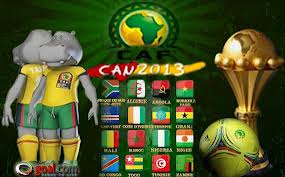
CAN 2013
Burkina Faso vs. Togo is a so-so game… Anybody’s guess on who will be the winner is good; I give the slight upper edge to Togo.
Lastly, Ghana vs. Cape-Verde will be a nice game to watch. First because this is Cape Verde’s first ever participation at the African Cup of Nations, and also because they have truly earned their place at the CAN, and have so far pleased by their work. The Blue Sharks also happens to have a singing coach who brings joy to the players. This said, I believe Ghana to be the favorite and the strongest side, and I think Asamoah Gyan‘s teammates will be eager to clear last year’s defeat and finally lift the trophy.
I can’t wait to watch a Côte d’Ivoire vs. Ghana final… Elephants vs. Black Stars …the ‘great generation’ as Drogba‘s teammates are known, vs. Ghana’s greats…that promises (if it happens) to be a hot game! I can already see fire on the mountain.
Je viens de me rendre compte que le site djime.com qui était entièrement dedié au roi Béhanzin, n’est plus actif. J’ai donc decidé de poster ici, la version francaise, l’originale du discours d’adieu du roi Behanzin. J’avais deja traduit dans son intégralité ce discours du roi Behanzin en anglais. The English versionhere.
=============
« Compagnons d’infortune, derniers amis fidèles, vous savez dans quelles circonstances, lorsque les Français voulurent accaparer la terre de nos aïeux, nous avons décidé de lutter.
Nous avions alors la certitude de conduire notre armée à la victoire. Quand mes guerriers se levèrent par millier pour défendre leDanhomèet son roi, j’ai reconnu avec fierté la même bravoure que manifestaient ceux d’Agadja, deTegbessou, deGhézoet deGlélé. Dans toutes les batailles j’étais à leurs côtés.
Malgré la justesse de notre cause, et notre vaillance, nos troupes compactes furent décimées en un instant. Elles n’ont pu défaire les ennemis blancs dont nous louons aussi le courage et la discipline. Et déjà ma voix éplorée n’éveille plus d’écho.
An Amazon warrior ca 1890
Où sont maintenantles ardentes amazones qu’enflammait une sainte colère? Où, leurschefs indomptables : Goudémè, Yéwê, Kétungan? Où, leursrobustes capitaines : Godogbé, Chachabloukou, Godjila? Qui chantera leurssplendides sacrifices? Qui dira leurgénérosité ?
Puisqu’ils ont scellé de leur sang lepacte de la suprême fidélité, comment accepterais-je sans euxune quelconque abdication?Comment oserais-je me présenter devant vous, braves guerriers, si je signais le papier du Général ?
Non !A mon destin je ne tournerai plus le dos. Je ferai face et je marcherai. Car la plus belle victoire ne se remporte pas sur une armée ennemie ou des adversaires condamnés au silence du cachot.Est vraiment victorieux, l’homme resté seul et qui continue de lutter dans son cœur. Je ne veux pas qu’aux portes du pays des morts le douanier trouve des souillures à mes pieds. Quand je vous reverrai, je veux que mon ventre s’ouvre à la joie. Maintenant advienne de moi ce qui plaira à Dieu ! Qui suis-je pour que ma disparition soit une lacune sur la terre ?
Partez vous aussi, derniers compagnons vivants.Rejoignez Abomey où les nouveaux maîtres promettent une douce alliance, la vie sauve et, paraît-il, la liberté. Là-bas, on dit que déjà renaît la joie. Là-bas, il paraît que les Blancs vous seront aussi favorables que la pluie qui drape les flamboyants de velours rouge ou le soleil qui dore la barbe soyeuse des épis. Compagnons disparus, héros inconnus d’une tragique épopée, voici l’offrande du souvenir : un peu d’huile, un peu de farine et du sang de taureau. Voici le pacte renouvelé avant le grand départ. Adieu, soldats, adieu !…
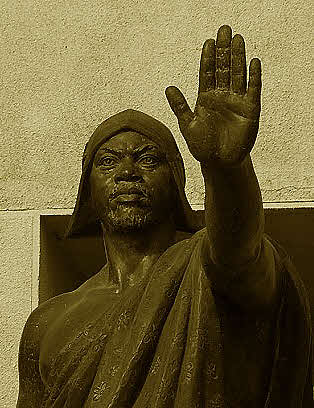
Behanzin, the Last King of independent Dahomey
Guédébé…reste debout, comme moi, comme un homme libre. Puisque le sang des soldats tués garantit la résurrection duDanhomè, il ne faut plus que coule le sang. Les ancêtres n’ont plus que faire de nos sacrifices.Ils goûteront mieux le pur hommage de ces cœurs fidèles unis pour la grandeur de la patrie. C’est pour quoi j’accepte de m’engager dans la longue nuit de la patience où germent des clartés d’aurore. Guédébé, comme le messager de la paix, va àGhohooù campe le général Dodds.Va dire au conquérant qu’il n’a pas harponner le requin. Va lui dire que demain, dès la venue du jour, de mon plein gré, je me rends au village de Yégo. Va lui dire que j’accepte, pour la survie de mon peuple, de rencontrer dans son pays, selon sa promesse, le président des Français. »
extrait de – Kondo le requin – Jean PLYA – Ed. CLE
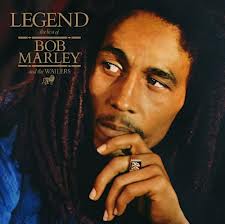
“How long shall they kill our prophets…?”as Bob Marley said, “… while we stand aside and look?”Sir Bob Marley said it all: How long shall we let these conquerors beat us down? bombard us? kill our prophets? What were Lumumba, Sankara, Cabral, Um Nyobé, Ouandié, Khadafi, Ben Barka, or Gbagbo’s sins? To love their country: to want to save their countries from western greed. What were we doing when they were all killed? Why on earth are we, Africans, just looking (and sometimes applauding) while some countries, Côte d’Ivoire, Libya, and now Mali are being bombed? Why and how long are we going to look while our prophets are being killed?
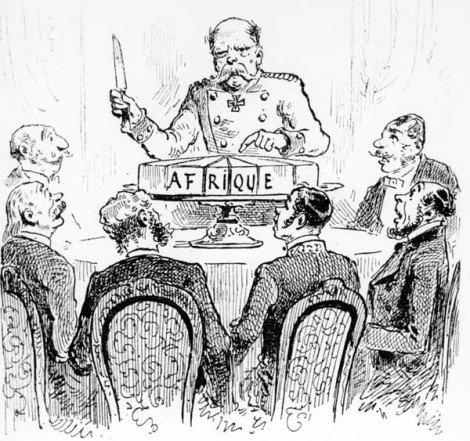
Le partage de l’Afrique a la Conference de Berlin de 1884
I just heard of Charles Blé Goudé being arrested. My heart is broken as I hear some Africans applaud… yes my heart is shattered when I hear people say “oh he deserved it.” Deserved what? Deserve being beaten to death because he stood up for his country while external forces were invading it? Deserve being humiliated because he dared walk out in the streets of Abidjan bare-handed to fight external forces, because he brought the youth together, because he woke Ivorians and Africans to their rights to respect, independence, and fairness? Yes… as Sir Marley said: “Emancipate yourself from mental slavery [slavery of the mind; slavery mentality: ignorant mentality]”… “Have no fear for atomic energy.” Some African head of states said when Côte d’Ivoire and Libya were being bombed ” It is better not to say anything; we will just agree with these westerners otherwise they will bomb us too!” now peaceful Mali is under attack; peaceful and desertic Mali is being bombed. Which other peaceful African country will be next? It is better to rise, save our prophets, and talk… than to drink the milk of cowardice, fear, treachery, and ignorance. Have no fear for atomic energy, just stand against injustice… that is way better than treachery or the cancer of betrayal as Amilcar Cabral called it. Enjoy Sir Marley, and remember that the milk of cowardice never saved our ancestors, and will never save us; our ancestors thought that they were sparing themselves from harm, but 50, 100, 500 years later their children are still fighting the battles they should have fought in the first place. History repeats itself… are we still going to stand aside while our prophets are being killed? are we going to fear atomic energy, and run as cowards? No matter how far we run, or how much we hide, they are coming for us… we might have seeming peace for 20 years, but our children will still have to fight our battles!
J’ai trouvé cet article sur Cameroon Voice du Pr. Chems Eddine Chitour assez interessant. Depuis que les occidentaux se sont lançés a une reconquête du monde: Côte d’Ivoire, Libye, Syrie, et maintenant Mali… on se pose bien des questions. Les questions fondamentales demeurent: à qui le tour? Pourquoi cette politique de la gâchette facile? pourquoi acquérir ce gain si facile, pourquoi tant de paresse? Les Occidentaux devraient reconnaitre que leur systeme capitaliste a bel et bien été la faute de leur chute… et beaucoup de pays tels la France et les Etats-Unis devraient le reconnaître, et faire une réforme de leur système, règler leur dette, et non mettre le reste du monde à feu et à sang, et ensuite prétendre que la Chine est l’ennemi du monde. Franchement… c’est assez difficile de comprendre une intervention aérienne française au Mali, un pays du tiers-monde où les gens n’arrivent même pas à joindre les 2 bouts. C’est assez difficile d’accepter que des petits rebelles pourraient constituer une menace pour la France qui aurait même besoin du support militaire américain. Les attentats récents en Algérie contre des ressortissants américains semblent présenter l’Algérie comme le prochain pays sur la ligne de mire des sanguinaires français qui ont toujours rêvé de mettre l’Algérie à genoux en y commettant les plus grands genocides de l’histoire de l’humanité. Que le bon Dieu nous garde des paresseux, et des envieux! Ces derniers feraient mieux de se mettre au travail comme les Chinois!
========
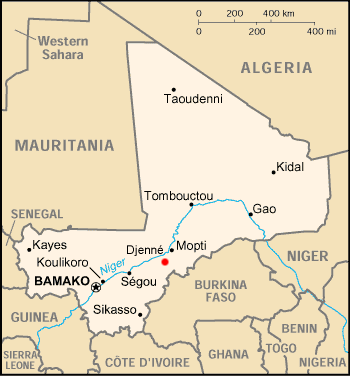
Map of Mali
Ça y est! Comme nous l’avons prédit dans un article précédent, l’Afghanisation du Mali est en marche! Pourquoi l’engouement des redresseurs de tort de l’Empire et de ses vassaux pour un pays qui, en théorie, est un désert au sens qu’il ne contient rien de comestible à moins que nous n’ayons pas toute l’information sur les réelles potentialités de ce pays voisin. […]
Curieusement, ces dernières semaines notamment avec les accords de Ansar Eddine et du Mnla à Alger, qui devaient ensuite être reçus par les responsables de la Cédéao pour une solution négociée, avaient fait miroiter une possible paix sans intervention militaire. Tout s’est précipité. Une résolution fut arrachée aux Nations unies le 20 décembre 2012, elle autorise une intervention en cas d’échec de la diplomatie. Cette diplomatie qui n’a pas eu à faire ses preuves puisque trois semaines après, la France intervenait pour stopper les mouvements se revendiquant d’un Islam fondamentaliste, sans accord du Conseil de sécurité. [surprenant comme ce scenario ressemble a celui de la Libye avec les Nations Unies qui sortent des resolutions suivies des frappes aériennes franco-americaines]. […]
L’intervention au Mali a été engagée après le forcing français pour l’adoption, le 20 décembre 2012, de la résolution 2085 par le Conseil de sécurité de l’ONU. Pour autant, aucune résolution de l’ONU n’autorise (ni n’interdit du reste) l’intervention française. […] Continue reading ““Le Mali en miettes. A qui le tour?” de Chems Eddine Chitour”→
My fellow friends may the year 2013 be the year of all greatness, success, harmony, and peace! I would like to thank all those who visited my blog, and all my future visitors … I am grateful for your trust and faith in my blog. We have more than tripled the number of viewers this year: keep on visiting, keep on sharing, and keep on commenting. I wish you all wonders without borders, grace, and peace for 2013. To all those who witnessed the horrible events in Mali, South Africa, Cote d’Ivoire, and Libya, to all those who felt powerless in 2012, it is time to rise and keep fighting, it is time to stay strong and keep loving our neighbors. We need to stay strong, alert, and open as always. Above all, we need to keep praying for 0ur beautiful continent. We are all agents of hope, we are all agents of good, and we need to be agents for the betterment of Africa. As Franklin Boukaka said of Mehdi Ben Barka, and would say to us now: ‘ our work is that of humanity.’
5. President Laurent Gbagbo‘s hearing at the International Criminal Court (ICC) was scheduled for June 18, 2012, but was postponed to August 13, 2012, and now has been postponed indefinitely. Apparently the ICC cannot find proofs of all their allegations against Laurent Gbagbo, and thus prefer stalling.
The VMK (Source: VMK)
6. Oussama Mellouli, of Tunisia, won Gold in the 10 km marathon open water, to become the first swimmer to ever win olympic medals in both the pool and open water (August 2012).
7. David Rudisha of Kenya, became the first man to break a record at the London Olympics, in the 800m (August 2012).
8. Alaeeldin Abouelkassem of Egypt won silver in fencing, becoming Africa’s first medal in fencing (August 2012).
2012 was a different year with a lot of disappointments, hurts, pains, coup d’etat, and all sorts of things in Africa. We said goodbye to quite a few people in 2012, including:
1. President John Atta Mills of Ghana, who joined his ancestors suddenly on 24 July 2012… So long Prof… May the land of Ghana hold you tight.
2. President Meles Zenawi of Ethiopia, who passed on 20 August 2012… leaving Ethiopia in turmoil.
3. President Bingu wa Mutharika of Malawi, who passed away on 5 April 2012… he is succeeded in power by the second woman president in Africa: Mrs. Joyce Banda.
4. Minister Paul-Antoine Bohoun Bouabre of Côte d’Ivoire left us on 10 January 2012; this is the man who single-handedly saved Cote d’Ivoire from a financial cliff.
5. Cameroonian legendary footballer Théophile Abega, nicknamed ‘The Doctor’, left us on November 15, 2012. He was voted as one of Africa’s top 200 players of the past 50 years.
6. Charles Taylor, former president of Liberia, was sentenced to 50 years for war crimes in May of this year.
7. A coup d’etat deposed the rightful president of Mali, President Amadou Toumani Toure (ATT) on 22 March 2012, one month before scheduled elections. This has left Mali in turmoil; the country is now going down the path of Cote d’Ivoire and Libya: split into two, and eventually … broken apart?
9. Abdoulaye Wade, the négrier of Senegal, was booted out of his presidency by the people of Senegal who voted for Macky Sall on 25 March 2012 (a true example of democracy in Africa).
10. Last but not least, the most hateful one of all: Nicolas Sarkozy, the ‘bourreau’ of Africa was booted out of the French presidency on 6 March 2012 … bye bye Sarko… you went for the recolonization and destruction of Cote d’Ivoire and Libya… and the deck of cards are still falling; now Mali… ? Sarko is gone… but his deeds are still going on.
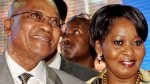
Today I would like to talk about Mrs. Gloria Bongekile Ngema-Zuma who just gave an interview to BBC. She is Jacob Zuma (J.Z.)‘s fourth wife, married on April 2012. She is an accomplished woman, educated, and really I have to say it: a contradiction to many young African girls growing. She is an accomplished professional accountant, and IT manager… and for her to become the fourth wife of somebody, even if that somebody is the president of a nation, is simply tasteless. I know that it is prestigious to be a president’s wife, but come’ on for the sake of the young girls out there in South Africa, and Africa… is this really the example to be set? So as a woman, you can be as accomplished as you want, but you are only worth to be a man’s fourth wife? You cannot be your own person? Or he cannot love and respect you enough to leave all his other wives?
Jacob Zuma and his fourth wife, Bongi Ngema
Now, some may ask me if I would have preferred for her to be his mistress? Of course not, but I find it revolting to have a president who has four wives. I find it disgusting to have a president, in modern days, who holds onto the past, and who cannot make up his mind… because truly that’s is what it all boils down to: decisiveness, discipline, and control. No wonder there has been violent attacks on Africa ever since Jacob Zuma became president of South Africa: destruction of Côte d’Ivoire after the 180 degrees turn of Zuma, destruction of Libya under the vigilant eye of Zuma, massacre of defenseless miners at the Marikana’s mines, etc. Is promiscuity now allowed at the top of the state? There is really something to having one wife, committing to marriage to only that person, and above all, having the oneness of mind, or rather a ‘single’ vision. What should a young girl growing up think? She can only be powerful if she is in a polygamous marriage; even educated, she is only worth being somebody’s 2nd, 3rd, or 4th wife? Why can’t she be his only wife?
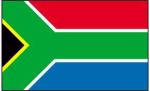
Flag of South Africa
As I listened to Mrs. Zuma’s interview, I have to admit that I was appalled, as she could not even answer the simple question as to why? The only answer was:” I am a grown woman, making my own choices.” Of course, there are lots of grown women around the world making their own choices, but when you are a first lady, you no longer make choices for yourself, you also have to acknowledge impacts on society. What about young girls? How can you talk about modernism when there is so much contradiction in your thoughts? Now, she says she is Zulu first, and then modern woman second. Yes that’s true, but does she abide by all Zulu rules? Are all Zulu women in polygamous marriages? I am African first, but does that mean that our daughters should undergo excision?I am African first, does it mean that servants in the kingdom should still accompany the king in his grave? I am African first, does that mean that albino children or twins (in some African traditions) should still be killed at birth?Of course not! For somebody, a first lady (or 4th lady), to blurt: “I am Zulu first, then xyz second,” … i.e. that’s why I live in prehistoric ages is simply disgusting. No offense to Mrs Zuma, but I do not want any of our daughters to see her as an example. Now, somebody could argue that: ‘maybe she wanted to influence young girls, and she could only do that as the president’s wife’… Sure, but she was already influencing young girls by being the great manager that she was. If President Zuma and her loved each other, could he not have divorced to marry her? Couldn’t she have waited till the end of his term to be with him? Couldn’t she have influenced the president by demanding that he divorces his other wives? Now, that would have been the symbol of a strong woman whose influence on young girls would have been strongly felt over generations!
Thank goodness there are still other great African women out there who stand for their very own convictions and inspire young African women. What next for J.Z.? A fifth wife for 2013?
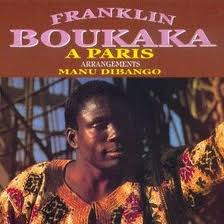
“Les Immortels” is a song written and composed by Franklin Boukaka, the great Congolese singer, to honor the great Moroccan leader Mehdi Ben Barka, African resistants, and world revolutionaries. Franklin Boukaka was a singer ahead of his time who loved his country, and had a passion for liberty. Franklin Boukaka was a freedom fighter, poet, composer, activist, and fought for African independence both politically, but above all by his great songs which today are still sung across Africa (you all have probably heard of “Aye Africa“). Born into music on 10 October 1940, with musician parents, he was murdered during the coup that deposed Ange Diawara during the night of 23-24 February1972. His greatest album was “Le Bucheron” realized with Manu Dibango, which contains “Les Immortels.” With all that is happening in Africa, with the coup against Laurent Gbagbo in Côte d’Ivoire, the crush of Libya and the guide of the revolution Mouammar Khadafi, and with the destruction of Mali, “Les Immortels” is still of actuality. Enjoy!














 African Heritage