Yesterday, David Olusoga of BBC Two published a documentary on Britain’s Slave Owners part 1: Profit and Loss. His work was very profound, and was of course very painful, as it dealt with slavery. Here is the synopsis, from BBC Two website:
“In 1834 Britain abolished slavery, a defining and celebrated moment in our national history. What has been largely forgotten is that abolition came at a price. The government of the day took the extraordinary step of compensating the slave owners for loss of their ‘property’, as Britain’s 46,000 slave owners were paid £17bn in today’s money, whilst the slaves received nothing.
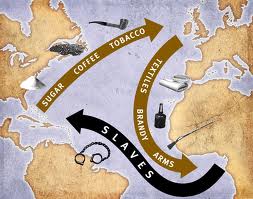
The Transatlantic slave trade
For nearly 200 years, the meticulous records that detail this forgotten story have lain in the archives virtually unexamined – until now. In an exclusive partnership with University College London, historian David Olusoga uncovers Britain’s Forgotten Slave Owners. Forensically examining the compensation records, he discovers the surprising range of people who owned slaves and the sheer scale of the slavery business.
Slaves on board a ship
What the records reveal is that the slave owners were not just the super-rich. There were widows,clergymen and shopkeepers; ordinary members of the middle-classes who exploited slave-labour in distant lands. Yet many of them never looked a slave in the eye or experienced the brutal realities of plantation life.”
Check out the BBC Two website which has an interactive view of it. I also liked the video link below about some instruments of torture used in Jamaica to punish slaves. I invite you to find this outstanding documentary by David Olusoga. Below is an interview he gave.
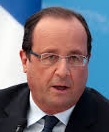
It took over 70 years for a French President to finally admit the genocide perpetrated in Cameroon by France between 1950 and 1970, a genocide which claimed over 400,000 lives, and displaced countless others. In his visit to Cameroon last Friday, French president François Hollande acknowledged that French forces had tried to quash colonial separatists in the 1950s and said he was ready to open up the history books. He said, “I recognize that there have been extremely traumatic and even tragic episodes.” Should we jubilate?
Ruben Um Nyobé
I say NO. It is true that this is somewhat a step forward: recognition of wrong done. However, I call it arrogance to wake up one day, and finally say, “Oh, yes, I killed your fathers, mothers, brothers, or sisters, … I showered many of your cities with Napalm, … I decapitated so many of your freedom fighters and hung their heads in the villages’ square, … I killedRuben Um Nyobé, Felix-Roland Moumié, Castor Osende Afana, Ernest Ouandié, and so many others, … I forced some of you into exile, … and I displaced countless others inside and outside your borders.” And so what? Should we clap for you? where is the apology? Didn’t you think we knew you did that? Where is the reparation?
Maquisards’ heads during the genocide in Cameroon
During the Maquis years, many lost a loved one; is there a reparation for that loved one? that father who never saw his children grow up? that mother who never saw her son again? What about those who kept waiting, and waiting, hoping that after so many years the loved ones would come back home?… What about the pain of that young girl walking to school who had to watch the decapitation of ‘maquisards’ on the public place: she was scarred for life! What about those entire villages burnt with napalm? And those who were displaced internally from French Cameroon to British Cameroon, running for their dear lives and leaving behind their lands? What about Ruben Um Nyobé and his family? Felix-Roland Moumié, and his widow who suffered years of imprisonment in the harshest places? and Ernest Ouandié… and all the children who had to watch in horror as he took his last breath under the firing squad’s shots? What about the remaining population whose history was erased from textbooks, those who now have a gap in their past?
UPC Leaders (L. to R.) front row: Castor Osende Afana, Abel Kingué, Ruben Um Nyobé, Felix Moumié, and Ernest Ouandié
And to stand up there, and say “yes I recognize that we killed you”… it’s like Hitler waking up today, and telling Holocaust survivors and their descendants, “I killed you, jailed your parents, forced you into exile, brought fear into your souls, and decimated every part of you… what can you do?” It is simply arrogant! It is just too easy. Until there is a clear “I am sorry”, until there is a clear “here is what we will do to correct the wrong”, until there is a clear “arrest of all perpetrators”, until there is a clear “story in the history textbooks, opening of all the classified documents”…. until there is a clear “respect for those killed,” until then, there will be no respect for arrogant presidents of the hexagon in our dictionaries!
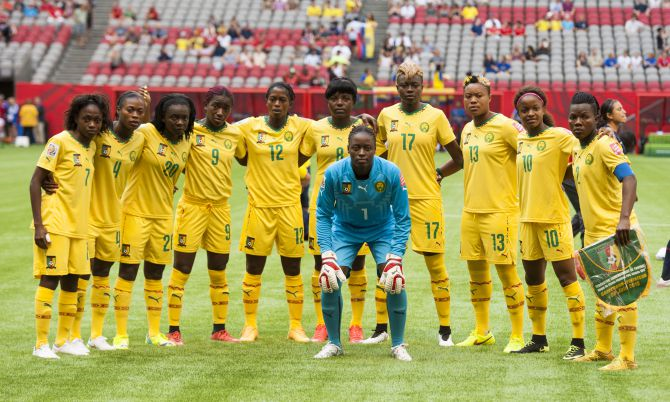
I was quite proud of the Cameroonian team who succeeded in going through the first round of the 2015 Women FIFA’s World Cup in Canada. This was Cameroon’s first World Cup participation. With no government support, barely any equipment, and little organization, they managed to do well with so little. Here is a quote by the Cameroonian coach Enow Ngachu, “The day we prepare and organize very well, I think an African nation will one day win the World Cup. … We just hope that with our performance many things will change in Cameroon and in Africa.”
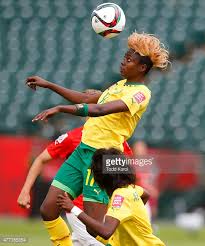
Gaelle Enganamouit in action (Getty Images)
On June 20th, China PR survived a tough examination from Cameroon with a lone early strike from Wang Shanshan, thus ending the Lionnes of Cameroon’s journey. Both teams played with high-tempo and intensity from the opening whistle in Edmonton with chances aplenty at either end, but it was the Chinese who remained resilient at the back to advance into the last-eight. We are very proud of these Cameroonian sisters who showed that African women, and women in general, can play very good, entertaining, and amazing football/soccer, and should be equally cared for by their governments and people. My hat to Gaelle Enganamouit, Madeleine Ngono Mani, Christine Manie, Gabrielle Aboudi Onguene, and all the other sisters who made us proud. Indomitable Lioness Gaelle Enganamouit became the first African to score a hat-trick at the Women’s World Cup. Below is a highlight from the game Cameroon – Switzerland, which was quite intense and beautiful to watch. Enjoy!
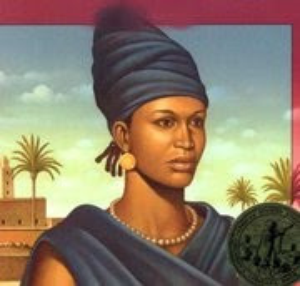
Queen Ndate Yalla Mbodj (from the cover of Kings and Queens of West Africa, by S. Diouf)
In 1855, when the French arrived to colonize Senegal, the first power of resistance they encountered was a woman. Her name was: Ndate Yalla Mbodj. While in France, women were not recognized as citizens until 90 years later, the French were stunned by this woman of beautiful stature, face, and strong body, and who headed an immense army. She was a beautiful and proud warrior, who inherited a rich tradition of bravery and gallantry.
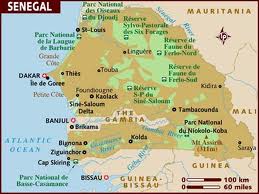
The Lingeer or Queen Ndate Yalla Mbodj (1810 – 1860) was the last great queen of the Waalo, a kingdom in the northwest of modern-day Senegal. She was a heroine of the resistance against French colonization and Moors invasion. She was also the mother of Sidya Leon Diop or Sidya Ndate Yalla Diop, who went on to become one the greatest resistants to the colonization of Senegal.
Map of modern-day Senegal
Queen Ndate succeeded to her sister Ndjeumbeut Mbodj. She was officially crowned Queen of the Waalo on October 1st 1846 in Ndar (now called Saint-Louis), the capital of the Waalo. Her reign was marked by an ongoing defiance of the French against which she fought a fierce battle. By 1847, she opposed the free passage of Sarakolé people by sending a letter to the governor expressing her willingness to defend the respect of her sovereignty over the valley in these terms: “We guarantee and control the passage of cattle in our country and we will not accept it the other way. Each leader governs his country as he pleases.“
Warrior from the Waalo Kingdom, 1846
She fought both the Moors who happen to encroach on her territory, and the colonialist army led by Louis Faidherbe, the butcher, and bandit, who later became governor of Saint-Louis and colonial head of administration and army. Almost 10 years into her reign in 1855, she encountered the greatest colonialist pirate Faidherbe, with an army of 15,000 strong, fully armed and ready to fight her, dethrone her, and colonize Waalo and Senegal. Faidherbe defeated her army in bloody battles, before capturing Saint-Louis. In February 1855, while the Faidherbe’s troops were entering the Waalo, the Lingeer spoke to the principal dignitaries of her country as such: “Today, we are invaded by the conquerors. Our army is in disarray. The tiedos of the Waalo, as brave warriors as they are, have almost all fallen under the enemy’s bullets. The invader is stronger than us, I know, but should we abandon the Waalo to foreign hands?” (Aujourd’hui nous sommes envahis par les conquérants. Notre armée est en déroute. Les tiédos du Walo, si vaillants guerriers soient-ils, sont presque tous tombés sous les balles de l’ennemi. L’envahisseur est plus fort que nous, je le sais, mais devrions-nous abandonner le Walo aux mains des étrangers?) … “This country is mine alone!”
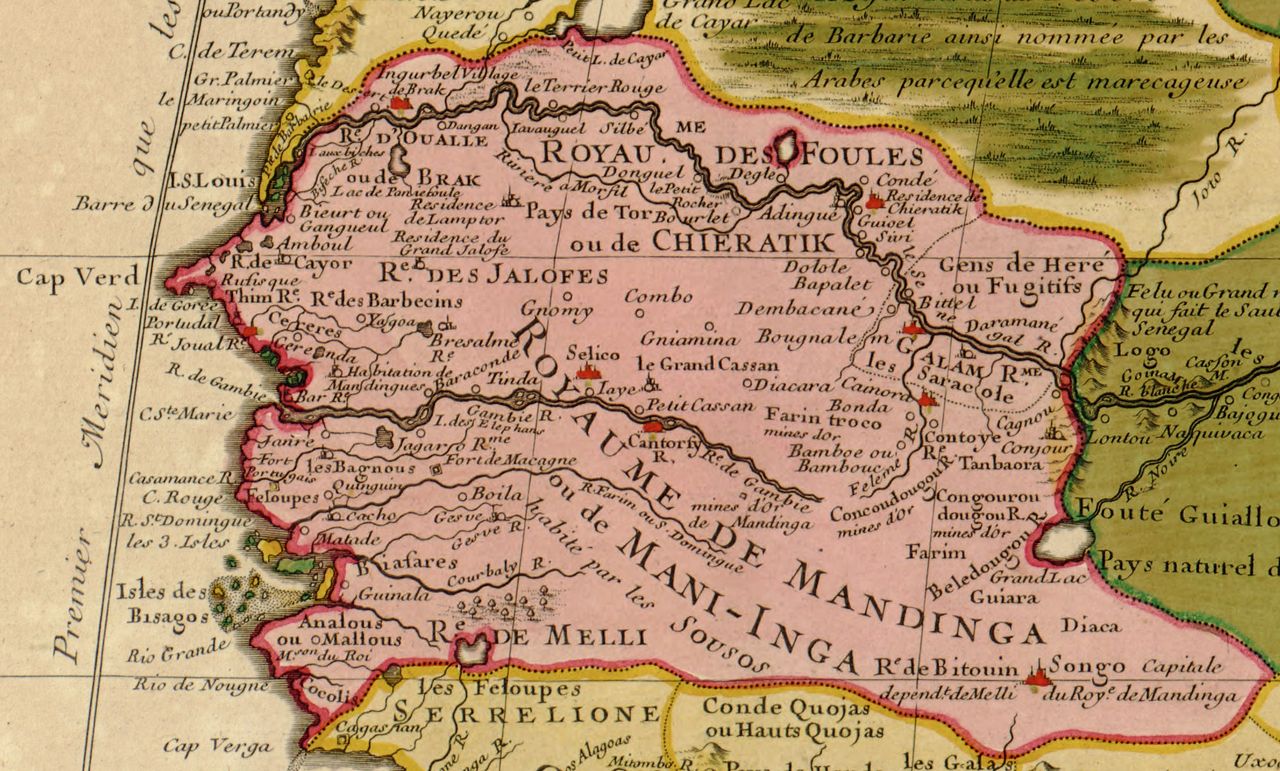
She eventually lost the battle, but not the war; which continued to be a war of resistance until the early part of the twentieth century by Lat Dior Diop, and many other ‘Gelewars’. This conquest would forever change the trajectory of her reign and the geopolitical, military, and geographical road map of Senegambia, “Ganaar” (now called Mauritania), Mali (formerly called French Sudan), and Fouta.
Senegambia in 1707, with the Kingdom of Waalo written as ‘R. d’Oualle ou de Brak’
Her father was Brak (King) Amar Fatim Borso Mbodj, and mother was Lingeer (Queen) Awo Fatim Yamar Khuri Yaye Mboge. Her son, Sidya Leon Diop, who would later too become an anti colonialist, and fight the French until his capture, and exile to die in Gabon in 1878. Her son Sidya was captured as a hostage in Saint-Louis by General Faidherbe during their bloody war with Ndate, and was baptized ‘Leone’ and sent to Algiers for schooling in 1861. When he returned to Senegal two years later in 1863, he was enlisted in the French colonial army; the first African or Senegalese to hold such a post. But as the saying goes —like mother, like son, he refused to do their dirty job of joining forces with the European colonial foreigners and mercenary apparatus, against his mother’s kingdom and people. He then changed strategy and rallied with Lat Dior Diop and others, which resulted in his betrayal, and capture by the colonial forces; and exile to Gabon (just like Samori Toure).
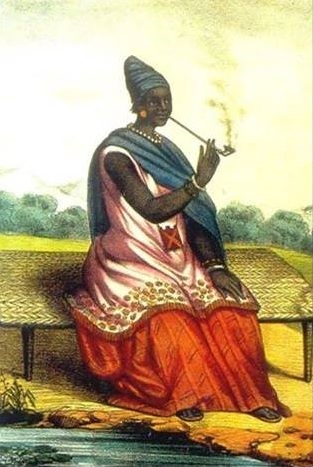
Ndate Yalla Mbodj
Queen Ndate Yalla Mbodj, as a true ‘lingeer’, developed the women’s army as one of the most formidable forces to recon with in her reign. The story of this Senegambia Queen is best amplified in oral tradition by the local griots. Her women army was similar to the “Amazon” women army of Benin, Behanzin’s fearless protective women’s army. She later went into exile in Ndimb in the northern part of the Waalo and died in Dagana, where today a statue has been erected in her honor (the only one erected in honor of a queen nationwide). To learn more, check out: Maafanta.com, Matricien.org, au-Senegal.com; the book Kings and Queens of West Africa by Sylviane Diouf has an entire chapter dedicated to this great queen.
Ethiopia is known as the cradle of humanity, but also as one of the best stables for long distance runners in the world. Ethiopia has produced a lot of super stars of the long distance running, but one who stands out above all is Haile Gebrselassie, the king of the distance. As a child, I remember being glued to the TV waiting to watch Haile’s performances. It was like watching a maestro at work. I loved seeing him run the whole 9600 m, then sprint through the last 200-400 m like he had just started the race. Gebrselassie has inspired me, and thousands of youths to run. We have all dreamed of running the distance the way he ran.
Haile Gebrselassie, of Ethiopia, defeating Paul Tergat of Kenya in the 10000 m run at the Sydney 2000 Olympics in a historic finish.
So it is with sadness that I learnt of Gebrselassie’s retirement from competitive running. I am delighted to have had a chance to see him in his prime years, and watch him transition from 10000 m to marathon running, and there still express perfection. Truly, everything he did in his running was done with perfection, striving to be the very best every stride he took, and that is the message to everyone out there: strive for perfection, strive to do the very best you can in everything you do, every single day. To that effect, Gebrselassie said: “You need three things to win: discipline, hard work, and, before everything commitment. No one will make it without those three, sport teaches you that;” and “When you run the marathon, you run against the distance, not against the other runners, and not against time.” I am leaving you with the article I wrote three years ago about him, and with this great video on some of his accomplishments.
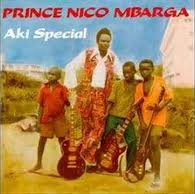
To celebrate Mother’s day this Sunday, I just wanted to bring back “Sweet Mother” by Prince Nico Mbarga. “SweetMother” is one of the most popular songs on the African continent, ahead of Miriam Makeba‘s “Malaika“, Franco‘s “Mario“, and Fela Kuti‘s “Lady“. What is so special about this song, is that it is an ode to all our precious mothers, it is often called Africa’s anthem sung by a child to his mother. It is a highlife song sung by Prince Nico Mbarga and his group Rocafil Jazz International, a Cameroonian-Nigerian artist, and the song has rocked many on the continent; Sung in Pidgin English, “Sweet Mother” became one of the top sellers in the history of Nigerian music. It was voted as Africa’s favorite song by BBC in 2004, and many other programs. So, to all the mothers out there, Happy Mother’s Day and enjoy “Sweet Mother“!!!
“Sweet Mother“ by Prince Nico Mbarga
Sweet Mother Sweet mother I no go forget you for the suffer wey you suffer for me.
Sweet mother I no go forget you for the suffer wey you suffer for me.
When I dey cry, my mother go carry me she go say, my pikin, wetin you dey cry ye, ye, stop stop, stop stop make you no cry again oh.
When I won sleep, my mother go pet me, she go lie me well well for bed, she cover me cloth, sing me to sleep, sleep sleep my pikin oh.
When I dey hungry, my mother go run up and down. she go find me something when I go chop oh.
Sweet mother I no go forget you for the suffer wey you suffer for me
When I dey sick, my mother go cry, cry, cry, she go say instead when I go die make she die.
O, she go beg God, God help me, God help, my pikin oh.
If I no sleep, my mother no go sleep, if I no chop, my mother no go chop, she no dey tire oh.
Sweet mother I no go forget you, for the suffer wey you suffer for me.
You fit get another wife, you fit get another husband, but you fit get another mother? No!
And if I forget you, therefore I forget my life and the air I breathe.
And then on to you men, forget, verily, forget your mother, for if you forget your mother you’ve lost your life.
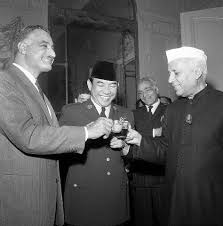
Nasser, Sukarno, and Nehru celebrating the success of the conference in 1955
As the world marks the 60-year-anniversary of the Conference of Bandung, the real turning point in the history of decolonization for Asian and African countries, I found this article on Pambazuka particularly relevant. One question still remains: has anything changed 60 years later? Do we need another Bandung Conference? Is the world a better place for the ‘weaker’ countries? Enjoy! For the full article, go to Pambazuka (pour une lecture en francais, aller sur Voltaire).
============
One of the key outcomes from the Bandung Conference [in 1955] was the Afro-Asian hope to open the opportunity for the Global South representing largely Asian, African, Latin American and Oceania to have a voice in world affairs. The creation of a non-alignment space to seek freedom from joining either the USA or the USSR camp was a clear objective. The choice to pursue agency to realize full independence from all forms of colonialism, which much of Africa was still in, and the urgent need to deal with the risk of neo-colonialism by the recognition and appreciation to strengthen the formally independent Asian countries to remain free appeared to have motivated the Bandung gathering. The Bandung spirit and purpose was primarily driven to bring about a total post-colonial condition by removing the penetrability of the African, Asian, Oceania and Latin American peoples by opening the non-alignment route to independence and freedom. The objective was to try to identify and pursue ways and strategies of development along a decolonizing trajectory, free from the dictation of either the USA dominated world order or the attempt by the ex-USSR through the Cold War to create an alternative non-capitalist-driven world order.
Bandung Conference – 1955
Though in many ways the 1955 conference in Bandung, Indonesia was a turning point for attempting to construct a post-colonial international political order; we still live in a world where imperialism, colonialism, war, exploitation, injustice and unfairness continue to complicate the contemporary world political economic space. What was loudly voiced at Bandung was the anti-colonial spirit and the aspiration for building a world order that appreciates rather than ignores the Global South and the newly growing numbers of independent countries from colonialism still remain largely unfulfilled. Instead of decoloniality prevailing we have neo-colonialism penetrating most of the Global South. The state and condition of post-coloniality is still waiting to be realized. We need a new and revitalized Bandung Conference spirit and a strong Global South to put on the agenda a total post-colonial reality to guide the architecture of new global world re-order. Continue reading “The Conference of Bandung – 60 years later”→
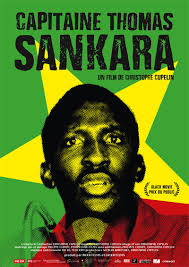
I had to share the trailer of the documentary “Capitaine Thomas Sankara” by Christophe Cupelin, which was shown this year at the FESPACO 2015 in Ouagadougou, Burkina Faso. This is the first time a movie about Thomas Sankara, the African Che, could be shown at the FESPACO in 27 years since Compaore‘s coup. Enjoy!
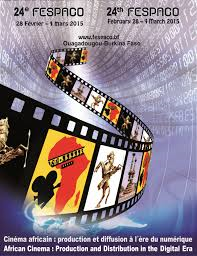
FESPACO2015ended last week, and ran from February 28th until March 7th. The festival’s glamour was not at its usual, since the overthrowing of Blaise Compaoré, but it still took place in Ouagadougou, Burkina Faso, and brought in some great African films and documentaries.
“FIEVRES” by Hicham Ayouch
This year’s festival featured, for the first time, films from the African diaspora. 720 films competed, and 134 were selected in the 5 categories. The winner of this year’s Golden Stallion of Yennenga was “Fievres” by the French-Moroccan filmmaker, Hicham Ayouch. The film tells the story of a 13 year old boy, displaced and prone to violence who learns that he has a father after his mother is sent to jail, and is sent to live with his father in a Parisian suburb. The beauty of “Fievres” is its focus on telling the tale between a father and son who have to learn to be father-son, and also the cultural identity among immigrants, and practicing Muslims in France.
“Fadhma N’Soumer” by Belkacem Hadjadj
The Silver Stallion was awarded to Algerian director Belkacem Hadjadj for his film on “Fadhma N’Soumer“, a stunning biopic on the life of the Algerian resistance leader who fought against the French colonial forces in Kabyle. I was so happy to see this movie made, and winning the second prize, as I had written about Lalla Fadhma N’Soumer a while ago, and wanted her praises to be sung. This is truly Africans telling their own stories, and honoring their greatest heroes and heroines. Applauses to director Belkacem Hadjadj for telling our history.
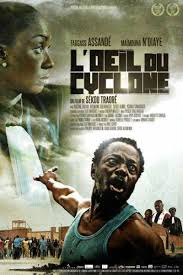
“L’Oeil du Cyclone” (The Eye of the Cyclone) by Sekou Traore
The Bronze Stallion was awarded to Burkinabé director Sekou Traoré “L’Oeil du Cyclone” (The Eye of the Cyclone), which is a political drama set in an unnamed African country plagued by civil war. The film follows an idealistic young lawyer committed to defending a former child soldier charged with war crimes. The movie shows two faces of Africa: the young, idealistic and futuristic, vs. the broken and consumed with the past. The movie also won the festival awards for Best Actress (Maimouna N’Diaye – who is clearly a rising star of African cinema), and Best Actor (Fargass Assandé).
“Capitaine Thomas Sankara” by Christophe Cupelin
The Burkinabé public finally had the chance to see the documentary “Capitaine Thomas Sankara” by Christophe Cupelin, which would have never been allowed at FESPACO under Blaise Compaore’s tenure (Thomas Sankara‘s murderer, best friend, and coup-formenter). It was a time to celebrate the life of Burkina Faso’s greatest hero. To read more about this year’s FESPACO, check out The Guardian, and the FESPACO homepage.
Pendant Ivory mask representing Queen Idia, Iyoba of Benin City (16th Century)
A British man recently decided to return looted art that his grandfather had taken (stolen?) away during the 1897 Benin City Massacre. The article about the art returning is on BBC. I do salute the man for doing it; and I wish the British museums and museums around the world will return art looted by Europeans in African countries and countries around the world. True, the man excuses his grandfather’s acts by saying: “We are taught from a very young age that the killing of enemy combatants under the umbrella of statehood is a regrettable necessity of life.” And excuses the art looting by saying, “To him [his grandfather], it was probably no more than picking up stuff that’s washed up on the beach, because people had fled and nobody owned them any longer.” But he is happy they are now back in Benin City. “These objects are part of the cultural heritage of another people… to the people of Benin City, these objects are priceless.”
I also decided to link back to the story I wrote a while ago about the Benin City Massacre.


















 African Heritage