Below is the translation of a letter in which the Kings and Chiefs of Little Popo and Grigi in Togoland (actual Togo) are asking for their lands to be placed under the protection of the German Imperial Majesty the Kaiser, i.e. to be placed under German protection, or rather placing (not knowing the full extent) their lands under German protectorate. This was signed on March 5th of 1884. Remember that Little Popo is now known as Aného in Togo. Grigi might have been the town of Glidji.
====
Map of Togoland in 1885
I. We, the signatories, Kings and chiefs of Little Popo and Grigi, express our gratitude to Your Majesty for having assisted us in upholding peace in our land.
II. There would be no threat and no uncertainty, if the British government would refrain from interference in the affairs of our lands, which it desires, while we desire her not to have it.
III. We ask Your Majesty to provide us with protection and to avoid such an annexion.
IV. We implore Your Majesty to come to our aid, as we have placed ourselves fully under your protection.
V. We humbly request to take quick action.
signed King Aiaushi Agbanor of Little Popo and Grigi, Caboceer Quadjovi, chief Pedro Quadjo and 11 other signatures
Today, I present to you the text of the treaty signed between King Mlapa– the King of Togo, or rather his representative Chief Plakko or Plakkou, and the Consul General Gustav Nachtigal thereby placing his land under German protectorate. This is the famous July 5th 1884 treaty which marks the beginning of the German protectorate in Togoland and the birth of this German colony in West Africa. As you read it, remember that Porto Seguro is now Agbodrafo and Bagida is Baguida in Togo. Note also that when it is said ‘King of Togo,’ Togo in this case refers to the area around Togoville, the village which gave its name to the entire country. As always, European colonizers used one main treaty in one area of the country (mostly coastal) to claim ownership over the rest of the country. The original in German can be found in Geschichte der deutschen kolonien by Horst Gründer, UTB (2018) p. 91-92
The Consul General for the German Reich, Dr. Gustav Nachtigal, in the name of His Majesty the Kaiser of Germany, and Mlapa, King of Togo, represented for himself, his heirs and his chiefs by Plakkou, carrier of King Mlapa’s stick, have come to the following agreement :
Article 1 King Mlapa, desiring to protect legitimate trade, which mostly is carried out by Germans, and to grant the German merchants full security for their lives and property, requests the protection of His Majesty the German Kaiser, so that he is enabled to uphold the independence of his territory, which stretches from Porto Seguro‘s eastern border to the western border of Lomé or Bey Beach. His Imperial Majesty grants such protection, with the reservation of legitimately acquired rights of third parties.
Article 2 King Mlapa will cede no part of his lands and sovereignty rights to any foreign country of person, and he will not sign any treaty with any foreign power without the previously given approval of His Imperial Majesty.
Lome, Togo: loading of cotton bales, early 1900s
Article 3 King Mlapa grants protection and free trade to all German subjects who live in his land, and promises never to grant merchants of other nations privileges, preferential treatment or protection beyond what is granted to the Germans. King Mlapa, without His Imperial Majesty’s approval, will refrain from collecting tariffs other than those presently collected, which are 1 Shilling for every ton of palm kernels 1 Shilling for every barrel of palm oil which are to be paid to the chief of the respective location.
Article 4 His Majesty the German Kaiser will respect all trade treaties previously signed by King Mlapa and others, and will in no way place burdens upon free trade in King Mlapa‘s land.
Map of Togoland in 1885
Article 5 His Majesty the German Kaiser will not interfere in the manner the tariff so far has been collected by King Mlapa and his chiefs
Article 6 The signatory parties reserve matters of mutual interest, not included in this treaty, for future agreements.
Article 7 This treaty takes force immediately, reserved ratification by the German government. In order to testify, we have signed in the presence of the witnesses which have signed
Witnesses
Painting of Togoland in 1908 (R. Hellgrewe)
J.J. Gacher, J.B. Ahpevon, interpreters H. Randad Josua Lenze Mandt, Lt. at sea Dr. Max Buchner Chief Plakko Chief Adey of Lomé or Bey Coodaycee Hadji, 2nd chief of Bey Okkoo Nukoo King Garsa of Bagida
1 Translator’s footnote : Here a text originally written in English, and printed in German translation in the RTA, has been re-translated into English. Thus it might differ slightly in diction from the original text.
This article is from Variety Reports. It is a step forward and I applaud the great work of Malenga Mulendema and Malcolm Wopea. I also hope that we Africans can and will fund our own animated series which will be broadcast around the world as well. For the full article, go to Variety Reports.
====
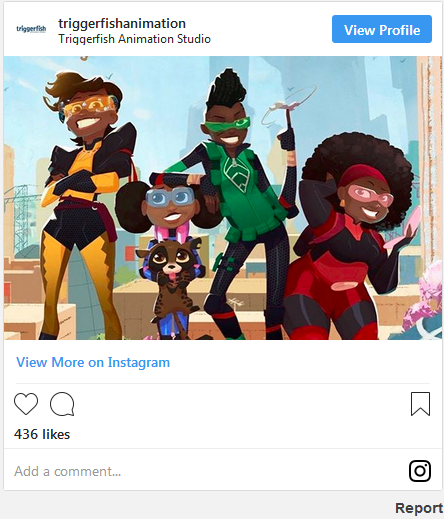
Netflix is adding to its growing slate of African content with its first original animated series, “Mama K’s Team 4,” produced by South Africa’s award-winning Triggerfish Animation Studios and British kids’ and family entertainment production company CAKE.
The series follows four teenage girls living in a futuristic version of Lusaka, Zambia, who are recruited by a retired secret agent to save the world. It was created by Zambian writer Malenga Mulendema, who in 2015 was one of eight winners of the Triggerfish Story Lab, a pan-African talent search backed by the Cape Town-based animation studio and The Walt Disney Co. The series is designed by the Cameroonian artist Malcolm Wopea.
“In creating a superhero show set in Lusaka, I hope to introduce the world to four strong African girls who save the day in their own fun and crazy way,” Mulendema said. “Most importantly, I want to illustrate that anyone from anywhere can be a superhero.”
La charte de l’imperialisme telle publiee dans le journal “La Nouvelle Expression”
A while ago, I published the charter of Imperialism in French (La charte de l’impérialisme). Today, I would like to bring it to you in English for all to understand how dominated Africans have been, and how that domination continues to this day. As you read this, can you give example of where each one of these articles has been applied on the African continent nowadays?
=====
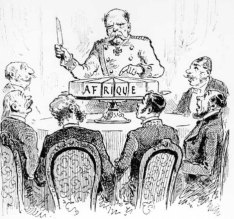
The present “charter” was drawn up in Washington during the “slave trade”, then quietly negotiated at the “Berlin conference in 1885” while the Western powers shared Africa; renegotiated secretly in Yalta at the time of division of the world in two blocks after the Second World War and during the creation of the “League of Nations”, the ancestor of the “UN”.
I. GENERAL PROVISION
Article 1: From the Motto: – Motto of imperialism: Governing the world and controlling the riches of the planet;Our policy is to divide and conquer, dominate, exploit and loot to fill our banks and make them the most powerful in the world.
Le partage de l’Afrique a la Conference de Berlin de 1884
Article 2: No third world country constitutes a sovereign and independent state.
Article 3: All power in Third World countries comes from us, who exert it through pressure on the leaders who are only our puppets.No organ of the Third World can attribute to it the exercise.
Article 4: All Third World countries are divisible and their borders displaceable according to our will.Respect for territorial integrity does not exist for the Third World.
Article 5: All dictators must put their fortunes in our banks for the security of our interests. This fortune will be used for donations andcredits granted by us as assistance and development aid to Third World countries.
II. THE POLITICAL REGIME
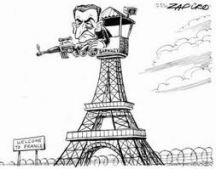
Nicolas Sarkozy, by Zapiro (source Grigrinews.com)
Article 6: Any power and government established by us is legal, legitimate and democratic. But any other power or government that does not emanate from us is illegal, illegitimate and dictatorial, regardless of its form and legitimacy.
Article 7: Any power that opposes any resistance to our injunctions loses its legality, legitimacy and credibility. He must disappear.
III. TREATIES AND AGREEMENTS
Article 8: We do not negotiate agreements and contracts with Third World countries, we impose what we want and they undergo our will.
Article 9: Any agreement with another country or negotiation without our approval is null and void.
IV. FUNDAMENTAL RIGHTS
Article 10: Wherever there is interest, Third World countries have no rights, in the southern countriesour interests go before law and international law.
Article 11: Freedom of expression, freedom of association and human rights only make sense in the country where the leaders oppose our will.
Article 12: The peoples of the Third World have no opinion or right, they suffer our law and our law.
10,000FCFA (BEAC-1992)
Article 13: Third world countries have neither culture nor civilization without referring to Western civilization.
Article 14: We are not talking about genocide, massacre, or “war crimes” or “crimes against humanity” in countries where our interests are guaranteed. Even though the number of victims is very important.
V. PUBLIC FINANCES
Article 15: In Third World countries, no one has the right to put in their banks a ceiling of money fixed by us.When the fortune exceeds the ceiling, it is deposited in one of our banks so that profits return in the form of loans or economic development aid in cash or in kind.
Article 16: The countries whose leaders show total submission to us, our puppets and our valets will not be entitled to the aid mentioned above.
Article 17: Our assistance must be accompanied by strong recommendations to prevent and break the development of Third World countries.
Libya, the Prey of the West (2011)
VI. MILITARY TREATIES
Article 18: Our armies must be always stronger and more powerfulthan the armies of the Third World. The limitation and prohibition of weapons of mass destruction does not concern us, but the others.
Article 19: Our armies must help each other and unite in the war against the army of a weak country to show our supremacyand be feared by the countries of the Third World.
Article 20: Any military intervention aims to protect our interests and those of our valets.
Article 21: Any operation of evacuation of the nationals of the Western countries hides our real mission, that to protect our interests and those of our valets.
VII. INTERNATIONAL AGREEMENTS
Article 22: The UN is our instrument, we must use it against our enemies and third world countries to protect our interests.
Article 23: Our goal is to destabilize and destroy the hostile regimes and to place our puppets under the protection of our military under cover of the mandates of the “UN” forces.
Article 24: “UN” resolutions are texts that give us the right and the means to strike, kill and destroy countries whose leaders and peoples refuse to submit to our injunctionsunder the cover of the resolutions of the Council Security Council.
Article 25: Our duty is to keep Africa and other countries of the world in the underdeveloped, the bet, the division, the wars, the chaos to dominate them, exploit them and plunderthemthrough the “Missions” of ” United Nations “.
Lumumba detained, December 1960
Article 26: Our golden rule is thephysical liquidation of Third World nationalist leadersand leaders.
Article 27: The laws, resolutions, courts and tribunals of the “United Nations” are our tools of pressure against the leadersand leaders of the countries that defend the interests of their peoples.
Article 28: Leaders of Western Powers can not be prosecuted, arrested or incarcerated by “UN” courts and tribunals, even if they commit “war crimes”, “genocide” or “crimes against humanity” .
“People in the United States [the West] still have a ‘Tarzan’ movie view of Africa. That’s because in the movies all you see are jungles and animals . . . We [too] watch television and listen to the radio and go to dances and fall in love.” Miriam Makeba
View of Douala from the airs: on the other side of the bridge (not shown) is Bonabéri, old Hickory Town
I never thought that bombing, grenades, and warships had been used in wars in Africa prior to the 20th century. Little did I know that it had been in use in the 19th century, during the European invasion of Africa that is known as the scramble for Africa. Today we will talk about the first bombings on Cameroonian soil which occurred on 22 December 1884, when Germans on warships SMS Bismarck and SMS Olgabombed Hickory Town (Bonabéri) in Cameroons Town (modern-day Douala). What might have caused these bombings by German forces on Cameroonian soil, long before the area was ever known as Kamerun?
Kum’a Mbappé, Bonaberi 1884 Liberte by Enoh Meyomesse
Well, when the 12 July 1884Germano – Duala Treaty was signed between the representatives of the Jantzen & Thormählen firm and some of the Douala kings, King Ndumbé Lobé Bell and King Akwa, it was not a unanimous choice among the locals. As a matter of fact, most of the population was against the treaty, and sided with Kum’a Mbappé also known as Lock Priso, King of Hickorytown. The other kings had signed treaties ceding their lands to the Germans without consulting with the others. Kum’a Mbappé refused to sign the treaty. On that fateful day, when the Germans raised their flag in Hickory Town, after raising it in Joss Town, Kum’a Mbappé reacted by writing to the German consul: “Pull that flag down. No man buy we. They want to give us plenty dash, we tell them no. Leave us free and not make us plenty trouble.” The Germans, of course, did not heed the warning, and Kum’a Mbappé ordered the flag to be taken down and the mast ripped apart, a German merchant was killed in the fightings that ensued.
Eduard Knorr, in 1884
Kum’a Mbappé and his people courageously resisted and defeated the German army. The Germans were outnumbered. After this defeat, German consul Max Buchner wrote to Germany to send troops with real armament, cannons, bombs, grenades, in order to level out Hickory Town and kill Kum’a Mbappé who was a thorn on his side.
Opposition to German rule followed the annexation of July 1884. Lock Priso still favored the British and staged a rebellion in December 1884. Around this same time, King Bell faced off against his own people, who were largely opposed to the German rule. Bell then found himself up against the other Duala chiefs in the Duala War, which was fought over the killing of a Bonabéri Duala and Bell’s alleged refusal to share his profits with the other sub-lineages. Germans played the competitors against one another – this is a classic technique used by Europeans: divide-and-conquer. They supported the weaker King Bell to counter the powerful KingAkwa.
SMS Olga during the shelling of Hickory Town on December 21, 1884
From December 20th – 22nd, Commander Eduard von Knorr sent by Berlin decided to intervene immediately, and sent ashore a landing party of some three hundred men from warships SMS Bismarck and SMS Olgato arrest the leaders of the anti-German tribes and destroy their villages. The troops from SMS Bismarck that went ashore and landed north of Hickorytown, while the men from SMS Olgawent ashore south of the village. The Germans fought their way into the town, forcing the local forces to retreat into the mangrove forest, where they could not easily be pursued. While this operation was underway, Knorr received word that other hostile locals had attacked the trading post operated by Jantzen & Thormählen in Joss Town and had captured the company’s local manager. Knorr sent SMS Olgaupriver to shell enemy positions, and on 22 December, the landing parties returned to their ships, having lost one man killed aboard SMS Olgaand eight men wounded between the two ships. German sailors descended on Bonabéri, and burnt the city down; the deluge of fire was endless and lasted several days. They also stole the princely bow or Tangué from Kum’a Mbappé’s ship, considered the symbol of the Belé-Belé people (people of Hickory-Town): the Tangué is a sort of a bow, carved and personalized, sort of a pennant that identifies a king among the people of these water tribes. The German consul Max Buchner wrote in his war diary,
Max Buchner
“Lock Priso’s palace is plundered, a colorful and striking image. We set it on fire. But I have asked all the houses to be inspected before to find ethnographic treasures. My main booty is a great wooden carved work, the princely bow (tangué) of Lock Priso, which will be sent to Munich.” [“Le palais de Lock Priso est mis à sac, une image colorée et saisissante. Nous y mettons le feu. Mais j’ai demandé avant d’inspecter toutes les maisons pour trouver des trésors ethnographiques. Mon butin principal est une grande œuvre sculptée en bois, la proue princière (tangué or tangu’a bolo, in Duala language) de Lock Priso, qui sera envoyée à Munich.”]
The bow, Tangué, of Kum’a Mbappé at the Ethnographic Museum of Munich (Wikipedia)
After several days of fighting, the German army won because of their superior arms, and also the help sent by other Duala kings. Negotiations went on, and a peace treaty (i.e. a treaty acknowledging defeat) was finalized on 13 January 1885, forcing Kum’a Mbappé to accept German rule in Hickory Town. This hero of Cameroonian resistance, passed away in 1916.
The symbol of the Belé-Belé people, the Tangué, was only returned over 100 years later, after tireless work from one Kum’a Mbappé’s grandsons, Prince and professor Kum’a Ndumbe III and others. To learn more, please read the book Kum’a Mbappé Bonabéri 1884 Liberté! by Enoh Meyomesse, and visit the website of this proud descendant of Kum’a Mbappé, Prince Kum’a Ndumbe III at AfricAvenir.
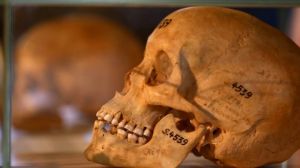
I know this dates from last August, 2018, but I had to share. Note that out of the hundreds of skulls taken by Germany, only a bit over 25 were returned; if the German racial study has been discredited, why not return all of them? The excerpt below is from the BBC; for the full article, go to the BBC. As a reminder, the first genocide of the 20th century occurred in Namibia, on African soil. It was perpetrated by Germans on the Herero and Nama people of Namibia. It was extremely brutal and almost wiped out all Herero people. It was a campaign of racial extermination and collective punishment that the German Empire undertook in German South-West Africa (modern-day Namibia) against the Herero and Nama people. It took place between 1904 and 1907 during the Herero Wars. Today it is known as the Namibian genocide or the Herero and Namaqua genocide.
======
Namibian skulls (Reuters)
Germany has handed back the human remains of indigenous people killed during a genocide in colonial Namibia (German South-West Africa) more than 100years ago.
… The bones had been sent to Germany for now-discredited research to prove the racial superiority of white Europeans.
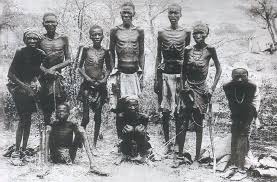
Tens of thousands of Herero and Nama people were murdered in response to an anti-colonial uprising.
Their descendants are still waiting for an apology from the German government.
The genocide began in 1904 after a Herero and Nama rebellion in response to the German expropriation of their land and cattle.
The head of the military administration in what was then known as German South West Africa, Lothar von Trotha, issued an extermination order in October 1904.
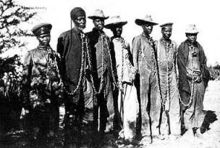
Chained Herero men
The Herero and Nama were forced into the desert and any who were found trying to return to their land were either killed or put into concentration camps.
There is no agreed figure of how many died but some estimates have put it as high as 100,000.
It is thought that 75% of the Herero population and half of the Nama population died.
… There are thought to be hundredsof Namibian skulls in Germany and on Wednesday more than 25 remains were handed back.
Skulls from Germany’s other African colonies, including modern day Cameroon, Tanzania, Rwanda and Togo, were also used in the discredited studies.
In 2016, Germany said it was prepared to apologize in principle but it is still negotiating with the Namibian government over the form of the apology and how to deal with the legacy of the genocide. [Funny how, when it was time to kill, they never negotiated]
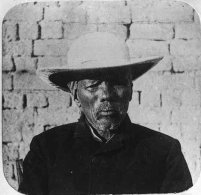
Hendrik Witbooi, Namaqua Chief and freedom fighter
… Germany has argued that it has given Namibia millions of dollars in development aid to support all people in the country. [They forget to tell you that they are still benefiting from the mines and resources of Namibia]
… But descendants of the victims are angry that there has been no apology and no agreement of reparations.They are also unhappy that they are not part of the negotiations. …
A crown from the Maqdala exhibition at the V&A in south-west London – looted in 1868. (Source: V&A Museum)
A British museum [National Army Museum] is to return a lock of hair that the Ethiopian government considers a national treasure.
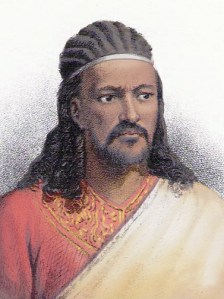
It was cut from the head of Emperor Tewodros II, who killed himself rather than be taken prisoner by the British during their 1868 invasion of Ethiopia. …
Strands of Emperor Tewodros II’s hair were given to the National Army Museum in London 60 years ago. …
The museum told the BBC it had decided not to make photographs of the hair public out of respect, because the matter was “too sensitive”. The remains are described as two pieces “no bigger than the size of a two-pence coin”.
Departure of the British expeditionary forces from Maqdala with the loot – Illustrated London News 1868
The National Army Museum has now agreed to return the artefact, but says it is not returning any other items of African origin.
“It’s definitely not a precedent,” a spokesperson for the museum told the BBC.
“That’s the only one that’s been requested. They have to be formal, written requests to the director with a case“. …
The move has reignited demands for the UK to return all the looted artefacts on display in British museums. …
FESPACO 2019 (featuring Maimouna N’Diaye – 2015 winner of Best Actress in a leading role)
2019 marks the 50th year anniversary of the FESPACO. As a reminder, the FESPACO (Festival Panafricain du cinema et de la television de Ouagadougou) is the Panafrican Film and Television Festival of Ouagadougou, and is the largest African film festival, held biennally in Ouagadougou, the capital of Burkina Faso. First established in 1969, and boasting some of Africa’s greatest writers and filmmakers (like Ousmane Sembene), the FESPACO offers a chance for African filmmakers and professionals to showcase their work, exchange ideas, and meet other filmmakers, and sponsors. Filmmakers from around the continent come together in Ouagadougou which is transformed into the Hollywood or the Cannes of the continent for this 8-day celebration. This year’s FESPACO ran from February 23 to March 2nd.
The Golden Stallion of Yennenga
To mark the 50th-year edition, a particular focus was set on reflecting on the collective memory and future of the pan-African cinema. Films from 16 African countries were vying for the Golden Stallion of Yennenga, a prize named after the story of a 12th century beautiful princess who is considered the mother of the Mossi people, Princess Yennenga.
The Golden Stallion of Yennenga 2019 was awarded to the movie “The Mercy of the Jungle” directed by Joel Karekezi of Rwanda. “The Mercy of the Jungle” shows the arduous road trip taken by foot of two soldiers lost in the jungle during the time of the Democratic Republic of Congo wars. It beat out 19 other candidates to get the Golden Stallion of Yennenga. Marc Zinga, a Belgian, also took best actor for his role in “The Mercy of the Jungle.”
Joel Karekezi, winner of the 2019 Golden Stallion of Yennenga (Fraternite Matin)
Second prize went to “Karma”, a drama by Egyptian director Khaled Youssef, while third place was awarded to Tunisian Ben Hohmound, who directed “Fatwa”, another drama.
This year also, women have complained about the fact that in 50 years, not a single woman has won the top prize at FESPACO. This highlights a problem of gender equality for film directors. South African actress Xolile Tshabalala, who featured in “Miraculous Weapons”, directed by Jean-Pierre Bekolo, a Cameroonian asked, “can it be that in 50 years, there hasn’t been a single woman capable of telling a great story to win the Fespaco?” Burkinabe director Apolline Traore said that any award had to be earned, not considered a token gesture, but admitted that there is a problem in gender equality for directors. “There’s no equality for the craft of a woman director, not just in Africa, but in the world,” she said. Traore won a special prize on Friday for her film, “Desrances”.












 African Heritage