A crown from the Maqdala exhibition at the V&A in south-west London. (Source: V&A Museum)
I was stunned by the title of this article on the Guardian, and the preposterous thought that a country whose treasure it is, Ethiopia, would have to be loaned its own treasures which were looted by the British and taken to Great Britain. It is just so outrageous that such a thought could even be uttered! Below are snippets of the article. For the full article, go to The Guardian.
===
” Victoria and Albert Museum director says artefacts could be sent to Africa on long-term loan.
Treasures including a gold crown and a royal wedding dress, which were taken from Ethiopia by the British 150 years ago, could be returned to Africa by the Victoria and Albert Museumon long-term loan.
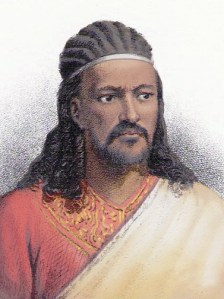
Emperor Tewodros II
Ethiopialodged a formal restitution claim in 2007 for hundreds of important and beautiful manuscripts and artefacts being held by various British institutions, all plundered after the 1868 capture of Maqdala, the mountain capital of Emperor Tewodros II in what was then Abyssinia.
That request has been refused. But in the run-up to a Maqdala display opening this week at the V&A, a compromise has been offered bythe museum’s director, Tristram Hunt, who said: “The speediest way, if Ethiopia wanted to have these items on display, is a long-term loan … that would be the easiest way to manage it.”…
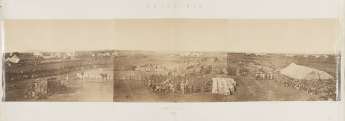
British Camp at Zoola, Abyssinia expedition 1868-9 (Source: Victoria and Albert Museum, London)
They have never been on public display because of their religious importance and can only be seen, even by a curator, with the agreement of the Ethiopian Orthodox church.
Other objects are on display but the British Museum argues the value of them being seen by the public is in a global context. A spokeswoman said the museum would consider any loan request from Ethiopia.
Here are the words of the Scottish explorer Mungo Park in 1795 about the great city of Timbuktu, and its central place in the gold trade in Africa, and the world at the time.
====
“Timbuktu is regarded as the gold warehouse of theManding. It is where the merchants of Tunis, Tripoli, Fez, Morocco, come to take it [gold] to distribute it in the whole North of Africa. The biggest part of this gold then moves on the Europe. One can observe that the Gold Coast ofGuinea, which is thus called only because the trade of the gold dust is done there, is located towards the Manding: but I don’t know if the gold found there was brought from the mountains, through the rivers of the north or those of the south. Maybe through all ; because part of the gold of theWangarais being sold on the south coast.”
Nelson and Winnie Mandela, on Nelson’s release from prison on 11 Feb. 1990
It is with great sadness that I learned of the passing ofWinnie Madikizela-Mandela, the mother of the Nation. My eyes still remember that pivotal day, ofFebruary 11, 1990, whenWinnie Madikizela-Mandelawalked hand-in-hand with her husband Nelson Mandela as he was coming out of jail after 27 years, and raised her fist to the entire world, to a reception of hundreds of supporters and thousands around the globe. We had all prayed for that day, and that day came because of Winnie’s selfless battle against apartheid.
Winnie Madikizela-Mandela
The incredibly dignified and beautiful Winnie Mandela fought like no other, and I can truly say today that without her constant fight to keep her husband’s name and fight alive during those27 yearshe spent in jail, nobody would have remembered Nelson Mandela, and the history of South Africa and the1994rainbow democracy would have been different. For it is because of Winnie Madikizela-Mandela that we all know Nelson Mandela to the extent that we know him today. While he was in jail 27 years, furthering and refining his law studies and other things, she was out there tirelessly working for the freedom of her people, keeping his name alive, and fighting the apartheid system. Winnie fought, and endured so many hardships: brutalized by the police, constantly forced to lose her job by the apartheid system, single-handedly raising her 2 children, repeatedly thrown in jail for her values, harassed, beaten, and humiliated by the system, her children constantly thrown out of school or denied admission because of who she was, exiled/banished to a very racist white-only community for years, and so much more. At one point she was thrown in jail for 17 months, and spent most of that time in solitary confinement, where she had no formal contact with another human being at all aside from her interrogators, among which were notorious torturers.
Winnie Mandela, wearing her khaki slacks, helps bereaved comrades carry the coffin of an apartheid victim (SA History.com)
Part of what kept Winnie motivated during her banishment (exile), and even throughout her life, was her exceptional ability not to become demoralized and her inexhaustible tenacity to keep busy. While she was living out her banishment she established a local gardening collective; a soup kitchen; a mobile health unit; a day care center; an organisation for orphans and juvenile delinquents and a sewing club.
Winnie Madikizela-Mandela at an ANC rally (Source: Reuters)
Sadly,while she waited 27 years for Nelson Mandela, it took him 4 years after coming out of prison to get rid of her! Really? Seriously? I guess women are supposed to keep the candle up and be loyal, while men are not held to the same standards. Any man who would have gone through 27+ years of what theapartheid system did to Winnie would have cracked, but not Winnie, she fought the fight, she fought for her people, and in 2009, the people re-elected her to the parliament in great fanfare. In January 2018, the University Council and University Senate of Makerere University, Kampala, Uganda, approved the award of an honorary Doctor of Laws (LLD) degree to Winnie Nomzano Madikizela-Mandela, in recognition of her fight against apartheid in South Africa. Julius Malema, the leader of the EFF, said last June: “She [Winnie Madikizela-Mandela] should have been the first female president (of the country)‚ a real president who was not going to be a front for male leadership.”
Winnie Madikizela-Mandela celebrating her 80th birthday surrounded by Julius Malema and Cyril Ramaphosa (Source: Timeslive.co.za)
Please readSA Historywho celebrated the life of OUR HEROINE the gorgeous and strong Winnnie Madikizela-Mandela, the mother of the nation (do not forget to read what I said aboutAfrican Women and Revolution); also read her book, Part of My Soul Went with Him.We, Africans, have to write our own history, and celebrate our heroes. Winnie Madikizela-Mandela was a hero like none other. Without Winnie Madikizela-Mandela, the world would not have known Nelson Mandela! If anybody has earned their place in history and in the hearts of her people, it is definitely Winnie Madikizela-Mandela! She was a woman of principle, and of great love for her people!
Here is the trailer to the movie celebrating the life of King Mkwawa, the Hehe leader who inflicted the German Schutztruppe their first defeat on African soil. I salute King Mkwawa and the Hehe people who fought for their freedom and resisted the Germans for over 7 years. 17th August 1891 marks the first defeat of Germans colonial forces, and also the victory of King Mkwawa and the Hehe people. A lot can be said about a king whose people loved him dearly to the point that no one within his ranks were willing to betray him for money. The fact that the return of his skull was part of the Treaty of Versailles also denotes his great aura. This, however, makes us wonder how many more of our treasures, statues, and even skulls of our great warriors and kings may still be exposed or hidden in Western museums and galleries. We demand their return; these belonged to our ancestors, thus they belong to us and are a part of identity! Enjoy!
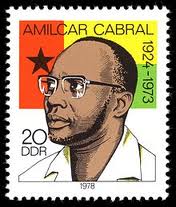
Amilcar Cabral on a stamp with the flag of Guinea Bissau
“The colonists usually say that it was they who brought us into history: today we show that this is not so. They made us leave history, our history, to follow them, right at the back, to follow the progress of their history. Today, in taking up arms to liberate ourselves, in following the example of other peoples who have taken up arms to liberate themselves, we want to return to our history, on our own feet, by our own means and through our own sacrifices.” Amilcar Cabral
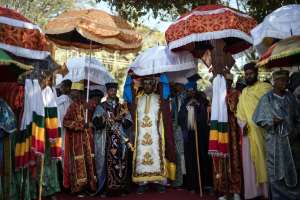
Priests walking with the Tabot, the Ark of the Covenant, in a procession through Gondar (Carl Court, Getty Images/ The Guardian)
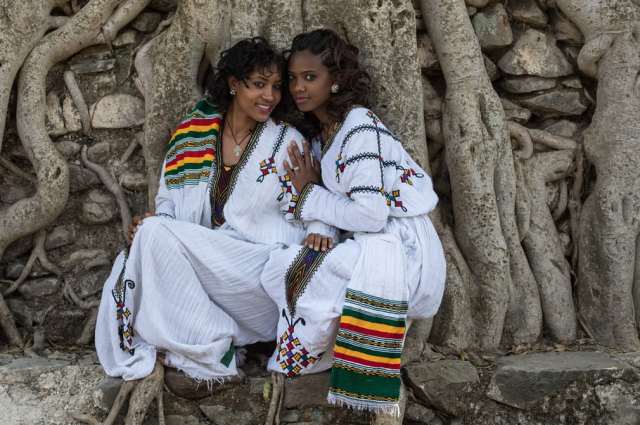
Today we celebrate the Timkat Festival, the Ethiopian celebration of Epiphany. This year, it takes place on 19 January, while on leap years it is on 20 January (which is the 10th day of the Terr – Ethiopian calendar). It is a celebration of the baptism of Jesus Christ on the Jordan River by John the Baptist (Matthew 3:13–17; Mark 1:9–11; Luke 3:21–23). For the celebrations, pilgrims come from around the country to enact the baptism, celebrating the Epiphany, which lasts 3 days.
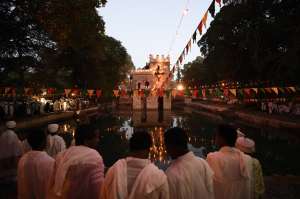
Pilgrims at Fasilides’ Castle in Gondar (Carl Court / Getty Images/ The Guardia)
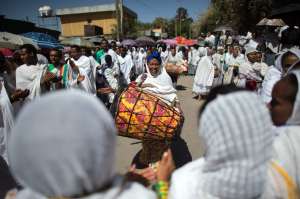
The best place for the celebration is in Gondar at the Fasilides Castle: a Pure Gem of Ethiopia’s Rich History. During the ceremonies of Timkat, a procession headed by the most senior priest is led to the river, carrying the Tabot, a model of the Ark of the Covenant, reverently wrapped in rich cloth. Once the water is blessed, many jump into the water to partake into the renewal of the baptismal vows. It is a great joy, for many believe that the sick are cured. It is a feast of celebration, and processional crosses of varying size and elaboration as well as various Ethiopian artifacts can be seen on the occasion. Participants wear the traditional shamma, which is a thin, white cotton wrap worn like a toga and as headdress. The best places to attend the event are in Lalibela, Gondar, or Addis Ababa.
Female drummers during the festival (Carl Court / Getty Images / The Guardian)
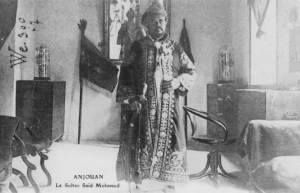
The Comoros was a French colony until 1975. Below is a treaty signed between a representative of the French Republic and the Sultan of Anjouan on 21 April 1886. As you can see from this treaty, France did not just get the rights to almost everything, but it also got the right to judge Anjouan citizens, but most importantly, it also got the right to choose the successor to the throne of the sultanate, in cases when the Sultan’s first choice could not take over. So this way of France meddling into local politics and choosing local kings that could be their puppets instead of the ones chosen by the people or traditions, is not new!
The government of the French Republic, rightfully represented by Mr Gerville-REACHE, Commandant of Mayotte and His Highness ABDALLAH BEN SULTAN SALIME, Sultan of Anjouan, intervening directly, concerned by the development of the prosperity of the Anjouan Sultanate, have decided to consecrate by the following conventions the friendship relations existing between us for a long time and to ensure the preponderance of France in Anjouan.
Article I
His Highness assisted by the council of ministers places the Island of Anjouan under the protection of France. She commits herself, and thereby commits her successors to never deal with any other nation and to never grant any privilege to foreigners without the consent of France.
Article II
The subjects of His Highness will be able, in all freedom, to enter, reside, circulate, and trade in France or in French colonies in the same conditions as the French settlers, on one part, the French will enjoy the same freedom in the states of His Highness.
Article III
The Sultan hereby makes the commitment to provide French industrials who would want to settle in Anjouan the lands that they will need for their exploitations, within the bounds of his domain.
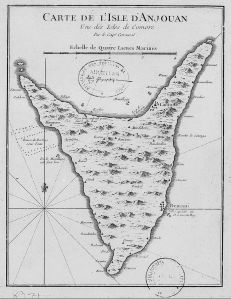
Map of the Comoros with the Anjouan island
Article IV
Disputes that could arise between the French citizens and people of Anjouan will be judged in French courts.
Article V
The rights of the foreigners actually established on the island remain reserved such that in no case the French government will be responsible for the execution of former facts and conventions. If there were any dispute about those facts and conventions, the Government of the Republic will be referee.
Article VI
Anjouan buildings will be treated in French ports as French ships. The same advantages will be given to the Republic’s ships which will enter in a port tributary to the states of His Highness.
Article VII
In order to ensure peace in Anjouan and to allow the regular succession on the throne, according to the customs of the country, the sultan makes his choice of his successor as SALIM BEN ABDALLAH, his eldest son, and in case of the later’s decease, before the advent on the throne of ABDALLAH ben SALIM, oldest son of SALIME. The French government will have to settle the throne’s succession in cases where the dispositions taken by His Highness would have no effect and in cases when there will be no direct and immediate heir in his family.
Article VIII
The Sultan promises to provide each of his brothers with means of livelihood.
Image of Anjouan (Source: BBC)
Article IX
To end the civil wars that have plagued ANJOUAN for many years, the French Government and His Highness declare that any person who would have taken arms against a constituted government will be considered a rebel and judged according to the laws of the country.
Article X
The Government of the Republic is committed to not grant asylum to any Anjouan person who, found to be a rebel, would seek refuge in France, in Mayotte, and in any other French possessions.
Article XI
His Highness commits not to take arms in any of the islands of the Comoros and not to lend his support to any party and assistance without the consent of the Commandant in Mayotte.
Article XII
The Sultan declares that there does not exist between his kingdom and any other power an act that could invalidate the current convention.
Article XIII
The Sultan commits to take all necessary disposition for the abolition of slavery in all his states.
Mutsamudu, capital of Anjouan, today (Nationsonline.org)
Article XIV
The present contract which will be final after the approval of the Government of the Republic has been signed in the presence of, on one part, MM. BRICH, lieutenant of the vessel, commandant of the “CHACAL” DE LESTRAC, deputy commissioner of the Marine, GAUTHIER and LESQUIVIT, sailors, DESLANDES, Medical doctor of the 2nd class in the Marine; on the other part, of SALIME BEN SULTAN ABDALLAH, MOHAMED ben sultan SALIME, SAID ATTOUMASI ben sultan SALIME, SAID ALI ben sultan SALIM, ABDALLAH MOHAMED or DIAMOND prime minister, SAID JAFFAR minister of Foreign Affairs, SAID ALI ben SAID MOCOU, MAUOME ALLASSE BEN SAID ABDERHAMA, MASAILA, …*
Made in 3 expeditions in MOUSSA MOUDOU (ANJOUAN) the 21st April 1886 (Is Radjabou 1303 era of the hegire)
Signed: GERVILLE-REACHE, DESLANDES, BRICH, LESQUIVIT, de LESTRAC, GAUTHIER, Sultan ABDALLAS, King of Anjoua, H.H. Prince SALIME, interpreter of the Government
Here is a documentary about Robert Mugabe and his history, his life, and his leadership. This video talks about him, the fight for independence, the loss of his first son while imprisoned by the British in Rhodesia, and the renaming of the country from Rhodesia to Zimbabwe, after the Great Zimbabwe Empire. I only recently found out that Mugabe had been influenced by Kwame Nkrumah: African Visionary and Ghana’s First President. He had lived and trained at the Takoradi Teacher Training College in Ghana, where he met his first wife Sally Hayfron Mugabe. It is sort of a short biography.
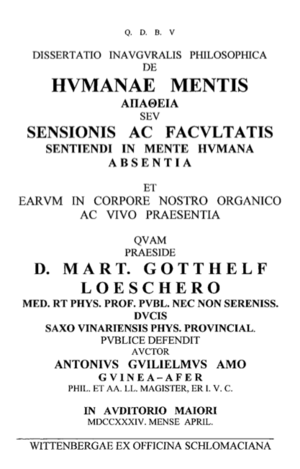
Amo Anton Wilhelm earned his doctorate degree in philosophy from the University of Halle in Germany. He was a respected Ghanaian German philosopher who taught at the Universities of Halle and Jena in Germany in the 1730s… That’s right… you read it well, 1730! His thesis was the rights of Africans in Europe! He is said to have been the first African person born in Africa to be awarded a doctorate degree from a European university, and to later teach there. Enjoy the Elikia M’Bokolo’s piece, on RFI, on Anton-Wilhelm Amo, also known as Amo Guinea Afer!
How many of you know that two great African queens have been cited in the Bible? Most people know about the Queen of Sheba who was the queen of a kingdom in modern-day Ethiopia, and gave birth to a son to the Great King Solomon (Solomon was taken by her beauty). The second queen, who most people ignore or forget, is the Candace, or queen, of Nubia, Amanitore. She is mentioned in the Bible, Acts8:26–40, or should we say her finance minister is, and so by ramification she is cited. So who was Amanitore, this African queen who was cited in the Bible?
Candace (queen) Amanitore is the daughter of the Nubian warrior queen Amanishakheto and grand-daughter to another warrior queen, Amanirenas. She descends from a long line of kings and queens who ruled over the ancient Kushitic Kingdom of Meroë, which also is referred to as Nubia in many ancient sources. In Egyptian hieroglyphics the throne name of Amanitore reads as Merkare. Like all her predecessors, she was a warrior queen who led forces to battle. Her rule extended over the area between the Nile and the Atbara rivers.
Amanitore’s pyramid in Meroe (Wikipedia)
Kandace Amanitore is often mentioned as co-regent with Natakamani although the evidence does not show whether she was his wife or his mother. Many believe that she might have been his mother. Images, on pyramids, of Natakamani frequently include an image of Amanitore. Her royal palace was at Gebel Barkal in modern-day Sudan, which is now a UNESCO heritage site.
Amanitore is mentioned in a number of texts as a ruler. These include the temple at the Nubian capital of Napata in present-day Sudan, in a temple in Meroë near Shendi, again in Sudan, and at the Naqa Lion Temple.
She was part of the Meroitic historical period and her reign began in 1 BC. The rule of her successor, Amanitaraqide, was complete by 50 AD. She is buried in her own pyramid in Meroë. The tomb is approximately 6 m square at its base, and not a pyramid in the mathematical sense.
Nubian pyramids at Meroe (Wikipedia)
Amanitore was among the last great Kush builders. She, and Natakamani, were involved in restoring the large temple of Amun at Meroë and the Amun temple at Napata after it was demolished by the Romans. Reservoirs for the retention of water also were constructed at Meroë during her reign. The two rulers also built Amun temples at Naqa and Amara. At Naqa, the great centre of the steppe-country south of Meroe: the frontal approach to the temple of Amun became a pylon whose decoration combines Egyptian influences and purely Meroitic features, while the most famous building is the Naqa lion temple whose reliefs are among the most representative examples of Meroitic art.
The quantity of buildings that was completed during the middle part of the first century indicates that she led the most prosperous time in Meroitic history. More than two hundred Nubian pyramids were built, most plundered in ancient times.
She led a wealthy country, with large resources of gold, and exported jewelry, exotic animals, and textiles.
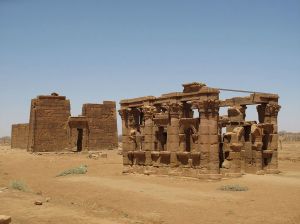
Sculpted palace? on the facade of the temple in the background, a king and queen – could this be King Natakamani and Queen Amanitore? (Wikipedia – UNESCO)
The pyramids of the king, the queen and the princes have been identified at Meroë. The king and queen liked to be portrayed with one of the royal princes, Arikankharor, Arikakhatani or Sherkaror, varying according to the monument; perhaps the princes were viceroys of the provinces in whose principal temples they were pictured. Sherkaror seems to have ascended the throne in succession to his parents shortly after the opening of the Christian era; a rock carving at Gebel Qeili in the south of Butana shows him triumphing over innumerable enemies under the protection of a solar deity.













 African Heritage