I love history, archaeology and archives. … I just found a new passion: collecting money bills (old money bills, which are no longer in print) from the BEAC zone (central Africa), the BCEAO zone (West Africa), and from all over Africa! In essence, I collect rare old bills. My favorite bills of all times have always been the 10000 FCFA bills from 1978, and 1992 in the BEAC Zone … this was and still is the highest bill in print. What I liked the most was the images chosen: the BEAC building in Yaoundé (Cameroon), the beautiful woman with her cornrows representing the African beauty itself, the antelopes (this does not take away the fact that FCFA is a slave currency which should disappear). Be the judge!
I just wanted to follow up on the article on Kente cloth, with this great video on weaving Kente cloth. the video details the origin and the art behind Kente cloth. Enjoy!
Have you ever seen those beautiful bright multicolored scarves worn on graduation day by thousands of African Americans and African students across the United States? Those scarves are usually hand-woven, bright, and multicolored, worn to represent the membership to a Black sorority, fraternity, or to just an African student organization at the different colleges and universities.
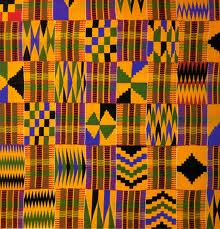
Well, those scarves are made from a material commonly known as Kente cloth, which originates from the Ashanti people of Ghana and Cote d’Ivoire. The Ashanti people used to (and still do) hand weave these bright multicolored clothes for their kings and noblemen. The tradition of kentecloth is said to have been developed in the 17th century, and stems from ancient Akan weaving techniques dating as far back as the 11th century AD (this is one of Africa’s textile tradition). Kente cloth is known as nwentoma(meaning woven cloth) in Akan language, and is a type of silk, cotton, or rayon fabric made of interwoven cloth strips which is native to the Akan/Ashanti ethnic group of Southern Ghana (and also Cote d’Ivoire). It is woven on a wooden loom, which produces a band about 10 cm wide; several bands will then be sewn together to make a larger cloth. The elaborate patterns arise from the mixture of different weaving techniques applied to the same band of cloth. The quality of the fabric, and weaving indicates the rank of the person, the best being reserved for the kings. It is worn by men as a toga, and by women as upper and lower wrappers. The art of weaving kente is passed down only to males, from generation to generation. The main center of weaving kente is around the Kumasi region of Ghana.
Kente cloth
An Ashanti legend has it that two friends who had gone hunting in the forest came across a giant spider (the famous Ananzé) who was weaving her web. They were so amazed that they stayed welded in place for two days, contemplating the spider at work. When they returned from hunting, they imitated the animal and wove a cloth out of raffia. This is how was born the first kente which was offered to the king. The Asantehene (king) was so amazed by the beauty of the present, that he elevated the weavers to the rank of royalty, and they became the king’s exclusive tailors. The clothes woven for the king were each unique, and whoever tried to reproduce them was severely punished.
Kente is an Akan royal and sacred cloth worn only in times of extreme importance and is the cloth of kings and nobility, before finding its way into bags, and scarves sold around the globe nowadays. In Akan culture, the different colors and intricate patterns used in the weaving do have traditional meanings.
White: is the color of purity, innocence, spirituality, and peace (mental, collective, and interior). Very small amount are found on the kente (sometimes just the threads are white). White has a divine and sacred character;
Paramount chief Nana Akyanfuo Akowuah Dateh II in Kumase, Ghana (Photograph by Eliot Elisofon,1970, National Museum of African Art).
Yellow: is the color of gold, and symbolizes preciousness, royalty, wealth (financial, spiritual, intellectual, etc), and fertility. It is associated with the earth’s generosity. This color is strongly represented in the kente, because the king, who wears it during public gatherings, embodies all these virtues: gold, royalty, wealth, high status, glory, spiritual purity. Yellow, just like the sun’s rays, also reminds of divine goodness.
Black: is the color of bereavement, and darkness, but also of mystery and secrecy. It is mostly used in initiation and purification ceremonies. It is an ambivalent color representing both obscurantism, and spiritual elevation; it is thus both feared and revered. Its discrete presence in kente reminds that noblemen are first and foremost the guardians of the throne. Black also represents maturation and intensified spiritual energy;
Blue: reminds of the big spaces: the sea and the sky. It symbolizes elevation, communion, humility, patience, and wisdom. The king and noblemen have perfect control over their environment. Blue is the color of peace, harmony, and love. It is sometimes associated with yellow or white, or red, to represent wealth and power which are founded on spirituality, and which bring tranquility, and balance, and constitutes a strong guarantee of stability for all powers;
Green: is the symbol of life, growth and harmony. Green reminds of the forest, the trees, birth, and youth. It is also linked to vegetation, planting, harvesting, growth, and spiritual renewal. Joined with blue and yellow on a kente, it completes the meaning of the clothing which expresses wealth and nobility founded on humility, humanism, and balance.
Other less common colors are:
A Kente cloth was offered to Michael Jackson during his enthronement as prince of Krindjabo (Côte d’Ivoire).
Grey:healing and cleansingrituals, and is associated with ashes;
Brown: is the color of mother earth, and is associated with healing;
Pink: mostly worn by women, is associated with the female essence of life: sweetness, tenderness, calmness, pleasantness;
Purple: is associated with feminine aspects of life, and is mostly worn by women;
Red:political and spiritual moods, bloodshed, sacrificial rites, and death;
Silver:serenity, purity, joy, and is associated with the moon;
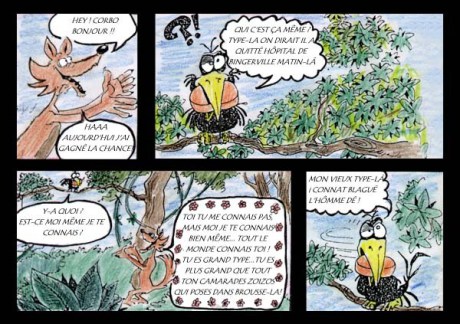
J’ai trouve cette belle illustration de la fable de Jean de La Fontaine ‘Le Corbeau et le Renard.’ C’est une fable que nous avions l’habitude de reciter au cours moyen 1 (CM1), quand nous etions petits. Vous reconnaitrez l’accent ivoirien dans les dessins (texte et dessins de LaCombe)… Alors regalez-vous bien!
Le Corbeau et le Renard
Maître Corbeau, sur un arbre perché, Tenait en son bec un fromage. Maître Renard, par l’odeur alléché, Lui tint à peu près ce langage : “Hé ! bonjour, Monsieur du Corbeau. Que vous êtes joli ! que vous me semblez beau ! Sans mentir, si votre ramage Se rapporte à votre plumage, Vous êtes le Phénix des hôtes de ces bois.” A ces mots le Corbeau ne se sent pas de joie ; Et pour montrer sa belle voix, Il ouvre un large bec, laisse tomber sa proie. Le Renard s’en saisit, et dit : “Mon bon Monsieur, Apprenez que tout flatteur Vit aux dépens de celui qui l’écoute : Cette leçon vaut bien un fromage, sans doute. “ Le Corbeau, honteux et confus, Jura, mais un peu tard, qu’on ne l’y prendrait plus.
The Crow and the Fox
Master Crow perched on a tree, Was holding a cheese in his beak. Master Fox attracted by the smell Said something like this: “Well, Hello Mister Crow! How beautiful you are! how nice you seem to me! Really, if your voice Is like your plumage, You are the phoenix of all the inhabitants of these woods.” At these words, the Crow is overjoyed. And in order to show off his beautiful voice, He opens his beak wide, lets his prey fall The Fox grabs it, and says: “My good man, Learn that every flatterer Lives at the expense of the one who listens to him. This lesson, without doubt, is well worth a cheese.” The Crow, ashamed and embarrassed, Swore, but a little late, that he would not be taken again.
Today, I will be talking about the late South African painter Gerard Sekoto. Gerard Sekoto is known today as the father of urban black art and social realism. Born in 1913, Gerard Sekoto grew up in South Africa at a time of apartheid. His entire art has been influenced by his life experience. He held exhibition in Johannesburg and Cape Town. His painting was actually the first painting by a Black artist to be exposed at the Johannesburg Art Gallery. He was a big fan of oil painting.
Gerard Sekoto’s depiction of Steve Biko’s death
In 1947, he exiled himself to Paris. His first two years were quite depressing and hard; they actually had nothing to do with painting. He played in French nightclubs as a pianist, and composed over 25 songs whose main themes were the loneliness of exile, and the courage of an immigrant trying to survive in a foreign country. Quite a global theme these days, in this global world!
In 1966, he visited Senegal, and was actually a guest of President Léopold Sédar Senghor. He visited Dakar for a year, and this visit reignited his passion for painting. Armed with his brushes, he fully immersed himself into the ‘Dakarois’ environment, and once again started painting African scenes.
Prisoners laboring hard in South Africa – by Gerard Sekoto
In the 1970s, he started expressing his opposition to the apartheid system back in his homeland, and started painting about it. One of his famous paintings is poignant depiction of Steve Biko‘s death, with Biko’s tearful mother at the center of the painting, Biko to the right of her, and a white policeman to the left. It is very sorrowful and vivid depiction… and to think of Biko’s mother! Most often, people paint the victim, and forget those they’ve left behind.
Sekoto never had a chance to return to South Africa, not even for his mother’s funeral. He ended his days in a retirement home for artists on the outskirts of Paris in 1993.
I would like to share with you this poem of the late president of Senegal, Léopold Sédar Senghor. This poem is an ode to the Black woman, but above all, to Senegal his country. Yes… after reading it several times, one realizes that Senghor was writing an ode to the Black woman, his mother, his sister, his daughter, but above all to Senegal which could be loved just like a woman, and whose “beauty stroke him to the heart like the flash of an eagle”, and whose “Savannah stretch[ed] to clear horizons, savannah shuddering beneath the East Wind’s eager caresses.” This poem was published in ‘Chants d’Ombre’ (1945), English translation by Melvin Dixon (in The Collected Poetry (CARAF books …)). As you read Senghor’s poem, do you see other meanings? who do you think was the intended audience? Do you feel, like me, that he is praising Senegal, the land of his ancestors? or is he talking about the woman of his dreams? Enjoy!
Femme noire
Femme nue, femme noire Vétue de ta couleur qui est vie, de ta forme qui est beauté J’ai grandi à ton ombre; la douceur de tes mains bandait mes yeux Et voilà qu’au cœur de l’Eté et de Midi, Je te découvre, Terre promise, du haut d’un haut col calciné Et ta beauté me foudroie en plein cœur, comme l’éclair d’un aigle
Femme nue, femme obscure Fruit mûr à la chair ferme, sombres extases du vin noir, bouche qui fais lyrique ma bouche Savane aux horizons purs, savane qui frémis aux caresses ferventes du Vent d’Est Tamtam sculpté, tamtam tendu qui gronde sous les doigts du vainqueur Ta voix grave de contralto est le chant spirituel de l’Aimée
Femme noire, femme obscure Huile que ne ride nul souffle, huile calme aux flancs de l’athlète, aux flancs des princes du Mali Gazelle aux attaches célestes, les perles sont étoiles sur la nuit de ta peau.
Délices des jeux de l’Esprit, les reflets de l’or ronge ta peau qui se moire
A l’ombre de ta chevelure, s’éclaire mon angoisse aux soleils prochains de tes yeux.
Femme nue, femme noire Je chante ta beauté qui passe, forme que je fixe dans l’Eternel Avant que le destin jaloux ne te réduise en cendres pour nourrir les racines de la vie.
Black Woman
Naked woman, black woman Clothed with your colour which is life, with your form which is beauty
In your shadow I have grown up; the gentleness of your hands was laid over my eyes. And now, high up on the sun-baked pass, at the heart of summer, at the heart of noon, I come upon you, my Promised Land, And your beauty strikes me to the heart like the flash of an eagle.
Naked woman, dark woman Firm-fleshed ripe fruit, sombre raptures of black wine, mouth making lyrical my mouth Savannah stretching to clear horizons, savannah shuddering beneath the East Wind’s eager caresses Carved tom-tom, taut tom-tom, muttering under the Conqueror’s fingers Your solemn contralto voice is the spiritual song of the Beloved.
Naked woman, dark woman Oil that no breath ruffles, calm oil on the athlete’s flanks, on the flanks of the Princes of Mali Gazelle limbed in Paradise, pearls are stars on the night of your skin
Delights of the mind, the glinting of red gold against your watered skin
Under the shadow of your hair, my care is lightened by the neighbouring suns of your eyes.
Naked woman, black woman, I sing your beauty that passes, the form that I fix in the Eternal, Before jealous fate turn you to ashes to feed the roots of life.
Very often, Africans are depicted on old pictures as naked people, walking around without any clothing. This seems to be quite at odd with the fact that the Dutch textile company VLISCO has been installed in Africa, more precisely in Togo, since 1846. So how could pictures from the 1800s and early 1900s only show naked Africans? The BBC recently ran a story on VLISCO and African textile tradition actually being European. The New York Times claimed that Africa’s fabric was entirely Dutch. I find this quite appalling, and I call this a falsification of history.
For starters, before VLISCO, Africa had a very rich textile industry as noted by Kankan Moussa‘s entire delegation being clothed from cotton woven with golden threads in 1300s during his pilgrimage to the Mecca (this will be a story for another day), or the Kanembu clothing tradition which dates as far back as the 800s. It is misleading to believe that the Wax hollandais is the only fabric worn by Africans, when we know that the Bogolan rises from a long tradition of weavers in Mali, or the Kente cloth of Ghana.A piece of Bogolan cloth
So what is the history of African fabric? Is there an African history of textile?
As pointed earlier, the African fabric industry is very old, and dates as far back as 5,000BC when ancient Egyptians began cultivating flax and weaving it into linen. An ancient pottery found at Badari shows an ancient depiction of a loom dating back to this period, while a 12th dynasty image from the tomb of Khnumhotep shows weavers using a horizontal loom (ca 2400 BC). Moreover, pyramids, sculptures, and hieroglyphs clearly show all Egyptians clothed.Even their neighbors to the south, the Nubians, had a flourishing textile industry, as can be seen on images on pyramids at Meroë, and images of the great queen Amanishakheto, as well as those of pharaoh Piye.Later on, as several civilizations flourished throughout Africa, cotton became a more commonly used fabric. The explorer Ibn Battuta does mention the presence of weavers in the Mali empire, and in Timbuktu, in the 1300s. As Islam was introduced in West Africa, many began wearing today’s version of the boubou.Kente cloth
Today, one can find a full tradition of textile flourishing throughout Africa. The Bogolan or ‘mud cloth’ is hand-woven fabric hailing from Mali. Kente cloth, is Ghana’s national fabric, with the most expensive ones made with golden threads for kings only (in the olden days). It is said that the British explorers were amazed by the beauty of the Ashanti king’s attire. Cameroon has a long history of cloth made from the bark of trees, with some fabric particularly made from the obom. Fibers from the raffia are still commonly used to make bags, and clothing. Moreover, in West Cameroon, Kings are dressed with finely woven clothing made by the best weavers of the kingdom embellished with beads. The Pygmies use bark cloth made from tropical fig trees, while people from Chad and the Central African Republic weave cotton strips on horizontal looms; they use a variety of natural dyes.
Ndebele woman
The Kuba people of the Democratic Republic of Congo, use raffia and make some of the most beautiful hand-woven blankets, clothing, and sculptures. The Ndebele of South Africa and Zimbabwe have a rich tradition of gorgeous colorful quilts and blankets entirely hand-made. Many would envy the elegance, color, and presentation of well-dressed Ndebele women.
So why are the New York Times and the BBC trying to falsify history?Even VLISCO patterns are not Europeans, as they are inspired by Africans, and made to address the needs of the African population. Yes, Africans wear have worn VLISCO textiles and many Nana Benz have prospered from it, but that doesn’t mean that they do not have their own rich tradition of textile. Africans have their textile industry which dates back millennia, and has probably inspired many in the world. So today as you wear a wax hollandais, remember that there are Kente cloth, Bogolan, and many other beautiful garments made by local artists well-deserving of praise.I am leaving you with a documentary video on Kente cloth weaving. Enjoy!
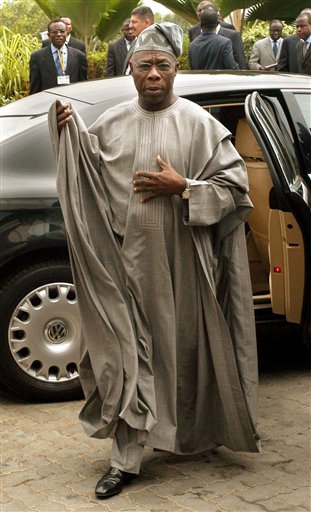
President Olusegun Obasanjo of Nigeria, famous for his grand boubous
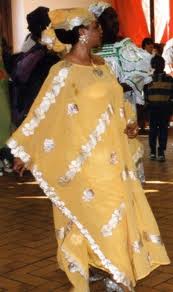
Yesterday I wore my green boubou with intricate gold embroidery in the front for a special African celebration. To say that I looked like royalty is simply an understatement. I looked majestic! So, for starters, you might ask me what is a boubou? Well, a boubou(or bubu, or grand boubou, or grand bubu) is an African garment worn by men and women in much of West Africa, and parts of Central Africa. The boubou generally consists of up to three pieces: a long-sleeved shirt, a pair of tie-up trousers that narrow at the ankles, and an open-stitched overflowing wide sleeveless gown worn over these two; all three are usually the same color, and were historically made from silk, but nowadays are made up of cotton or sometimes synthetic fabric made to resemble silk. The whole will be incomplete without a hat or chechia of any color. A woman’s boubou would differ from a man’s boubou by the fact that it will consists of two pieces: a wrapper at the bottom, and a large overflowing gown to top it all off, and of course an intricate headscarf. Its name comes from the wolof‘mbubb’, which made it into French, as boubou. In Yoruba, it is known as agbada; in Hausa, it is babban riga, while in Tuareg, it is k’sa grand boubou.
Woman wearing a boubou
The tradition of the boubou is old, and can be traced back to as far as the 8th century. Its origin lies with the clothing worn by the Islamized Tukulor (Toucouleur), Mandé, and Songhai peoples of the great Takrur and Ghana empires, and 13th century Mali and Songhai empires. In West Africa, the nobles of the different people were already wearing a garment more or less similar to the actual boubou. The different patterns in the embroidery already had precise meanings which varied for different ethnic groups and regions. The rest of the population, in majority craftsmen and farmers, wore garments similar to tunics for the upper body, and a wrapper or baggy trousers for the lower body.
In the past, in West Africa and Central Africa, only Islamized peoples used to wear the boubou: Fulani, Toucouleur, etc. … the other ethnic groups all had their own traditional garments of more or less similar genre. With trade among the peoples, the fashion industry, many African stylists (such as Alphadi) have specialized into the boubou and it has now gained international exposure.
The video below is short and simple, and addresses the boubou. It is a small documentary from Arte. Enjoy!
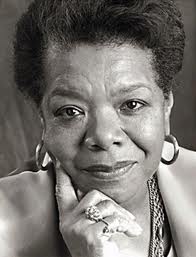
In celebration of the Women International Day on March 8th, I decided to post this poem by the great African American poet, Maya Angelou. It is dedicated to all the women of the world, the gorgeous, natural, and phenomenal women who make up our lives. Enjoy Phenomenal Woman.
Pretty women wonder where my secret lies. I’m not cute or built to suit a fashion model’s size But when I start to tell them, They think I’m telling lies. I say, It’s in the reach of my arms The span of my hips, The stride of my step, The curl of my lips. I’m a woman Phenomenally. Phenomenal woman, That’s me.
I walk into a room Just as cool as you please, And to a man, The fellows stand or Fall down on their knees. Then they swarm around me, A hive of honey bees. I say, It’s the fire in my eyes, And the flash of my teeth, The swing in my waist, And the joy in my feet. I’m a woman Phenomenally. Phenomenal woman, That’s me.
Men themselves have wondered What they see in me. They try so much But they can’t touch My inner mystery. When I try to show them They say they still can’t see. I say, It’s in the arch of my back, The sun of my smile, The ride of my breasts, The grace of my style. I’m a woman
Phenomenally. Phenomenal woman, That’s me.
Now you understand Just why my head’s not bowed. I don’t shout or jump about Or have to talk real loud. When you see me passing It ought to make you proud. I say, It’s in the click of my heels, The bend of my hair, the palm of my hand, The need of my care, ‘Cause I’m a woman Phenomenally. Phenomenal woman, That’s me.
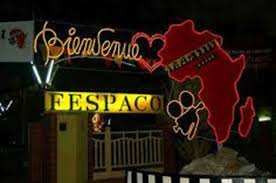
With the upcoming closing ceremony of the FESPACO this Saturday, I thought it important to talk about Africa’s film tradition. For starters, the FESPACO (Festival Panafricain du cinema et de la television de Ouagadougou) is the Panafrican Film and Television Festival of Ouagadougou, the largest African film festival, held biennally in Ouagadougou, the capital of Burkina Faso. First established in 1969, and boasting some of the Africa’s greatest writers and filmmakers (like Ousmane Sembene), the FESPACO offers a chance to African filmmakers and professional to showcase their work, exchange ideas, and meet other filmmakers, and sponsors. Filmmakers from around the continent all come together in Ouagadougou which is transformed into the Hollywood or the Cannes of the continent for this special occasion. This year’s FESPACO is presided by legendary director Euzhan Palcy (who made: Rue Cases Negres, A Dry White Season, Ruby Bridges).
The Golden Stallion of Yennenga
This year, 755 movies are competing in different categories. 20 feature films will be competing for the Golden Stallion of Yennenga (Etalon d’Or de Yennenga) which will be awarded Saturday March 2nd. The select 20 features in the ‘long metrage’ section address various subjects such as clandestine immigration (‘La Pirogue’ from Senegalese Moussa Traore, which was a big hit at last year’s Cannes festival), journalism and censorship (‘Les Chevaux de Dieu’ by Moroccan Nabil Ayouch, also featured at Cannes 2012), love (‘Love in the Medina’, by Moroccan filmmaker Abdelhai Laraki), war (‘La genese de la bataille d’Alger’, by Algerian filmmaker Said Ould Khelifa), theft in society (How to steal 2 million, from South African Charlie Vundla), ‘La republique des Enfants’ (Children’s republic) by Bissau-Guinean filmmaker Flora Gomes– a country abandoned by adults where children organize themselves into a prosperous country, or revolution and prostitutes in a war camp (‘Virgem Margarida’ directed by Mozambican Licinio Azevedo – which premiered at the Toronto International Film Festival last year).
Enjoy this photojournal by Nic Bothma on the the Guardian’s website. You can read some movies’ sypnosis on Gabonews. Enjoy the generic of this year’s festival, which tells the story of the famous princess Yennenga, and the festival.










 African Heritage