A blog about African history, and heritage, through audio and video files.
Author: Dr. Y.
I am an African in love with the history of the world, and particularly that of Africa. I am a child of love, an artist, a scientist, a lover, a friend, a human.
I am in love with nature and beautiful things, art, history, geography, travel, dance, food, science, and technology, and much more.
An illustration from Jules Verne’s book “Découverte de la terre” (“Discovery of the Earth”) drawn by Léon Benett. Ibn Battuta (1304-68/69) was a Moroccan Berber scholar and traveler
The Berber scholar and historian Abu Abdullah Ibn Battuta (commonly known in English as Ibn Battuta) is known as the most prolific and famous traveler of the middle ages. Born in Morocco in 1304, descending from a family of Islamic legal scholars (qadis) in Tangier, Ibn Battuta covered over 73,000 miles in 3 decades spanning 3 continents, Africa, Europe, and Asia. On one such travel, he visited the great Empire of Mali, and through his notes, we know what an audience with the Emperor Mansa Sulayman of Mali looked like. Travel to 1351 and enjoy a day in the court of the Emperor of one of the greatest empires in Africa, the Mali Empire, through the eyes of Ibn Battuta!
=====
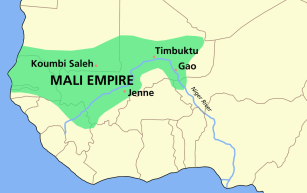
Mali Empire (Wikipedia)
On certain days the sultan holds audiences in the palace yard, where there is a platform under a tree, with three steps; this they call the “pempi.” It is carpeted with silk and has cushions placed on it. [Over it] is raised the umbrella, which is a sort of pavilion made of silk, surmounted by a bird in gold, about the size of a falcon. The sultan comes out of a door in a corner of the palace, carrying a bow in his hand and a quiver on his back. On his head he has a golden skull-cap, bound with a gold band which has narrow ends shaped like knives, more than a span in length. His usual dress is a velvety red tunic, made of the European fabrics called “mut’anfas.” The sultan is preceded by his musicians, who carry gold and silver guimbris[two-stringed guitars], and behind him come three hundred armed slaves [possibly servants]. He walks in a leisurely fashion, affecting a very slow movement, and even stops from time to time. On reaching the pempihe stops and looks round the assembly, then ascends it in the sedate manner of a preacher ascending a mosque-pulpit. As he takes his seat the drums, trumpets, and bugles are sounded. Three slaves go out at a run to summon the sovereign’s deputy and the military commanders, who enter and sit down. Two saddled and bridled horses are brought, along with two goats, which they hold to serve as a protection against the evil eye. Dugha stands at the gate and the rest of the people remain in the street, under the trees.
Sometimes one of them stands up before him and recalls his deeds in the sultan’s service, saying, “I did so-and-so on such a day,” or, “I killed so-and-so on such a day.” Those who have knowledge of this confirm his words, which they do by plucking the cord of the bow and releasing it [with a twang], just as an archer does when shooting an arrow. If the sultan says, “Truly spoken,” or thanks him, he removes his clothes and “dusts.” That is their idea of good manners.
This picture taken on April 13, 2019 shows a view inside the newly-dicovered tomb of the ancient Egyptian nobleman “Khewi” dating back to the 5th dynasty (24942345 BC), at the Saqqara necropolis, about 35 kilometres south of the capital Cairo. (Photo by Mohamed el-Shahed / AFP) (Photo credit should read MOHAMED EL-SHAHED/AFP/Getty Images)
Si vous recherchez les lois de l’harmonie, vous trouverez la connaissance (Egypte Ancienne).
If you search for the laws of harmony, you will find knowledge (Ancient Egypt).
The painted wooden coffins were found intact in burial shafts and contained mummies, amulets and wooden boxes. Photograph: Khaled Desouki/AFP/Getty Images
To be an archaeologist in Egypt is probably one of the highest wishes of any archaeologist out there: everyday there are new findings, and more importantly new insights into one of the world’s most ancient civilizations which happens to be African. The ancient Egyptian civilization has inspired many, and shed new light on life thousands of years ago in that area of the African continent. Few days ago, hundreds of Ancient Egyptians coffins were found at a cemetery in Saqqara; among the coffins was found a headless statue of Imhotep, Chief architect of Pharaoh Djoser‘s step pyramid, and possibly one of history’s first documented physician, and author of several wisdom texts. The mission found 250 colored wooden sarcophagi with well-preserved mummies, wooden statues and masks dating from 500 BC, as well as a cache of bronze mirrors, bracelets, necklaces, earrings, and more dating from the 15th century BC. Below are excerpts from an article on the Guardian. Enjoy!
====
Archaeologists working near Cairo have uncovered hundreds of ancient Egyptian coffins and bronze statues of deities.
The discovery at a cemetery in Saqqara contained statues of the gods Anubis, Amun, Min, Osiris, Isis, Nefertum, Bastet and Hathor along with a headless statue of the architect Imhotep, who built the Saqqara pyramid, according to Egypt’s ministry of tourism and antiquities.
The 250 coffins, 150 bronze statues and other objects dated to the late period, about 500BC, the ministry said.
They were accompanied by a musical instrument known as a sistrum and a collection of bronze vessels used in rituals for the worship of the goddess Isis.
The painted wooden coffins were found intact in burial shafts and contained mummies, amulets and wooden boxes. Wooden statues of Nephthys and Isis from an earlier period were also found, both with gilded faces.
Last month, Rwanda and the UK signed a deal to repatriate all African migrants that will come to the United Kingdom (UK) in search of a better tomorrow to Africa, and more precisely to Rwanda. The UK will pay Rwanda an “economic transformation and integration fund” amounting to£120 million, and will also fund each immigrant between£20,000and£30,000for their relocation and temporary accommodation in the scheme. Where do they find the money? I thought times were hard! Upon arrival in Rwanda, migrants will be temporarily accommodated in the capitalKigalias their claims for asylum are processed. If successful, migrants will then receivepermanent residency in the country and be offered permanent accommodation. It is expected that all claims will, at most, take three months to be processed. Once in Rwanda, migrants will not be allowed to return to the United Kingdom to seek asylum. As a skeptic, I wonder how that will work, given that we hear often about over-population in the city ofKigali… Certainly, as I have said countless times, Africa is the richest continent on this planet, and it is about time that we, Africans, stay home to make it work, and get rid of those governments (puppets of the West) that are seated on our destinies instead of risking our lives in the Sahara desert, the Mediterranean Sea, or the English Channel. As a side note, when we know that the Rwandan army is deployed in Mozambique (among other places) to watch over the interests of Total, I doubt that those asylum seekers will really be integrated in Rwandan society as Rwandans, but maybe as extras in the army to be sent out to protect foreign interests in other African countries? Hey, if I were the government of Rwanda, it is a really good deal! Enjoy the article below fromAfricaNews.
=====
Flag of the United Kingdom
Hotels and guest houses in Rwanda are being prepared to accommodate asylum-seekers illegally arriving into the UK.
It’s part of a controversial deal, signed by Rwanda and Britain, to deport illegal migrants to Kigali.
The plan aims to discourage desperate migrants from attempting to cross the English Channel by flying them some 6,400 kilometres to Rwanda where they are expected to stay for good.
Both Britain and Rwanda have faced criticism at home and with at least two UN agencies speaking out about the controversial plan.
Migrants arriving illegally in the UK – often in small boats crossing the English Channel – will have their asylum claims processed in Kigali.
“We will welcome these migrants with open arms, we will try to make them forget the problems that made them leave their country,” said Denis Bizimungu, general manager of the Desire Resort Hotel which is being refurbished and renovated to accommodate the migrants.
“We want to make sure that the idea of crossing the Mediterranean never comes back to their hearts, we want their hearts to be filled with joy in this country,” he added.
UN officials and other critics – particularly in the two countries – have raised human rights concerns and warned that such a move goes against the Refugee Convention.
… According to Rwanda’s deputy government spokesperson Alain Mukurarinda “the contract between Rwanda and the United Kingdom is clear.”
“All the expenses are taken care of by the British government,” he said.
Have you ever wondered about the meaning of the name Kigali, the capital of Rwanda? Is the name from the ancient Kingdom of Rwanda? Was Kigali its capital? Or is it the name of a local town the colonizer decided to turn into the seat of a new protectorate state in Africa?
Boulevard in Kigali, Rwanda
Well, Kigali takes its name from Mount Kigali at the foothills of which the city is located. In Kinyarwanda, the prefix ki- denotes objects, while the adjective –gali means ‘vast’, ‘broad’, ‘wide’. Thus the translation of the name Kigaliyields ‘great or big mount’ or ‘vast mountain,’ because the mountain itself is broad and wide. However, based on oral tradition, it is said that the name might have originated in the 14th century when local king Rugwe after conquering the area stood on top of the hill and stated “burya iki gihugu ni Kigali,” which translates to “this country is vast.” Note that the capital of the Kingdom of Rwanda was never Kigali, but Nyanza.
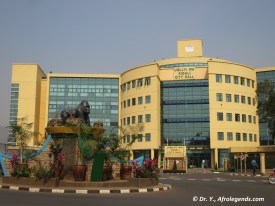
Kigali City Hall, Kigali, Rwanda
The city was established in 1907 by the German administrator and explorer Richard Kandt, who chose Kigali for its central location, and good views of the entire region (security-wise). Perched at an altitude of 1500 m, Kigali is made up of rolling hills and valleys, thus it is quite a strategic point. Kandt’s house was the first European house in the city, and is still in use today as the Kandt House Museum of Natural History. Very often to destroy the power of traditional and local kingdoms, colonial main cities and capitals were chosen away from the usual centers of power which might have carried a lot of the indigenous people’s traditions and thus caused a resistance to the colonial rule; this could also explain the choice of Kigali as the capital.
Kigali Genocide Memorial, Kigali, Rwanda
Kigali became the capital upon independence in 1962. Two other cities were considered as contenders for the title of capital, Nyanza the seat of the Mwami and the capital of the ancient kingdom, and Butare which was considered a cultural and religious center. Yet again Kigali won over the other two because of its central location. Over the years, Kigali has grown and expanded. However, the Rwandan civil war and Rwandan genocide of 1994 cast a dark cloud over Kigali, the Rwandan sky, and the entire sub-region. Over 800,000 people died during that time, which marked one of the darkest times in the history of the country. Today, one can still visit the Genocide Memorial in Kigali to remember those whose lives were taken.
Hotel des Mille Collines which at the height of the 1994 genocide housed over 1200 Hutus and Tutsis refugees, and was made famous by the movie Hotel Rwanda with his general manager Paul Rusesabagina who has been abducted from exile in 2020 and is currently jailed in Kigali by the Kagame regime
Today, Kigali has expanded tremendously, and grown significantly. Much of the city has been rebuilt, and today flourishes. It is the economic and financial hub of the country. In 2013, the economy was reported to be dependent on foreign aid and illegal resource extraction from the DRC. I once read comments from a member of the Rwandan financial ministry who explained that they were finding new precious stones or minerals every day on Rwandan soil… in reality, it is from neighboring DRC.
Overall, Kigali knows cooler temperatures than most countries around the equator, because of its high elevations. The city is particularly lauded for its cleanliness, innovation, and foreign investments. The quick turnaround and rebuilding of Kigali and Rwanda as a whole has made it a key player in all continental organizations. Although many criticize the government of Paul Kagame, it is no doubt that Kigali and Rwanda have experienced undeniable growth, thanks to a combination of the neighbor’s wealth and good governance.
Amahoro National Stadium entrance in Kigali, Rwanda
If you visit Kigali and Rwanda as a whole, please make sure to check your plastic bags at your point of origin as plastic bags are prohibited on Rwandan soil. Make sure to visit the Kigali Genocide Memorial, the Amahoro Stadium, the Presidential Palace Museum which was the abode of past president Juvénal Habyarimana, the Muslim mosque of the city, and the different craft centers. The city expands along all the different hills, and so make sure to ride around on the moto-taxis or use public transportation, and do not forget to buy the famous agaseke baskets for which Rwandans and Burundians are known for.
Have you ever stood in front of an African mask and wondered about the artist who made it: what was his name, origin, and life like? A few weeks ago, I had an argument with a European friend who specializes in art history, who tried to convince me, a child of mother Africa, that African art does not have authorship. He claimed that while looking at African masks, they were all cloaked with anonymity, and that probably African art traditions prized anonymity. I had to tell him that he needed to stop looking at African art through his tainted European lenses, but rather try it through African tunnel vision. First of all, African art’s function is not similar to that used by Europeans as decorative art. African art actually has functions that go beyond decorative; the art work has meaning, and a real place in society.
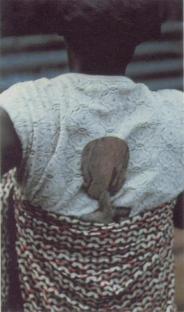
An Akua’ba tucked into the wrapper of an Asante woman. Photograph by Herbert M. Cole, Ghana, 1972 (RandAfricanArt.com)
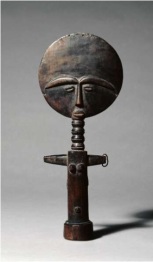
For instance, in the Asante (Ashanti) culture of Ghana, the Akua’ba (Akua’s child) figurines which are among some of the best well-known African wooden figures recognizable by their small disc head lodged on a cylindrical torso with or without arms, were used as legend says by Akua who could not have children; she ordered a figurine which she tied to her back and cared for as instructed by an African traditional priest, eventually being able to conceive; since then, many women desiring children have ordered Akua’ba figurines from artists and gotten them consecrated at shrines, and cared for in hope of conceiving. Also, some of the statues, like fertility statues, serve a particular purpose as the name states.
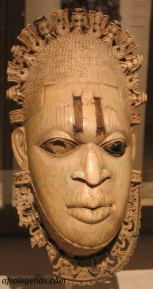
Pendant Ivory mask representing Queen Idia, Iyoba of Benin City (16th Century), exposed at the MET
Anonymity in African art is only a myth invented by Europeans as they came in contact with a foreign culture which they tried to explain via their own tainted cultural glasses. In the case of the Yoruba people of West Africa, as we saw earlier in the naming ceremonies [African Naming Tradition], names given at birth are not just used to differentiate individuals, but also serve to identify the essence of one’s personality and destiny called ori inu (inner spiritual head), which in Yoruba religious belief, determines a person’s success or failure in this world and directs his or her actions. The name also gives information about the person’s family, beliefs, history, origin, and environment. It is sacred! With every naming celebration, there begins a corresponding oriki (citation poetry), which grows with an individual’s accomplishments. Leaders, warriors, diviners, and other important persons, including artists are easily identified by their oriki, which chronicles their achievements [The Griot, the Preserver of African Traditions]. In Yoruba culture, there are different kinds of oriki: oriki Olurun (oriki for God), oriki orisa (oriki for gods/goddesses), oriki Oba ati Ijoye (oriki for monarchs and chiefs), oriki Akinkanju (oriki for warriors), oriki idile (oriki for families), to name just a few.
Below is the part of the oriki of Olowe, one of the greatest traditional Yoruba sculptors of the twentieth century; it was collected by John Pemberton III in 1988 from Oluju-ifun, one of Olowe’s surviving wives, and has been found to be instrumental in reconstructing his life and work. Outstanding Yoruba artists like Olowe whose works have been collected and studied by researchers have been identified in scholarly literature only by their nicknames or bynames such as, Olowe Ise (meaning Olowe from the town of Ise); Ologan Uselu (Ologan from Uselu quarters in Owo); and Baba Roti (father of Rotimi). This was done to protect the artist as he could become a vulnerable target to malevolent forces because of his standing in society or closeness to the king’s court, etc; in that case the artist never revealed his full name to strangers. However, when a person’s oriki is recited, it is assumed that anyone who listens carefully and understands it will know enough about the subject’s identity, name, lineage, occupation, achievements, and other qualities so that stating the person’s given name becomes superfluous. This is found on P. 11 – 12 of A History of Art in Africa, Monica Blackmun Visona, Harry N. Abrams (2001). Thus, authorship in African art is not veiled in anonymity, but rather the way authorship is conceived of is different. Enjoy!
Olowe, oko mi kare o
Aseri Agbaliju
Elemoso
Ajuru Agada
O sun on tegbetegbe
Elegbe bi oni sa
O p’uroko bi oni p’ugba
O m’eo roko daun se…
Ma a sin Olowe
Olowe ke e p’uroko
Olowe ke e sona
O lo ule Ogoga
Odum merin lo se libe
O sono un
Ku o ba ti de’le Ogoga
Ku o ba ti d’Owo
Use oko mi e e libe
Ku o ba ti de’kare
Use oko mi i libe
Ku o ba ti d’Igede
Use oko mi e e libe
Ku o ba ti de Ukiti
Use oko mi i libe
Ku o li Olowe l’Ogbagi
L’Use
Use oko mi i libe
Ule Deji
Oko mi suse libe l’Akure
Olowe suse l’Ogotun
Ikinniun
Kon gbelo silu Oyibo
Owo e o lo mu se
Olowe, my excellent husband
Outstanding in war.
Elemoso (Emissary of the king),
One with a mighty sword
Handsome among his friends.
Outstanding among his peers.
One who carves the hard wood of the iroko tree as though it were as soft as a calabash
One who achieves fame with the proceeds of his carving …
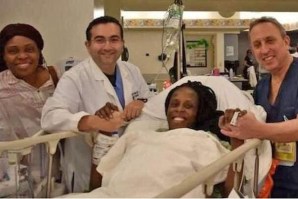
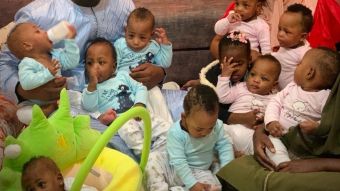
Halima Cisse, mother of nonuplets and the medical team in Morocco (Source: Africafreedomnetwork.com)
Can you imagine trying for one baby and ending up with 9 at once? It has been one year since the birth of the world’s first set of nonuplets. Conceived naturally, a first in the world, the 5 girls and 4 boys have all survived and are healthy and growing well. The parents, Abdelkader Arby and Halima Cissé, are from Mali. The babies have been taken care of by a full medical team in a hospital in Morocco. Initially, the medical teams both in Mali and then later in Morocco thought Halima Cissé was expecting septuplets, and so they were all surprised to find 9 babies in the end. Again, I salute the wisdom of the Malian government who saw fit to have the mother transferred to Morocco for more advanced specialist care; and I salute the immense dedication of the Moroccan team and government to the well-being of the babies. Excerpts below are from an article onthe BBC website.
=====
The nonuplets (Source: BBC)
The world’s only nonuplets – nine babies born at the same time – are “in perfect health” as they celebrate their first birthday, their father has told the BBC.
“They’re all crawling now. Some are sitting up and can even walk if they hold on to something,” said Abdelkader Arby, an officer in the Malian army.
They are still in the care of the clinic in Morocco where they were born.
He said their mother Halima Cissé, 26, was also doing well.
“It’s not easy but it’s great. Even if it’s tiring at times, when you look at all the babies in perfect health, [in a line] from right to left we’re relieved. We forget everything,” he told BBC Afrique.
He has just returned to Morocco for the first time in six months, along with their elder daughter, Souda, aged three.
… They will just have a small birthday celebration with the nurses and a few people from their apartment building, Mr Arby said.
“Nothing is better than the first year. We will remember this great moment …”
The babies broke the Guinness World Record for the most children delivered in a single birth to survive.
… Mrs Cissé and the children are currently living in what their father described as a “medicalised flat” that belongs to the owners of the Ain Borja clinic in Casablanca where the babies were born.
“There are nurses who are here, in addition to my wife, who help to take care of the children,” Mr Arby said.
… [The] boys are called Mohammed VI [in honor of the Moroccan king], Oumar, Elhadji, Bah [in honor of the Malian president at the time], while the girls are named Kadidia, Fatouma, Hawa, Adama and Oumou.
Each one has a unique personality, their father said.
“They all have different characters. Some are quiet, while other make more noise and cry a lot. Some want to be picked up all the time. They are all very different, which is entirely normal.”
Mr Arby also thanked the Malian government for its help. “The Malian state has put everything in place for the care and treatment of the nine babies and their mother. It’s not at all easy, but it’s beautiful and something that is comforting,” he said.
… “Everyone [in Mali] is very keen to see the babies with their own eyes – their family, friends, our home village, the whole country.”
On Monday May 2, 2022, Mali rescinded the defense treaties linking it to France. Remember that, as part of the colonial tax forced upon the Malian people by France (and all other 14 past French colonies in Africa), there is one rule which links Mali to France via defense agreements where France is supposed to help Mali in case of external attacks. As we have seen, France has not held its part of the bargain, instead funding and letting jihadists proliferate on the Malian territory and committing abuses against the local populations. Thus, the government of Mali decided to break off from its defense accords with former colonial ruler France, condemning “flagrant violations” of its national sovereignty by the French troops there. “For some time now, the government of the Republic of Mali notes with regret a profound deterioration in military cooperation with France,” spokesman Colonel Abdoulaye Maiga said in a televised statement.
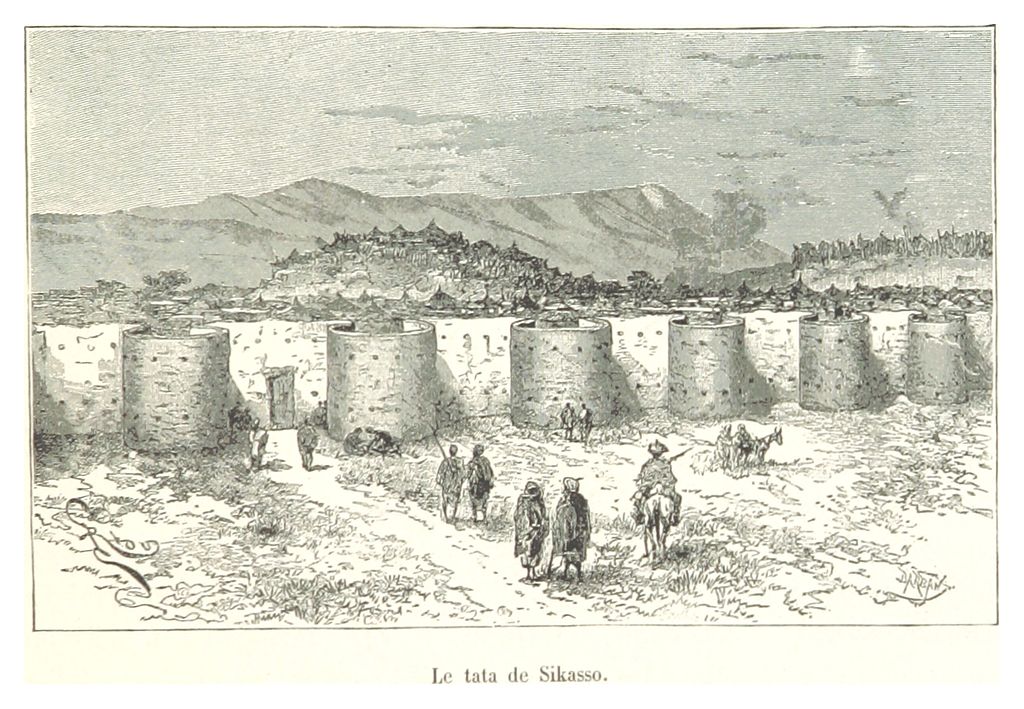
The tata of Sikasso, illustration by Édouard Riou published in Du Niger au golfe de Guinée, Hachette, 1892, by L.G Binger, p. 95
What might have further exacerbated the already tense relationship might have been the finding, about two weeks ago, of a mass grave near an army base which had been occupied by French forces. Although France has denounced these accusations, given the history of France abuses in Mali, and the region, it is hard not to believe. We all remember the French capture of the Tata of Sikasso on May 1, 1898 with Colonel Audéoud‘s troops and the destruction and desecration that followed. Even though it has been over a century, French abuses in Africa are numerous, from the genocide in Cameroon, Algeria, Madagascar, and countless other places.
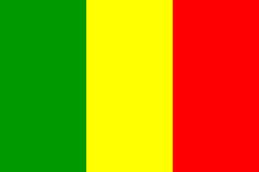
Flag of Mali
The decision to rescind the French defense agreements is an awesome decision, and it is about time! The remaining 14 countries still held under the rule of France via the colonial tax should rise up to say NO!… stand up as one man to say NO MORE!… ENOUGH is ENOUGH! … and stand alongside Mali.
#6. Right for France to pre-deploy troops and intervene military in the country to defend its interests
Under something called “Defense Agreements” attached to the Colonial Pact, France had the legal right to intervene militarily in the African countries, andalso to station troops permanently in bases and military facilities in those countries, run entirely by the French….




 Last month, Rwanda and the UK signed a deal to repatriate all African migrants that will come to the United Kingdom (UK) in search of a better tomorrow to Africa, and more precisely to Rwanda. The UK will pay Rwanda an “economic transformation and integration fund” amounting to

 Même si Dieu veille sur ton troupeau, aie soin de le confier à un berger




 La main de l’enfant ne peut atteindre l’étagère, ni la main de l’adulte passer à travers le goulot de la gourde