A blog about African history, and heritage, through audio and video files.
Author: Dr. Y.
I am an African in love with the history of the world, and particularly that of Africa. I am a child of love, an artist, a scientist, a lover, a friend, a human.
I am in love with nature and beautiful things, art, history, geography, travel, dance, food, science, and technology, and much more.
Last year, one journalist made fun of actress Zendaya’s hair because she wore dreadlocks to the red carpet; this reminded me of when Viola Davis had sported a short ‘afro’ to the Oscars … as if it was wrong for a Black woman to wear her hair in natural hairstyles. Why should an African woman be made to conform to something she is not? What is wrong with wearing our hair the way God made it?Without the relaxers, and perms made to straighten or rather beat the African-ness out? Every style should be celebrated.Our cultures are so unique… and the way we dress our hair is so unique, and should be loved and appreciated for what it is, a definition of who we are.
Viola Davis (Wikipedia)
It is high time, African women accept, appreciate, and embrace their heritage. It is impossible to beat the Afro out of oneself… just embrace it, and wear it as a peacock wears its feathers … with great pride! The poem below “African Hair” by Esmeralda Yitamben just says it all, and as I read it, I am proud to be African, born with this amazing hair. The author writes about the versatility of the African (Afro) hair, its beauty, its abundance, its richness, its kinkiness, and yes, its unruliness as well. True, I do not agree with the author’s mention of relaxers, but hey… every style should be valued. The original poem can be found on Kalaharireview.com. Enjoy! (The BBC also did a piece on Afro hair).
‘African Hair’
Kinky hair,
Picky hair,
Wavy hair,
Frizzy hair,
Hair the colour of ebony,
Sometimes sprinkled with hints of mahogany.
As splendid, lush, and full as the equatorial rainforest of Congo,
Woolen and soft like a sheep’s fur.
Shining with shea butter,
like a gem, under the moon’s smile.
O Sustaining Nature,
Blessed are our heads with beautiful hair:
Hair that can be braided, cornrowed, relaxed, and yes, even locked.
From Jamaican style dreadlocks, like Bob Marley’s hair,
To Jackson 5’s Afro,
To Maasai bald heads,
To Fulani princess corn rows,
To Bantu knots,
To Senegalese zillion braids,
To simple, hard-pressed, relaxed hair,
Precious Mother, Thou have blessed the Black race with a lion‘s mane.
Yes… we are talking about the very first WebTV for mobile phones developed in Francophone Africa. This is an innovative project launched by Inoussa Maïga of Burkina Faso. Maïga’s specialty is in the agricultural sector, talking to farmers and addressing the problems of the land workers. This is an amazing idea, which can have impact in all sectors of their lives. Many countries in Africa are not poor, they actually have a lot of food, however, they lack the infrastructures (poor roads) to bring in their products in due time and in good quality to the city, or the best markets. So imagine, if one used the WebTV to inform said farmers about the latest roadblocks from one city to another; imagine if one used WebTV to tell breeders about ways to vaccinate their cattle, or the next time there will be a veterinary in town to vaccinate or take care of their herds. Maïga’s project will start with journalists based in 4 countries: Burkina Faso, Côte d’Ivoire, Cameroon and Benin.There are so many ways indeed. Enjoy the full article on Samsa.fr. Don’t forget to visit his blog at GoogolFarmer.
At work, interviewing a farmer in Africa (Source: GoogolFarmer)
It seemed quite unfair not to say a few words about the passing of Boutros Boutros-Ghali, the first African to serve as the United Nations (UN) Secretary General. Boutros Boutros-Ghali was the first Egyptian, and the first African to serve in such a position from 1 Jan 1992 to 31 Dec 1996. True, he only served one term, and was faced with the wrath of the US because of his refusal to support NATO’s bombing in Bosnia, and the UN lame response during the genocide in Rwanda.
Bill Clinton and Boutros Boutros-Ghali (Source: The Guardian)
His five years in office were clouded by controversy, especially about perceived UN inaction over the 1994Rwandan Genocide and Angolan Civil War of the 1990s. He served at a time of crises in Somalia, Rwanda, the Middle East, and the former Yugoslavia. To some, he was an effective diplomat who was caught in a rift between the UN and the United States. Others, most notably in Washington, saw him as a symbol of all that was wrong with the United Nations. Boutros-Ghali wrote in his memoir, Unvanquished: A US-UN Saga (1999), about his tenure at the UN, and the disappointments he suffered there.
According to many, his biggest diplomatic accomplishment pre-dates his time as UN Secretary General, when he served as Egypt’s foreign minister under President Anwar El Sadat, and played a key role in negotiating the Camp David agreement brokered by the US president Jimmy Carter. The Guardian published a nice piece on Boutros Boutros-Ghali‘s life and legacy. So long to this son of Egypt.
In celebration of Valentine’s day which is going to be this Sunday, the song ‘IyawoMi‘ by Nigerian singer Timi Dakolo seems appropriate. The song is about a promise of love to that precious one… it is a ‘forever and for always‘ promise. It is a beautiful song which can be played at weddings as well. And the beat is simply amazing; it is a classic. The chorus: “Iyawo mi, Ololufe mi, Ore mi, Alayo mi, I will love you forever.” In Yorùbá, Iyawo mi= my wife, Ololufe mi= mylover, Ore mi= my friend, Alayo mi= my joy (one who brings mejoy). It could be sung to a man as well, by substituting the words oko mi (myhusband) to iyawomi(mywife). Enjoy and happy Valentine’s day to all… and in reality, one day is not enough to tell that loved one about your love, everyday should be an occasion to declare your love, in some way, shape, or form; because in reality, all we have is today, the present (a gift)… make the best out of it!
A game scene from ‘AURION: Legacy of Kori-Odan’ (source: kickstarter.com)
Video game players, and in particular African video game players will be excited by the latest, the first Gaming studio to see the light in Central Africa, and particularly in Cameroon. The games produced by this company embody African myths and culture. According to its founder, Olivier Madiba, the content of their games combine African characters and folklore. Kiro’o Games, Central Africa’s first video studio, latest project Aurion: Legacy of the Kori-Odan is an action-RPG (Role Playing Game) with which the studio intends to unify and transmit African culture by combining various myths, tales and traditional values into the gaming experience.
A game scene from AURION: Legacy of Kori-Odan (source: kickstarter.com)
“The history of our continent is rich … we took inspiration from local Cameroonian traditions, like the Ngondo Festival celebrated by the Sawa people, and we also incorporated symbolism adapted from that of the Akan people of Ghana, specifically the Adinkra writing style,” said Olivier. Aurion: Legacy of the Kori-Odan is set in a world of elemental energies and ancestral powers, where players assume the role of a traditional ruler, Enzo Kori-Odan, rightful ruler of the Zama kingdom, who uses the Aurion power granted him by his ancestors to regain control of his kingdom. To learn more, go to VenturesAfrica and TheNewAfrica. Kudos to Olivier Madiba and his team, all the best in their endeavor! Africa needs more of you.
L’écureuil est petit, mais il n’est pas l’esclave de l’éléphant(Proverbe Bornu – Tchad). Je ne vaux pas grand-chose, mais je ne suis pas ton sous-fifre.
Elephant
The squirrel is small, but it is not the elephant’s slave(Bornu proverb – Chad). I may not be worth much, but I am not your side-kick.
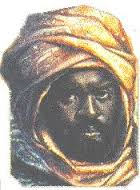
Today, I will be talking about Idris Alooma (also Idris Alaoma, or Idris Alauma), the only Bornu King whose name has survived the test of time. This article is long overdue, as it focuses on the Bornu and Kanem-Bornu empires.
Idris Alooma’s reign belonged to the great Sayfawa or Sefuwa dynasty which ruled the Bornu empire from the 16th and 17th centuries. According to the Diwan al-salatin Bornu, Idris Alaoma was the 54th King of the Sefawadynasty, and ruled the Kanem-Bornu empire located in modern-day Chad, Cameroon and Nigeria. In many works, he is known by his mother’s name, Idris Amsami, i.e. Idris, son of Amsa. The name Aloomais a posthumous qualificative, named after a place, Aloor Alao, where he was buried. He was crowned king at the age of 25-26. According to the Diwan, he ruled from 1564 to 1596. He died during a battle in the Baguirmi where he was mortally wounded; he was later buried in Lake Alo, south of the actual Maiduguri, thus the name Alooma.
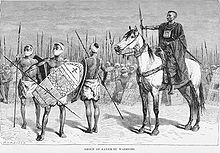
Group of Kanem-Bu warriors in the 1800s
Idris was an outstanding statesman, and under his rule, the Kanem-Bornu touched the zenith of its power. He is remembered for his military skills, administrative reforms and Islamic piety. His feats are mainly known through his chroniclerAhmad bin Fartuwa. During his reign, Idris avoided the capital Ngazargamu, preferring to set his palace 5 km away, near the Yo river (Komadugu Yobe), in a place named Gambaru. The walls of the city were red, leading to a new architecture using red bricks characteristic of his reign. To this day, some murals still exist in Gambaru and are over 3m tall. These are vestiges of a flourishing empire. Idris Alooma was known by the Kanuri title of Mai for king.
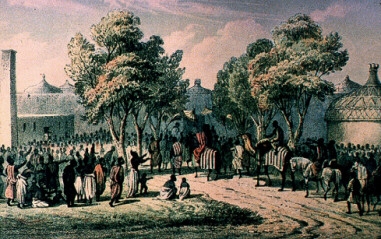
Kanem-Bornu court in the 1700s
His main adversaries were the Hausa to the west, the Tuareg and Toubou to the north, the Bulala to the east, and the Sao who were strongly implanted in the Bornu region (and will be decimated by Alooma’s military campaigns). One epic poem extols his victories in 330 wars and more than 1,000 battles. His innovations included the employment of fixed military camps with walls, permanent sieges and scorched earth tactics where soldiers burned everything in their path, armored horses and riders as well as the use of Berber camels, Kotoko boatmen, and iron-helmeted musketeers trained by Ottoman military advisers. His active diplomacy featured relations with Tripoli, Egypt, and the Ottoman Empire, which sent a 200-memberambassadorial party across the desert to Alooma’s court at Ngazargamu. Alooma also signed what was probably the first written treaty or ceasefire in Chadian history.
Alooma introduced a number of legal and administrative reforms based on his religious beliefs and Islamic law. He sponsored the construction of numerous mosques and made a pilgrimage to Mecca, where he arranged for the establishment of a hostel to be used by pilgrims from his empire. As with other dynamic politicians, Alooma’s reformist goals led him to seek loyal and competent advisers and allies, and he frequently relied on eunuchs and slaves who had been educated in noble homes. Alooma regularly sought advice from a council composed of heads of the most important clans. He required major political figures to live at the court, and he reinforced political alliances through appropriate marriages (Alooma himself was the son of a Kanuri father and a Bulala mother).
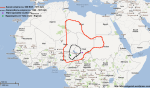
Map of the Kanem and Kanem-Bornu empires
Kanem-Bornu under Alooma was strong and wealthy. Government revenue came from tribute (or booty if the recalcitrant people had to be conquered) and duties on and participation in trade. His kingdom was central to one of the most convenient routes across the Sahara desert. Many products were sent north, including natron (sodium carbonate), cotton, kola nuts, ivory, ostrich feathers, perfume, wax, and hides, but the most profitable trade was in slaves. Imports included salt, horses, silk, glass, muskets, and copper.
Alooma took a keen interest in trade and other economic matters. He is credited with having cleared the roads, designed better boats for Lake Chad, introduced standard units of measure for grain, and moving farmers into new lands. In addition, he improved the ease and security of transit through the empire with the goal of making it so safe that “a lone woman clad in gold might walk with none to fear but God.” To learn more, check out the books: History of the first twelve years of the reign of Mai Idris Alooma of Bornu (1571-1533) by his Imam: Ahmed ibn Fartua; together with the “Diwan of the sultans of Bornu” and “Girgam” of the Magumi; and The Africans, ed. J.A. Tome 3, 1977.












 Dieu ne donne pas à porter plus qu’on peut porter


 Le chien ne retourne jamais là où on l’a frappé







 African Heritage