At Last: Senegalese Tirailleurs now allowed to receive their pension while living in Senegal

Inauguration of the Place des Tirailleurs-Sénégalais with Tirailleurs aged over 90-years-old on 10 March 2023 (Source: Sylvie Koffi, RFI)

Nine Senegalese tirailleurs, men who served for France for its liberation during the wars, have now won the right to receive their pension while living in Senegal. These men, aged 85 to 96 years, have served in the French army during the wars of Indochina and Algeria, and were forced to live in France at least 6 months per year to get their retirement pension! This meant that in essence, most of them just stayed in France, unable to afford the trips back home to Senegal. For those who do not know, the term “tirailleur” was the name given by the French Army to indigenous infantry recruited in the various French colonies of Africa. They were not all Senegalese, even though the name always said “tirailleur sénégalais,” but rather came from all over Africa. They served France in a number of wars, including World War I, World War II, Indochina, Algeria, and several others. The name “Tirailleur” is a link of two words “tir ailleurs” to laugh and denigrate the African troops by saying that the soldiers were not capable to shoot on target, more to mean “shoot off target”; it could be translated as skirmisher. Although these soldiers fought to help free France, most of them were never recognized, and instead were insulted, laughed at, and sometimes even abused or more. Find here an article on The Conversation, and more importantly on the video of the Massacre of Thiaroye [Thiaroye: A French Massacre in Senegal‘Thiaroye Massacre’ by Ousmane Sembene] showing the poor treatment and sometimes massacre of these tirailleurs by the French, when they returned home after serving France.
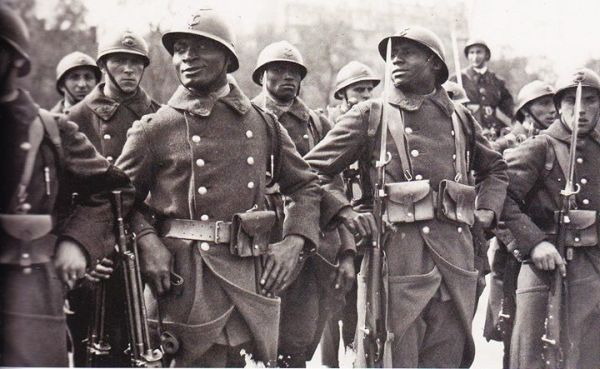
Senegalese Tirailleurs serving in France in 1940

So, after most of them have died, these remaining 9 Senegalese tirailleurs had to reside in France for at least 6 months every year to receive their due pension!!! Unbelievable! Who knows the atrocities they witnessed in the name of France? Who knows the blood, sweat, and trauma they lived through? Now that only 9 are remaining, France cannot even pay them their pension of 950 Euros per month! 950 Euros per month for 9 people? How difficult can it be for France who gets 500 billion Euros every year from Africa [The 11 Components of the French Colonial Tax in AfricaAfrica is funding Europe!FCFA: France’s Colonial Tax on AfricaIs France Trying to (re) Colonize Africa?]? And these men, tirailleurs Senegalais in their advanced age, had to live in France to even see a money that is due them? And people actually had to fight, and write petitions for the French government to finally agree to pay them in Senegal. See… they always wait for everybody to die, before even acknowledging them [The British Government apologizes for Mau Mau atrocities].

Enjoy the articles on RFI, France24, and AfricaNews. Excerpts below are from AfricaNews.

====

It is a trip they almost stopped dreaming of. Nine Senegalese veterans, aged 85 to 96, who fought for France during the XXth century, will join their families in Senegal.

After years and sometimes decades of living thousands of miles from their relatives so they could claim their French army pension, the soldiers were moved on their way to the airport Friday (Apr.28).

A few days before the journey home, AFP met with Yoro Diao [head medic during the war in Indochina, Vietnam, in charge of the stretcher bearers, carrying the wounded under enemy fire], a veteran aged 95….

It’s a victory,” the decorated veteran said on Wednesday (Apr.26) as he prepared his flight.

I’m going to live and eat well. I’ll walk around the village. It’s paradise over there,” he added, a smile lighting up his thin face.

Hundreds of thousands of African soldiers fought for their colonial master France in the two world wars and against independence movements in Indochina and Algeria. But until this year, surviving veterans among the so-called “Senegalese Infantrymen” had to live in France for half the year or lose their pension. In January, the French state dropped the condition, saying they could return home for good and continue receiving their monthly allowance of 950 euros ($1,000). It would also pay for the flight and move of any veterans wishing to leave.

… Their pensions were increased to adjust for inflation for the first time in almost five decades in 2006.

I was shocked that all these old men who had contributed to our freedom couldn’t even become French,” said [Aissata Seck, Head of the Association for the Memory and History of Senegalese Infantrymen].

… Diao said the French government’s waiver has been a long time coming — too late for some veterans who are now too frail to make the journey home. But for those who still can, “it’s better late than never,” he said.

Japan’s Prime Minister tours Africa

Flag of Japan

Amidst the news of chaos in Sudan, it is easy to forget other news happening at the same time across the continent. When it comes to Africa, the Western media have a chic to make us focus only on the worst things on the continent, and rarely the good. After all, if anybody watches the news, they would not think that there is joy and happiness, prosperity, and abundance in Africa; not everything is as portrayed in the news. This week, Japan’s Prime Minister, Fumio Kishida, is touring Africa. The tour started last Sunday in Egypt, followed by Ghana, then Kenya, and Mozambique (Japanese banks are among the international banks financing the multi-billion dollar deal involving the French firm Total in Mozambique (Who/What did we say goodbye to in Africa in 2020?)). In this tour, Japan has vowed to give 500 million dollars in financial support to Africa over the next three years to promote stability and peace on the continent. The New Scramble for Africa is on… are Africans awake? Excerpts below are from AfricaNews.

====

Flag of Egypt
Flag of Egypt

Japan’s Prime minister is on an African tour. He arrived Monday (May. 1st) in Ghana, the day before he was in Egypt. He is set to visit Kenya and Mozambique.

The Prime Minister of Japan arrived at the Kotoka International Airport in Accra, Ghana and is expected to hold a bilateral discussion with President Nana Akufo-Addo.

Egypt’s president Abdel Fatthah al-Sissi welcomed Sunday (Apr. 30), Fumio Kishida.

After a meeting with the Secretary-General of the Arab League at the institution’s headquarters in Cairo, Kishida held talks with Egypt ‘s leader.

Map and Flag of Ghana

Al Sissi detailed the topics per the agenda during a press conference.

We reviewed the challenges the international arena is witnessing today, in particular the massive economic repercussions left by the Ukrainian crisis on developing countries that exceeded what the coronavirus pandemic caused in terms of a rise in inflation rates, energy and food prices, and expectations of a decline in the growth rate.”

The discussions came as Japan is to host the G7 Summit scheduled on 19-25 May.

We discussed many regional issues of common concern, especially the Palestinian issue and the situation in Libya. Developments in Sudan occupied an important aspect of the talks“.

….

Unrest in Sudan

Flag of Sudan

A few weeks ago, we talked about The New Scramble for Africa. Our hearts go out to our brothers and sisters in Sudan as unrest rises in the country. Those who think that this is a “simple” feud between two generals, or two “brothers” as portrayed in the news, must look deeper. Why are US troops getting deployed there? In the early 2000s, people around the globe were bombarded non-stop with information about the genocide in Darfur and “slavery” in Sudan; we were all told that Northern Sudanese were “white” who treated poorly their Southern Sudanese brothers who were “Black” which is a very simplistic and exaggerated way of looking at Sudan (remember Libya and Slavery: Sheep without a Shepherd in recent years?). Hollywood stars such as George Clooney came out in numbers claiming to care about the plight of the Black man, and saying that the Black people of Darfur Sudan were enslaved by their lighter skinned Sudanese brothers.To all who know the tactic of divide-and-conquer, and know social conflicts in Africa, we are always manipulated into thinking that every conflict in Africa is about this tribe vs. that tribe, this group vs. group; thus neighbors become enemies, when in reality, it is a diamond mine or oil field coveted by external forces which is at the core of the issue (Northern Mozambique today). The conflict in Sudan led to the split of Sudan, which was then Africa’s largest country, into Sudan with capital in Khartoum, and South Sudan with capital in Juba. Many forget that the southern part of then-Sudan was rich in oil fields, and that this split diminished Sudan’s oil output to the detriment of the newly created South Sudan (in passing, wasn’t the Pope in South Sudan in February? The Pope Visits the Democratic Republic of Congo and South Sudan), thus putting a big dint on Sudan’s partnerships with China (Sudan was providing more than 10% of China’s oil needs and a Chinese presence on the horn of Africa). After the split, the world’s attention which was on Darfur moved on, Darfur which was supposedly the goal of Western interventions was never resolved, but South Sudan with the oil fields was detached from Sudan.

The New Scramble for Africa (Source: Source: Dr Jack & Curtis for City Press, National Institute African Studies (NIAS))

The cold war between the West and the East took place mostly in other countries like Angola, Mozambique, Congo, Afghanistan, Nicaragua in Africa, Asia, Latin America with many coups d’état and conflicts around the globe. Similarly today, the new kind of war has started yet again, but this time, it is on African soil with The New Scramble for Africa as the world moves toward energy-“conscious” policies.

How do we, Africans, stop from having our lands be a theater for others’ wars? How can we independently make learned decisions for our people without being dragged in others’ conflict?

Saï Island: Influences from Pharaonic Egypt, Christianity, and Islam in Nubia

Church pillars on Sai Island (Source: Atlas Obscura)

Our hearts go out to our brothers and sisters in Sudan whose country is going through unrest again. This unrest is part of the New Scramble for Africa, and to a greater extent the great global war between the West and the East which as always plays on other continents.

Today, we will continue our exploration of Saï Island, an island in Sudan which contains ruins spanning thousands of years and several empires. It is the largest island on the Nile river, about 12 km long and 5.5 km wide. Although Sudan is today an Islamic country, Saï was once occupied by Egyptians during the New Kingdom, and later was the site of the ancient medieval Christian Nubian Empire known as Makuria which flourished in Sudan between the 7th and 14th centuries. Later, during the 16th century, the Ottomans founded a fortress on the island. Saï Island has always been Nubian, and over the centuries has seen different cultures, religions, and much more.

Ruins on Sai Island (Source: Lendi Travel)

Many Empires have prevailed on the island. The presence of the Egyptian town and temple which dates back to 1500 BC is a good example of the strong imprint of the Pharaonic Egypt, with among many other things a spolia bearing the  cartouche of Amenhotep IV, amongst other 18th Dynasty rulers: the fort was founded by Pharaoh Ahmose and then overbuilt by Amenhotep I and his successors. Saï Island was also an important royal site during the Meroitic period as testified by the discovery of pillars/columns with the names of the Queen Amanitore and King Natakamani of Nubia. It is clear today that Saï Island was the seat of a Nubian Bishop as indicated by the remains of a Medieval Christian cruciform church, identified as a cathedral, the largest in Nubia; while the Ottoman presence is noted by the remains of a fort built in the 2nd half of the 16th century AD. The place is full of pottery dating several centuries, if not millenia. However, part of the island, the northern part, was flooded when Lake Nasser was created in 1971 (most monuments that were destroyed were on the Nubian/Sudan side of the dam, while a lot on the Egyptian side were recovered and moved to higher ground – don’t get me wrong, Abu Simbel is amazing and worthy to have been saved, but wasn’t the fortress at Buhen just as important?).

Chert pebble with ochre residue from Sai Island, Sudan. (Source: Illustration by Van Peer, et al.
(2004))

Saï Island is an exceptional testimony to early human occupation in this part of Africa, notably the Homo-erectus and the Homo-Sapiens. It provided early attested evidence for the use of color in the world with rare finds of ochre and ways to manipulate it (Saï Island in Sudan – Earliest Site with Evidence of Ochre Use by Modern humans). It is one of the key sites in Sudan (which was not flooded) which shows the prime influence of Egyptian culture in Nubia during the 2nd millennium BC, and the evolution and fusion of both cultures with mutual influences from Nubia and Pharaonic Egypt across centuries. All these attributes qualify Saï Island as unique with an outstanding Universal Value.

To learn more about the findings of this cathedral and more on Saï Island, check out these articles on the Smithsonian Magazine, UNESCO World Heritage, the Art Newspaper, Sudan National Museum‘s website, Tomb26 on Saï Island, and much more.

Saï Island in Sudan – Earliest Site with Evidence of Ochre Use by Modern humans

Chert pebble with ochre residue from Sai Island, Sudan. (Source: Illustration by Van Peer, et al.
(2004))

Saï Island, in Sudan, is located in the Nubian region of the Nile River, and is the very earliest site with evidence of ochre use by modern humans. It is the largest island on the Nile River, and was occupied intermittently by people throughout the Paleolithic. The island is rich in history, and today we will focus on the color impact of Saï island in the history of the world.

Found on the island, there are several archaeological layers dating from about 180,000 to 200,000 years ago. Excavation there has yielded large quantities of red and yellow ochre. While red is almost always the dominant color at early human sites, the inhabitants of Saï Island seem to have preferred yellow pigment. The significant use of yellow ochre there indicates strong cultural choices and the use of new manipulation techniques to change colors, call it chemistry, which could have been heating or something else. Thus, Saï Island is known for being the site of the earliest ochre-processing kit in the world; on the site were found sandstone mortars, a rectangular sandstone slab with a depression carefully hollowed out in its center. The slab appears to have been a grinding stone, with evidence of ochre powder within the depression. Two small pieces of chert stone with fragments of ochre still attached were found nearby. The pieces of chert were used to crush the ochre into a fine powder on the slab, like an early mortar and pestle. These were dated to about ca 180,000 years ago. This makes Saï island an important site to understand the initial emergence of modern human behavior in the world, and thus the start of colors, and new techniques of manipulations of ochre.

To learn more, check out Van Peer et al. J. of Human Evolution 45, 187 (2003) and Fulcher et al., J. of Archaeological Sci. Rep. 33, 102550 (2020).

Proverbe Congolais sur les conséquences / Congolese Proverb on Consequences

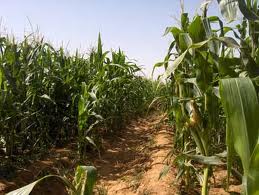
Un champ de maïs
Un champ de maïs

Quand on chasse l’abeille de l’épi de maïs, on ne mangera pas de maïs (Proverbe Ngbaka – République Démocratique du Congo (RDC)).

When we chase the bee from the ear of corn, we will not eat any corn (Ngbaka Proverb – Democratic Republic of Congo (DRC)).

African Joke: All Secrets Out

Religious leader

Three religious leaders get together and decide to confess their faults and weaknesses to each other so that each prays for the other. 

The first says: “My problem is money. I love money too much and I often steal from offerings and tithes. Pray for me because I am not proud of it.”

Relaxed and at ease, the second says: “Mine is women. I love women too much and when I see a woman, I want to sleep with her. I have slept with all the women in my parish. Pray to help me.

The third starts crying. The other two take two hours to calm him down. Then he finally speaks in tears: “My problem is kpakpato. I don’t know how to keep a secret; so everything you just said, tomorrow everyone will know, even if you pray for me!


The original in French is found on Nouchi.com . Adapted and Translated to English by Dr. Y. Afrolegends.com

Unity during Religious Holidays

Unity

Very often, our differences are emphasized, rather than our similarities. For instance, our different religions, different political views, different races, different tribes, countries, etc, more emphasis is placed on what divides us, rather than on what unites us: humanity! We are all humans and neighbors on this big planet that is called Earth. In Senegal, Christians and Muslims reinforce their unity and solidarity during the Christian holiday of Easter with the “Ngalakh” dessert. In a country that is mostly Muslim (over 95%), the people of Christian faith share Ngalakh dessert for “Good Friday” with the rest of their community. The dessert has come to symbolize unity and solidarity between Muslims and Christians in Senegal; just like during Eid al-Adha or Ramadan, Muslim families share meat and couscous with their Christian neighbors. Enjoy and learn more about ways that unite us, rather than divide us. Excerpts below are from AfricaNews.

====

Flag of Senegal
Flag of Senegal

… In Senegal, where approximately 4 percent of the population is Christian, the feverish preparation that started before Easter to be celebrated on 9 April continues unabated. Christian families prepare a special dessert for “Good Friday”, which represents the end of the Great Lent (Careme) fast that the Christian community keeps during the Easter period and coincides with the Friday before Easter Sunday.

Ngalakh, the first flavour that comes to mind when Easter is mentioned in Senegal, is prepared with “thiakry”, a type of semolina commonly used in West Africa, baobab tree fruit, nutmeg, milk, sugar and peanut cream. Christian families gather early on Friday at the home of a family elder and cook enough Ngalakh for almost the entire neighbourhood. Ngalakh has a liquid consistency and is served with grated coconut, banana slices and raisins.

The young people of the house make a list of Muslim neighbours and acquaintances and distribute most of the dessert to them until Friday afternoon.

Ngalakh, an Easter tradition, is considered one of the symbols of unity and solidarity between Muslims and Christians in Senegal today.

… “This solidarity is unique to Senegal

… Coly [Adama Manga] said, “In Senegal, everyone respects each other’s religion, no one is in a competition of ‘my belief is superior to yours’. This is a secular country. We live here peacefully together with Christians as well as many sects.

Use of Old Laptop Batteries to Power Bikes?

Laptop battery (Source: Greencell.global)

Have you noticed how nothing lasts anymore? The quality of things has gone down, and the entire society seems to be on programmed obsolescence: even the quality of the roads, furniture, clothing, electronics, etc… everything is focused on profit, profit, profit, and very little on durability, or rather durability for just a few months, enough to buy the next product. We will talk about this programmed obsolescence another day. However, a Kenyan man has found use for old laptop batteries to power bikes. As we are pushed towards electric vehicles, his invention could enable a new way of thinking, focused on recycling and re-using what is readily available, as opposed to creating new waste. This article is not an endorsement of electric bikes, but rather a celebration of ingenuity and new ways of (re)using old things to make new ones. Excerpts below are from AfricaNews.

====

Paul Waweru is going shopping. He’s on the hunt for old laptop batteries. They cost him just KSH 50 ($0.50) per piece, but this Kenyan high school physics teacher has found an innovative use for the waste product.

They will power bikes. After he collects the items from dealers in Nairobi, he takes the haul back to his workshop. Here, he sorts them, dividing the working cells from those which are not working.

Waweru then assembles them into a battery that can be used to power electric motorbikes. He was inspired to come up with this innovation after running into trouble with a bike he’d bought.

… He’s founded a company called Ecomobilus to supply his laptop-battery powered bikes. He collects frames from old motorbikes, removes the engines and replaces them with a battery and a motor to propel the bike. They run on a 60 V direct current. The batteries take hours to charge but can take 45 minutes if on a fast charger. A fully charged battery can travel a distance of up to 100 kilometres. He says his invention compares very well to traditional motorbikes.

Ecomobilus bikes are more advantageous compared to other gasoline powered bikes. Number one, because of the cost of maintenance. Ecomobilus bikes require zero maintenance because there are no mechanical parts that need to be repaired every often, we give it at least two years for services because the engines are no longer there, we are dealing with motors,” he says.

….

Proverbe Congolais sur la tentation / Congolese Proverb on Temptation

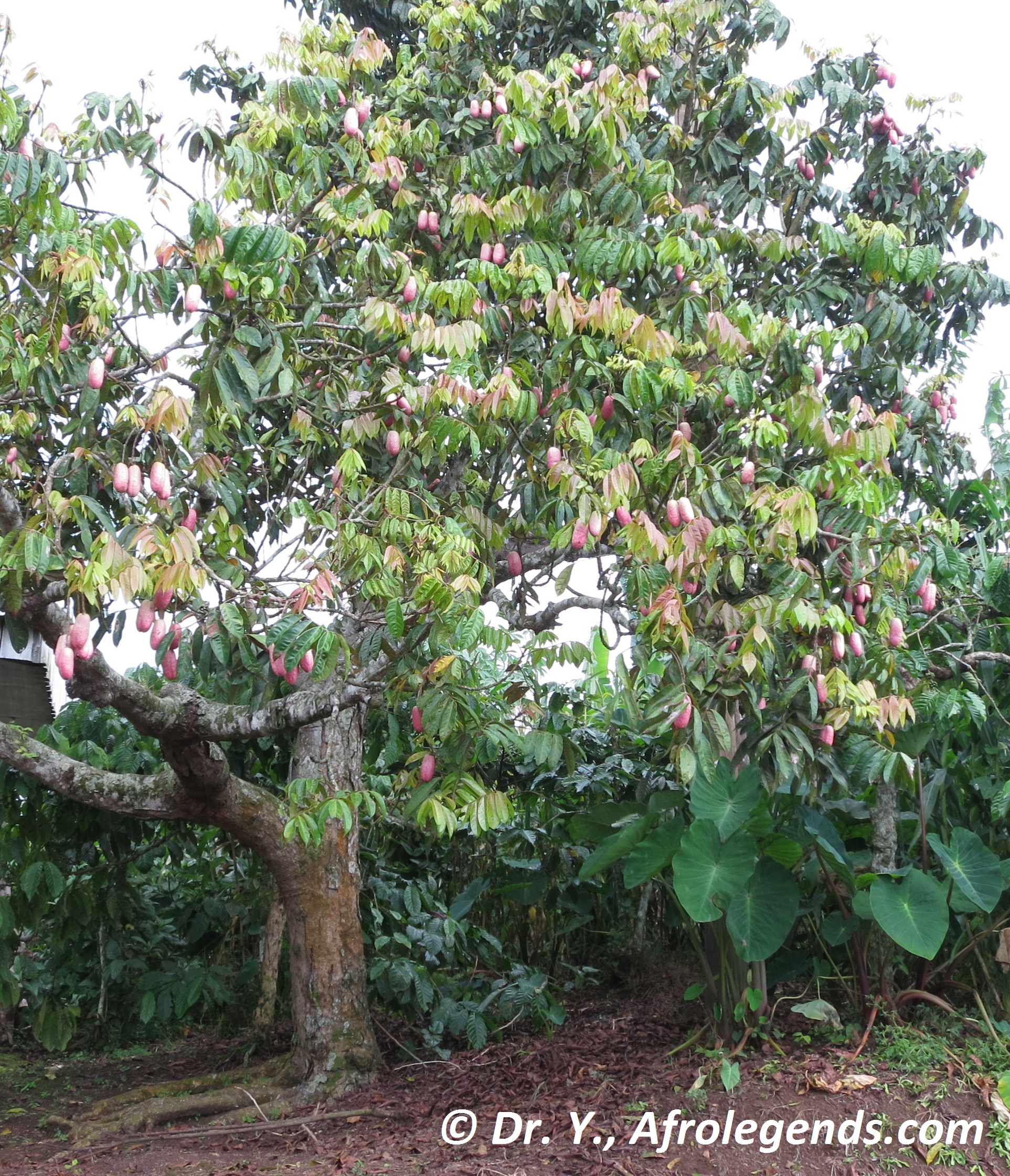
Safoutier / Safou tree

Le safou mûr tente le chasseur (proverbe Ngombe – République Démocratique du Congo (RDC)). – L’occasion fait le larron.

The ripe safou tempts the hunter (Ngombe proverb – Democratic Republic of Congo (DRC)). – Opportunity knocks.