Cameroonian Musical Genius : Ekambi Brillant

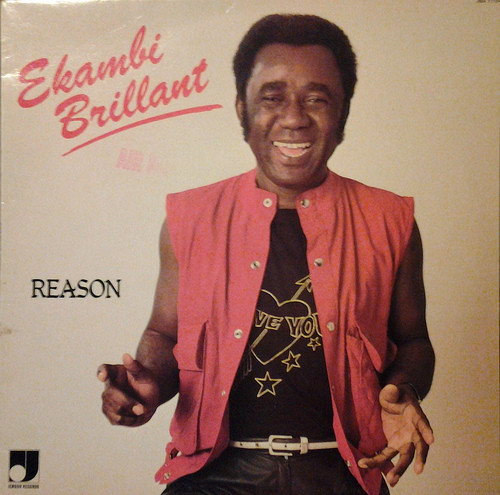
Ekambi Brillant on the cover of his 1987 album Reason (Source: RhythmConnection.Blogspot.com)

Ekambi Brillant was without doubt one of Cameroon’s greatest artists and one of the great African musicians. Originally from Dibombari, a village close to Douala, Brillant spent his youth with his maternal grandparents in Jebale, a suburban island of Douala. Per the words of Cameroonian author Elolongue Epanya Yondo, Jebale is known as the “emerald island, flamboyant jewel” on the Wouri estuary; no wonder, it served as the inspiration to a young Ekambi!  His passion for music was born from ancestral roots and from watching and listening to fishermen singing on their way back home from the sea.

Wouri river and the Djebale island seen on the other side

In 1962, Brillant was admitted to the 6th grade in the prestigious Lycée Général Leclerc (General-Leclerc High School) of Yaoundé. It was there, under the careful attention of Mr. Daniel Zane, his French music teacher, that he learned to play music, particularly the guitar. In 1971, at the age of 23, he stopped his studies and moved to Douala, where he joined the band The Crack’s as a guitarist. He applied for and won the music contest launched by the Office of French Broadcasting Television (ORTF), judged by some of the continent’s great musical personalities such as Manu Dibango and Francis Bebey. Thanks to this prize, he was able to release his first 45 rpm record, Jonguèlè la Ndolo, which sold 20,000 copies.
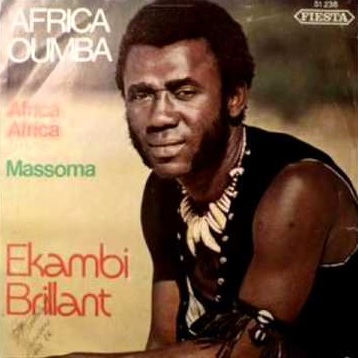
Ekambi Brillant’s album ‘Africa Oumba’

In 1972, he flew to France, where, with the support of Jean Dikoto Mandengue, a Cameroonian bassist, he produced and released his second 45 rpm record with Phonogram. The album was a major success and sold 25,000 copies. As stated before, Ekambi Brillant’s love for his country, his people, and music can be felt in every single note!

In 1975, he ended his deal with Phonogram and began a collaboration with Slim Pezin, with whom he released the album Africa Oumba, which included the major hit song “Elongui.” The song became an incredible source of inspiration for several other artists, both African and European, including the Greek singer Demis Roussos, who sang it as “L.O.V.E. Got a Hold of Me.” Roussos’ version used the exact melody of Ekambi Brillant’s original makossa hit, but he never acknowledged Ekambi Brillant—not even with a tribute. It was only later that African fans (including yours truly) loudly affirmed that this was Brillant’s original work. In the past, African compositions have often been adapted/plagiarized without formal credit, especially when entering European or American markets. Roussos earned millions from Ekambi’s song, without giving him a penny. This is reminiscent of Andre Marie Tala, Cameroon’s Blind Musical Virtuoso, and his song Hot Koki which was plagiarized by  James Brown, or more recently Shakira with “Waka Waka (This Time for Africa)” “adapting” the “Zamina mina (Zangaléwa)” song and claiming in an interview to have gotten inspiration while walking on a beach. The album Africa Oumba reached a record of about 4 million sales (diamond disk). Further collaborations with Slim Pezin as producer yielded titles such as Soul Castel and Musunguédi. In 1976, Ekambi Brillant formed his band known as The Ebis (Ekambi Brillant Show).
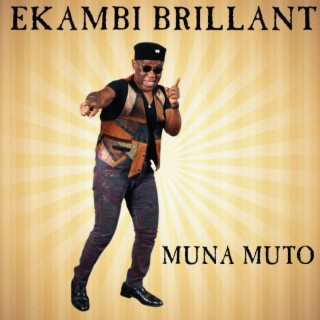
Ekambi Brillant ‘Muna Muto’

Over the course of his career, Brillant released nearly 20 albums. Brillant passed away on 12 December 2022 in Douala at the age of 74, after a battle with a long-term illness. Unfortunately, like many in Cameroon, he was a brilliant soul who barely received the recognition his genius deserved. He was from a generation of outstanding Cameroonian artists.

Ekambi Brillant remained an inspiration to generations of artists, propelling several careers and guiding many musicians—both Cameroonian, such as Marthe Zambo, Valery Lobe, and Alhaji Touré, and African, such as Cella Stella and Angelique Kidjo. He was so advanced, brilliant, and inspired … going through his music portfolio is filled with great sounds and a great source of inspiration. Cameroonians should get inspired from his work and celebrate his genius. 

.

Ernest Ouandié: People tell the story of his last days

Ouandié1
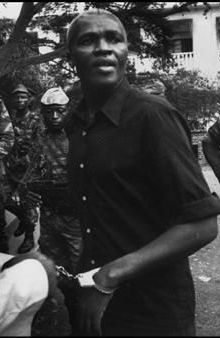
Ernest Ouandie, a few minutes before his execution in Bafoussam

On 15 January 1971, Ernest Ouandié, the leader of the UPC, was publicly executed in the capital of the Western region, Bafoussam, his natal province.

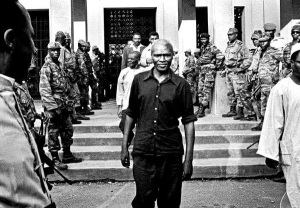
In reality, three people had been executed. Those 3 were: Gabriel Tabeu, aka “Wambo, the electricity“, Raphaël Fotsing, and Ernest Ouandié. The three were tied to a pole, facing a firing squad. The first two fell first. Ernest Ouandié, who had been accused of attempting to create a revolution, the organization of an armed bands, assassinations and other things, refused to be blindfolded. This led to a dispute between the authorities and him. Finally, they granted him his final wish, and as he was falling through the weight of the bullets, he shouted “Others will continue the struggle” staring death in the eye.

Up until the last minute, we did not think that the government was going to execute Ernest Ouandié and his comrades. People thought that they could be condemned for life. It was for us a big surprise. They made us get out of school to go watch the execution of the nationalists. In the crowd, we disapproved of what was going to happen, even kids like us. There was in reality, a strong current of sympathy for the rebels. That is why as soon as Ernest Ouandié and his companions were shot, it was as if I had been wounded in the depths of my heart.  The gust had wounded the head of a person who was at the parish of the evangelical church,”  says Wanko Tchonla, a trader in Bafoussam. On the day of the event, he was a student at the Saint Joseph school of the cathedral.  He still keeps in memory that sad day of 15 January 1971.” [“Jusqu’à la dernière minute, nous ne croyions pas que le gouvernement allait faire exécuter Ernest Ouandié et ses camarades. Les gens pensaient qu’on pouvait les condamner à vie. C’était pour nous une grande surprise. On nous a fait sortir de l’école pour voir l’exécution des nationalistes. Dans la foule, on désapprouvait ce qui allait se passer, même les enfants comme nous. Il y avait en réalité un fort courant de sympathie pour les rebelles. C’est pour cela que dès que l’on a tiré sur Ernest Ouandié et ses compagnons, c’est comme si j’avais reçu une blessure au fond de mon cœur. La rafale avait blessé la tête d’une personne qui se trouvait au niveau de la paroisse du plateau de l’église évangélique ”, raconte Wanko Tchonla, commerçant à Bafoussam. Au moment des faits, il est élève à l’école Saint Joseph de la cathédrale. Il garde en souvenir la triste journée du 15 janvier 1971.]

Ouandie2
Ernest Ouandie, on his way to his execution

It is no coincidence that the government of Ahmadou Ahidjo had decided to execute Ernest Ouandié in Bafoussam even though his conviction had been pronounced by the military court of Yaoundé. It is was important to create a collective psychosis in the minds. That is why people are always afraid to demonstrate for their rights. People are even afraid to join a political party by fear of being killed.” [“Ce n’est pas par simple hasard que le gouvernement d’Ahmadou Ahidjo avait décidé de faire exécuter Ernest Ouandié à Bafoussam alors que sa condamnation avait été prononcé par le tribunal militaire de Yaoundé. Il fallait créer une psychose collective dans les esprits. C’est pour cela que vous voyez que les gens ici ont peur de manifester pour revendiquer leurs droits. Les gens ont même peur de s’engager dans un parti politique parce qu’ils craignent d’être tués.”] Jean Michel Tékam, candidate for the Cameroonian Social Democratic Party (Parti social démocrate camerounais) in 1996.

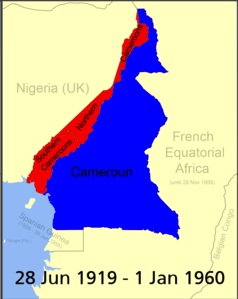
Map of Cameroon from 1919 to 1960, including both Cameroons (French in Blue, and British in red)
Map of Cameroon from 1919 to 1960, including both Cameroons (French in Blue, and British in red) – Ouandie was fighting for One Cameroon and its freedom from colonial powers

Martin Kapnang, retired communal agent, remembers the staging around Ouandié’s execution. “ We knew that they had arrested the rebel chiefs. The administration had brought people, even from surrounding villages, to watch the execution of rebels. But the conditions under which their trial had unfolded always seemed very confusing. Because as soon as the arrest of Ernest Ouandié and others had been announced, we knew that they will be executed even if the greatest attorneys in the world intervened in their favor.” [“Nous savions que l’on avait arrêté les chefs maquisards. L’administration avait fait venir les gens même des villages environnants pour voir comment on devait tuer les maquisards. Mais les conditions dans lesquelles leur procès s’était déroulé semblaient toujours floues. Car dès que l’on avait annoncé l’arrestation de Ernest Ouandié et autres on savait qu’ils devaient être exécutés même si les plus grands avocats du monde intervenaient en leur faveur.”]

As soon as the first salvo is fired, he shouts: “Long live Cameroon” and then falls to the ground. A European officer detaches himself from the group of spectators, walks toward the dying man, puts his hand on his holster, leans forward and shoots…
[cited in Jean Ziegler, Les Rebelles: Contre l´Ordre du Monde: Mouvements Armes de Liberation Nationale du Tiers Monde, Published 1983, Editions du Seuil ]

Why the Name: Windhoek?

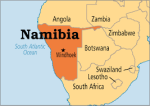
Nambia2Ever wondered what the name of the capital city of Namibia, Windhoek, mean? To me, thinking about the English beginning ‘Wind‘, I wonder if its name has something to do with wind, even though Namibia was never a British colony? However the end part ‘Hoek‘ does not sound English at all. Could the name be a European ‘deformation’ of a local name, the way Yaoundé or Abidjan are?
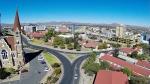
Windhoek_19eme siecle
Windhoek settlement at the end of the 1800s

Well, imagine my surprise when I found out that Windhoek stand for ‘wind-hoek‘ or “Wind Corner” in Afrikaans (Windhuk in German). Knowing that the country was a German colony, why will it have an Afrikaans’ name? The two languages being so close together, maybe the name was first German, and later on Afrikaans, given that the country fell under South African ‘administration’ after Germany lost first world war.  Well, it is said that the city was founded in 1844, by Captain Jonker Afrikaner who named it Windhoek after the Winterhoek Mountains at Tulbagh in South Africa, where his ancestors originated from.

Windhoek_2
Windhoek settlement at the end of the 1800s

In its history, the city of Windhoek has had at least 7 different names: “Aigams” for hot springs as named by the local nomadic Khoekhoe people; “Otjomuise” for the place of steam as named by the local Herero people; both names referring to the hot springs located near today’s city center. It was later named “Queen Adelaide’s Bath” by English explorers in 1836. Then it was named “Concordiaville” by Rhenish Missionaries. In 1840, it was named “Winterhoek” by Jonker Afrikaner and his group of Nama people who were emigrating from the Cape. It became “Windhuk” in 1890 with the German colonization of the country, and it has been “Windhoek” since 1920 under South African administration and has remained so after independence in 1990.

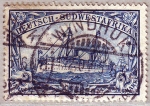
Windhoek_Stamp
Windhoek settlement at the end of the 1800s

Located in the Khomas Highland plateau area, in central Namibia, Windhoek stands at around 1700 m above sea level. It is the social, economic, political, industrial, and cultural center of the country. It is a bustling, growing city, and tourism is playing a big part in the city’s life as well. Enjoy the video below about Windhoek.


Why the name: Yaoundé?

Yaoundé around the May 20th Boulevard

Yaoundé, the capital of Cameroon and its second largest city after Douala, is often known as “the city with the seven hills” because of the hills surrounding it… but what does it really mean?  Does its name refer to its hills?

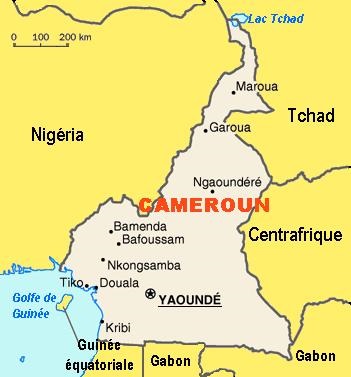
Map of Cameroon, with the capital Yaoundé

In Béti, Yaoundé is often called, Ongolo-Ewondo, or the Ewondos’ enclosure (la clôture des Ewondos).  The city was born around 1889, when the German traders implanted a camp in the Ewondo region and called it Sono station after a local Ewondo chief Essono Ela who had offered them hospitality (the Germans had encountered a strong resistance in the Vouté and Eton regions).  Hearing locals from the coast refer to it as Ya-Ewondo or Among the Ewondo (chez les Ewondos), the Germans called it ‘Jaunde’ and it later turned into ‘Yaunde’, and in French Yaoundé.  The station later turned into an administrative region under the leadership of the botanist Zenker who established a detailed map of the area in 1890.  Upon its creation, it was first a scientific post (probably because of the botanist), and later in 1895 became a military and trading post for ivory and rubber.

Yaoundé at night
Yaoundé at night

Yaoundé was not always the country’s capital.  After the 1909 volcanic eruption of Mt Cameroon in Buéa (Gbéa) which was then the capital, and the humid climate of Douala, the Germans decided to move the capital to Yaoundé because of its central location and its milder climate (and of course, no volcano).  After Germany’s defeat in World War I, Cameroon was placed under French (the eastern regions) and British protectorate (the western regions).  Yaoundé consequently became the capital of French Cameroon, and continued as the capital of the Republic of Cameroon after independence (it was first the Federal Republic of Cameroon in 1961, then The United Republic of Cameroon in 1972, which then officially became the Republic of Cameroon in 1984).  From 100 inhabitants on 2 acres on land at the end of the 19th century, Yaoundé is today a vibrant city home to almost 2 million inhabitants.

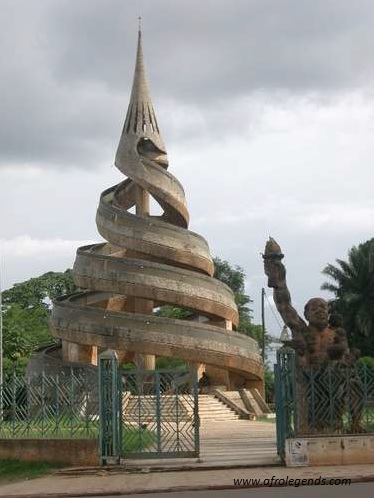
The Reunification Monument in Yaoundé

Yaoundé lies at the center of the nation, at about 600 – 1000 m above sea level.  The city first grew around the Mfoundi river.  A network of hills make up its landscape such as Mts Mbam Minkom (1295 m), Nkolodom (1221 m), Messa, Fébé, Akokdoué in the North and West, and Mt Eloumden (1159 m) in the south.  The rivers are the Mfoundi, Ekozoa, Biyeme, and Mefou.  Today, Yaoundé is the siege of power, the presidential palace, the house of parliament, all ministries and embassies. Please enjoy this song of one of Cameroon’s great singers: André-Marie Tala about Yaoundé, and its beauty.  What I have always liked about Yaoundé are its hills (and the red soil):  from the top of one them, other parts of the city can be seen; it gives a feeling of “breathing in” or “taking in” the beauty of the entire city.  Feel the joy of visiting this city which, like Rome has 7 hillsEnjoy the Rome of Africa!