
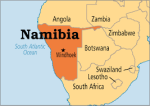
 Ever wondered what the name of the capital city of Namibia, Windhoek, mean? To me, thinking about the English beginning ‘Wind‘, I wonder if its name has something to do with wind, even though Namibia was never a British colony? However the end part ‘Hoek‘ does not sound English at all. Could the name be a European ‘deformation’ of a local name, the way Yaoundé or Abidjan are?
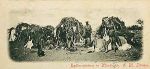
Well, imagine my surprise when I found out that Windhoek stand for ‘wind-hoek‘ or “Wind Corner” in Afrikaans (Windhuk in German). Knowing that the country was a German colony, why will it have an Afrikaans’ name? The two languages being so close together, maybe the name was first German, and later on Afrikaans, given that the country fell under South African ‘administration’ after Germany lost first world war. Well, it is said that the city was founded in 1844, by Captain Jonker Afrikaner who named it Windhoek after the Winterhoek Mountains at Tulbagh in South Africa, where his ancestors originated from.
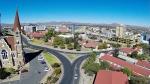
In its history, the city of Windhoek has had at least 7 different names: “Aigams” for hot springs as named by the local nomadic Khoekhoe people; “Otjomuise” for the place of steam as named by the local Herero people; both names referring to the hot springs located near today’s city center. It was later named “Queen Adelaide’s Bath” by English explorers in 1836. Then it was named “Concordiaville” by Rhenish Missionaries. In 1840, it was named “Winterhoek” by Jonker Afrikaner and his group of Nama people who were emigrating from the Cape. It became “Windhuk” in 1890 with the German colonization of the country, and it has been “Windhoek” since 1920 under South African administration and has remained so after independence in 1990.
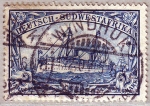
Located in the Khomas Highland plateau area, in central Namibia, Windhoek stands at around 1700 m above sea level. It is the social, economic, political, industrial, and cultural center of the country. It is a bustling, growing city, and tourism is playing a big part in the city’s life as well. Enjoy the video below about Windhoek.
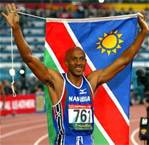
The athlete of the week is Frankie Fredericks: the handsome, good-looking, strong, fast, and powerful brother from Namibia. Yep that’s right, Frankie Fredericks is one of those athletes I loved watching in the 1990s. Always consistent, always strong, and everpresent, Frankie Fredericks was a force to reckon with. How many silver medals has he gotten while contending the 100 m and 200 m at the Olympics? 4 Silver medals! That’s right, an African with 4 silver olympic medals! He has also won several gold medals at the World Championships, World Indoor Championships, All-Africa Games, and Commonwealth Games. He is thus far Namibia’s only olympic medalist.
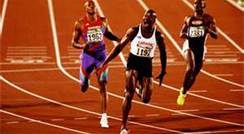
Born in Windhoek, Namibia’s capital, Frankie began running at the age of 13, and particularly loved football (soccer for Americans). However, when he was awarded a scholarship to attend Brigham Young University, in the USA in 1987, he quickly moved his passion to track and field. In 1991, as Namibia gained independence from South Africa, Frankie started officially compete for his country. At the Barcelona Olympics in 1992, Frankie Fredericks won 2 silver medals in 100 m and 200m, giving Namibia its very first olympic medal. In 1996 at the Atlanta Olympics, Frankie again won 2 silver medals coming 2nd to Donovan Bailey in the 100m, and 2nd to Michael Johnson in the 200 m. Due to injuries, Frankie was absent at Sydney Olympics in 2000, and Namibia dearly missed him there. He raced the 200m at the Athens Olympics in 2004, and came out 4th, and finally retired at the end of that year at the age of 37 (Imagine a 37 year-old sprinter coming 4th at the olympics, running against young folks like Shawn Crawford, Justin Gatlin, and Bernard Williams). At the beginning of that run in Athens, Frankie was given a standing ovation that lasted few minutes, and at the end, he said “It is quite emotional, … I always wanted to go out with a medal, but sometimes in life you don’t get everything you want.” Frankie has run the 100 m under 10 s more consistently than most athletes (he is ranked 4th behind Ato Boldon of Trinidad & Tobago, Maurice Greene of the US, and Asafa Powell of Jamaica).
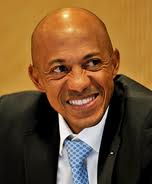
Off track, Frankie has a computer science degree and a masters of business administration, and he has created the Frank Fredericks Foundation to foster young Namibian athletes. In 2004, he was elected by fellow athletes to serve on the board of the International Olympic Committee. Please check out the tribute to Frankie Fredericks given by International Association of Athletics Federations IAAF athletics.
The personable and wildly popular Fredericks spent the greater part of a decade-and-a-half at the pinnacle of his craft, a record for longevity nearly unprecedented in the sprints. What was always fun about watching Frankie run was his consistency: Frankie was constant on the distance, and a very reliable athlete, training hard to represent his country and continent at the highest level. I am sure most people had never heard of the country Namibia, but when Frankie was running, the whole world could hear and feel Namibia rising!


 African Heritage