South African Lawyer Navi Pillay is 2026 Nobel Peace Prize Laureate

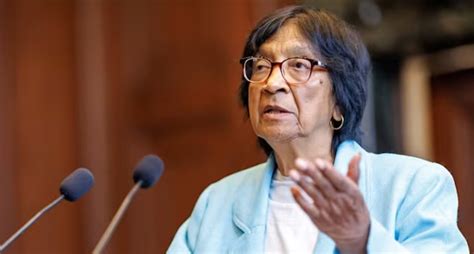
Navi Pillay (Source: inews.zoombangla.com)

This year, South African lawyer Navi Pillay is the 2026 Nobel Peace Prize laureate. She joins 4 other illustrious countrymen Nobel peace laureates, Albert Luthuli (1960 – first Black person to be win the award), Desmond Tutu (1984), Nelson Mandela (1993) joint with F. W. de Klerk (1993). This makes her the first South African woman to win the prestigious prize. She also joins other continental laureates such as Egyptian Anwar Sadat (1978), Ghanaian Kofi Annan (2001), Kenyan Wangari Maathai, first African Woman Nobel Peace Prize Laureate (2004), Egyptian Mohamed ElBaradei, Liberians Ellen Johnson Sirleaf (2011) and Leymah Gbowee (2011), Congolese Denis Mukwege (2018), and Abiy Ahmed (2019). As you can see she is only the fourth African woman to win the prestigious award. As a food for thought, isn’t it weird that a lot of these awards are given out just before the awardees start wars or something of the sort? … so not sure how much weight we should really put into them as ‘peace’ prizes, but the world still seems to praise these.
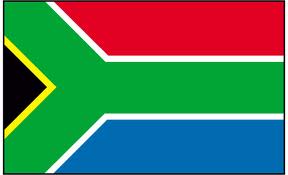
Flag of South Africa

Who is Navi Pillay? She is a South African of Tamil-Indian origin whose grandparents emigrated to South Africa, specifically to Durban at the turn of the 20th century to work on the sugar plantations. Her family established itself there, and she grew up in Durban during the apartheid era, later went on to study law at Harvard University in the United States, and went on to become the first woman of color to open a law firm in South Africa, during the apartheid era. She spent her early career defending activists who risked everything to challenge injustice at a time when injustice and the justice system in South Africa was viciously divided along color lines. Her work carried the same courage and clarity that would later define her global leadership. She built a reputation for judicial rigor and moral courage

She established herself not only at home in South Africa, but also beyond its borders. As a judge at the International Criminal Tribunal for Rwanda, she helped establish that sexual violence can be prosecuted as genocide. At the International Criminal Court at the Hague, she strengthened the foundations of accountability for mass atrocities. Later, as a United Nations High Commissioner for Human Rights, she insisted that human rights must remain central even when political winds shift. Today, she continues her work at the International Court of Justice (that instrument used by the ‘International Community’ to police the rest of the world to its advantage), serving as an ad hoc judge in cases involving genocide and crimes against humanity. Her career spans more than 50 years, consistently focused on holding perpetrators of mass atrocities accountable and expanding the reach of international law.

Pillay received the Nobel Peace Prize award in the historic Nuremberg courtroom; there she dedicated her award to survivors of international crimes. Her words reminded the world that peace is not simply the absence of conflict. Peace is the presence of accountability. Peace is the recognition of truth. Peace is the courage to confront harm and repair it. Peace is staying cool-headed in the face of adversity and discerning the good from the bad!

Navi Pillay’s achievement is a milestone for Africa. As we saw above, she joins a long list of illustrious Africans. Her achievement is also a milestone for women, particularly women in law, and for every person who believes in the power of justice. Her legacy continues to grow, and her work lights a path for future generations of lawyers, activists, and leaders who refuse to accept silence in the face of suffering.

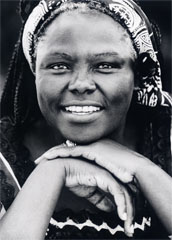
Wangari Maathai, first African Woman Nobel Peace Prize Laureate

Wangari Maathai
Wangari Maathai

I once took a class in environmental and social changes, where I studied the work of Dr. Wangari Maathai.  Her boldness and her stand for truth made her a great role model for many African women, and Africans in general.  She was bold! “Wangari Maathai was known to speak truth to power,” said John Githongo, an anticorruption campaigner in Kenya who was forced into exile for years for his own outspoken views.  “She blazed a trail in whatever she did, whether it was in the environment, politics, whatever.”  Indeed, Wangari Maathai was one of the most widely respected women on the continent, where she played many roles: environmentalist, politician, feminist, professor, human rights advocate, and head of the Green Belt Movement which she started in 1977. She was scoffed at by the Kenyan Forestry department who thought that uneducated women could not fight the desert.  She told them ‘We need millions of trees and you foresters are too few, you’ll never produce them. So you need to make everyone foresters.’ I call the women of the Green Belt Movement foresters without diplomas.”

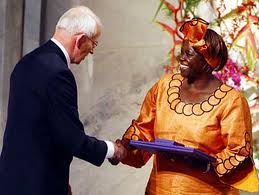
Wangari Maathai receiving the Nobel Peace Prize

As a star student after high school, she won a scholarship to study biology in Kansas (US), and went on for a Masters of Science at the University of Pittsburgh, and later a doctorate degree in veterinary anatomy at the University of Nairobi where she later taught and became chair of the department in the 1970s.  Wangari’s work started with the Green Belt Movement with the mission of planting trees across Kenya to fight erosion, stop desertification, create firewood for fuel, provide jobs for women, and empower the women of Kenya.  According to the United Nations’ data, her organization has planted over 45 million trees in Kenya, helped 900,000 women, and inspired similar projects in other African countries.  “Wangari Maathai was a force of nature,” said Achim Steiner, the executive director of the United Nations’ environmental program.  He likened her to Africa’s ubiquitous acacia trees, “strong in character and able to survive sometimes the harshest of conditions.”

Maathai planting a tree

Her work was illustrated in one of my secondary school English textbook.  The government of Arap Moi was trying to build a skyscraper in one of Nairobi’s only parks, and she brought women who protested until the government abandoned the project.  She was beaten by police until she fainted.  Wangari was not one to back down from her beliefs.  She would go to jail for what she believed in.  For instance, her husband divorced her because he said she was too strong-minded for a woman.  When she lost her case in court, she criticized the judge and told him her mind, and was thus thrown to jail.

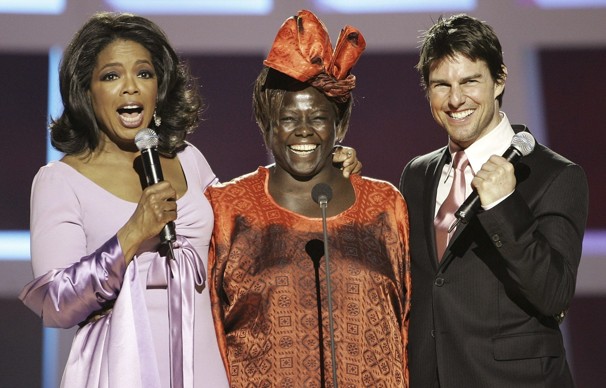
Oprah Winfrey and Tom Cruise congratulating Wangari Maathai on her Nobel Peace Prize

In presenting her with the Peace Prize, the Nobel committee hailed her for taking “a holistic approach to sustainable development that embraces democracy, human rights and women’s rights in particular” and for serving “as inspiration for many in the fight for democratic rights.”  Wangari Maathai has received many honorary degrees, including an honorary doctorate from the University of Pittsburg, her alma mater.  Check out articles by the BBC, CNN, her Interview on NPR, and the Huffington Post whose article is entitled “Wangari Maathai and the Real Work of Hope .”  Don’t forget to click also on the The Green Belt Movement website, and the movie “Taking Root: The Vision of Wangari Maathai.”   She once said that ‘we should all be hummingbirds‘: doers, and not spectators, even in the face of great challenges; do the best you can.  Goodbye Wangari, your work is not over, for Africa has been blessed with millions of Wangari Maathais who will continue your outstanding work.