Timbuktu under Attacks: Arise to save African Treasures

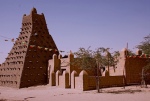
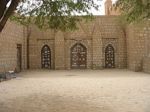
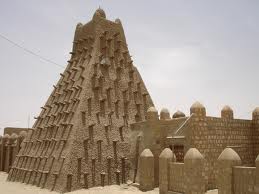
Sankore Mosque in Timbuktu

It is with horror that I watched and read about Timbuktu‘s desecration these past weeks, and I could not /would not stay silent as African treasures are being ransacked and destroyed.  Why would somebody destroy such a rich historical city?  Why would someone want to erase history?  Then I read the articles on BBC,  and they say that the destruction was conducted by muslim fundamentalists.  Seriously who do these media think we are?  Stupid?  Muslim fundamentalists?  Isn’t Timbuktu’s history linked to Islam?  Why on earth would somebody who loves and respects Islam destroy a place dear to his life?  It’s like saying that a catholic fanatic would want to destroy the Vatican or Jerusalem… really?  then they say these Muslim fundamentalists are from Northern Mali and are Touareg groups working to divide Mali.  See, again, BBC must really think that we are stupid or newborns.  How could a Malian, a Northerner, a Touareg, destroy his own home?  unless this group is not from Northern Mali…  unless this group is from somewhere else.  Remember Libya? there were foreigners attacking, and NATO, which destroyed the beautiful Libyan historic places: Sabratha and Leptis Magna … Remember that remains of Babylon were almost destroyed during the attacks of 2003?  Where are these stolen treasures today?  Please watch this video on Timbuktu and learn why any son of Africa should fight for its preservation.  There is over 10 centuries of history in Timbuktu, and it is our duty to save this place.  There are over 700,000 manuscripts saved in public libraries and private collections.  Check out this photojournal on BBC.  Enjoy and share!

Djenné: the mud brick (adobe) city

Djenné
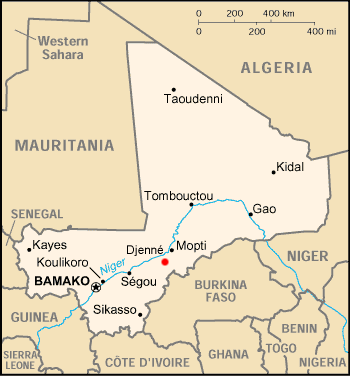
Map of Mali with Djenné

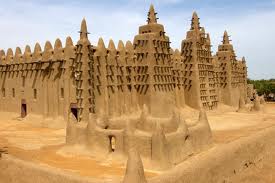
Djenné is a city of Mali whose history is closely linked to that of Timbuktu. It is well-renowned for its mud brick architecture, and today most of the city is considered a UNESCO World Heritage Site. In no place in the world do you have a civilization entirely built on mud! Maybe that is why Malians are so renowned for their work on mudcloth a.k.a. bogolan! The Djennenké say that nowhere in the world would you find people who can build in mud like Djenné’s masons: their work with mud is pure magic, as illustrated by the beautiful Great Mosque of Djenné. The masons’ family lines stretch back half a millenium! They mix the clay from the surrounding plains with the water from the Bani river, and bring to life an architecture purely from Djenné rising with splendor.

Great Mosque of Djenné

Djenné has fallen victim of time, erosion, and particularly rain which deteriorates the mud structure. Recently, as part of protecting this UNESCO world heritage, restoration started. For this process, Djenné masons divide up the work according to whose ancestors originally built the houses, the families that inhabit them, and themselves: dirt from old brick is reused only within the dwelling which it came from, since it is believed to carry a blessing which cannot be transferred; this is a practice whose roots date back to 250B.C.. Before the arrival of the French in 1900s, Djenné’s masons built using the technique of Djennefere or the art of building with cylindrical bricks, as opposed to rectangular bricks introduced by the French. Recently, a Malian-American team of archaeologists found in the base of wall fragments, from about A.D. 1400, of a type of bowl Djennenké still place in foundations for protection; another fragments with Arabic inscriptions dating back to A.D.

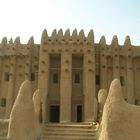
Great Mosque of Djenné
Entrance

1118. This is important, since before Djenné, there was Jenné-Jeno (before 200 B.C.), the “city without a citadel” which had no royal palace or ruler with an army, but was made up of different tribes or clans with different specialties which formed a sort of democracy where they came together to trade and decide community affairs. After 1100, Jenné-Jeno shrank, and by the 14th century, it felt and a new city, Djenné, grew from the trans-saharan trade in salt and gold. Djenné was later on invaded by Arab traders who introduced islam to the city. Later, Djenné was part of the great Mali Empire, the Songhai empire, the Ségou Kingdom, the Macina Empire, and the Toucouleur Empire. In essence, in Djenné, the old and the new merged, the mud from the earth grew, and the learning was passed on from generations to generations, making Djenné, the city built on mud rising from the splendors and knowledge of the past!

Map of Djenné
Map of Djenné

Both Djenné and Jenné-Jeno are UNESCO World heritage sites. You can learn about them on the UNESCO WHC website, as well as on Wikipedia, Architecture in Mali, and Djenne Patrimoine. Enjoy:

Timbuktu, one of the world’s first and oldest university

Timbuktu
Timbuktu

Oh wow… I always knew Timbuktu (Tombouctou in Mali) because of the story of the great emperor of the kingdom of Mali, Mansa Kankan Musa. I knew it was the center of his empire, but it is only lately that I realized that it was one of the world’s first and oldest thriving university! Students came from all over the world to study at Timbuktu. Imagine that, students from the middle east, and Europe coming to Africa to study! oooohhhh … Goodness Gracious, that sight only would make me proud! Well, to those who say Africa only has an oral tradition, go and check out the 700,000 manuscripts at the great Sankore University in Timbuktu, and tell me what you think! Oh la la…

In one documentary, the speaker mentions that they translated one of the manuscript on Algebra from Arabic to

Sankore University in Timbuktu

French, and sent it to France to be evaluated educationally; well, that manuscript revealed that the mathematics it contained was currently studied in 2nd year of university in France, and the speaker then says “and that was taught at universities in Timbuktu before the 16th century“!  Wow… my Goodness!

Timbuktu also houses some of the world’s oldest mud mosques, and every year the people of the city unite to re-do the walls of the mosque. It was added to the UNESCO world’s heritage list in 1988  (http://whc.unesco.org/en/list/119/).

Read about it on Wikipedia: http://en.wikipedia.org/wiki/Timbuktu