The “Greatest Active Playwright in the English-Speaking World”, South African Athol Fugard is no Longer

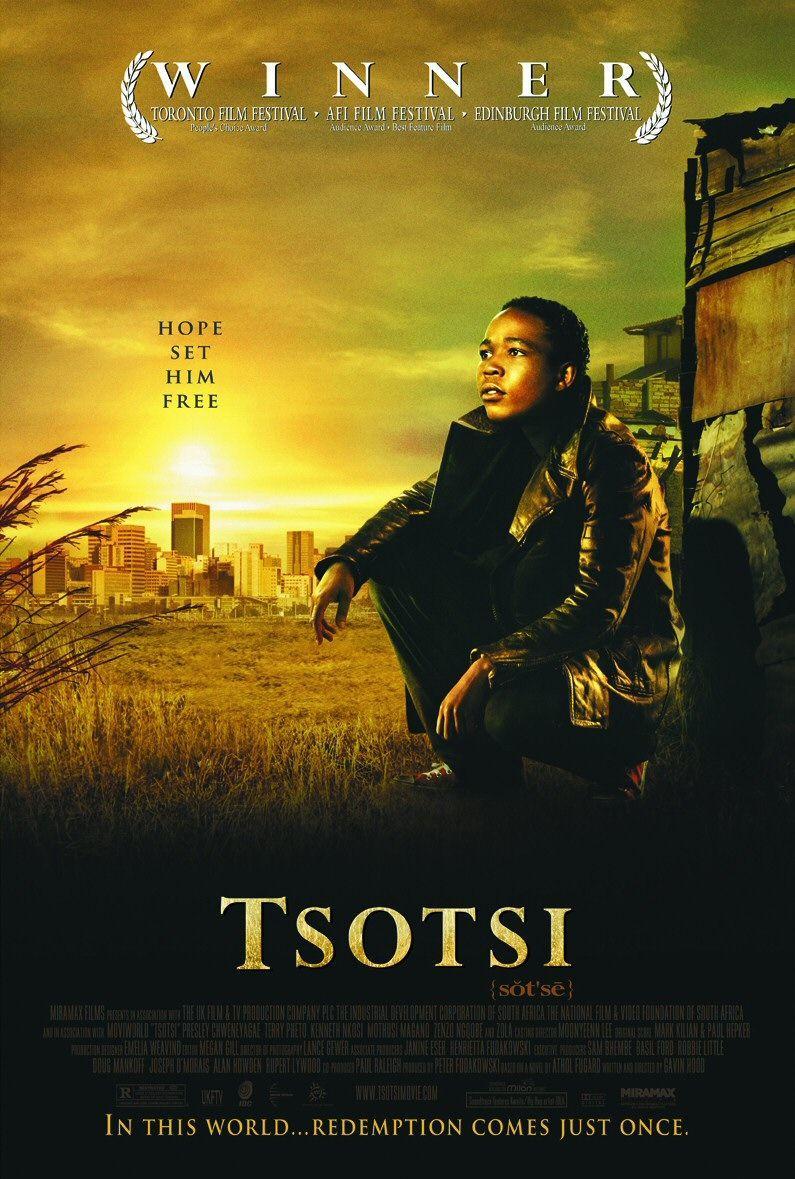
Theatrical poster of “Tsotsi”

Have you by any chance watched the South African movie “Tsotsi”? In 2006, it was the first South African film and first African film not made in French to win an Oscar for foreign language film and numerous international awards. It tells the story of a ruthless gang leader who steals a car, only to find a baby in the back seat. The movie is based off the novel by the same name “Tsotsi” by South African playwright, novelist, actor, and director widely regarded as South Africa’s greatest playwright Athol Fugard.

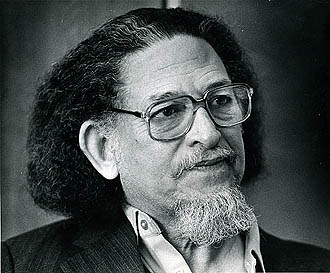
This past Saturday, Athol Fugard, who in 1985 was acclaimed as “the greatest active playwright in the English-speaking world” by Time, passed away at the age of 92. His work confronted apartheid and spanned over 7 decades with over 30 playwrights. He was a critic of apartheid and very early broke the rules and included all as in his 1961 breakthrough play, Blood Knot, which featured for the first time in South African history a black and white actor played by Fugard himself, and was played in front of a multiracial audience. 

Excerpts below are from the BBC. Enjoy!

=====
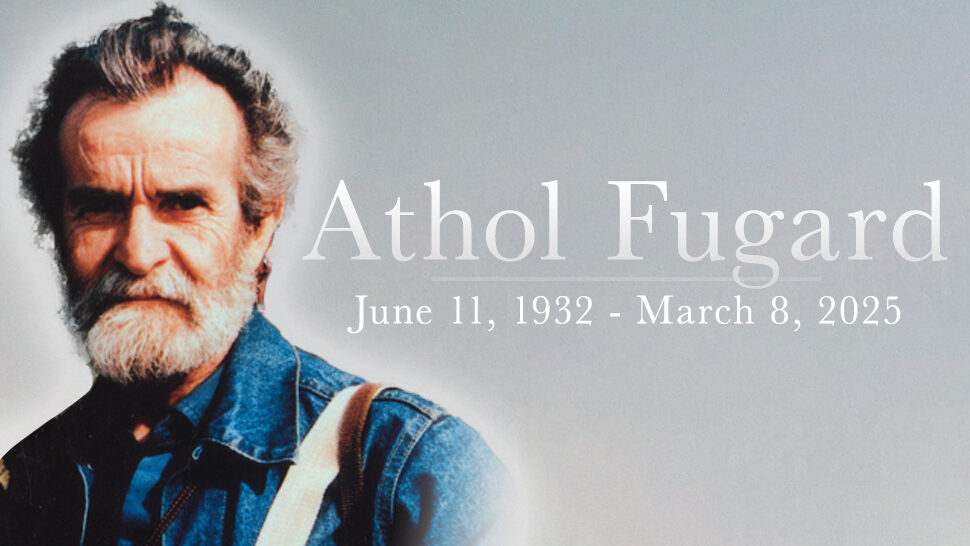
Athol Fugard (Source: Playbill.com)

Athol Fugard, who has died aged 92, was widely acclaimed as one of South Africa’s greatest playwrights.

The son of an Afrikaner mother, he was best known for his politically charged plays challenging the racist system of apartheid.

… Fugard wrote more than 30 plays in a career that spanned 70 years, making his mark with The Blood Knot in 1961. It was the first play in South Africa with a black and white actor – Fugard himself – performing in a front of a multiracial audience, before the apartheid regime introduced laws prohibiting mixed casts and audiences. The Blood Knot catapulted Fugard onto the international stage – with the play shown in the US, and adapted for British television. The apartheid regime later confiscated his passport, but it strengthened Fugard’s resolve to keep breaking racial barriers and exposing the injustices of apartheid. He went on to work with the Serpent Players, a group of black actors, and performed in black townships, despite harassment from the apartheid regime’s security forces.

Fugard’s celebrated plays included Boesman and Lena, which looked at the difficult circumstances of a mixed-race couple. Having premiered in 1969, it was made into a film in 2000 starring Danny Glover and Angela Bassett.
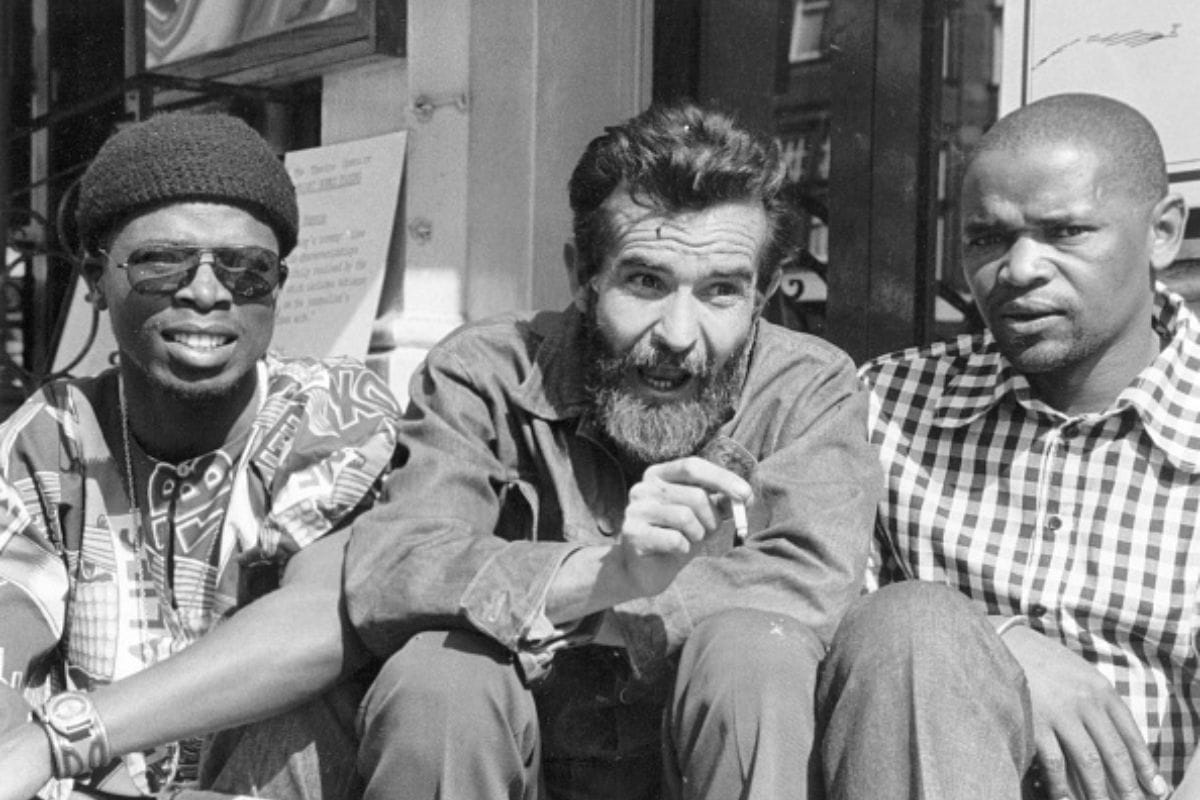
John Kani (left), Athol Fugard (center) and Winston Ntshona at the Royal Court Theatre in 1973. Picture: Evening Standard/Getty Images

His novel, Tsotsi, was also made into a film, winning the 2006 Oscar for best foreign language movie.

… Other well-known plays by Fugard include Sizwe Banzi Is Dead and The Island, which he co-wrote with the actors John Kani and Winston Ntshona, in a powerful condemnation of life on Robben Island, where anti-apartheid icon Nelson Mandela was imprisoned.

… Fugard won several awards for his work, and received a lifetime achievement honour at the prestigious Tony awards in 2011, while Time magazine described him in 1985 as the greatest active playwright in the English-speaking world.

Apartheid defined me, that is true… But I am proud of the work that came out of it, that carries my name,” Fugard told the AFP news agency in 1995.

“Hopes for a Better World” by Dennis Brutus

Dennis Brutus (Source: Sahistory.org.za)

I found this poem by the great South African writer, activist, educator, journalist, and poet, Dennis Brutus, “Hopes for a better world.” I found it quite appropriate in these times. Dennis Brutus is known as one of the most prolific South African writers. Born in then Southern Rhodesia (now Zimbabwe), Brutus grew up in Port Elizabeth (Gqeberha) where he was classified as “coloured” under South African apartheid codes. He was an activist against the apartheid government of South Africa in the 1950s and 1960s, best known for his campaign to have South Africa banned from the Olympic Games due to its institutionalized segregation system of apartheid. He is among Africa’s greatest and most influential modern poets.

This poem, “Hopes for a better world” was written on a trip from Caracas, Venezuela, to Durban, South Africa. At the beginning of the poem, Brutus stated, “There are lively political struggles in our time, particularly in Venezuela, Ecuador and Bolivia.” The poem is really about the outlook one has on life, the wish for simple joys, and the hope that something good will come. It highlights simple needs: the joys that come from a smile, the appreciation of frankness, openness, and friendliness.

=====

Hope

Hopes for a better world” by Dennis Brutus

Walking those ragged, pitted sidewalks

where walkers, shoppers surged

one had a sense of buoyant hope

surges of confidence, unleashed desire:

the broad-grinned ice cream vendor

frank gazed waitress swabbing spills:

all had a friendliness and trust:

it was good to walk those cordial streets

companioned by one striving to serve

Caracas to Durban, 2008-09, for p.b.

Nadine Gordimer: South African First Literature Nobel is no Longer

Flag of South Africa

Few countries in the world, apart from European and American (as if writing was only part of the western world) countries, can claim several Nobel prizes in literature. South Africa is one of those countries: with Nadine Gordimer and J.M. Coetzee.

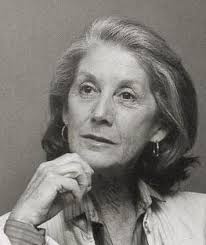
The South African Nobel-prize-winning author Nadine Gordimer, one of the literary world’s most powerful voices against apartheid, died today at the age of 90. She passed away peacefully at her home in Johannesburg. She was the first winner of this prize for South Africa.

Nadine Gordimer
Nadine Gordimer

Born in Gauteng, South Africa, in 1923 to immigrant European parents, Gordimer was awarded the Nobel prize for literature in 1991 for novels and short stories that reflected the drama of human life and emotion in a society warped by decades of white-minority rule.

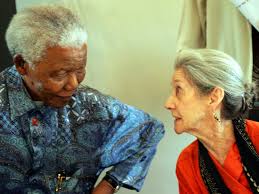
Many of her stories dealt with the themes of love, hate and friendship under the pressures of the racially segregated system that ended in 1994, when Nelson Mandela became South Africa’s first black president.  She became active in the then banned African National Congress (ANC) after the arrest of her best friend Bettie du Toit in 1960, and the Sharpeville Massacre on 21 March 1960.  Thereafter, she was a close friends with Mandela’s defense attorneys (Bram Fischer and George Bizos) during his 1962 trial; she actually helped Mandela edit his famous speech I am prepared to die. She was one of the first people president Mandela asked to see after his release from prison in 1990.

Nadine Gordimer and President Nelson Mandela

She was called one of the great “guerrillas of the imagination” by the poet Seamus Heaney, and a “magnificent epic writer” by the Nobel committee.  Her intense, intimate prose helped expose apartheid to a global readership and continued to illuminate the brutality and beauty of her country long after the demise of the racist government.  “She makes visible the extremely complicated and utterly inhuman living conditions in the world of racial segregation,” Sture Allen, permanent secretary of the Swedish Academy, said while awarding Ms. Gordimer the Nobel Prize for literature in 1991. “In this way, artistry and morality fuse.”

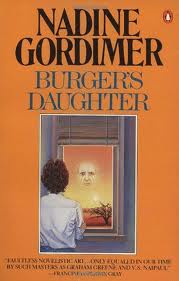
"Burger's Daughter" by Nadine Gordimer
“Burger’s Daughter” by Nadine Gordimer

She had three books banned under the apartheid regime’s censorship laws, along with an anthology of poetry by black South African writers that she collected and had published.  The first book to be banned was ‘A World of Strangers,’ the story of an apolitical Briton drifting into friendships with black South Africans in segregated Johannesburg in the 1950s.  In 1979 Burger’s Daughter was banished from the shelves for its portrayal of a woman’s attempt to establish her own identity after her father’s death in jail makes him a political hero.

I never read any of her work, and now plan to start.  Thank you to Nadine Gordimer for her brightness, and for her endless fight for freedom through her works.

‘Love Poem for my Country’ by Sandile Dikeni

An antelope at dusk
An antelope at dusk in the African Savannah

In the past I have always wished that we, Africans, could be patriotic.  I came across this beautiful poem ‘Love poem for my country‘ by South African writer Sandile Dikeni.  I really enjoy the way the author describes his country, the valleys, the birds, the ancient rivers, and its beauty.  He feels the peace, the wealth, and the health his country brings.  He is one with his country.  He is at home!  His country is not just words or food, or friends, or family, it is more, it is his essence!  That is true patriotism, the bond that links us to the bone to our motherland.  Enjoy!

My country is for love
so say its valleys
where ancient rivers flow
the full circle of life
under the proud eye of birds
adorning the sky.

My country is for peace
so says the veld
where reptiles caress
its surface
with elegant motions
glittering in their pride

My country
is for joy
so talk the mountains
with baboons
hopping from boulder to boulder
in the majestic delight
of cliffs and peaks

My country
is for health and wealth
see the blue of the sea
and beneath
the jewels of fish
deep under the bowels of soil
hear
the golden voice
of a miner’s praise
for my country

My country
is for unity
feel the millions
see their passion
their hands are joined together
there is hope in their eyes

we shall celebrate

by Sandile Dikeni