How Puppet Regimes are Built : 3 Consequences

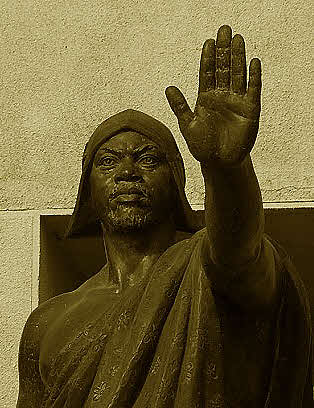
Statue of Behanzin in Abomey, Benin

Today, we will continue our discussion on “How Puppet Regimes are Built.” We will focus on African regimes, particularly those installed in Francophone Africa, regimes inherited from the colonial era. We all remember how King Behanzin, Prempeh ISamori Toure, and countless others were replaced by docile and easy to manipulate puppets serving France. This is still ongoing, and can explain those ridiculous laws or rules, or even election numbers made by these horrible puppets today: Sassou Nguesso, Paul Biya, Alassane Ouattara, to name just a few. Given that their authorities are not based on the sacred laws of the countries, but are rather backed by foreign powers and their guns, they do not fear to strangle their people for decades. A century later, the modus operandi of the puppets installed yesterday during slavery times and today during ‘independence’ has not changed

“Quand l’Africain était l’or noir de l’Europe” de Bwemba Bong

Below are the consequences of building puppet regimes, as detailed by Pr. Bwemba Bong in his book “Quand l’Africain était l’or noir de l’Europe. L’Afrique: Actrice ou Victime de la Traite des Noirs? – Démontage des mensonges et de la falsification de l’histoire de l’hydre des razzias négrières transatlantiques” (When the African was the black gold of Europe. Africa: Actress or Victim of the Slave Trade ? – Dismantling the lies and falsification of the hydra history of the transatlantic Slave Raids),” MedouNeter 2022, p. 170 (translated to English by Dr. Y, Afrolegends.com). In his section titled “The transformation of the administrators of the so-called French-speaking colonial Black Africa into anti-African, ethnic ogres and terrorists”, he explains so well :

… The slave-trading origins of the power held by “African political leaders” have entailed three notable consequences:

    1. It has undermined the sacred foundations of authority in Black Africa, for that authority “ceases to derive its legitimacy from a reference to ancient sacred procedures. It no longer appears to have received its sole consecration from the Ancestors, from divinities, or from the ritual forces associated with every manifestation of authority. This phenomenon is further accentuated by the fact that missionary activity creates a religious diversity that fractures the spiritual unity of which the sovereign or the chiefs serve as symbols. At the same time, it contributes to a secularization of authority,” writes Georges Balandier [in Le contexte sociologique de la vie politique en Afrique noire, dans Revue française de science politique, 1959, p.604-605].
    2. Traditional checks and balances have been destroyed: the Council of Elders, in particular, vanished due to the control exerted by European slave traders. Consequently, punishable abuses—even those that were effectively sanctioned—were no longer, and are no longer, curbed in accordance with the interests of the group. Georges Balandier characterizes this phenomenon as a “rupture of traditional systems for limiting power,” a rupture he describes in these terms: “sovereigns wield a more arbitrary power, albeit one that is more circumscribed, and the consolidation of power matters more than the acquiescence of the governed. The latter, conversely, may attempt to appeal to the foreign administration in order to oppose certain decisions made by traditional authorities. On both sides, the relationship is distorted, and mutual obligations no longer appear clearly defined.”
    3. By the grace of the occupying power, delinquent slave-broker intermediaries [western puppets in Africa] had become, and remain to this day, the replacements for legitimate traditional authorities. This status, bolstered by the perverted prerogatives inherited from their European creators, enabled them then, as it does now, to assume the responsibilities of tax collectors, census takers, administrators, and the like. It also empowered these “chiefs” to requisition populations for forced labor, the construction of bridges and roads, and other such tasks. The overwhelming majority of these “chiefs” were remunerated by the slave system in their capacity as public agents.

Strategies to Destabilize a Country : the Case of Guinea

Sekou Toure, Cover Time Magazine, Feb. 16, 1959

The Guinea of Sekou Toure was the first country to say ‘NO’ to the General de Gaulle. Sekou Touré, proud descendent of one of the great African leaders who fought colonialism, Samori Touré, said, on 25 August 1958, Sekou Touré said: “Il n’ya pas de dignité sans liberté. Nous préférons la liberté dans la pauvreté à la richesse dans l’esclavage.” [There is no dignity without freedom. We prefer freedom in poverty to wealth in slavery].

After Sekou Toure said ‘No‘, De Gaulle did not take it lightly and reacted harshly to crush the new Guinean state, and ensure that no other African countries followed the Guinean example.  The Washington Post back then, observed how brutal the French were in tearing down all what they thought was their contributions to Guinea: “In reaction, and as a warning to other French-speaking territories, the French pulled out of Guinea over a two-month period, taking everything they could with them. They unscrewed light bulbs, removed plans for sewage pipelines in Conakry, the capital, and even burned medicines rather than leave them for the Guineans.” Imagine that, they unscrewed light bulbs! It is said that they even poured cement on water pipes!… the French reacted like a really angry boyfriend who had been thrown out.

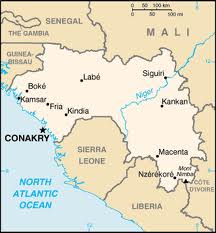
Guinea-Conakry
Guinea-Conakry

Maurice Robert, head of the African cell for the Service de documentation extérieure et de contre-espionnage (SDECE), France‘s external intelligence agency from 6 November 1944 to 2 April 1982 said in an interview, « Nous devions déstabiliser Sékou Touré, le rendre vulnérable, impopulaire et faciliter la prise du pouvoir par l’opposition. Une opération de cette envergure comporte plusieurs phases : le recueil et l’analyse des renseignements, l’élaboration d’un plan d’action à partir de ces renseignements, l’étude et la mise en place des moyens logistiques, l’adoption de mesures pour la réalisation du plan. Avec l’aide d’exilés guinéens réfugiés au Sénégal, nous avons aussi organisé des maquis d’opposition dans le Fouta-Djalon. L’encadrement était assuré par des experts français en opérations clandestines. Nous avons armé et entraîné ces opposants guinéens pour qu’ils développent un climat d’insécurité en Guinée et, si possible, qu’ils renversent Sékou Touré. Parmi ces actions de déstabilisation, je peux citer l’opération Persil, par exemple, qui a consisté à introduire dans le pays une grande quantité de faux billets de banque guinéens dans le but de déséquilibrer l’économie. » [“We had to destabilize Sékou Touré, make him vulnerable, unpopular and facilitate the seizure of power by the opposition. An operation of this scale involves several phases: the collection and analysis of information, the development of an action plan based on this information, the study and implementation of logistical means, the adoption of measures to implement the plan. With the help of Guinean exiles who had taken refuge in Senegal, we also organized opposition groups in Fouta-Djallon. Supervision was provided by French experts in clandestine operations. We have armed and trained these Guinean opponents so that they develop a climate of insecurity in Guinea and, if possible, overthrow Sékou Touré. Among these destabilizing actions, I can cite Operation Persil, for example, which consisted of introducing a large quantity of counterfeit Guinean banknotes into the country with the aim of unbalancing the economy.”]

Flag of Guinea

Thus, the strategies to destabilize Guinea were, among others, 1) Make Sekou Toure weak and impopular by financing and arming his opponents; 2) using exiled Guineans in neighboring Senegal, training them militarily to create zones of insecurities in the country to eventually topple off Sekou Toure’s government; 3) economically weaken the country by using fake currency.

There are numerous examples of how these strategies were used in recent years: in Cote d’Ivoire during the presidency of Laurent Gbagbo with the armed rebellion financed from external forces, terrorist forces’ attacks in the AES countries, and much more…