The western media have been pouring vitriol against African leaders who stand for justice, and equality for their people. In recent years, the web of lies they have woven against the leaders of the AES has been quite thick. However, it is nothing new: we just have to travel down memory lane to the days of Sekou Touré of Guinea, Kwame Nkrumah of Ghana, Amilcar Cabral of Cabo Verde and Guinea Bissau, Patrice Lumumba of Congo, Thomas Sankara of Burkina Faso, Laurent Gbagbo of Cote d’Ivoire, and more recently John Magufuli of Tanzania, or Pierre Nkurunziza of Burundi, it is nothing new. In some countries, many of the independence leaders have seen their names and struggles erased from the history books, to be replaced by these lies.
In his book The Assassination of Lumumba, Ludo de Witte details on page 12,that in 1961, at the height of the Congolese crisis, the media of those days used the usual techniques:
The Assassination of Lumumba by Ludo De Witte
Faced with unconstitutional secessions which eroded the very foundations of the state, Lumumba’s government found itself forced to take measures against the press organs that openly sided with the coup leaders. The Belgian press took this as an opportunity to launch even harsher attacks on the Congolese government. From Leopoldville, Manu Ruys entitled an article: “Lumumba Restricts Press Freedom”. New blended imperceptibly into a call to arms againt the Congolese government: “Prime Minister Lumumba’s brutal condemnation of federalism [in fact secessions!] … We are in a police state where the future is no longer secure. “
Don’t these words sound familiar? Just a month ago, the German DW titled Sahel juntas are ‘crushing’ basic freedoms. In February, it was Humans Rights Watch which was saying that the Military Juntas continue their repression… Yet the same media are silent about the repression in other places with docile puppets. The examples are countless, and one thing is certain: History repeats itself! The question is… are we going to be awake or remain asleep while they lie about our leaders?
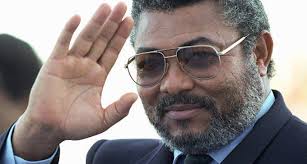
President Jerry Rawlings of Ghana (Source: thecable.ng)
Well, 2020 has been quite a year… when 2020 started, nobody could have told me that there would be a “global pandemic” and I would have believed it, that there will be a confinement and I would have believed, that people will be having “virtual parties” and I would have believed, or that people would have been walking around faceless i.e. masked and I would have believed. What a year! For sure, 2020 is going out, and there will be no other 2020. So let us remember 2020 in Africa, and remember the people, situations, and more that we said goodbye to.
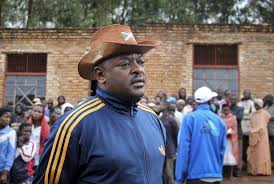
Pierre Nkurunziza during a community event (Source: PressHerald.com)
President J.J. Rawlings, former President of Ghana joined his ancestors this past November. The Ghanaian president J.J. Rawlings has a strong place in history as an influential, courageous, tough-talking, bold, impactful leader and charismatic Statesman who left deep impressions on the political landscapes of his country and, indeed, Africa.Just like the Ghana of today owes a lot to Kwame Nkrumah the father of its independence, the Ghana of today owes a lot to J.J. Rawlings, the father of its economic stability and face-lift. There were a lot of tributes, and I found so much similarities between the words of Rawlings and some that I have echoed here on his blog, J.J. Rawlings in His Own Words: African Identity, Betrayal, and More.
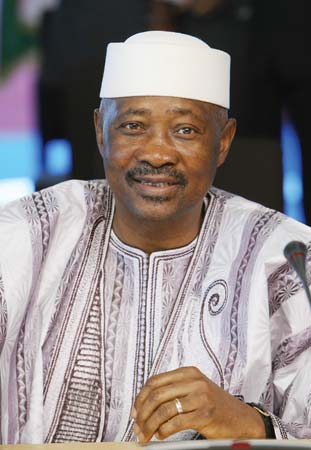
The soldier of democracy, the former president of Mali, Amadou Toumani Toure (ATT), also changed plane this year: GoodBye to Amadou Toumani Touré (ATT) -Former President of Mali. As I said earlier, this was a man of integrity! Some may call him a realist. When then president Traoré asked the army to keep firing at the Malian people, he stood up and said ‘NO’. He took power, and steered the country towards its first democratic elections. Then he stepped down. Later, he won the presidential election with a coalition, and served 2 terms. When in 2012 there was a coup against him, he resigned, and left the office. Others in Africa should copy a page from ATT’s book.
This year we said goodbye to Mory Kante : the Electrifying Griot from Guinea. Often known as the “electronic griot” because he modernized local traditional instruments such as his kora which he electrified, and fused African music with styles and instruments from Western pop. His 1987 hit “Ye Ke Ye Ke” is a hit I still dance to. If you ever come across a kora, or listen to Ye Ke Ye Ke remember the electrifying griot Mory Kante and the great musical century-long traditions dating back to the Ghana Empire, Ancient Kingdom of Africa.
Zindzi Mandela (Source: Timeslive.co.za)
In July, Zindzi Mandela: the daughter of Nelson and Winnie Mandela passed away. As well, as being remembered by her family and loved ones, the world remembers her as the young woman who read Nelson Mandela‘s letter of rejection in 1985. Reading that letter required a lot of courage, determination and strength to defy the apartheid regime and stand in front of a full stadium thirsty for words of encouragement, and hope from their leaders to keep facing the injustices of an inhumane regime.
This past November as well, Mamadou Tandja, the former President of Niger changed his plane of existence. Did you know that France’s nuclear power is funded by the uranium of Niger? and that Niger gets nothing for it? Tandja was the president who asked that the French nuclear company Areva start to pay something to Niger. During his terms, the relationship with Areva, which had enjoyed a de facto four decade monopoly in the country, worsened as he sought to curb the power of French influence by striking a deal with Sino-U in 2007 to develop a uranium mine, resulting in competition for Areva. As you can guess, he was deposed in a coup. Remember The 11 Components of the French Colonial Tax in Africa which gives France monopole over riches, mines, in a country? So long brother!
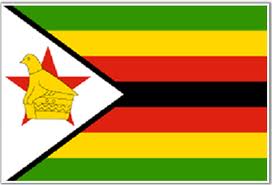
In September, common sense left the government of Zimbabwe, when it decided to compensate white farmers the hefty sum of 3.5 billion dollars… within 12 months, when the country is currently on life support and there is no money in its coffers [Is Zimbabwe the New Haiti?]! This is outrageous! When the economy is in shambles, how can the government agree to this? Did these white farmers ever compensate the Africans after independence in 1980 for using their lands for a century, for abusing them off their lands? And for all the years of economic embargo forced on the country? Then in September, Zimbabwe agreed to return seized land to foreigners. What is funny is that the government has been doing this in hopes of having the embargo removed, but the country is still under serious economic embargoes. Don’t they learn from history? Zimbabwe is indeed the new Haiti!
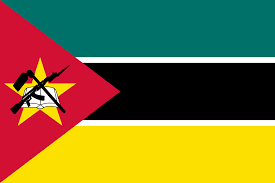
Flag of Mozambique
Peace in northern Mozambique seems to have become evasive, ever since that 15 billion dollars contract with the French firm Total for the oil in Cabo Delgado, and the discovery of one of the largest oil, diamonds, rubies in the world there. Tell me it is not connected? Now they want us to believe that there is islamist insurgency in Mozambique of all places!… And now Pope Francis has money to help the people and children of Mozambique who have been displaced by conflict! … Why did the Vatican not help the government of Samora Machel back then? why the people of Mozambique? Those diamonds and riches are really Africa’s downfall! Just a look at the banks financing the project reminds you of the Berlin conference of 1884 [Selection from the 1885 Berlin Conference Final Act]: 19 commercial bank facilities among which UK Export Finance (UKEF), the Export Import Bank of the United States, Italy’s SACE, the Netherlands’ Atradius, the Export Credit Insurance Corporation of South Africa, Japan Bank for International Cooperation, Nippon Export and Investment Insurance, and the Export-Import Bank of Thailand [Reuters].
Pierre Nkurunziza during a community event (Source: PressHerald.com)
Given all the negative rhetoric played by the foreign media, I thought it will be good to remind all of Pierre Nkurunziza‘s achievements. I will focus mostly on his work within his country of Burundi. As we saw earlier, internationally he helped broker peace in Somalia.
A popular president
A president in office doing manual work, taking part in soccer games, had never been seen before. This president, Pierre Nkurunziza, was not a “traditional” president in his white marble castle, but was seen rather as a simple man, a man of the people, a man like the people he served. He was seen cycling, and taking part in community work. He was also an avid soccer player and lover; he owned a soccer team and trained them.
Some children
Free education and health
During his investiture, some of his first adopted measures were free primary school education (i.e. from Kindergarten through 6th grade), free childbirth, and free health for all children under 5. This might not be seen as much, but in a poor country such as Burundi, free primary school education definitely increases the literacy of the people and offers parents very needed help. Similarly, free health services for women during childbirth, and for children under 5 is a tremendous help. This is an achievement not seen in many places in the world, not even in Western countries.
A religious president
Nkurunziza was not afraid to show his faith. He was deeply religious. For each public event, or manual work, prayers were said at the beginning and at the end of these events. This led him to put God first in the constitution of the country, as well as establishing a day of national solidarity.
Flag of Burundi
A Patriot
He deeply loved his country Burundi and his people. He pushed for ancient local cultures and values long forgotten to be re-instated and taught in schools. He established the national day of the commune which is celebrated in the old fashion.
The works
During his tenure, from 2007 to 2014,5200 schools were built, compared to 1900 schools from 1962 to 2007. Several roads were asphalted and created RN12, RN13, RN15, RN18, RN19, … Hospitals and community universities, classrooms, stadiums, modern markets, including the new Ntare Rushatsi presidential palace were erected.
Most importantly, he is the first president of Burundi to have ruled the country without a civil war.
So long Pierre Nkurunziza: we, the people, salute your patriotism, love of your country, and people. You will be remembered for your great achievements.
This past Monday, the relatively young (55 years-old) president of Burundi, Pierre Nkurunziza, died of a heart attack. It deeply saddened me. Why? Because of what he stood for, and his will to give decency to his own people or rather to govern his country without foreign involvement in their affairs. Pierre Nkurunziza was the first president of Burundi to have ruled without civil war.
With this global ‘pandemic,’ It has finally been understood that whatever the West calls democracy is not really democracy, but rather the government of the entirepopulation by a few. In the past, people have said that Pierre Nkurunziza was not a democrat and was holding onto power. Yet… he had been in power 15 years due to step down in August, and I did not hear the West complain about his neighbor Kagame in power for over 20 years. It is as if democracy is a word or rather a card pulled out of a bucket by Western powers to threaten those who prefer to do the bidding of the people rather than their bidding.
Flag of Burundi
Given that he had asked the UN to get out of his country last year, and then last month the WHO, and was one of the few countries to get out of the WHO because of their compromising and virulent tendencies in his country… is it a surprise that he died so suddenly?
Nobody talks about his achievements. What were Pierre Nkurunziza’s achievements?
Upon assuming office in 2005, Nkurunziza faced the significant challenges of maintaining peace and stability in the country, as well as rebuilding its war-battered economy. Burundi was emerging from over 10 years of civil war and unrest when he took over.
He united the country and brought in peace, during his first 10 years.
He rebuilt the infrastructures of his country, and oversaw the disarmament of several armed groups in Burundi.
He helped foster peace in the region: in 2007, he sent troops to Somalia as part of an African Union peacekeeping mission to prevent al-Shabab, an al-Qaeda-linked armed group, from overrunning the Horn of Africa country’s government.
Pierre Nkurunziza was an avid footballer (Source: Al-Jazeera)
The East African Community, a regional bloc, said in a statement: “Nkurunziza’s contribution to the re-establishment of constitutional order, peace, ethnic tranquility, rights and equality for all since his ascendancy to power in 2005 in Burundi cannot be overemphasised.”
“His commitment to security and rights for all irrespective of social, ethnic, religious or political background remains a beacon on which Burundians can build on to further their development objectives,” it added.
In 2015, Nkurunziza made the controversial decision to seek a third term in office. A coup was launched in May 2015 while Nkurunziza was abroad, but it was swiftly foiled. Despite several delays, an opposition boycott, and ‘international’ pressure (we know what that means), polls were held and Nkurunziza won a third term. After the 2015 elections, the situation took a turn for the worse, when donors cut off funding and placed sanctions on Burundi (similar to Côte d’Ivoire when France was bombing it in 2010, or Libya with the NATO coalition in 2011, or Zimbabwe). History repeats itself, we now know that when a country is placed under ‘international’ sanctions, it is usually because the leader might be serving his people.
In 2017, Nkurunziza formally withdrew Burundi from the International Criminal Court (ICC) – the first country to do so – amid accusations the court was focusing too much on the continent. Every African country should withdraw from that sham called ICC which only prosecutes African (Black) leaders. Later the UN left (remember ONUCI taking sides in Côte d’Ivoire?), and BBC and VOA were kicked out of the country for inciting violence, and spreading false news.
Burundi basket
In the streets of Bujumbura, “some residents said they would remember the former leader [avid football player], a born-again Christian known for his preaching, for the good things he did for their country.”
“I will remember him for the advice he gave us. He always told us to love our country. He always put God first and someone who does that will not face hardships in life,” Achel Niyongere told Al Jazeera.
Patrick Harakandi added: “He is the first president to govern Burundi until he finished his term. He made history. He ruled Burundi for 15 years without a civil war.” (Al Jazeera)





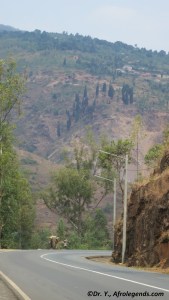 During his tenure, from


 African Heritage