UPC Leaders (L. to R.) front row: Castor Osende Afana, Abel Kingué, Ruben Um Nyobé, Felix Moumié, and Ernest Ouandié
After my article on one of Africa’s greatest freedom fighter, the Cameroonian leader, Ruben Um Nyobé, I thought that this small rare video with pictures of Um Nyobé would be very fit to add to our knowledge. Ruben Um Nyobé with the UPC in 1948 were the first in Africa to ask for the independence of their country, Cameroon. He was murdered by the French colonial administration, and his story was totally buried for many years: it was as if he had had no impact on the lives of Cameroonians, and Africans as a whole. It is just amazing to realize that, 50 years later, he had spoken at the United Nations tribune three times for the independence and reunification of Cameroon in 1952, 1953, and 1954. It is amazing to think that in Cameroon, there was someone of the caliber of N’Krumah, Lumumba, and Nyerere… Yes… Ruben Um Nyobé’s place should be at the Pantheon (if it existed) of African legends. Enjoy!!!
Today, we will do a Memory recall… Please enjoy this great independence speech delivered by Patrice Lumumba in 1960 to the people of Congo, few months before his assassination. It is a pure jewel! The French version is here →LUMUMBA discours. Don’t forget to watch the video!!!
——————-
Men and women of the Congo,
Victorious fighters for independence, today victorious, I greet you in the name of the Congolese Government. All of you, my friends, who have fought tirelessly at our sides, I ask you to make this June 30, 1960, an illustrious date that you will keep indelibly engraved in your hearts, a date of significance of which you will teach to your children, so that they will make known to their sons and to their grandchildren the glorious history of our fight for liberty.
For this independence of the Congo, even as it is celebrated today with Belgium, a friendly country with whom we deal as equal to equal, no Congolese worthy of the name will ever be able to forget that is was by fighting that it has been won, a day-to-day fight, an ardent and idealistic fight, a fight in which we were spared neither privation nor suffering, and for which we gave our strength and our blood.
We are proud of this struggle, of tears, of fire, and of blood, to the depths of our being, for it was a noble and just struggle, and indispensable to put an end to the humiliating slavery which was imposed upon us by force.
This was our fate for eighty years of a colonial regime; our wounds are too fresh and too painful still for us to drive them from our memory. We have known harassing work, exacted in exchange for salaries which did not permit us to eat enough to drive away hunger, or to clothe ourselves, or to house ourselves decently, or to raise our children as creatures dear to us.
We have known ironies, insults, blows that we endured morning, noon, and evening, because we are Negroes. Who will forget that to a black one said “tu“, certainly not as to a friend, but because the more honorable “vous” was reserved for whites alone?Read the full speech here →Patrice Lumumba Independence speech
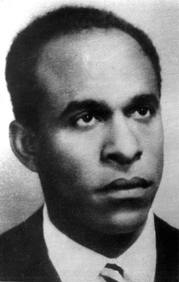
This is a great article by Frantz Fanon, which I published earlier in French. (You will find the original here). In view of all the events occurring in Africa (bombing of Cote d’Ivoire and Libya) with the UN approval, I thought that this article, published in 1964, was so important that I had to translate it into english for all to read! Enjoy…
—————————————————
The great success of the enemies of Africa is to have corrupted the Africans themselves. It is true that these Africans had vested interest in the murder of Lumumba. Heads of puppet governments, in a fake independence, faced everyday by massive opposition from their peoples, it did not take long to convince themselves that the real independence of the Congo would put them personally at risk. And there were other Africans, a little less puppet, but who get frightened when it comes to disengaging Africa from the West. It seems as if these African Heads of State are still afraid to face Africa. These, also, though less actively, but consciously, contributed to the deterioration of the situation in Congo. Little by little, we were reaching the agreement in the West that there was a need to intervene in Congo, we could not let things evolve at this pace.
Gradually, the idea of a UN intervention was taking shape. So we can say today that two simultaneous errors were committed by Africans.
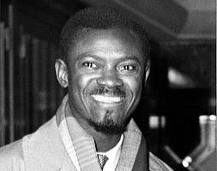
Patrice Lumumba
And first by Lumumba when he sought the intervention of the UN. He should have never called on the United Nations.The UN has never been able to properly solve problems brought to man’s consciousness by colonialism, and whenever it has intervened, it was to actually come to the aid of the colonial power to the oppressed country. Look at Cameroon. What kind of peace do the subjects of Mr. Ahidjo kept in check by a French expeditionary force, which most of the time, made its debut in Algeria, enjoy? The UN, however, controlled the autodetermination of Cameroon and the French government has set up a “Provisional Executive” there.
Look at Viet-Nam. Look at Laos.
It is not true to say that the UN fail because the causes are too difficult.
In reality the UN is the legal card used by imperialist interests when brute force has failed. The sharing, the mixed controlled joint committees, under guardianship are international means of torture to break the will of the people, cultivating anarchy, banditry and misery.
L’article qui suit vient du site 2011, Année Frantz Fanon. La similarité entre la démise de Patrice Lumumba 50 ans plutot, et celle de Laurent Gbagbo aujourd’hui pousse a se poser beaucoup de questions. Ici le grand écrivain antillais Frantz Fanon, en 1960, fait une analyse de ce qui n’a pas marché, et ce que Lumumba et les Africains en général devraient faire. Quelle pertinence! et quelle réalité!
———————————————————–
Le grand succès des ennemis de l’Afrique, c’est d’avoir corrompu les Africains eux-mêmes.
Il est vrai que ces Africains étaient directement intéressés par le meurtre de Lumumba. Chefs de gouvernements fantoches, au sein d’une indépendance fantoche, confrontés jour après jour à une opposition massive de leurs peuples, ils n’ont pas été longs à se convaincre que l’indépendance réelle du Congo les mettrait personnellement en danger. Et il y eut d’autres Africains, un peu moins fantoches, mais qui s’effraient dès qu’il est question de désengager l’Afrique de l’Occident. On dirait que ces Chefs d’État africains ont toujours peur de se trouver face à l’Afrique. Ceux-là aussi, moins activement, mais consciemment, ont contribué à la détérioration de la situation au Congo. Petit à petit, on se mettait d’accord en Occident qu’il fallait intervenir au Congo, qu’on ne pouvait laisser les choses évoluer à ce rythme.
Petit à petit, l’idée d’une intervention de l’ONU prenait corps. Alors on peut dire aujourd’hui que deux erreurs simultanées ont été commises par les Africains.
Et d’abord par Lumumba quand il sollicita l’intervention de l’ONU. Il ne fallait pas faire appel à l’ONU. L’ONU n’a jamais été capable de régler valablement un seul des problèmes posés à la conscience de l’homme par le colonialisme, et chaque fois qu’elle est intervenue, c’était pour venir concrètement au secours de la puissance colonialiste du pays oppresseur. Voyez le Cameroun. De quelle paix jouissent les sujets de M. Ahidjo tenus en respect par un corps expéditionnaire français qui, la plupart du temps, a fait ses premières armes en Algérie ? L’ONU a cependant contrôlé l’autodétermination du Cameroun et le gouvernement français y a installé un “exécutif provisoire”.
Voyez le Viet-Nam. Voyez le Laos.
Il n’est pas vrai de dire que l’ONU échoue parce que les causes sont difficiles.
En réalité l’ONU est la carte juridique qu’utilisent les intérêts impérialistes quand la carte de la force brute a échoué. Les partages, les commissions mixtes contrôlées, les mises sous tutelle sont des moyens internationaux de torturer, de briser la volonté d’expression des peuples, de cultiver l’anarchie, le banditisme et la misère.
Car enfin, avant l’arrivée de l’ONU, il n’y avait pas de massacres au Congo. Après les bruits hallucinants propagés à dessein à l’occasion du départ des Belges, on ne comptait qu’une dizaine de morts. Mais depuis l’arrivée de l’ONU, on a pris l’habitude chaque matin d’apprendre que les Congolais s’entremassacraient.
On nous dit aujourd’hui que des provocations répétées furent montées par des Belges déguisés en soldats de l’Organisation des Nations Unies. On nous révèle aujourd’hui que des fonctionnaires civils de l’ONU avaient en fait mis en place un nouveau gouvernement le troisième jour de l’investiture de Lumumba. Alors on comprend beaucoup mieux ce que l’on a appelé la violence, la rigidité, la susceptibilité de Lumumba.
Tout montre en fait que Lumumba fut anormalement calme.
Les chefs de mission de l’ONU prenaient contact avec les ennemis de Lumumba et avec eux arrêtaient des décisions qui engageaient l’État du Congo.
Comment un chef de gouvernement doit-il réagir dans ce cas ? Le but recherché et atteint est le suivant : manifester l’absence d’autorité, prouver la carence de l’État. Donc motiver la mise sous séquestre du Congo.
Le tort de Lumumba a été alors dans un premier temps de croire en l’impartialité amicale de l’ONU.
Il oubliait singulièrement que l’ONU dans l’état actuel n’est qu’une assemblée de réserve, mise sur pied par les Grands, pour continuer entre deux conflits
armés la “lutte pacifique” pour le partage du monde. Lire la suite …
This Monday marked the 50 year anniversary of the assassination of the great African giant Patrice Lumumba. How could I pass on such an occasion to talk about him? 50 years later, his speech and his vision still ring true. Lumumba dared to defy the Belgian King Baudouin by telling him on independence day what he saw as the Belgian hold on Congo. He was blunt! He spoke the truth! He was not malleable… He could not be manipulated by Europeans! He was a menace because he was a free man proud to be Congolese.
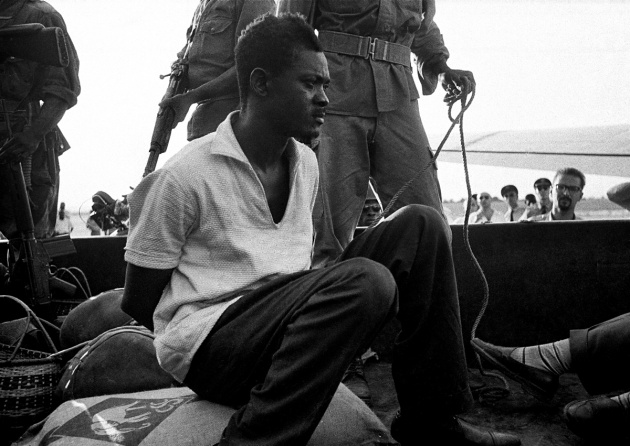
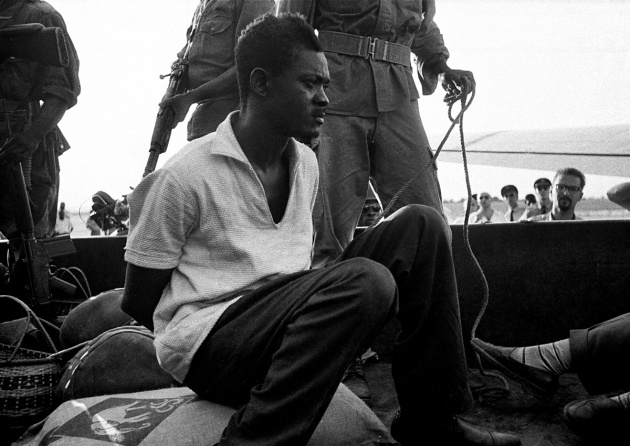
Lumumba detained
I always wondered what would have happened if Lumumba had not been so open about his ambitions for his country? What would have happened if he had played their game, and hidden his cards? Then we, Africans, would have never had our African hero! Someone had to say what we all felt: oppressed, hated, enslaved, diminished,… someone had to make us proud of being Congolese/African again… someone had to re-establish our dignity! That someone happened to be Patrice Emery Lumumba! Patrice died because he had great ideals, and because he trusted others. For the problem in the Katanga province, he went to the United Nations; he trusted that establishment to resolve the conflict peacefully, and to help solve the Katanga secession…. Instead they, with all the interests they represented (US, Belgium,France, etc…), refused to help him… the US of Kennedy refused to help him out, and thus he turned to the USSR to keep his country united. With the USSR, he was able to solve the rebellion in the Katanga and Kasai provinces… but the Americans and Belgians were mad that he had been helped by the Soviets; they decided to have him murdered after this affront (they used Mobutu, and Tshombe)! Once again, we Africans sold our own brother… I wonder where the Maurice Tshombe, or Kibwe, or the Joseph Mobutu are today… History will remember them as tyrants, dictators, and puppets of the West! Isn’t it interesting that history keeps repeating itself? Today the United Nations are starting a war in Ivory Coast in the name of installing a puppet-president in a soveraign country… Have you ever seen the UN so vehemently ask for war in a country? Only in Africa could this be possible… I used to dream that this was a peace organization! Actually, it is an organization to impose the will of the West on third world resource-rich countries.
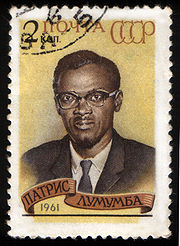
Lumumba on a USSR commemorative stamp in 1961
The following documentary will tell it all: how the Belgians did not like Lumumba because he was not a puppet, how they started the Katanga secession and supported it; how Lumumba went to the UN for help in keeping his country united and was refused help; how Lumumba went to the US to ask for help, and was not even received by president Kennedy; how he turned to the USSR to solve his problem in the Katanga and Kasai provinces; how that event precipitated his end. 50 years later, Lumumba’s ideals and vision are still actual. Lumumba is the symbol of aspirations of an entire continent. His spirit lives on, and his pride is ours!
Lumumba (2000)
I live you with an excerp from a letter he sent to his wife before his death: “… the future of the Congo is beautiful and [I] expect for each Congolese, to accomplish the sacred task of reconstruction of our independence and our sovereignty; for without dignity there is no liberty, without justice there is no dignity, and without independence there are no free men.” You can find the Integral version of this letter on AfricaWithin.com, as well as his famous 30 June 1960 independence day speech. Please don’t forget to check out: Wikipedia, The Guardian which deemed the assassination of Lumumba as the most important of the 20th century, The Daily Nation of Kenya deemed Lumumba the bright spark in a land of despair, and The New York Times which called it an assassination’s long shadow. At last, the movie Lumumba (2000) is what finally got the Belgian admitting their part in the assassination of Lumumba.







 African Heritage