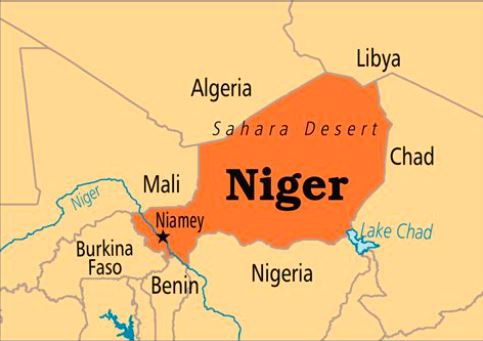
In the Sahara desert, in the country of Niger, near the city of Tesker, a team of scientists has discovered a new species of dinosaur which lived in the area 95 million years ago. The new species, named Spinosaurus mirabilis, measures 12 m long, has a long snout adapted for catching fish, and features a spectacular curved crest on its head which is the largest ever found on a predatory dinosaur.
The expedition has been led by American paleontologist Paul Sereno from the University of Chicago who explains that the crest was likely ornamental, similar to features seen in some modern birds, rather than a weapon; this could later be found not to be the case, as we, humans, often interpret some ancient findings through our modern eyes. The dinosaur also had interlocking teeth, ideal for gripping slippery fish, showing its adaptation to life near water. This rare finding was cause for great joy within the team. Using modern tools including solar-powered laptops, members of the team were able to digitally assemble the images of the bones right in the middle of the Sahara.
Paleontologist Paul Sereno with a skull cast of the Spinosaurus mirabilis. Credit: Keith Ladzinski / Fossil Lab, University of Chicago / AFP/Getty
The team will be returning to Niger for further work. Sereno and his team are helping to establish a Heritage Center at the University of Niamey and planning 2 museums, one in the capital and the other in Agadez to showcase the country’s rich paleontological history.
This discovery sheds a light on the fact that the Niger’s desert is a major dinosaur fossil site, with many more discoveries to be made. There is a great need to train Nigerien and African archaeologists, paleontologists, and museum specialists as the field is overall a virgin field in Africa. Africans need to learn, so that they can tell their own history!
Today, we will talk about the capital of the great country of Niger, Niamey. Growing up, I often pondered on the name of the capital of Niger: was it a name that had something to do with Niger? Did it have to do with the fact the city is located on the banks of the Niger River, the third longest river of Africa, which has its source in Guinea near the Sierra Leone border, and runs in a crescent shape through Mali, Burkina Faso, Niger, Benin, and Nigeria? What is the origin of the name Niamey?
Niamey in 1930 – in the center is the house of the French governor (Source: Photo by Walter Mittelholzer – Dec 1930)
The region of Niamey has been inhabited by local populations for as long as forever; the Songhay , Gurma, Hausa are some of its inhabitants. Niamey is said to have been founded by the Maouri, a subgroup of the Hausa people, who came from Matankari (the historic capital of the Arewa) towards the end of the 19th century. From local folklore, they first settled on the island called Neni Goungou (pronounce Neni Gungu) which faces the actual city of Niamey, before settling on the left bank of the Niger river, near a tree. This gave rise to the name Niame, from Niathe name of the tree, and mein the Zarma language which means ‘shore where water is drawn from.’ There is another legend, less likely in my opinion, which claims that the chief of a Kalle (subgroup of the Zarma people) clan would have exclaimed, talking to his slaves: Wa niammané, meaning “take this country.” The first version seems more likely.
Aerial view of Niamey in 2021 (Source: Adrien Barbier / AFP / Getty Images)
Niamey started expanding from a village to a city in the year 1900 in a place which was previously a crossroad between several villages Foulani Koira, Gaweye, Kalley, Maourey, Zongo, Gamkalé, and Saga. The city grew on the left bank of the river as it meanders from west to east. European explorers arrived in the area quite late. Thus, European explorers who traveled through West Africa, such as Heinrich Barth and Charles Monteil never made it to the area. It is only in 1898 that the name of Niamey appears in the reports of the Hourst expedition, named after the French officer Émile Auguste Léon Hourst who was directing a hydrographic expedition. Thus, in 1901, Niamey was a village numbering 600 inhabitants at the arrival of the French mission Lenfant. Niamey replaced Zinder as the capital of Niger on 28 December1926, because of its strategic position closer to major cities of French colonies, Upper Volta/Burkina Faso and Dahomey/Benin, contrary to Zinder which was closer to Nigeria a British colony. During the colonial period, Niamey also served as an important connection point in overland trade of agricultural goods. Niger is still a major provider of agricultural goods to neighboring countries, uranium, and more recently with oil discovery.
Niamey in 2020 (Source: NigerHeritage.org)
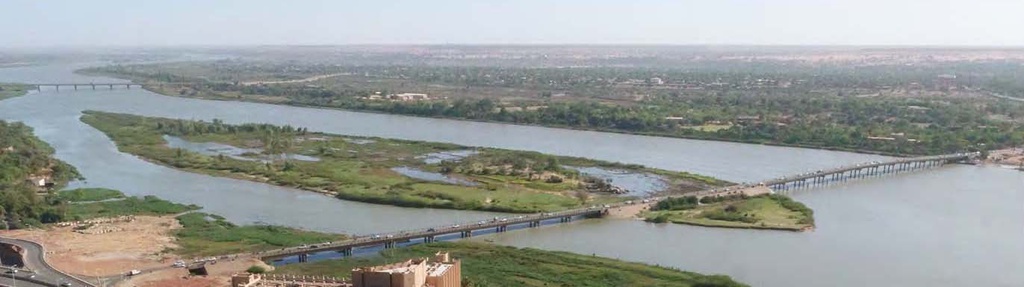
Today in Niamey, the vast majority of the population and government and commercial buildings are located on the eastern bank of the Niger river. The city center contains a number of wide boulevards linking roundabouts. Two bridges connect the two sides of the city – the Kennedy Bridge and the Friendship Bridge. The western bank area consists mainly of residential areas such as Gaweye, Saguia, Lamorde, Saga, and Karadje, as well as Abdou Moumouni University. This year, the government renamed major streets of the city after local heroes, as it should normally be. Over the years, the population has grown significantly and today Niamey counts almost 1 million inhabitants.
View of the Isle of Gaweye and the Kennedy Bridge (Source: NigerHeritage.org)
If you ever visit Niamey, do not forget to visit the Niger National Museum, which incorporates a zoo, a museum of vernacular architecture, a craft center and exhibits including dinosaurskeletons and the Tree of Ténéré, which was until 1973, one of the few remaining trees in the Sahara Desert and one of the most isolated trees on earth used as a landmark by caravans through the Ténéré region of northeast Niger. Other places of interest include the seven major market centers, the most popular being the large Niamey Grand Market, a traditional wrestling arena, the Great Mosque, and a horse racing track. Most of the colorful pottery sold in Niamey is hand made in the nearby village of Boubon. As you walk through the city, try to see if you can find that tree at the origin of the name Niamey, and enjoy the well-renowned Nigerien’s hospitality.