On the black woman. “I believe that black has been oppressed by white; female by male; peasant by landlord; and worker by lord of capital … the black female worker and peasant is the most oppressed. She is oppressed on account of her color like all black people in the world; she is oppressed on account of her gender like all women in the world; and she is exploited and oppressed on account of her class like all workers and peasants in the world. Three burdens she has to carry.” Wizard of the Crow
On unity. In A Grain of Wheat, Ngũgĩ stressed the importance of unity of resisting tyranny, “Our fathers fought bravely. But do you know the biggest weapon unleashed by the enemy against them? It was not the Maxim gun. It was division among them. Why? Because a people united in faith are stronger than the bomb.”
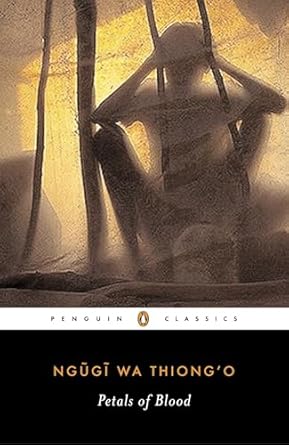
Petals of Blood by Ngũgĩ wa Thiong’o
Like Sengat-Kuo in his poem “Ils sont venus“, Ngũgĩ highlighted in Petals of Blood the holy trinity of the Bible, the guns, and commerce to conquer and oppress Africans, “He carried the Bible; the soldier carried the gun; the administrator and the settler carried the coin. Christianity, Commerce, Civilization: the Bible, the Coin, the Gun: Holy Trinity.“
Language as a weapon. In his groundbreaking book Decolonising the Mind: The Politics of Language in African Literature, he championed the use of the mother tongue, arguing, “To speak one’s language is to celebrate one’s identity, … but to impose a language is a way to divide people – it is to practice tribalism of another kind.”
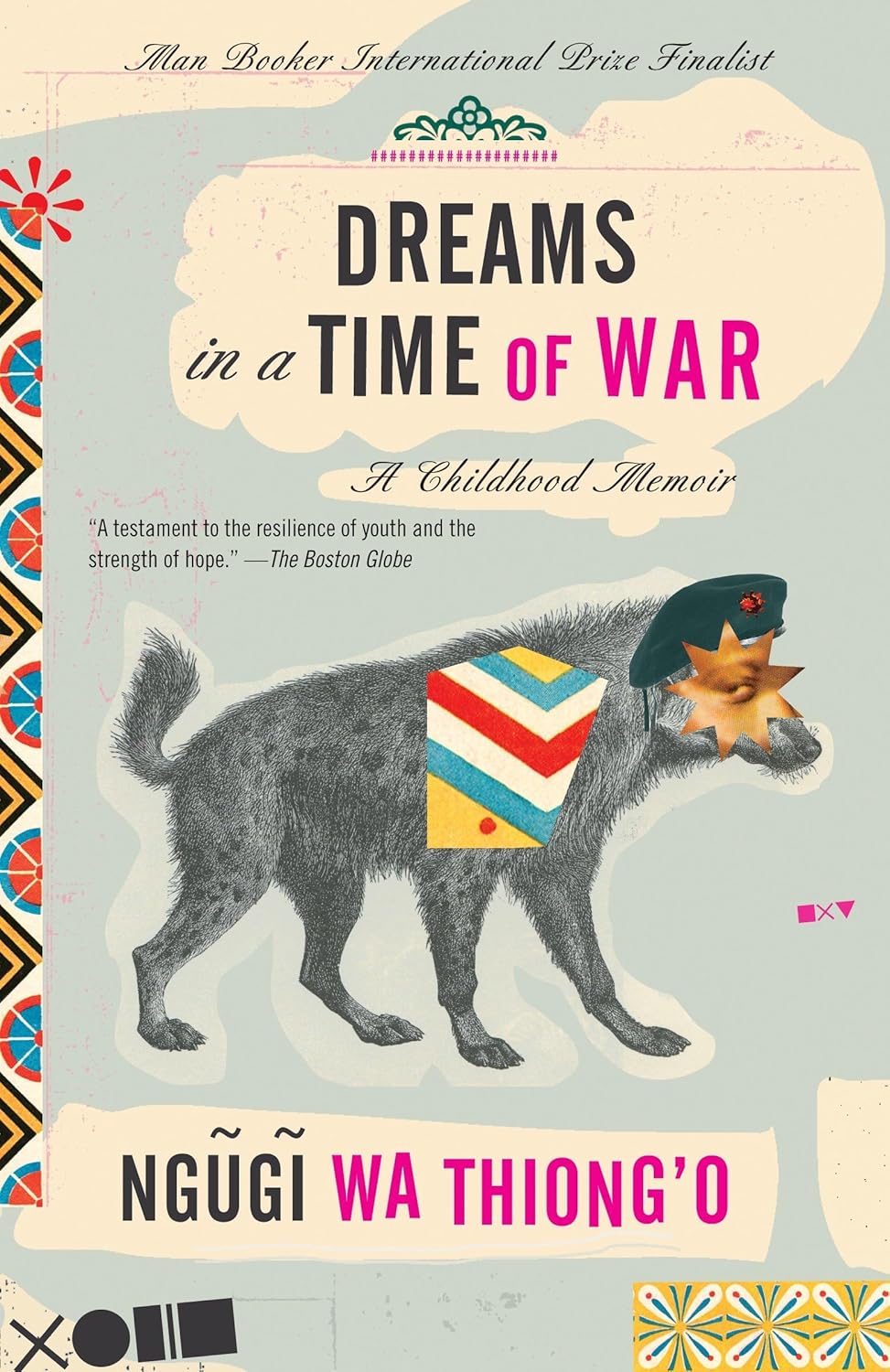
Dreams in a Time of War: A Childhood Memoir by Ngũgĩ wa Thiong’o
On Women condition. In Wizard of the Crow, Ngũgĩ said, “The condition of women in a nation is the real measure of its progress.“
On self-validation. in Dreams in a Time of War, he added “Belief in yourself is more important than endless worries of what others think of you. Value yourself and others will value you. Validation is best that comes from within.“
World acclaimed Kenyan writer Ngũgĩ wa Thiong’o is no longer. Millions of school children in Africa grew up reading his first books Weep not child (1964), the first novel in English published by an East African, followed by The river between (1965) and A Grain of Wheat (1967). A Cameroonian friend of mine used to love reading The river between, and could recite almost every line. Weep not child explored the impact of the Mau Mau rebellion on a young boy’s family and education, The river between focused on the cultural clash between traditional Gikuyu society, while A Grain of Wheat focused on the disillusionment of the post-independence era.
Chinua Achebe (Source: AP Photo)
Like the venerated Chinua Achebe, Ngũgĩ wa Thiong’o was counted among the baobabs of modern African literature, as the author of several novels, plays, short stories, critical pieces, and children books. Like Achebe, he was tipped several times to win the Nobel Prize for Literature, leaving fans dismayed each time the medal slipped through his fingers. We are counted among those fans who each time hoped, but were always disappointed… it’s like the real African authors never get rewarded. This is a lesson for all that we need to reward our own, create awards and celebrate our own, instead of waiting for others to celebrate them. His daughter Wanjiku wa Ngũgĩ who announced his passing on May 28, 2025, said, “He lived a full life, fought a good fight. As was his last wish, let’s celebrate his life and his work.”
“Weep not Child” by Ngugi wa Thiong’o
Ngũgĩ reached fame writing in English, and then decided to write in Gikuyu, his mother-tongue. Today, his books are written in Gikuyu, and then translated into English; he was a strong proponent of African languages and was adamant about expressing his art in Gikuyu. Like so many East African leaders, he attended the prestigious Makerere University in Uganda, and later the University of Leeds in the UK. Upon his return to Kenya, he taught at the University of Nairobi where he worked to “decolonize the minds,” campaigning to decolonize the curriculum by prioritizing African literature and languages. He was instrumental in the abolition of the English Literature Department in favor of a broader, African-centered literary program. The 1970s decade also saw him drop his patronym James Ngugi, to be fully known as Ngũgĩ wa Thiong’o.
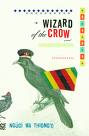
“The wizard of crow” by Ngugi wa Thiong’o
His work spanned over six decades, documenting the transformation of his country, Kenya, from a colony of Great Britain to a democracy with all its issues. He fought the government and was arrested several times, and spent a year at a maximum security prison where he wrote his novel Devil on the Cross (Caitaani mũtharaba-Inĩ), the first modern novel in Gikuyu, written on prison toilet paper. Once out of prison, faced with constant harassment from the government, he went into exile and taught at some of the world’s best universities, including Yale University, New York University, Northwestern University, and the University of California, Irvine where he was a Distinguished Professor of English and Comparative Literature and served as first director of the International Center for Writing and Translation.
Ngugi wa Thiong’o (Source: TTbook.org)
His was a unique voice, a voice which never stopped to urge for the decolonization of the minds. To this effect, he wrote Decolonising the Mind: The Politics of Language in African Literature (1986) which advocates for linguistic decolonization of Africa; the book became one of his best known non-fiction work. In his speech at Wits University in Johannesburg in 2017, titled ‘Secure the base, decolonise the mind’, Ngũgĩ spoke about the ‘power relationship between the language of the conqueror and the language of the vanquished’, and asked whether, after fifty years, we have ‘regained the cultural and intellectual independence that we had lost to colonialism’, adding ‘I have always argued that each language, big or small, has its unique musicality; there is no language, whose musicality and cognitive potential, is inherently better than another,’ he said [The Johannesburg Review of Books]. Ngũgĩ is survived by 9 children of whom 4 are also authors like himself.
A few weeks ago, the son of Africa’s revered writer, Ngugi wa Thiong’o: world acclaimed Kenyan writer, took to X and wrote about his father being an abusive husband, “My father Ngugi wa Thiong’o physically abused my late mother. He would beat her up. Some of my earliest memories are of me going to visit her at my grandmother’s where she would seek refuge.” The tweet went viral, and took everyone by surprise. Surprise, because human tendency makes it so that we tend to place our heroes on pedestal as if they were no longer human; surprise, because Ngugi wa Thiong’o alongside Chinua Achebe is one of Africa’s greatest writers worthy of the Nobel prize of literature; surprise, because Ngugi wa Thiong’o work has been denouncing colonialism, imperialism, nepotism, neo-colonialism, and African governments’ repression and mismanagement, but never has he denounced the conditions of the African woman; lastly, surprise because, in Africa, and in Kikuyu culture particularly, it is not so common to air one’s dirty laundry in public, particularly against an elder. Sure enough, the son, Mukoma wa Ngugi responded to the backlash, “We cannot use African culture to hide atrocities,” he wrote on X. “My father beat up my mother. What is African about that?”
I, like so many, am against violence in general, and violence against women in particular. As we digest the news about Ngugi wa Thiong’o, is it not time for our acclaimed African writer who is in his twilight years to give us one masterpiece which focuses on patriarchy, women condition, and women in general, as an atonement? Is it not time for this to open up a dialogue?
Below is an excerpt from Al Jazeera. Enjoy, it is a nice read!
=====
Ngugi wa Thiong’o (Source: TTbook.org)
On March 12, Mukoma wa Ngugi, the Kenyan American poet and author, who is the son of Ngugi wa Thiong’o, the famed writer widely seen as a giant of African literature, took to X, formerly Twitter, to allege that his father was an abusive husband. “My father Ngugi wa Thiong’o physically abused my late mother. He would beat her up. Some of my earliest memories are of me going to visit her at my grandmother’s where she would seek refuge.”
Mukoma’s tweet went viral and solicited hundreds of responses that exposed the long, dark shadow patriarchy continues to cast over many African societies. Sure, many commentators thanked Mukoma for sharing his account of a man who is not only his father, but an African cultural icon. Others, however, were less complimentary and appeared to be gravely offended by his openness. They accused him of embarrassing his father and seeking validation from Westerners.
… Ten days after his initial statement, on March 23, Mukoma responded to the criticism he received for speaking up for his mother. “We cannot use African culture to hide atrocities,” he wrote on X. “My father beat up my mother. What is African about that?” In another post, he described the culture of violence against women that underpins Kenyan society as a “patriarchal cancer”.
Chinua Achebe (Source: AP Photo)
Ngugi is a literary genius, a storyteller par excellence and a respected revolutionary. Before there was the internet, video on-demand platforms, TV or even radio in most households, two African giants dominated African literature: Chinua Achebe, the Nigerian author, and, of course, Ngugi. From the 1960s, AchebeandNgugiarticulated African identity and consciousness amid the anti-colonial struggle. They stood up for the human rights of Africans with their words.
Through novels like Things Fall Apart and Arrow of God, to name a few, Achebe chronicled the impact of colonialism on Igbo culture, religion and sociopolitical systems. And in a Man of the People, he explored the failings of postcolonial leadership and states.
“Weep not Child” by Ngugi wa Thiong’o
Ngugi, who went by the name James early in his career, also focused on African opposition to colonial rule. Weep not Child, for instance, deals with the so-called Mau Mau Uprising, while A grain of wheatlooks at the state of emergency in Kenya’s struggle for independence (1952–60). Through these and other novels, Ngugi advocated for resistance against colonial oppression and repression in the independence era. In 1978, he was arrested and detained for a year without trial by the administration of former Kenyan President Jomo Kenyatta over a play titled Ngahlika Ndenda (I will marry when I want). Over the years, Ngugi was regularly harassed and victimised by authorities in Kenya for voicing his opposition to corruption, misrule and the abuse of power. He has stayed the course and today, at the age of 86, continues to advocate for freedom from neocolonialism and political oppression. With 13 honorary degrees from institutions around the world, as well as countless awards, including the 2022: PEN/Nabokov Award for Achievement in International Literature, Ngugi is a certified literary genius. But, for all of his achievements in the last 60 years, the famed author appears to have failed where it counted most: protecting African women.
He produced many timeless literary classics, and became a leading voice in the fight against colonialism and post-colonial repression, but according to his own son, could not liberate his dear wife, sons and daughters from the extreme ravages of toxic masculinity and domestic violence. Of course, in the wake of Mukoma’s public disclosures, Africans could choose to label Ngugi a flawed genius. He is, after all, human. They could – as many tried to do in lashing out at [Mukoma] – brush his alleged abuse of his wife under the carpet in the name of protecting his literary and revolutionary legacy. This would be an easy and convenient position to take.
But it wouldn’t be right.
“The wizard of crow” by Ngugi wa Thiong’o
… Ngugi, it seems, wanted women to experience liberty from colonialism and post-colonial subjugation, but remain bonded to the steely constraints of Kikuyu culture. … To his mind, it seems, there were limits to women’s human rights. For a long time, under the guise of tradition, African men have been allowed and even encouraged to discipline “their women” and children with violence [this does not apply to all African men]. Thus, many argue Ngugi is just a product of his times and what he is said to have done to his late wife should not be judged through a 21st-century progressive lens.
… Ngugi’s alleged violence is, unfortunately, a window to a continental(and, frankly global) problem. Hence, his son’s revelations should not become a point of contention. This should instead be a teaching moment.
Ngugi wa Thiong’o is a world-acclaimed Kenyan writer cut from the same cloth as African veteran Chinua Achebe. Ngugi is the author of several novels, plays, short stories, critical pieces, and children books. Ngugi reached fame writing in English, and then decided to write in Gikuyu, his mother-tongue. Today, his books are written in Gikuyu, and then translated into English. His first books Weep not child (1964) followed by The river between (1965) were on the secondary school syllabus in Cameroon, and a friend of mine used to love reading The river between.
The wizard of crow
When Ngugi first started writing in Gikuyu, he was threatened by the Kenyan government, and in the late 70’s, the political overtone of his play I will marry when I want, got him arrested by the then vice-president Daniel Arap Moi (who later became president, and ruled Kenya for 22 years). After his release from jail, Ngugi spent two decades in exile, and tried returning to Kenya in 2004 under the new government, but was viciously attacked in his hotel and his wife was sexually assaulted… after that he returned to the USA where is a professor at New York University. His latest novel, The wizard of crow which is 1000-pages long, and which I own, discusses a dictatorship in an imaginary country in Africa.




 African Heritage