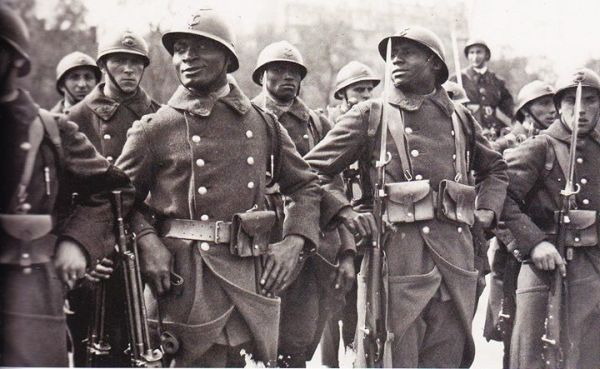
There was a time when Africans of another generation, proudly sang La Marseillaise… That was the generation of the tirailleurs, the generation of those trained in France before and after ‘independence’, the generation who loved the Métropole. There was a time when, like the kids described below by Marcel Homet in Congo Français: Terre de souffrance (Paris 1934), Africans believed that France, the land of Marianne, could want their freedom or at least a ‘fair’ partnership. The current generation, after seeing the sweat and blood of their parents and grandparents in the uranium mines or banana plantations, after suffering, after witnessing the NATO attacks on Libya, Cote d’Ivoire, or the repeated putsches funded by France on their territories, or seeing their economy and savings fall to the exchange factor of their currency FCFA in Francophone Africa, or seeing these French and foreign companies plundering their resources for over a century with no roads no hospitals and barely any taxes paid… this generation has become disillusioned, and can no longer sing La Marseillaise. They have learned that singing La Marseillaise equates with the massacre of Thiaroye, the genocides in Algeria, Cameroon, Madagascar, and so many other places, or more recently the joint attacks of NATO on Libya. Singing La Marseillaise has equated to so much blood so much so that this generation no longer wants anything to do with France or imperialist forces.

As you read the description below from another time, it is interesting to note how the gruesome conditions of from another era do not seem to have changed much with time. We are fighting today, whether in Niger, Mali, Burkina Faso for dignity and for respect owed to any human being. We are fighting for the right to use our resources as we see fit. We are fighting for simple, human dignity. Below are excerpts from Marcel Hormet in Congo Français: Terre de souffrance (Paris 1934) where he describes a time of forced labor in French colonies, in this case Congo which was part of the French Equatorial Africa (Afrique Equatoriale Francaise (AEF)).
======
In the village square of Loko, a few children – aged eight to ten – pass by, singing *La Marseillaise* in French. They vanish around the bend in the path.
Slowly, the tricolor flag rises up the mast planted before the chief’s dwelling. Everyone uncovers their heads. That anthem, still echoing in the distance, that song of liberty and hope, which can be so deeply moving, takes on a poignant significance here. Unwittingly, the children who proclaim it, understanding nothing of its meaning, are thereby giving voice to the aspirations of a people looking to France for some alleviation of the colony’s pitiful plight: empty bellies, festering sores, and an undisguised slavery, more rigorous than the trade ever was in the era of “ebony wood.”
In French Equatorial Africa, when exhausted slaves die, the local government replaces them, one for one.
Why, then, bother to hold back?
(Sur la place de Loko, quelques enfants de huit à dix ans, passent en chantant “en français” la Marseillaise. Ils disparaissent au tournant du chemin.
Au mât planté devant la demeure du chef monte lentement le drapeau tricolore. Tout le monde se découvre. Ce chant qui, là-bas, résonne encore, ce chant de liberté et d’espoir qui peut être si émouvant, prend ici une signification poignante. Sans s’en rendre compte, les enfants qui le clament et qui n’y comprennent rien manifestent ainsi les aspirations d’un peuple qui attend de la France un adoucissement au sort pitoyable de la colonie : ventres vides, plaies suppurantes et cet esclavage non déguisé, plus strict que ne l’a jamais été la traite à l’époque « du bois d’ébène ».
En AEF, lorsque les esclaves épuisés sont morts, le gouvernement local les remplace, nombre pour nombre.
Pourquoi alors se gêner ?)