History Repeats Itself : the Victim is Disarmed, while the Aggressor is Funded

Patrice Lumumba

History repeats itself! After Patrice Lumumba’s 30 June 1960 Independence speech, the Congo Crisis started. The Belgians were not happy to leave their colony and thus funded Moïse Tshombe in the Katanga for the secession of Congo. This was at the height of the Cold War, and served as a proxy conflict between the East and the West or the Soviet Union and the United States and cronies. A little over a week later, on 9 July, Belgium deployed paratroopers, without the Congolese state’s permission, in Kabalo and elsewhere to protect fleeing white civilians. As the conflict persisted, Lumumba appealed to the United Nations, but he was told that all aid to the Congolese government would be going through the UN. Finding this out, his Deputy Prime Minister Antoine Gizenga declared:

The people of the Congo do not understand why we, the victims of aggression, we who are in our own land . . . are systematically and methodically disarmed while the aggressors, the Belgians, who are in our conquered country, still have their arms and and all their firepower. . . . The UN forces allow Katanga to consolidate secession and let the Belgians behave as if they were in an occupied country under the smokescreen of a phoney Katanga provincial government that we, the legitimate government of the Congo, have declared illegal.” Antoine Gizenga, in CRISP, Congo 1960, p. 615

As you read these words uttered by Deputy Prime Minister Gizenga over 66 years, does it not read like the aggression that the Democratic Republic of Congo (DRC) has been going through at the hands of the M23, proxy troops of Rwanda used to loot the Congolese resources? These words remind us of the conflict in Cote d’Ivoire with the Marcory treaties where the victims were disarmed while the aggressors were armed… and so many other conflicts in Africa: the victim wishing for his dependence is disarmed pushed into a corner, while the aggressor is funded by the West. All of this, under the watchful eyes of the UN, just as in 1960!

Amilcar Cabral on the Colonizer installing Puppets

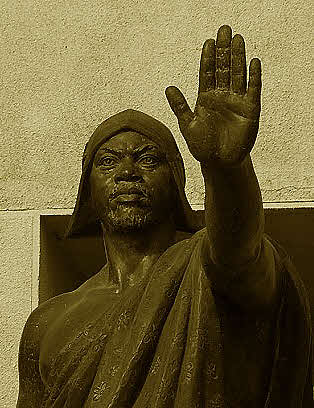
Statue of Behanzin in Abomey, Benin

As you all know, we have seen in recent coups and throughout history, that the colonizers/oppressors in Africa tend to install fake chiefs, or rather puppets to serve their interests. Remember when Agoli-Agbo (French puppet) was installed after King Behanzin was deposed in 1894? or Patrice Lumumba with Joseph Mobutu in 1961, or more recently Thomas Sankara by Blaise Compaoré in Burkina Faso in 1987, and countless others … history repeats itself. This behavior is not just observed at the top of the country, but even at the levels of the local traditional chiefs… where the successions are contested thus breaking the will of the people, and the passing on of a culture, effectively destroying the oppressed. I could not have said it better than  Amilcar Cabral, himself during his February 20, 1970 speech, as part of the Eduardo Mondlane Memorial Lecture Series at Syracuse University, Syracuse, New York, under the auspices of The Program of Eastern African Studies. Enjoy!

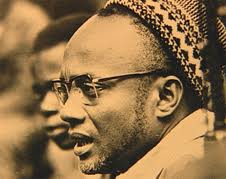
Amilcar Cabral
Amilcar Cabral

====

the colonizer who represses or inhibits significant cultural activity on the part of the masses at the base of the social pyramid, strengthens and protects the prestige and the cultural influence of the ruling class at the summit. The colonizer installs chiefs who support him and who are to some degree accepted by the masses; he gives these chiefs material privileges such as education for their eldest children, creates chiefdoms where they did not exist before, develops cordial relations with religious leaders, builds mosques, organizes journeys to Mecca, etc. And above all, by means of the repressive organs of colonial administration, he guarantees economic and social privileges to the ruling class in their relations with the masses. All this does not make it impossible that, among these ruling classes, there may be individuals or groups of individuals who join the liberation movement, although less frequently than in the case of the assimilated “petite bourgeoisie.” Several traditional and religious leaders join the struggle at the very beginning or during its development, making an enthusiastic contribution to the cause of liberation.

But here again vigilance is indispensable: preserving deep down the cultural prejudices of their class, individuals in this category generally see in the liberation movement the only valid means, using the sacrifices of the masses, to eliminate colonial oppression of their own class and to re-establish in this way their complete political and cultural domination of the people.

… among the oppressor’s most loyal allies are found some high officials and intellectuals of the liberal professions, assimilated people, and also a significant number of representatives of the ruling class from rural areas.

… Without minimizing the positive contribution which privileged classes may bring to the struggle, the liberation movement must, on the cultural level just as on the political level, base its action in popular culture, whatever may be the diversity of levels of cultures in the country. The cultural combat against colonial domination–the first phase of the liberation movement–can be planned efficiently only on the basis of the culture of the rural and urban working masses, including the nationalist (revolutionary) “petite bourgeoisie” who have been re-Africanized  or who are ready for cultural reconversion. Whatever may be the complexity of this basic cultural panorama, the liberation movement must be capable of distinguishing within it the essential from the secondary, the positive from the negative, the progressive from the reactionary in order to characterize the master line which defines progressively a national culture.

Confronted with such a necessity, the liberation struggle is, above all, a struggle both for the preservation and survival of the cultural values of the people and for the harmonization and development of these values within a national framework.