We owe a lot to those who lost their lives for us to enjoy amazing freedoms. In Windhoek, the capital of Namibia, there is a monument, The Genocide Memorial, erected to celebrate those who went before, who lost their lives for us to be free. The Genocide Memorial can be found south of the Sam Nujoma statue on Independence Museum in Windhoek, Namibia. On the monument, is written, “Their blood waters our freedom.” On the inner plaque, whether on the back or front of the statue, are found images of the Herero and Nama people of Namibia who were almost entirely exterminated by the Germans, Germany in Namibia: the First Genocide of the 20th Century. At the top of the monument, are a man and woman in an embrace who have broken their shackles of the South African military occupation. The couple stands atop a rendering of a traditional Namibian dwelling.
So wherever we are, it is important to know that our ancestors gave their blood and sweats for us to stand tall today, and it is our duty to continue to battle for the next generations. Their blood waters our freedom!!!
“Their Blood Waters Our Freedom” Monument at the Independence Museum, in Windhoek, Namibia“Their Blood Waters Our Freedom,” back of the monument
A few weeks ago, the Namibian government then represented by President Hage Geingob issued one of the strongest expressions of solidarity to the Palestinians facing the blows of Israel’s ongoing destruction of Gaza on January 13, in support of South Africa’s case bringing the charge of genocide against Israel to the International Court of Justice. It issued the following statement in response to the German government’s decision to officially support Israel’s denial of these charges [Namibia criticizes Germany]:
Namibia rejects Germany’s support of the genocidal intent of the racist Israeli state against innocent civilians in Gaza. Germany committed the first genocide of the twentieth century in 1904–1908, in which tens of thousands of innocent Namibians died in the most inhumane and brutal conditions . . . President [Hage] Geingob appeals to the German Government to reconsider its untimely decision to intervene as a third-party in defense and support of the genocidal acts of Israel before the International Court of Justice.
The German Government is yet to fully atone for the genocide it committed on Namibian soil…
We have discussed the first genocide of the 20th century, committed by Germany in … Namibia, on African soil. We are not talking about World War II, but instead the real first genocide of the 20th century which almost wiped out all the Herero and Nama people of Namibia, Germany in Namibia: the First Genocide of the 20th Century. It was a campaign of racial extermination and collective punishment that the German Empire undertook in German South-West Africa (modern-day Namibia) against the Herero and Nama people, which took place between 1904 and 1907 during the Herero Wars. Today it is known as the Namibian genocide or the Herero and Namaqua genocide. It was cruel, gruesome, and yet today, many Germans don’t even know that their country had a colonial past! Hello? Germany had 4 colonies in Africa, Togoland (Togo), Kamerun (Cameroon), German East Africa (Tanzania), and German South-West Africa (Namibia), and in most of them great atrocities were committed, yet, it is as if the history annals of the world have refused to acknowledge the humanity of the countless Africans who died. Recently, a German movie producer made a movie to reintroduce the German society to its colonial heritage. Recently, Germany agreed to pay Namibia €1.1bn over historical Herero-Nama genocide, while recognizing the actions as genocide, yet falling short of calling it reparations. Excerpts below are from the Guardian. You will also hear of the painful requests of many families for the return of their ancestors’ skulls (why on earth are these museums still holding onto people’s skulls?) Germany Returns Skulls of Namibians Genocide Victims, Germany Returns Artifacts Stolen From a Namibian Freedom Fighter.
=====
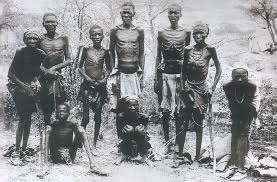
Survivors of the Herero genocide (Wikimedia)
It was one of the darkest eras in German history, and the first genocide of the 20th century: the mass killing of tens of thousands of people in German South West Africa after a rebellion against colonial rule by the Herero and Nama tribes.
More than 100 years later, a feature film about the violence perpetrated by Germany in what is now Namibia explores that brutal colonial past for the first time. Its director hopes Measures of Men will bring the calamitous episode to the attention of ordinary Germans.
“Germany has denied its colonial past for 120 years,” Lars Kraume said, in advance of the film’s domestic release on Thursday. “Most people are unaware Germany even had a colonial past, let alone anything about the brutality of it – it is not even taught in schools.” [Aren’t Africans humans too? are their deaths meaningless?]
… Measures of Men, filmed mainly on location in Namibia using local crew and expertise, tells the story of Alexander Hoffmann – played by Leonard Scheicher – a young, idealistic but wide-eyed ethnologist who questions the evolutionist racial theories of the time, according to which sizes and shapes of skulls determined intelligence. His attempts to rebut the pseudoscientific legitimisation of the superiority of white people over people from the colony of south-west Africa leads him to take first an intellectual and then a romantic interest in Kezia Kambazemi, the interpreter of a delegation of Nama and Herero people who are shipped to Berlin to participate in the Kaiser’s “Völkerschau”, or human zoo exposition.
Despite studying history for his final exams in Germany, Kraume became aware of Germany’s colonial past only when he visited Namibia in the early 1990s, immediately after its independence from South Africa. …
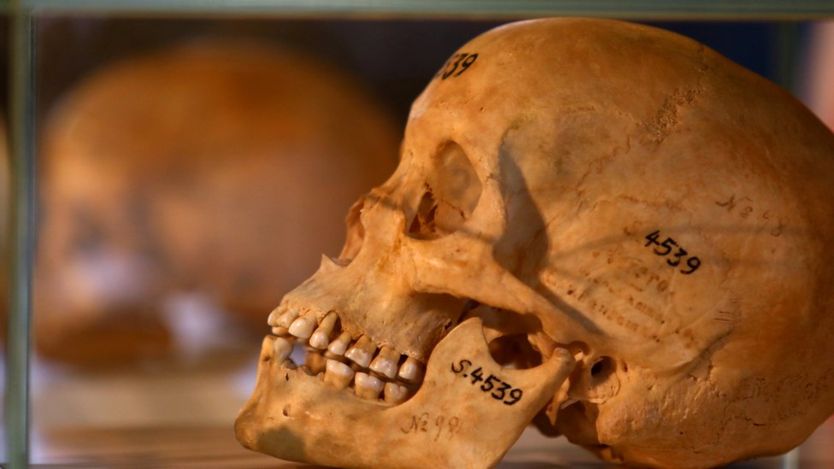
Namibian skulls (Reuters)
Kraume was particularly shocked by the existence of thousands of skulls of people murdered by Germans, which were gathered and shipped to Germany in large quantities and still exist in museums across the country.
“I cannot comprehend the fact that we have these skulls, like artefacts, stored in ethnological museums,” he said. “I cannotunderstand why they are still being kept and have not been given back.
“You ask yourself: ‘Why were the skulls collected in the first place, and why have we not seen fit to give themback?’”
… The film’s relevance to the present day, Kraume said, is also in its depiction of how those in power choose to ignore scientific facts and truth for political gain and in order to maintain the status quo. …
Although 2021 has globally been a tough year, there are still events that lend to celebration. As we turn the page of 2021 and delve into 2022, it is good to note that in 2021, a lot of “firsts” have taken place on the African continent. Below are a few of the events that brought joy. There are many more, of course, but I selected 11. Enjoy, and add in the comments other celebratory events that have marked the continent this year.
In May, a Malian woman gives birth to 9 babies (from natural conception). This marks the first single birth and survival of nonuplets in the world. Halima Cisse, a Malian woman, has given birth to nonuplets, 5 girls and 4boys, in a hospital in Morocco [World Record: Malian Woman gives Birth to Nine Babies].
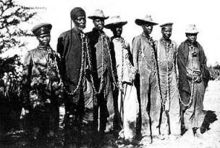
Chained Herero men
Germany agrees to pay Namibia €1.1bn over historical Herero-Nama genocide in May of this year. This is historic, late, and probably not enough compared to the loss in human lives… yet it is important! The money will be paid over 30 years in aid programs… (probably a way to siphon money back to Germany, while appearing to be giving something), and pales in comparison to the billions worth of Namibian diamonds and cobalt mine that will profit German companies in fine print [Germany in Namibia: the First Genocide of the 20th Century].
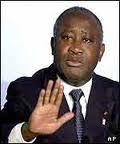
Laurent Gbagbo
In June, after 10 years of imprisonment, and over 20 years of persecution, Laurent Gbagbo, the former president of Cote d’Ivoire finally lands home amidst celebrations from his supporters in the country and abroad [Laurent Gbagbo is Back in Cote d’Ivoire]. Although there have been subsequent disappointing actions on his part, it is nonetheless a victory over the International Court of Justice, and all the persecution Blé Goude (How long shall they kill our prophets…?), him, and countless others have gone through, and remains a major cause for celebration, as it shows that, for a just cause,perseverance and determination always bear fruits.
In June, Petra Diamonds pays Tanzanians for its abuse [Petra Diamonds pays £4.3m to Tanzanians ‘abused’ by its contractors]; this is significant as it shows that it is not impossible to demand reparations from these giant companies that pollute our lands and abuse us. It sets a precedent.
Tokyo 2020 Olympics logo (Olympics.com)
Late July marks the start of the Tokyo 2020 Olympics after one year of postponement, and Africa wins new victories. Tunisian Ahmed Hafnaoui offers the African continent its first medal of the games, by winning gold in the 400m freestyle swimming; Hugues Zango of Burkina Faso gives his country its first ever medal at the Olympics by winning the bronze medal in the men’s triple jump; while Eliud Kipchoge successfully defends his Olympic title at the marathon becoming the 3rd person in the history of the games to win successive marathons [African Wins at the Tokyo 2020 Olympics].
In October, Tanzanian writer Abdulrazak Gurnah is awarded the Nobel Prize of Literature, making him the fifth African to win the illustrious prize [Tanzanian Abdulrazak Gurnah awarded Nobel Prize of Literature]. As you can see, the African literary scene is flourishing.
100 years after René Maran, an African wins the prestigious French Prix Goncourt. The award was given to Senegalese writer Mohamed Mbougar Sarr. This is the first time that a Sub-saharan African person wins the prize, and the third time for a Black person in the almost 120-years history of the title [100 years after René Maran, An African wins the Prestigious Prix Goncourt], even though people of African descent make up so much of the French population over the past century.
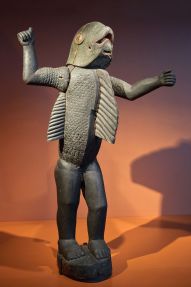
Benin Fon statue symbolizing Behanzin man shark (Musee du quai Branly – Jacques Chirac)
Congolese Rumba has been recognized as a UNESCO Intangible World Heritage. Congratulations to both Congos, the Republic of Congo and the Democratic Republic of the Congo (DRC) for working together. We do hope that this is just the first step in a collaboration that will extend to other domains including economic success and beyond [Congolese Rumba Wins UNESCO Protected Status].
Now, there are a lot more such as David Diop winning the International Booker prize for his book “At Night All Blood is Black” which focuses on Tirailleurs Senegalais; or the Senegalese influencer Khaby Lame being ranked number 2 on Tik Tok for his wordless humor which transcends language barriers and cultures (he is the fastest growing Tik Tok influencer with 120 million followers); or even Madagascar’s secretary of police, Serge Gelle, swimming for about 12 hours to reach shore after his helicopter crashed in the Indian Ocean off the northeast coast of the country. When rescued, Gelle said “My turn to die has not yet come, thank God.” So let us all be grateful for this year, and for the people and events who have brought joy to our lives, and let us move forward to a new year.
This is historic, late and probably not enough compared to the loss in human lives… yet it is historic nonetheless! Germany has agreed to pay 1.1 billion Euros over the Herero-Nama genocide [Germany in Namibia: the First Genocide of the 20th Century]. This will be paid in existing aid programs over 30 years. I am always skeptical of these aid programs, because countries and companies usually get their money back that way…; plus there are probably billions worth of Namibian diamonds or cobalt mines that will profit German companies in the fine prints. Anyways, for the first time, Germany called the atrocities ‘genocide‘, but fell short of calling the arrangement ‘reparations’ and ‘compensation’ [Have Germans finally acknowledged the Namibian Genocide?]. It is a step forward, we acknowledge it, and recognize the progress. Enjoy! Excerpts below are from the Guardian.
=====
Germany calls atrocities ‘genocide’ but omits the words ‘reparations’ or ‘compensation’ from a joint statement.
Germany has agreed to pay Namibia €1.1bn (£940m) as it officially recognised the Herero-Nama genocide at the start of the 20th century, in what Angela Merkel’s government says amounts to a gesture of reconciliation but not legally binding reparations.
Tens of thousands of men, women and children were shot, tortured or driven into the Kalahari desert to starve by German troops between 1904 and 1908 after the Herero and Nama tribes rebelled against colonial rule in what was then named German South-West Africa and is now Namibia.
Chained Herero men
Since 2015, Germany has negotiated with the Namibian government over what it calls an attempt to “heal the wounds” of historic violence.
“Our aim was and is to find a joint path to genuine reconciliation in remembrance of the victims,” the German foreign minister, Heiko Maas, said in a statement. “That includes our naming the events of the German colonial era in today’s Namibia, and particularly the atrocities between1904and 1908, unsparingly and without euphemisms.
“We will now officially call these events what they were from today’s perspective: a genocide.”
On Thursday, official circles in Berlin confirmed reports in Namibian media that after nine rounds of negotiations the two sides had settled on the text of a joint declaration and a sum of €1.1bn, which will be paid separately to existing aid programmes over 30 years.
Of the overall sum, more than a billion euros will go towards projects relating to land reform, rural infrastructure, water supply and professional training. Communities of Herero and Nama descendants, which form ethnic minorities in all of the seven affected regions, are meant to be involved in the development of the specific projects.
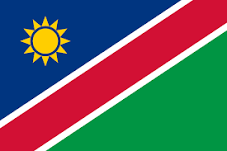
Flag of Namibia
… The text of the joint declaration calls the atrocities committed by German troops a “genocide” but omits the words “reparations” or “compensation” – a move borne out of fear that such language could set a legal precedent for similar claims from other nations.
A spokesman for the Namibian president, Hage Geingob, described German’s acknowledgment of genocide “as the first step” in the right direction. “It is the basis for the second step, which is an apology, to be followed by reparations,” the spokesman said.
Some of the numerous groups that make up the descendants of the genocide’s survivors have been critical of the framing of the negotiations from the outset and have declined to back the Namibian government’s stance. ….









 African Heritage