Why the name: Yaoundé?

Yaoundé around the May 20th Boulevard

Yaoundé, the capital of Cameroon and its second largest city after Douala, is often known as “the city with the seven hills” because of the hills surrounding it… but what does it really mean?  Does its name refer to its hills?
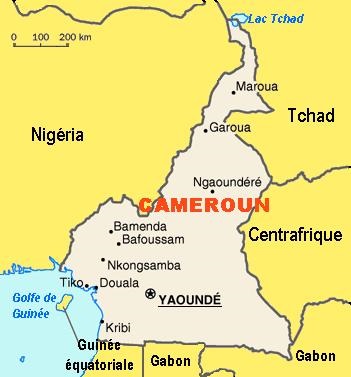
Map of Cameroon, with the capital Yaoundé

In Béti, Yaoundé is often called, Ongolo-Ewondo, or the Ewondos’ enclosure (la clôture des Ewondos).  The city was born around 1889, when the German traders implanted a camp in the Ewondo region and called it Sono station after a local Ewondo chief Essono Ela who had offered them hospitality (the Germans had encountered a strong resistance in the Vouté and Eton regions).  Hearing locals from the coast refer to it as Ya-Ewondo or Among the Ewondo (chez les Ewondos), the Germans called it ‘Jaunde’ and it later turned into ‘Yaunde’, and in French Yaoundé.  The station later turned into an administrative region under the leadership of the botanist Zenker who established a detailed map of the area in 1890.  Upon its creation, it was first a scientific post (probably because of the botanist), and later in 1895 became a military and trading post for ivory and rubber.

Yaoundé at night
Yaoundé at night

Yaoundé was not always the country’s capital.  After the 1909 volcanic eruption of Mt Cameroon in Buéa (Gbéa) which was then the capital, and the humid climate of Douala, the Germans decided to move the capital to Yaoundé because of its central location and its milder climate (and of course, no volcano).  After Germany’s defeat in World War I, Cameroon was placed under French (the eastern regions) and British protectorate (the western regions).  Yaoundé consequently became the capital of French Cameroon, and continued as the capital of the Republic of Cameroon after independence (it was first the Federal Republic of Cameroon in 1961, then The United Republic of Cameroon in 1972, which then officially became the Republic of Cameroon in 1984).  From 100 inhabitants on 2 acres on land at the end of the 19th century, Yaoundé is today a vibrant city home to almost 2 million inhabitants.
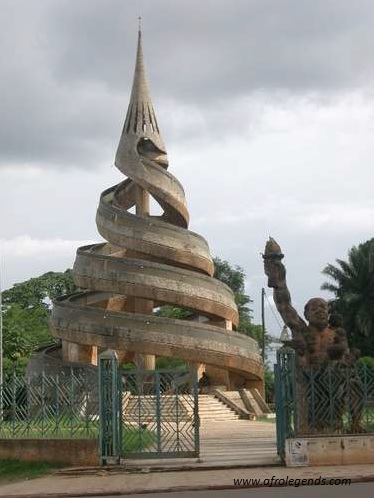
The Reunification Monument in Yaoundé

Yaoundé lies at the center of the nation, at about 600 – 1000 m above sea level.  The city first grew around the Mfoundi river.  A network of hills make up its landscape such as Mts Mbam Minkom (1295 m), Nkolodom (1221 m), Messa, Fébé, Akokdoué in the North and West, and Mt Eloumden (1159 m) in the south.  The rivers are the Mfoundi, Ekozoa, Biyeme, and Mefou.  Today, Yaoundé is the siege of power, the presidential palace, the house of parliament, all ministries and embassies. Please enjoy this song of one of Cameroon’s great singers: André-Marie Tala about Yaoundé, and its beauty.  What I have always liked about Yaoundé are its hills (and the red soil):  from the top of one them, other parts of the city can be seen; it gives a feeling of “breathing in” or “taking in” the beauty of the entire city.  Feel the joy of visiting this city which, like Rome has 7 hillsEnjoy the Rome of Africa!

Rudolf Douala Manga Bell: One of Cameroon’s first Resistant

Rudolf Douala Manga Bell - ca 1900s
Rudolf Douala Manga Bell – ca 1900s

Today, I would like to talk about one of the heroes of Cameroonian history, Rudolf Douala Manga Bell, who stood against the Germans in the 1910s in Kamerun.  His courage, and strong determination earned him the right of martyr and hero in the history of the Douala (or Duala) people, and thus of Cameroon.

Rudolf Douala Manga Bell was born in 1872, and studied in Cameroontown (modern-day Douala).  He was the first son of King Manga Ndumbe Bell, of the Douala people.  After completing his primary education and part of his secondary school in Cameroon, he went to study at the Lycée of Aalen in Bonn (Germany) finishing secondary school.  He later went on to study law at the university there.

Kamerun (German Cameroon)

Manga Bell married Emily Engome Dayas, the daughter of an English trader and a Douala woman after his return home in 1896.  He also became a civil servant.  On 2 September 1908, he succeeded to his father as Paramount Chief (Chef Supérieur) of the Bell dynasty (founded since 1792) which encompassed the Bonamandone, Bonapriso, Bonadoumbe, all owners and inhabitants of the Plateau Joss in Douala.  In those days, Douala was composed of several tribes: Bakole, Bakweri, BambokoIsubu (or Isuwu), Limba (or Malimba), Mungo, and Wovea.  Among those chiefs, some of them including the famous King Akwa, signed a Germano-Douala treaty on 12 July 1884, which placed Cameroon under German protection.  Cameroontown thus became Kamerunstadt.

Rudolf Douala Manga Bell, Leader of Douala people

In 1910, the German governor of Cameroon, Theodor Seitz, approved an urbanization project for the city of Douala (Kamerunstadt had been renamed Douala) set to turn it into one of the largest ports of Africa.  The project outlined a plan to relocate the Douala people inland from the Wouri river to allow European-only settlement of the area.  Neighborhoods such as Neu Bell, Neu Akwa, and Neu Deido were to be created for the indigenous people; these new allotments were going to be separated from the ‘European city’ by a barrier 1km wide (early version of apartheid!).  The expropriations affected most of the Douala clans, who were angered and formed a united front behind Manga Bell.  Rudolf Douala immediately refused, and told the Germans that the treaty signed in 1884 did not stipulate the removal/expulsion of the locals from their lands, and that this separation constituted a form of apartheid.  Manga Bell then enlisted the help of Hellmut von Gerlach, a German journalist.  Gerlach managed to secure a suspension order from the Reichstag Budget Commission in March, but the order was overturned when Colonial Secretary Wilhelm Solf convinced elements of the press, businessmen in the colony, politicians, and other groups to finally rally behind the expropriation. Manga Bell and the Douala requested permission to send envoys to Germany to plead their case, but the authorities denied them.  In secret, Manga Bell sent Adolf Ngoso Din to Germany to hire a lawyer for the Douala and pursue the matter in court.

Adolf Ngosso Din, Assistant to Rudolf Manga Bell
Adolf Ngoso Din, Assistant to Rudolf Manga Bell

Manga Bell then turned to other European governments and to leaders of other African ethnic groups for support.  His envoys to other Cameroonian leaders reached Bali, Balong, Dschang, Foumban, Ngaoundéré, Yabassi, and YaoundéCharles Atangana (Karl Atangana), leader of the Ewondo and Bane peoples, kept Manga Bell’s plan secret but urged the Douala leader to reconsider.  In Bulu lands on the other hand, Martin-Paul Samba agreed to contact the French for military support if Manga Bell petitioned the British.  However, there is no evidence that Manga Bell ever did so.  In Foumban, Ibrahim Njoya, sultan of the Bamum people, rejected the plan and informed the Basel Mission on 27 April 1914 that Manga Bell was planning a pan-Kamerun rebellion.  The missionaries alerted the Germans.
Noticing the German lack of respect of the signed law, who started removing locals from their lands, Bell allied with other chiefs of Cameroon to counter the colonial plans.  During the mutiny, the Germans arrested the Douala leader and Ngoso Din on 10 May 1914 accusing him of high treason.  Their trial was held on 7 August 1914.  World War I had just begun, and an attack by the Allied West Africa Campaign in Kamerun was imminent; accordingly, the trial was rushed. On 8 August 1914, Rudolf Douala Manga Bell and Ngoso Din were hanged.

Let us all celebrate Rudolph Douala Manga Bell,  the Tét’èkombo (the king of kings in Douala), the first, the uniter of Cameroon (already reaching out to other kings), and one of Cameroon’s biggest resistant.  Enjoy this old rendition by Charles Ewandje (probably recorded in the 70′s) of Tet’Ekombo an ode to resistance and to the land.  The song was written in 1929 in memory of Rudolf Douala Manga Bell.

Félix Moumié: Un independantiste Camerounais

Felix Moumie
Felix Moumie

Charité bien ordonnée commence par soi-même!” Il est enfin temps que je parle d’un des pères de la nation camerounaise, d’un unique indépendantiste qui s’est battu pour la libération de son pays, et qui a été lâchement assassiné en Suisse (empoisonné) par les services secrets Français: Felix-Roland Moumié! C’est en 2006, que nous decouvrons pour la première fois, l’histoire ou plutôt un bref sommaire relatant les derniers jours de cet indépendantiste à travers un documentaire intitulé “L’assassinat de Felix Moumié- L’Afrique sous contrôle,” réalisé par Frank Garbely.

Les leaders de l'UPC: Ruben Um Nyobe, Felix Moumie, et Ernest Ouandie
Les leaders de l’UPC: Ruben Um Nyobe, Felix Moumie, et Ernest Ouandie

Felix Moumié, médécin de formation (chirurgien d’ailleurs), deviendra le leader de l’Union des Populations du Cameroun (UPC) après l’assassinat de Ruben Um Nyobé. Il menera bien le parti et sera assassiné à son tour, empoisonné dans un restaurant de Genève en Suisse. Dans le documentaire que vous verrez ci-dessous, faites attention de ne pas etiquetter Moumié. La chose qui me fait vraiment mal quand je vois ce documentaire, c’est sa veuve, Marthe Ekemeyong Moumié qui pleure et réclame que lumière soit faite sur la mort de son mari, et surtout que son corps lui soit remis afin qu’il puisse être enterré dans son pays natal, le Cameroun.

Marthe Ekemeyong Moumie

La chose qui me fait encore plus mal, c’est de savoir que cette dame qui s’est battue pour que la mémoire de son mari soit célébrée fut violée et assassinée au début de l’année (Janvier 2009) à Ebolowa!  Pourquoi ce crime ignoble? Qu’est-ce-qu’une pauvre dame inoffensive peut-elle faire à qui que ce soit? Comme quoi il y a encore certaines choses qui méritent d’etre déterrées, et il est important que les Camerounais connaissent leur histoire. Une chose est sûre et certaine, je lève mon chapeau à cette dame qui mérite de faire partie des annales des femmes fortes du continent Africain.

N’oubliez pas de regarder les parties suivantes 2 et 3 (Felix Moumie Part 2, Felix Moumie Part 3)

N’oubliez pas d’aller contribuer sur Wikipedia… la page sur Moumié est presque vide! Felix Moumié sur Wikipedia