Gabon Signs Manganese Production and Extraction Partnership

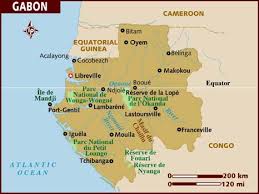
Map of Gabon

As we highlighted last week, Gabon was part of the five African countries invited to the White House last year by US President Donald Trump. Gabon was the only country invited to the summit which was not part of West Africa. Gabon is not only rich in oil but also rich in uranium and manganese, and has one of the world’s largest iron deposit. Gabon has significant iron ore reserves, particularly in the Belinga area, which is estimated to hold about one billion tons of iron ore. Since the visit, Gabon has unveiled several infrastructure deals including the Belinga–Boué–Mayumba railway (901 km) which will open up the north east areas of the country, a new deep-water port, the Boué hydroelectric dam, and a push for local processing of mineral resources. 

Yesterday, the president of Gabon Brice Clotaire Oligui Nguema, while in visit in France to meet French President Macron, unveiled yet another project, this time in connection with the French mining group Eramet for the exploitation of Manganese; with hopes of opening the south east region by rehabilitating approximately 650 km of railway linking Owendo near the capital Libreville to Franceville in the east as part of the Trans-Gabon Railway, and the exploitation and transformation of 700,000 tons of manganese (Africanews). There will be three phases including the creation of a factory for the production of manganese oxide to be built in Libreville by 2028, the construction of a unique site in Moanda specially for the transformation of this mineral in Gabon, and lastly the building of new plant for the production of manganese alloys locally to be built in 2031.
Flag of Gabon

The office of the Gabonese president stated that the agreement will help “generate greater added value within the country, support its industrialisation and boost the competitiveness of the national economy.” These will be followed by other agreements to cover security (maybe consolidating the defense part of The 11 Components of the French Colonial Tax in Africa? Not to forget that Oligui Nguema came to power via a coup) and water and energy sectors.

We applaud all these projects which mark a jump towards the industrialization of the country, and pray that these actually end up benefiting the people, as opposed to the countless other agreements signed over the years which have very little to show for. We still hope that African countries would unite to make stronger contracts/ agreements to get the best deals possible and bigger jumps toward development.

Who/What did We Say Goodbye to in Africa in 2025 ?

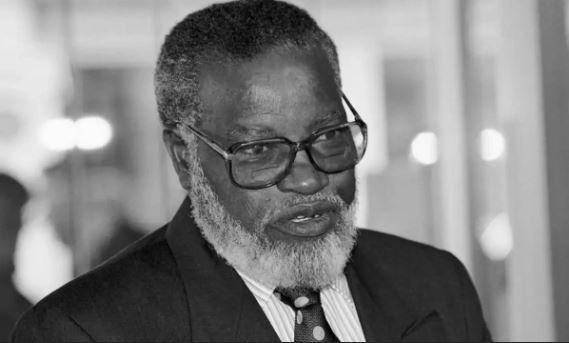
Sam Nujoma (Source: newscentral.africa)

2025 is coming to an end, and there are a few people we said goodbye too, and situations as well. Below are some of them:

  1. This February, on Saturday, February 8 2025Sam Nujoma, Namibia’s first president and founding father passed away at the age of 95. Nujoma led the long fight for independence from South Africa for many years, which culminated with independence on 21 March 1990 of South West Africa, as the country was formerly known. So Long to Sam Nujoma, Namibia’s First President.
  2. In April, Amadou, of the Malian duo Amadou and Mariam passed away at their home in Bamako, Mali. The Grammy-nominated duo Amadou & Mariam was a blind duo from Mali. They both met at the Institute for the young blind in Bamako in 1976 and their song “Je pense a toi” helped them get world fame. So Long to Malian Singer, Member of Duo Amadou & Mariam
  3. Flag of Gabon

    Brice Oligui Nguema of Gabon, the coup leader who kicked Ali Bongo out of power, the one the West lauds so much, traded his military fatigues for a suit and won the elections by a landslide with a score worthy of a Banana Republic, 90.35%! and Yes, he got all the accolades of the West! This was a total imposture! Recall that Oligui Nguema took the power when the populations protested the presidential elections when Ali Bongo was declared winner instead of the rightful winner who was Albert Ondo Ossa; thus Nguema should have stepped in to right the wrong by putting on the one the people had voted for; instead he took over under the applause of the “international community”. Gabon and the Double Standards of the International Community, and Gabon Oligui Nguema Wins by Landslide.

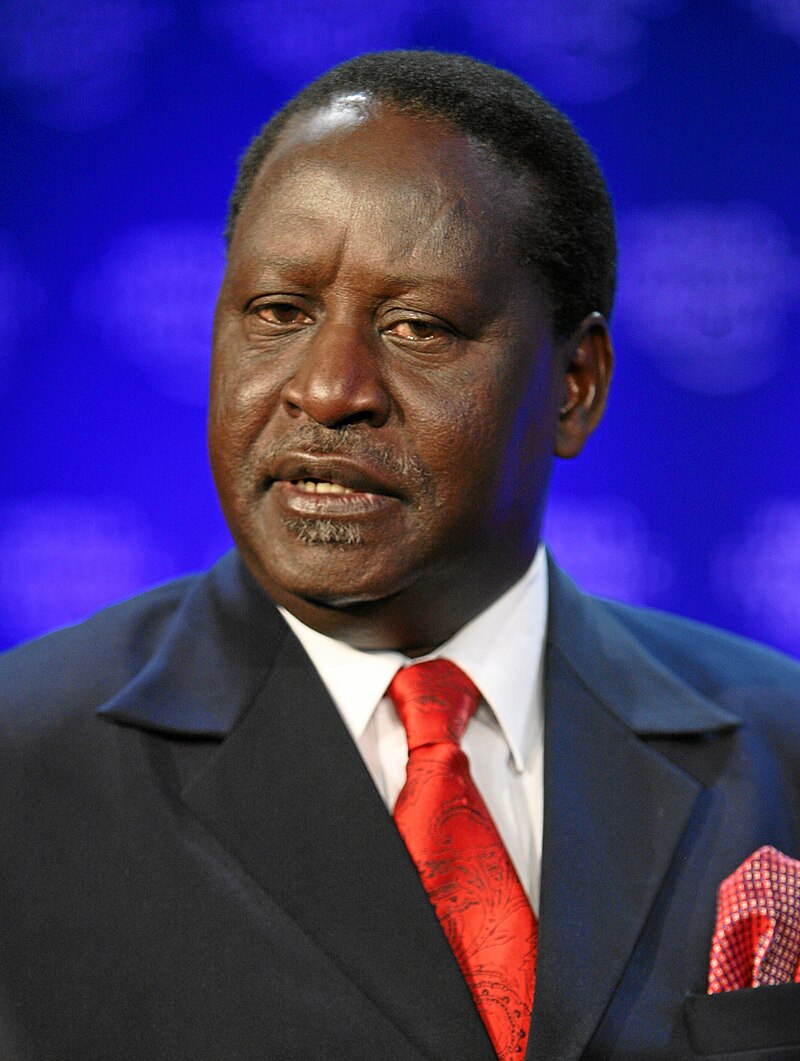
  4. Raila Odinga (Source: World Economic Forum)

    This year Kenya, and the whole of Africa said goodbye to Raila Odinga, the inevitable and greatest opposition leader and fighter to the end for Kenyan democracy. Raila Odinga had been a dominant unavoidable force in Kenyan politics for over 30 years. He was a baobab in Kenya’s political scene, who has always fought for the freedom and democracy in Kenya. Out of the past 5 elections, 1997, 2007, 2013, 2017, and 2022, he had always contested, came second, and even narrowly won to the point that there have always been disputes which have gone as far as civil unrest as in 2007… even the last elections which saw Ruto win were tight with the presence of Odinga. So Long to Raila Odinga, Fighter to the End for Kenyan Democracy, and Raila Odinga in His Own Words.

  5. Flag of Cameroon

    Cameroonians saw another weird presidential elections. Not sure if what happened there was a real election. Paul Biya was reelected for a 7th term after 43 years as president of the country, with 20 before as minister and prime minister. This would mark 43 years of walking backwards for Cameroon… no electricity, no water in most places, and major cities overflowing with refuse.  After a magic trick in the 11th hour, where by a switch of a virtual pen, the best and strongest opponent, Maurice Kamto, was removed from the presidential election contest; then the elections took place with another opponent who barely 2 months before was a minister to the regime Issa Tchiroma. To be honest, after 43 years, there is no doubt that anybody would win against the incumbent. Cameroon – Where Self-Hate is used to Keep a Country in Bondage, and Cameroon – History Repeats Itself ? Since then, there have been protests in the country.

  6. La Cote d'Ivoire
    La Cote d’Ivoire

    Alassane Ouattara, president of Cote d’ivoire, was reelected for a 4th term he was not supposed to be able to run for (in view of the country’s constitution), after selectively eliminating some of the major contenders like Laurent Gbagbo and Tidjane Thiam, leaving only a few such as Simone Gbagbo, Jean-Louis Billon, Ahoua Don Mello, and Henriette Lagou Adjoua. He won the elections with another Banana Republic-type score of 91.2%. Wow! The hijacking of the constitution and Ivorian freedom continues! Given that he serves well Western interests, he was congratulated for his reelection.

  7. Flag of Tanzania

    President Samia Suhulu Hassan of Tanzania was elected under shady circumstances and protests. The protests were suppressed in blood; it has been said that since the October 29 elections, there have been more than 2,000 detained, vehicles and buildings burned, and hundreds of deaths. Even the lady was inaugurated under tight security. Recall that she was never elected, but rather came to power after President John Magufuli passed away in office (So Long to President John Magufuli of Tanzania: The Bulldozer). She won with another kafkaesque score of 97%, after the country’s two main opposition parties were barred and the main opposition leader, Tundu Lissu, was imprisoned. Only seen on our continent! This is a clear hijacking of the freedom of Tanzanians; which we will go as far as calling it a coup against the people’s will.

  8. Flag of Guinea Bissau

    There was a coup d’etat in Guinea-Bissau, which looks more like a fake coup. Unlike other places, the coup d’etat was not condemned by ECOWAS or other places; and nobody was called junta by the West. Thus, Guinea Bissau traded Umaro Sissoco Embalo for a general he chose. Recall that he was not even supposed to run for elections, and violated his country’s constitution. He first ran into exile in Senegal, but later moved to the Republic of Congo; he has been accused by opposition and international figures such as former Nigerian president and election monitor Goodluck Jonathan of staging the coup to avoid losing the election against Fernando Dias da Costa. Since it was staged, nobody has called the newcomers, led by Horta Inta-A Na Man, as junta like for the Sahel.

  9. Flag of Madagascar

    There was a coup in Madagascar (2025 Malagasy coup d’état) which saw the fall of President Andry Rajoelina, the DJ who had previously been installed by France, and had also come into power after a coup against Marc Ravalomanana who was not accepted by the West. Macron and France helped fly Rajoelina out to safety in Dubai where he now resides. The new man in charge is general Michael Randrianirina. This coup started by the protests of the populations against power cuts and water outages which have been very common nationwide especially in the capital Antananarivo… they were met with violence from the government police… then it went on, until the army stepped up, and took Rajoelina out. Goodbye to Rajoelina, and welcome to Randrianirina … we hope that he will work for the Malagasy people.

  10. Flag of the Democratic Republic of Congo

    The Democratic Republic of Congo (DRC) signed a “peace” agreement with Rwanda. It started The Declaration of Principles between the Democratic Republic of Congo (DRC) and Rwanda signed in June by DRC and Rwanda foreign affairs ministers including the American Secretary of State. This was later ratified in December by both presidents Felix Tshisekedi of DRC and Paul Kagame of Rwanda in presence of the American President Donald Trump. As we had pointed out, how could a peace agreement with DRC be signed which does not clearly state that Rwanda is the aggressor of the DRC? How can there be a peace agreement, if Rwanda does not admit to its crimes against the Congolese people? Why is there no mention of the close to 10 million dead Congolese from this 30-year-old conflict? What sort of a peace is that if there is no justice? Well, to prove us right, new conflicts started in the region immediately after the signature of the agreement, or rather they never stopped. Peace Agreement between the Democratic Republic of Congo (DRC) and Rwanda: Is this for Real? Thus, the DRC is still under attack. We should tell all these Congolese and African politicians to stop signing documents in fear… nothing good comes out of negotiating from a position of fear!

  11. Flag of Sudan

    As the year closes, the civil war is still ongoing in Sudan, all of that under the eyes of the “international” community. Sudan’s brutal civil war has dragged on for over years, displacing millions and killing in excess of 150,000 people. This is now among one of the deadliest conflict in the world today. Our hearts go out to our Sudanese brothers and sisters.