Today, We will look at a poem by the most celebrated Ivorian writer Bernard Binlin Dadié. The poem below is titled “I Thank you God” or “I thank you my God,” and it is an ode to us Africans, raising the self-esteem. Dadié writes here about his pride of being born Black, around independence, when the colonizer had almost beaten out of us our pride of being Black, our pride of being ‘us’. Enjoy! a great poem from Bernard B. Dadié.
Je vous remercie mon Dieu, dem’avoir créé Noir, d’avoir fait de moi la somme de toutes les douleurs, mis sur ma tête, le Monde. J’ai la livrée du Centaure Et je porte le Monde depuis le premier matin.
Le blanc est une couleur de circonstance Le noir, la couleur de tous les jours Et je porte le Monde depuis le premier soir.
Je suis content de la forme de ma tête faite pour porter le Monde, Satisfait de la forme de mon nez Qui doit humer tout le vent du Monde, Heureux de la forme de mes jambes Prêtes à courir toutes les étapes du Monde.
Je vous remercie mon Dieu, de m’avoir créé Noir, d’avoir fait de moi, la somme de toutes les douleurs. Trente-six épées ont transpercé mon coeur. Trente-six brasiers ont brûlé mon corps. Et mon sang sur tous les calvaires a rougi la neige, Et mon sang à tous les levants a rougi la nature.
Je suis quand même Content de porter le Monde, Content de mes bras courts de mes bras longs de l’épaisseur de mes lèvres.
Je vous remercie mon Dieu, de m’avoir créé Noir, Je porte le Monde depuis l’aube des temps Et mon rire sur le Monde, dans la nuit crée le jour.
Ithank you God, for making me black, for making me the sum of all pains, putting on my head the world. I took the world to the Centaur And I have carried the world since the first morning.
White is a color of circumstance Black is the color of every day And I have carried the world since the first evening.
I am happy with the shape of my head shaped to carry the world, Satisfied with the shape of my nose which has to smell all the scents of the world, Happy with the shape of my legs ready to run all the steps of the world.
I thank you God, for having created me black for having made me the sum of all pains. Thirty-six swords have pierced my heart. Thirty-six brasiers have burned my body. And my blood for all the suffering reddened the snow, And my blood made the east red.
I am still Happy to carry the world, happy with my short arms of my long arms of my thick lips.
I thank you God, for having created me black, I carry the world since the beginning of times And my laughter on the world, at night created the day.
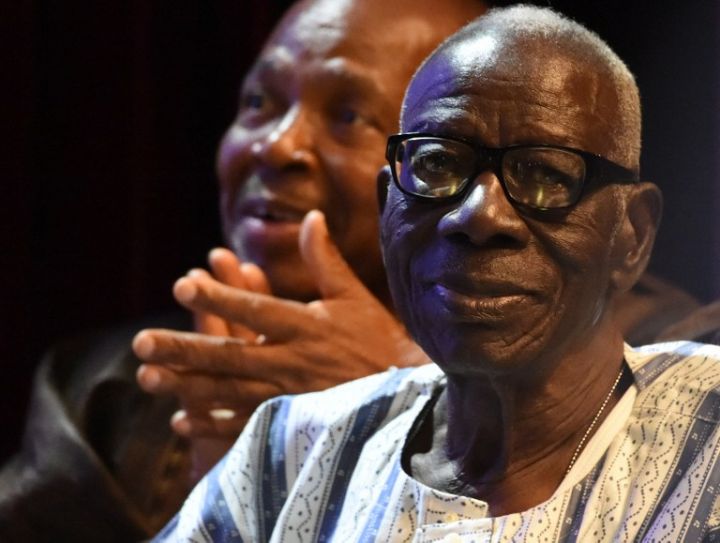
Africa just lost a giant… the world just lost a literary genius. Chinua Achebe was made of the cloth of kings. He was the emperor of words and just made reality seems so funny. He wrote in English, but yet made it his own; he made it African. Please hear the maestro in his own words.
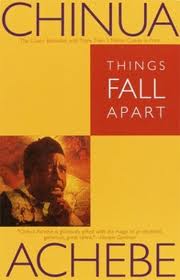
“Age was respected among his people, but achievement was revered. As the elders said, if a child washed his hands he could eat with kings.” – Things Fall Apart.
“The white man is very clever. He came quietly and peaceably with his religion. We were amused at his foolishness and allowed him to stay. Now he has won our brothers, and our clan can no longer act like one. He has put a knife on the things that held us together and we have fallen apart,” – Things fall Apart.
Achebe was a man of character, who could not be corrupted by honors. He twice turned down the offer of a title Commander of the Order of the Federal Republic, once in 2004 from Nigeria’s then President Olusegun Obasanjo and again in 2011 from President Goodluck Jonathan. He explained on the BBC: “What’s the good of being a democracy if people are hungry and despondent and the infrastructure is not there,” … “There is no security of life. Parts of the country are alienated. Religious conflicts spring up now and again. The country is not working.” Declining the honor, he wrote that “for some time now I have watched events in Nigeria with alarm and dismay. I have watched particularly the chaos in my own state of Anambra where a small clique of renegades, openly boasting its connections in high places, seems determined to turn my homeland into a bankrupt and lawless fiefdom. I am appalled by the brazenness of this clique and the silence, if not connivance, of the presidency … Nigeria’s condition today under your watch is, however, too dangerous for silence. I must register my disappointment and protest by declining to accept the high honour awarded me in the 2004 honours list.”
‘Things Fall Apart’ by Chinua Achebe
He wrote: “You see we, the little people of the world, are ever expendable.”
“It is sometimes good to be brave and courageous, but sometimes it is better to be a coward. We often stand in the compound of the fool and point at the ruins where a brave man used to live. He who has never submitted to anything will one day submit to his burial mat.” – Things fall apart.
“While we do our good works let us not forget that the real solution lies in a world in which charity will have become unnecessary.” – Anthills of the Savannah.
“To me, being an intellectual doesn’t mean knowing about intellectual issues; it means taking pleasure in them.”
“Nobody can teach me who I am. You can describe parts of me, but who I am – and what I need – is something I have to find out myself.”
“One of the truest tests of integrity is its blunt refusal to be compromised. ”
“We cannot trample upon the humanity of others without devaluing our own. The Igbo, always practical, put it concretely in their proverb Onye ji onye n’ani ji onwe ya: “He who will hold another down in the mud must stay in the mud to keep him down.” – The Education of a British-Protected Child: Essays.
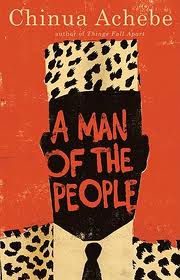
‘A Man of the People’ by Chinua Achebe
“‘It’s true that a child belongs to its father. But when a father beats his child, it seeks sympathy in its mother’s hut. A man belongs to his fatherland when things are good and life is sweet. But when there is sorrow and bitterness he finds refuge in his motherland. Your mother is there to protect you. She is buried there. And that is why we say that mother is supreme.” – Things fall Apart.
“Unfortunately, oppression does not automatically produce only meaningful struggle. It has the ability to call into being a wide range of responses between partial acceptance and violent rebellion. In between you can have, for instance, a vague, unfocused dissatisfaction; or, worst of all, savage infighting among the oppressed, a fierce love-hate entanglement with one another like crabs inside the fisherman’s bucket, which ensures that no crab gets away. This is a serious issue for African-American deliberation…. To answer oppression with appropriate resistance requires knowledge of two kinds: in the first place, self-knowledge by the victim, which means awareness that oppression exists, an awareness that the victim has fallen from a great height of glory or promise into the present depths; secondly, the victim must know who the enemy is.He must know his oppressor’s real name, not an alias, a pseudonym, or a nom de plume!” – The Education of a British-Protected Child: Essays.
“Women and music should not be dated.” – No Longer at Ease
“A man who pays respect to the great, paves the way for his own greatness.”
‘No Longer at Ease’ by Chinua Achebe
“I would be quite satisfied if my novels (especially the ones I set in the past) did no more than teach my readers that their past – with all its imperfections – was not one long night of savagery from which the first Europeans acting on God’s behalf delivered them.”
“Procrastination is a lazy man’s apology.” – Anthills of the Savannah
About his gift of writing, he said: “There is that great proverb — that until the lions have their own historians, the history of the hunt will always glorify the hunter. … Once I realized that, I had to be a writer. I had to be that historian.”… “It’s not one man’s job. It’s not one person’s job. But it is something we have to do, so that the story of the hunt will also reflect the agony, the travail — the bravery, even, of the lions.”
Tributes are pouring out from all corners of the world. Truly to have written a book which has been translated in over 50 languages is a great achievement for an African, and for anybody in this world. To boast over 20 literary works is amazing. As the Igbo proverb says: ” it is simply impossible for an iroko tree to fall and the forest to remain quiet.” A giant left us today, but his fingerprints will remain forever.
If the nobel prize was made to celebrate excellence, Chinua Achebe, should have certainly gotten it. Today his work is celebrated in every corner of the world!
This morning, I woke up to the horrible news of Chinua Achebe’s passing. Weird, how just yesterday I had ordered his latest book “There was a Country”, a memoir on the Biafran war. My goodness, how can Achebe be gone? I have all his books in my home library. Just yesterday, I was talking about how great his sense of humor was. My goodness, I was dreaming about reading more books from Achebe. What kind of thing is this?Chinua Achebe, you have inspired me… you have made me want to be a blogger… You have made me want to be a writer, an activist, and a truth speaker … hopefully, one day I will write books as funny as you did.
A friend’s dad went to school with Chinua Achebe, and he had this moral story to tell about Achebe: ” You can never be who you are not and never force your child to be what they were NOT meant to be. Achebe’s parents always wanted him to be a medical doctor. While in school, science was a struggle for him. But once he got back into himself and did what God had planned for him, the sky became his limit.”
So long to the Father of African literature, the inspiration to generations of writers, the maestro himself. Today, I truly felt like ‘things were falling apart.’
Here is a peace I wrote about him back at the very beginning of my blog: see… he was the first article I published in my ‘Great Literature’ section. Chinua Achebe: A Writer like No Other.
Today, We will look at a poem by the most celebrated Ivorian writer Bernard Binlin Dadié. The poem below is titled “Dry your Tears Afrika” or “Sèche Tes Pleurs“. Published in 1967, this poem is basically about Africa and her sons and daughters returning home. It is about healing the wounds of slavery, colonialism, and neo-colonialism. This poem was actually translated into Mende, a language spoken by ~ 46% of Sierra Leone. It was also set to music by American composer John Williams for the Steven Spielberg movie, Amistad. Below is the original poem in French, written by Dadié. The English version can be found below. Enjoy the text, and the video of the poem sung in Mende with the English translation.
Sèche tes pleurs Afrique! Tes enfants te reviennent dans l’orage et la tempête des voyages infructueux. Sur le ris de l’onde et le babil de la brise, Sur l’or des levants Et la pourpre des couchants des cimes des monts orgueilleux Et des savanes abreuvées de lumière Ils te reviennent dans l’orage et la tempête des voyages infructueux. Sèche tes pleurs, Afrique Ayant bu À toutes les fontaines d’infortune et de gloire, Nos sens se sont ouverts à la splendeur de ta beauté à la senteur de tes forêts, à l’enchantement de tes eaux à la limpidité de ton ciel à la caresse de ton soleil Et au charme de ta verdure emperlée de rosée.
Sèche tes pleurs, Afrique! Tes enfants te reviennent Les mains pleines de jouets Et le coeur plein d’amour. Ils reviennent te vêtir De leurs rêves et de leurs espoirs.
Bee ya ma yee ah, bee len geisia bee gammah. Bee ya ma yee ah, bee len geisia tee yamanga. Baa wo, kah ung biah woie yaa. Baa wo, kah ung biah woie yah, yah. Oo be ya ma yee ah, bee len geisia tee yamanga. Mu ya mah mu yeh, Mu ya mah mu yeh, Mu ya mah mu yeh, Afrika. Mu ya mah mu yeh, Mu ya mah mu yeh, Mu ya mah mu yeh, Afrika.Bee ya ma yee ah, bee len geisia tee yamanga. Mu ya mah mu yeh, bee len geisia bee gammah. Oo bee ya mah yee ah Bee len geisia tee yamanga. Mu ya mah mu yeh, Mu ya mah mu yeh, Mu ya mah mu yeh, Afrika. Mu ya mah mu yah, Mu ya mah mu yah, Mu ya mah mu yeh, Afrika.
Be ya mah yee ah, bee len geisia tee yamanga. Be ya mah yee ah, bee len geisia bee gammah. Mu ya mah mu yeh, Mu ya mah mu yeh, Mu ya mah mu yeh, Afrika. Mu ya mah mu yeh, Mu ya mah mu yeh, Mu ya mah mu yeh, Afrika. Mu ya mah mu yeh, Mu ya mah mu yeh, Mu ya mah mu yeh, Afrika.
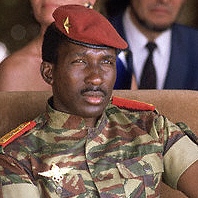
Je n’ai pu m’empêcher de partager avec vous ce pur joyau d’un autre temps: une interview du President Thomas Sankara par Mongo Beti. Cette interview n’avait jamais été publiée auparavant, jusqu’à ce que l’épouse de Mongo Beti, Odile Tobner, la mette sur le site de la Société des Amis de Mongo Beti (SAMBE). En 1985, Mongo Beti eut une entrevue privée avec notre ‘Che’ africain, Thomas Sankara, à la fin de laquelle, il lui envoya d’autres questions auxquelles Thomas répondit. Ci-dessous, vous trouverez quelques extraits de cet entretien, où j’ai mis les questions de Mongo Beti sous formes de thèmes, et les réponses de Sankara suivent juste après (en bleu). Pour l’intégrale, prière de visiter SAMBE.
==========
Sur les attaques ennemies: “Il y a partout aujourd’hui, aux quatre coins du continent, des N’Krumah, des Lumumba, des Mondlane, etc. Que Sankara soit éliminé aujourd’hui physiquement, il y aura des milliers de Sankara qui relèveront le défi face à l’impérialisme. …Toutefois, pour mille et une raison, notre peuple et la jeunesse révolutionnaire africaine restent attachées à Sankara et ne souhaitent jamais que le moindre malheur lui arrive.”
Sur la corruption: “Sans être un sociologue averti, ni un historien des sociétés précapitalistes africaines, je ne pourrai pas affirmer que la corruption est propre aux sociétés africaines. C’est un phénomène lié avant tout au système capitaliste, système socio-économique qui ne peut véritablement évoluer sans développer la corruption. Elle est donc incontestablement un héritage maudit de la colonisation. Ainsi, logiquement, pour combattre valablement la colonisation, le colonialisme et même le néocolonialisme, il faut aussi s’attaquer à la corruption.”
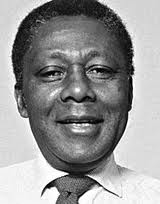
Alexandre Biyidi Awala, a.k.a. Mongo Beti
Sur les traditions africaines et la place de la femme (polygamie, excision): “On ne fait pas de révolution pour régresser dans le temps. C’est pour aller toujours de l’avant. La Révolution ne peut qu’étouffer tous les aspects négatifs de nos traditions. C’est cela notre combat contre toutes les forces rétrogrades, toutes les formes d’obscurantisme, combat légitime et indispensable pour libérer la société de toutes les emprises décadentes et de tous les préjugés, dont celui qui consiste à marginaliser la femme ou à la chosifier. … Nous luttons pour l’égalité de l’homme et de la femme, pas d’une égalité mécanique, mathématique, mais en rendant la femme l’égale de l’homme devant la loi et surtout devant le travail salarié. L’émancipation de la femme passe par son instruction et l’obtention d’un pouvoir économique. Ainsi le travail au même titre que l’homme, à tous les niveaux, la même responsabilisation et les mêmes droits et devoirs sont des armes contre l’excision et la polygamie, armes que la femme n’hésitera pas à utiliser pour se libérer elle-même et non par quelqu’un d’autre.”
Sur la cooperation, et la conference au sommet des chefs d’Etats francophones: “Lutter pour son indépendance face au colonialisme ne veut pas dire que l’on se prépare, une fois celle-ci obtenue, à quitter la terre pour aller s’isoler quelque part dans le cosmos. Quant aux conférences au sommet des chefs d’État francophones, ils servent, chaque fois que nous avons l’occasion d’y prendre part, de tribune, de tremplin pour notre révolution, pour la faire connaître, de dire ouvertement ce qu’elle pense de ces conférences ou instances politiques. Y participer pour dénoncer ce qui ne va pas dans l’intérêt des peuples africains est une stratégie beaucoup plus payante que les sarcasmes envoyés de l’extérieur.”
Sur le franc CFA: “le franc CFA, lié au système monétaire français est une arme de la domination française. L’économie française et, partant, la bourgeoisie capitaliste marchande française bâtit sa fortune sur le dos de nos peuples par le biais de cette liaison, de ce monopole monétaire.”
Sur le panafricanisme et Nkrumah: “Tout le monde constate aujourd’hui avec amertume, face aux méfaits et autres exactions de l’impérialisme en Afrique, que N’krumah avait très bien raison d’aller de tous ses voeux à l’unité du continent. Néanmoins l’idée demeure et il nous appartient, il appartient aux patriotes africains, de lutter partout et toujours pour sa concrétisation. Il appartient à tous les peuples panafricanistes de reprendre le flambeau de N’Krumah pour donner espoir à l’Afrique.”
Sur le parti unique: “Ce qui est discrédité c’est le parti unique bourgeois, parce que obéissant à une idéologie d’injustice, donnant le premier rôle à une minorité au détriment de la majorité. Un parti unique démocratique, c’est-à-dire un parti du peuple, ne peut en aucun cas être discrédité, parce qu’au service d’un peuple, des intérêts de la majorité. C’est sur une telle base qu’il faut voir la question du parti unique, qui est aussi une vision des masses.”
Sur la privatisation de certains secteurs: “La révolution burkinabé considère l’initiative privée comme une dynamique qu’elle prend en compte dans l’étape actuelle de la lutte du peuple burkinabé. … L’État ne peut pas s’engager dans une étatisation tous azimuts, même si le contrôle d’un certain nombre de secteurs vitaux de notre économie s’avère indispensable.”
Au camarade Mongo Beti, 3/11/85 La patrie ou la mort, nous vaincrons !
Today I will be talking about a writer of the caliber of Chinua Achebe and Ngugi wa Thiong’o, a writer often forgotten, a writer who fought with his writings for independence, a Cameroonian writer who wrote about Cameroon’s first freedom fighter Ruben Um Nyobé, and whose writings were banned… you have probably guessed it, I am talking about the great Mongo Beti.
Mongo Beti was born Alexandre Biyidi Awala, on 30 June 1932 in Akométan, near Mbalmayo, south of Yaoundé, the capital of Cameroon. From a young age, Mongo Beti was already exposed to the currents of independence and freedom that were shaking Cameroon, and was exposed to Um Nyobé. He would eventually get expelled from the local missionary school at 14, for being outspoken. As he himself said “At the time, I was very shocked by the idea of confessing my sins to someone else.” He would eventually attend the Lycee Leclerc in Yaoundé, and then move to the Sorbonne in Paris, France, for further studies.
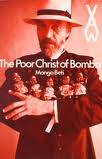
‘The Poor Christ of Bomba’ by Mongo Beti
Mongo Beti claimed that he entered writing through writing political tracts. His first piece was a short story published by Alioune Diop in 1953 in Présence Africaine, “Sans haine et sans amour” (Without hatred or love). He first started writing under the pen name Eza Boto, by fear of retaliation from the French colonial regime. His first book “Ville Cruelle” or “Cruel City” published in 1954, was actually on the school program in all high schools of Cameroon for many years in the 80s to late 90s. His second novel “Le Pauvre Christ de Bomba” (“The Poor Christ of Bomba“) was published under the pseudonym Mongo Beti, to distance himself from his previous piece. The name Mongo Beti means in Ewondo, ‘Son of the Beti people’. This new novel created a scandal because of its satirical and biting description of the missionary and colonial world. Under pressure from the religious hierarchy, the colonial administrator in Cameroon banned the novel in the colony. This novel was followed by “Mission Terminée” in 1957 (winner of the Prix Sainte Beuve 1958), andLe Roi Miraculé, 1958. All three books were translated into English and many other languages, which gave Beti a lasting international reputation. During this time, he also worked for the review Preuves, for which he reported from Africa, as well as a substitute teacher at the lycée of Rambouillet. He later on taught at the Lycee Pierre Corneille of Rouen until his retirement in 1994.
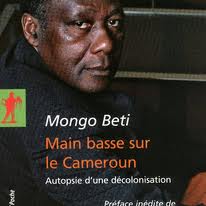
“Main basse sur le Cameroun…” de Mongo Beti
‘Wanted’ in the colony because of his sharp writings, and his connections to the UPC of Ruben Um Nyobé, Mongo Beti stayed in France. Ruben Um Nyobe’s murder by the colonial administration in 1958, truly shook Beti to his core; he fell silent and did not publish any book for the following decade. In 1971, he finally wrote “Main Basse sur le Cameroun, autopsie d’une décolonisation” (Cruel hand on Cameroon, autopsy of a decolonization) which was censored upon its publication by the French Ministry of the Interior Raymond Marcellin on the request, brought forward by Jacques Foccart, of the Cameroon government, represented in Paris by the ambassador Ferdinand Oyono. This essay perhaps sprang from frustration and rage at the collapse of the UPC rebellion and the public execution of its last leader, Ernest Ouandié, in 1970. It was a devastating critique of the authoritarian regime of Cameroon, and asserted that Cameroon and other colonies remained under French control in all but name, and that the post-independence political elites had actively fostered this continued dependence. The 1970s also saw two of his most passionately political novels, “Remember Ruben“ and “Perpetue et l’Habitude du Malheur,” both published in 1974.
In 1978 he and his wife, Odile Tobner, launched the bimonthly reviewPeuples Noirs. Peuples Africains (‘Black People. African People‘), which was published until 1991. This review chronicled and denounced tirelessly the evils brought to Africa by neo-colonial regimes. During this period were published the novels La Ruine presque Cocasse d’un Polichinelle (1979), Les deux mères de Guillaume-Ismael Dzewatama (1983), La revanche de Guillaume Ismaël Dzewatama (1984), also Lettre ouverte aux Camerounais ou la deuxième mort deRuben Um Nyobé (1984) and Dictionnaire de la Negritude (1989, with Odile Tobner). Frustrated by what he saw as the failure of post-independence governments to bring genuine freedom to Africa, Beti adopted a more radical perspective in these works.
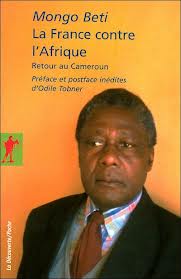
‘La France contre l’Afrique’ de Mongo Beti
Mongo Beti returned to Cameroon in 1991 after 32 years of exile. In 1993 he published La France contre l’Afrique, Retour au Cameroun, a book chronicling his visits to his homeland. After retiring from teaching in 1994, he returned to Cameroon permanently. He opened the Librairie des Peuples noirs (Bookstore of the Black Peoples) in Yaoundé and organized agricultural activities in his village of Akométam. However, his return did not leave the government silent: he was subjected to police aggression in January 1996 in the streets of Yaoundé, and was subsequently challenged at a demonstration in October 1997. In response he published several novels: L’histoire du fou in 1994 then the two initial volumes Trop de Soleil tue l’Amour (1999) et Branle-bas en noir et blanc (2000), of a trilogy which would remain unfinished. He was hospitalized in Yaoundé on October 1, 2001 for acute hepatic and kidney failure which remained untreated for lack of dialysis. Transported to the hospital in Douala on October 6, he died there on October 8, 2001. Some critics noted the similarity of his death to that of his heroine Perpetua, who also died while awaiting treatment in one of the country’s overburdened hospitals.
‘Trop de Soleil tue l’Amour’ by Mongo Beti
As I write about him today, I feel very sad that we, in Cameroon, don’t honor our heroes. No one can even fathom the depth of Mongo Beti’s work. It is immense, and his service to Cameroon’s history is beyond our imagination. At a time when everybody was scared of the regime (and rightly so, after the ‘maquis‘ years), he dared to write. From afar, yes, one might say from the safety of France and not Cameroon, he continued his mission of informing, and enlightening us. How many contributed like Mongo Beti to our knowledge of Ruben Um Nyobé? I am sure Mongo Beti’s book “Main basse …” is one of the rare written accounts of Ernest Ouandié. The African writer, Boubacar Boris Diop wrote: “Sans jamais se courber devant personne, il [Mongo Beti] a réussi à faire d’un simple pseudonyme un cri de ralliement. Sa vie durant, il a haï l’hypocrisie, le vain folklore et les faux-fuyants. Il est resté fidèle, jusqu’au martyre, à sa passion de la liberté.” (Without ever bending to nobody, he [Mongo Beti] succeeded in turning a pseudonym into a rallying cry. Throughout his life, he hated hypocrisy, vain folklore, and subterfuge. He remained faithful, up to martyrdom, to his passion for freedom.) Your work, O Mongo, is a true treasure in the archives of Cameroon. Peace be with you Mongo, you are not just a son of the Beti, but rather a son of Cameroon… Peace to you Mongo Cameroon.
This really good article by the Kenyan writer Binyavanga Wainaina on ‘How to Write about Africa‘ was recently shared with me. It was published by Granta magazine. One will be surprised to see that this is exactly the way Africa is depicted in Western televisions, magazines, news, and books. Such an interesting read, very satirical, and yes very thought-provoking. This is not the Africa I know, but this is the Africa sold on Western media. The entire article can be found on Granta.com.
==========
Always use the word ‘Africa’ or ‘Darkness’ or ‘Safari’ in your title. Subtitles may include the words ‘Zanzibar’, ‘Masai’, ‘Zulu’, ‘Zambezi’, ‘Congo’, ‘Nile’, ‘Big’, ‘Sky’, ‘Shadow’, ‘Drum’, ‘Sun’ or ‘Bygone’. Also useful are words such as ‘Guerrillas’, ‘Timeless’, ‘Primordial’ and ‘Tribal’. …
Never have a picture of a well-adjusted African on the cover of your book, or in it, unless that African has won the Nobel Prize. An AK-47, prominent ribs, naked breasts: use these. If you must include an African, make sure you get one in Masai or Zulu or Dogon dress.
Africa
In your text, treat Africa as if it were one country. It is hot and dusty with rolling grasslands and huge herds of animals and tall, thin people who are starving. Or it is hot and steamy with very short people who eat primates. Don’t get bogged down with precise descriptions. Africa is big: fifty-four countries, 900 million people who are too busy starving and dying and warring and emigrating to read your book. The continent is full of deserts, jungles, highlands, savannahs and many other things, but your reader doesn’t care about all that, so keep your descriptions romantic and evocative and unparticular. […] Continue reading “How to Write about Africa, by Binyavanga Wainaina”→
In the past I have always wished that we, Africans, could be patriotic. I came across this beautiful poem ‘Love poem for my country‘ by South African writer Sandile Dikeni. I really enjoy the way the author describes his country, the valleys, the birds, the ancient rivers, and its beauty. He feels the peace, the wealth, and the health his country brings. He is one with hiscountry.He is at home! His country is not just words or food, or friends, or family, it is more, it is his essence! That is true patriotism, the bond that links us to the bone to our motherland. Enjoy!
My country is for love so say its valleys where ancient rivers flow the full circle of life under the proud eye of birds adorning the sky.
My country is for peace so says the veld where reptiles caress its surface with elegant motions glittering in their pride
My country is for joy so talk the mountains with baboons hopping from boulder to boulder in the majestic delight of cliffs and peaks
My country is for health and wealth see the blue of the sea and beneath the jewels of fish deep under the bowels of soil hear the golden voice of a miner’s praise for my country
My country is for unity feel the millions see their passion their hands are joined together there is hope in their eyes
Anton-Wilhelm Amo was a respected Ghanaian German philosopher who taught at the Universities of Halle and Jena in Germany in the 1730s… That’s right… you read it well, 1730! This man is said to be the first African to be awarded a doctorate degree from a European university, and to later teach there. Who was Anton-Wilhelm Amo?
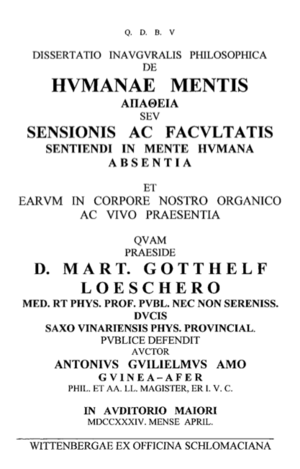
Anton-Wilhelm Amo was born in 1703 in Awukena near the town of Axim in Ghana. At the young age of 4, he was taken to Amsterdam; some accounts say that he was taken into slavery, others that he was sent to Amsterdam by a missionary based in Ghana. Either way, he was given as a present to the Duke of Brunswick-Wolfenbüttel. Amo was raised as a member of the family, and attended the Wolfenbüttel Ritter-Akademie from 1717 to1721, and then the University of Helmstedt from 1721 to 1727. He also met with the great German mathematician and philosopher Gottfried Leibniz who was a frequent visitor of the Wolfenbüttel palace. He then attended the Law school at the University of Halle in 1727, and finished his preliminary studies in two years at the end of which he wrote a dissertation thesis titled “The Rights of Moors in Europe.” He went on to further study philosophy and earn a doctorate degree in philosophy from the University of Wittenberg in 1734. Amo was a learned man, and a true polyglot as he mastered six languages: French, English, German, Dutch, Latin and Greek.
He was appointed professor of philosophy at the University of Halle in 1736, and went by his preferred name Antonius Guilelmus Amo, Afer of Axim. He taught psychology, ‘natural law‘, and the decimal system. He then published his second major work: ‘Treatise on the Art of Philosophing Soberly and Accurately (Tractatus de Arte Sobrie et Accurate Philosophandi). In 1740, he joined the University of Jena in Jena, central Germany. During the early years of the reign of Frederick II of Prussia, Amo was invited to the court in Berlin as a government councilor. Amo was also elected a member of the Dutch Academy of Flushing.
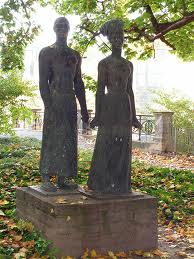
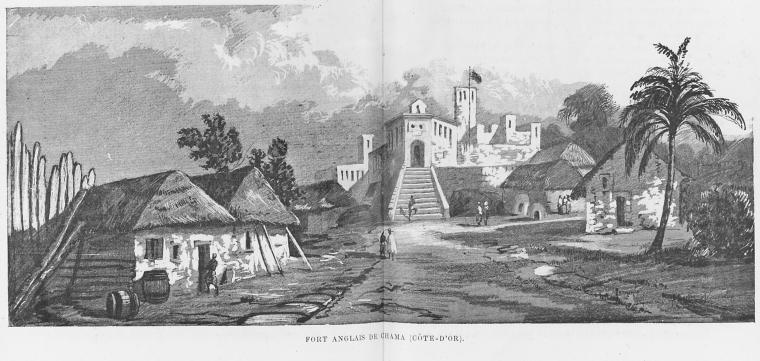
There were lots of social changes in Germany in the 1740s, and people were becoming less liberal, xenophobe, racist, and Amo himself was subject to public threats from his ennemies. Eventually, Amo returned to his land of birth, Ghana, and settled back in Axim where he was honored as a traditional doctor and worked as a goldsmith (by some accounts). He was laid to rest in Fort San Sebastian in Shama, Ghana, in 1759. Today, the University of Halle-Wittenberg annually awards the Anton-Wilhelm Amo prize to deserving students. There is also a statue in Halle in his honor. This man was at the time thought to be among the most prominent German thinkers of his times.
Fort San Sebastian or Fort Shama in Ghana, Henri Frey 1890
For more on this great man, please check out Anton Wilhelm Amo by Marilyn Sephocle (Journal of Black Studies Vol. 23, No. 2, Special Issue: The Image of Africa in German Society (Dec., 1992), pp. 182-187), Anton-Wilhelm Amo from SUNY Buffalo, The Life and Times of Wilhelm Anton Amo by W. Abraham, Transactions of the Historical Society of Ghana 7 (1964) P. 60-81, Anton Wilhelm Rudolph Amo, Anton-Wilhelm Amo, a Ghanaia Philosopher in 18th Century Germany on the blog of Justin E. H. Smith, and lastly Black History Month in Europe 2007: Amo’s Ghost where the blog’s author asks very poignant questions about the life of Amo. Everytime you think of Africa as the dark continent, or think that Africans were illiterate people, or had no ‘light’, think about Anton-Wilhelm Amo the great Ghanaian-German philosopher of the 1700s who taught great minds in Europe, and was among the most prominent German philosphers of his time.
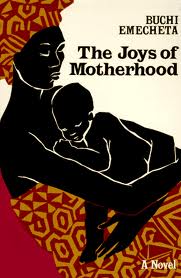
Today I would like to talk about a strong woman… a determined woman… an independent African female writer: Buchi Emecheta. Dr.Buchi Emechetais an established Nigerian author who has published over 20 books. She wrote such books asSlave Girl, The Joys of Motherhood, Second Class Citizen, The Bride Price, and more recentlyKehinde. Her themes have always revolved around motherhood, child slavery, and women independence. Buchi got married at the tender age of 16, and by the age of 22 was the mother of five children (they had moved to London after the birth of the first child for her husband to pursue higher education). Her marriage was unhappy and oftentimes violent. She used writing as an escape, to keep her sanity.The day her husband burnt her first manuscript marked Buchi’s rebirth. As she watched him burn her novel, she said ‘I am going to leave this marriage‘ and the man replied ‘what for? that stupid book?‘, and she told him, ‘I just feel you just burn my child.‘ (Source:Buchi Emecheta BBC). That was really her turning point. At the age of 22, she left her husband, raised her 5 children by herself, got a degree in sociology studying at night, andwrote 4 novels in the space of 5 years. She would often rise at dawn to pursue her dream of becoming a writer. She wore several hats: mother, student, writer, and worker.
'The Joys of Motherhood' by Buchi Emecheta
Like her Nigerian ancestors, she uses storytelling to teach morals, to entertain and to instruct. She brings to her writing the Igbo qualities of vividness, economy and directness. She speaks for the marginalized woman. Some of her first novels, such asIn the DitchandSecond Class Citizen, were quite autobiographical. She views her writing as the “release for all my anger, all my bitterness, my disappointments, my questions and my joy.”Please help me acclaim Buchi Emecheta, a powerful woman, a powerful writer, and a proud daughter of Africa. In her own words, Buchi advises ‘whatever you want to do with your life. “Just keep trying and trying. If you have the determination and commitment you will succeed.”‘(Source: ‘Just’ an Igbo Woman Interview by Julie Holmes in The Voice July 9, 1996.) Check out some of Buchi’s quotes on GoodReads.com.












 African Heritage