Discovery of a New Species of Dinosaur in Niger : Spinosaurus Mirabilis

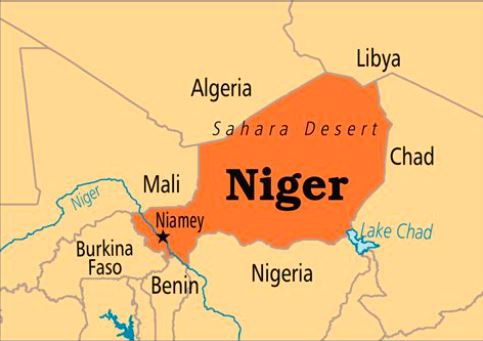
Map of Niger

In the Sahara desert, in the country of Niger, near the city of Tesker, a team of scientists has discovered a new species of dinosaur which lived in the area 95 million years ago. The new species, named Spinosaurus mirabilis, measures 12 m long, has a long snout adapted for catching fish, and features a spectacular curved crest on its head which is the largest ever found on a predatory dinosaur.

The expedition has been led by American paleontologist Paul Sereno from the University of Chicago who explains that the crest was likely ornamental, similar to features seen in some modern birds, rather than a weapon; this could later be found not to be the case, as we, humans, often interpret some ancient findings through our modern eyes. The dinosaur also had interlocking teeth, ideal for gripping slippery fish, showing its adaptation to life near water. This rare finding was cause for great joy within the team. Using modern tools including solar-powered laptops, members of the team were able to digitally assemble the images of the bones right in the middle of the Sahara.
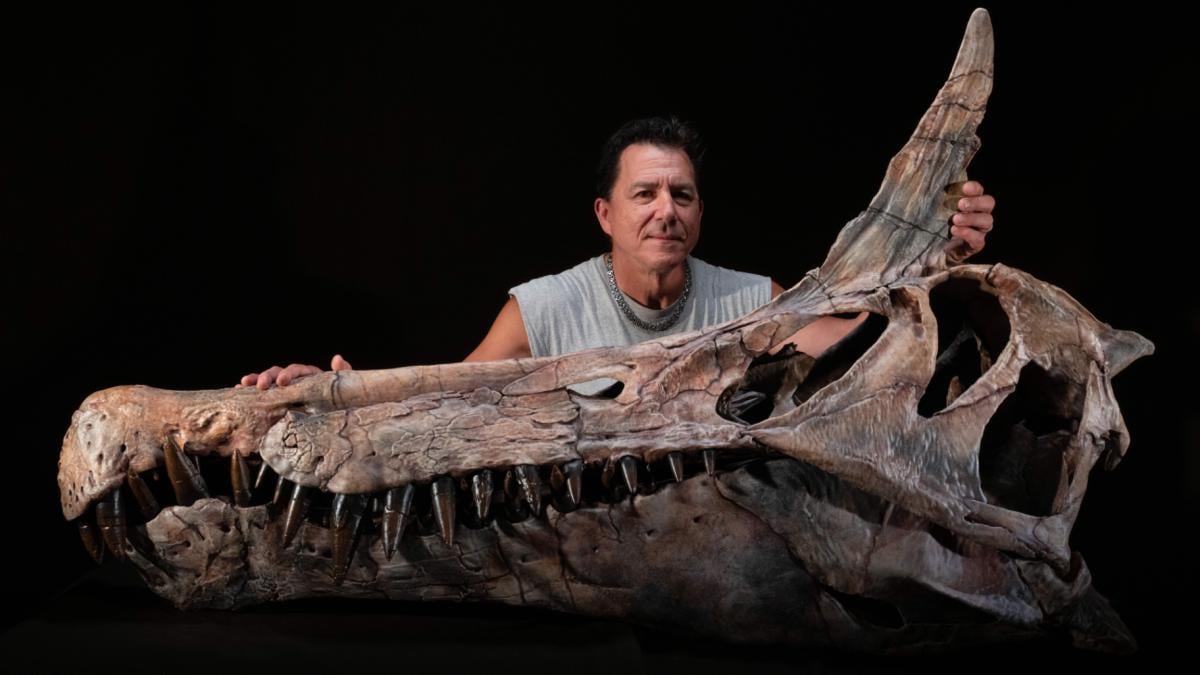
Paleontologist Paul Sereno with a skull cast of the Spinosaurus mirabilis.
Credit: Keith Ladzinski / Fossil Lab, University of Chicago / AFP/Getty

The team will be returning to Niger for further work. Sereno and his team are helping to establish a Heritage Center at the University of Niamey and planning 2 museums, one in the capital and the other in Agadez to showcase the country’s rich paleontological history.

This discovery sheds a light on the fact that the Niger’s desert is a major dinosaur fossil site, with many more discoveries to be made. There is a great need to train Nigerien and African archaeologists, paleontologists, and museum specialists as the field is overall a virgin field in Africa. Africans need to learn, so that they can tell their own history!

Check out Sci News, Discover Magazine, UChicago News, as well as the interview in RFI for more.


Africa’s Oldest Dinosaur found in Zimbabwe

Artistic reconstruction of Mbiresaurus raathi, which has been discovered in Zimbabwe (by Andrey Atuchin)

Scientists have unearthed in Zimbabwe, the oldest dinosaur ever found on African soil which lived 230 million years ago. As a parenthesis, dinosaur fossil hunting research is not big in Africa, so it is no surprise that on the cradle of humanity, people are still unearthing fossils. I am sure that if African scientists got vested in fossil hunting, the world will most likely awake to the era of the dinosaur, i.e. Africa being also the cradle of dinosaurs. Excerpts below are from the BBC; for more, also read the New Scientist. Enjoy!

=====

Scientists have unearthed in Zimbabwe the remains of Africa’s oldest dinosaur, which lived than 230 million years ago.

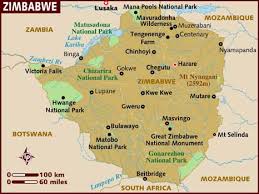
The Mbiresaurus raathi [love the name, named after Mbire in the Zambezi valley where the discovery was made, very African] was one metre tall, ran on two legs and had a long neck and jagged teeth. Scientists said it was a species of sauropodomorph, a relative of the sauropod, which walked on four legs. 

Flag of Zimbabwe
Flag of Zimbabwe

The skeleton was discovered during two expeditions, in 2017 and 2019, to the Zambezi Valley. When we talk of the evolution of early dinosaurs, fossils from the Triassic age are rare,” Darlington Munyikwa, deputy director of National Museums and Monuments of Zimbabwe, and who was part of the expeditions, told the BBC. He said that fossils from that era – which ended more than 200 million years ago – had been unearthed in South America, India and now Zimbabwe.

The find is expected to shed more light on evolution and migration of early dinosaurs, back when the world was one huge continent and Zimbabwe was at the same latitude as those countries, he said. Zimbabwe has been aware of other fossils in the area for decades and Mr Munyikwa said there were more sites that needed further exploration in the area, subject to funding availability [exactly, more African researchers need to delve into the field, and $$$]. It shows that dinosaurs didn’t start out worldwide, ruling the world from the very beginning,” Christopher Griffin, another scientist involved in the expedition, told the BBC. They, and the animals they lived with, seem to have been constrained to a particular environment in the far south – what is today South America, southern Africa and India.” He added that the find was the “oldest definitive dinosaur ever found in Africa“.

Prof Anusuya Chinsamy-Turan, a palaeontologist at the University of Cape Town, told the BBC that the discovery was important because it was part of the lineage that gave rise to the sauropod dinosaurs, which includes the diplodocus and the brontosaurus. … [Last July, she and her colleagues described a new iguanodontian dinosaur (Iyuku raathi) found in South Africa’s Eastern Cape Province. Thus, this is the second dinosaur find in less than a month].

… The near-complete skeleton of the Mbiresaurus raathi is stored in a room in a museum in Zimbabwe‘s southern city of Bulawayo. It is thought to date to the Carnian stage of the Triassic period, when today’s Zimbabwe was part of the massive supercontinent Pangaea.