A Ugandan author based in Great Britain whose debut novel was initially rejected by British publishers for being ‘too African‘, has won one of the world’s richest literary prizes.
She will receive $165,000 (£119,000). The prize money is more than double the amount that the Booker Prize winner gets, and organizers say it’s the richest award dedicated to literature after the Nobel Prize. Makumbi’s debut novel Kintu was first published in Kenya four years ago after British publishers rejected it for being “too African”. It was finally released in the UK this January. In Ugandan culture, Kintu is a mythological figure who appears in a legend of the Baganda of Uganda as a creation myth. According to this legend, Kintu was the first person on earth, the father of all people. Although her book is not about this Kintu, it follows a family who believes that there is a curse on them which has followed them over several generations, spanning more than 250 years.
I loved Makumbi’s Commonwealth short story, and lived through the pain of her main character. Now I cannot wait to read her first book and regal in Ugandan history and culture.
I share with you a poem by the late Congolese writer Tchicaya U Tam’si, “Vos yeux prophétisent une douleur”/”Your Eyes Prophesy a Pain.” Gérald-Félix Tchicaya is mostly known by his pseudonym Tchicaya U Tam’si, where U Tam’si means ‘the one who speaks for his country‘. Born in Mpili in the former French Congo (Republic of Congo), he was a poet, journalist, and an activist. He is considered by many as one of the greatest poets of his generation.
Patrice Emery Lumumba
U Tam’si’s poetry uses symbolism, dark humor, and surrealist, corporeal imagery to explore cultural identity in a politically unstable society. A member of the Congolese independence movement, a friend of Patrice Lumumba, U Tam’si creates work on the nature of African identity that is sometimes connected to Aimé Césaire’s Negritude movement, which advocated for the protection of a distinct African culture in the face of French colonialism and European exploitation.
To me, the pain U Tam’si talks about in this poem is that of slavery, of colonialism, of neo-colonialism, of tribalism. He talks as if he was in the 1600s, during slavery times, and predicting more pain.What do you think? What pain is U Tam’si talking about? The original poem was published in Anthologie Africaine: Poésie Vol2, Jacques Chevrier, Collection Monde Noir Poche, 1988; the English translation is brought to you by Dr. Y., Afrolegends.com.
Vos yeux prophétisent une douleur…
Comme trois terrils, trois collines de cendres!
Mais dites-moi de qui sont ces cendres?
La mer obéissait déjà aux seuls négriers
Des négres s’y laissaient prendre
Malgré les sortilèges de leurs sourires
On sonnait le tocsin
A coups de pied au ventre
De passantes enceintes:
Il y a un couvre-feu pour faisander leur agonie
Les feux de brousse surtout donnent de mauvais rêves
I am sure every African child has read either the entire book or excerpts of ‘L’Enfant Noir‘, ‘African Child‘ by the Guinean author Camara Laye . It is a school classic. When we were in school, the teacher will often give us dictations from this book. The book focuses mostly about Camara Laye ‘s childhood and was written in the 1950s at a time when most African writers were talking about independence, negritude, panafricanism, etc. This earned Laye’s some tough remarks from Cameroonian author Mongo Beti and others about his lack of interest in panafricanism and African independences. Today, I present to you this poem, ‘A ma mère / To my mother‘ of Camara Laye to his mother (published in Coup de Pillon), which is in reality an ode to all African women, and all mothers around the globe. Good to note his mentioning of blacksmiths in this poem, especially given that Camara Laye’s family was Malinke and he was born into a caste that traditionally worked as blacksmiths and goldsmiths. The English translation is by Deborah Weagel. Enjoy!
A ma Mère
Femme noire, femme africaine,
Ô toi ma mère, je pense à toi…
Ô Daman, ô ma Mère,
Toi qui me portas sur le dos,
Toi qui m’allaitas, toi qui gouvernas mes premiers pas,
Toi qui la première m’ouvris les yeux aux prodiges de la terre,
Je pense à toi…
Femme des champs, femme des rivières femme du grand fleuve, ô toi, ma mère je pense à toi…
Ô toi Daman, Ô ma mère,
Toi qui essuyas mes larmes,
Toi qui me réjouissais le cœur,
Toi qui, patiemment, supportais mes caprices,
Comme j’aimerais encore être près de toi,
Etre enfant près de toi !
Femme simple, femme de la résignation, Ô toi ma mère, je pense à toi. Ô Daman, Daman de la grande famille des forgerons, Ma pensée toujours se tourne vers toi, La tienne à chaque pas m’accompagne, Ô Daman, ma mère, Comme j’aimerais encore être dans ta chaleur, Etre enfant près de toi…
Femme noire, femme africaine, Ô toi ma mère, Merci, merci pour tout ce que tu fis pour moi, Ton fils si loin, si près de toi.
To my Mother
Black woman, African woman, O mother, I think of you …
O Dâman, O mother,
who carried me on your back, who nursed me,
who governed by first steps,
who opened my eyes to the beauties of the world, I think of you …
Woman of the fields, woman of the rivers, woman of the great river, O
mother, I think of you …
O Dâman, O mother, who wiped my tears,
who cheered up my heart,
who patiently dealt with my caprices,
how I would love to still be near you.
Simple woman, woman of resignation, O mother, I think of you.
O Dâman, Dâman of the great family of blacksmiths, my thoughts are
always of you, they accompany me with every step,
O Dâman, my mother, how I would love to still feel your warmth,
to be your child that is close to you …
Black woman, African woman, O mother, thank you; thank you for all
that you have done for me, your son, so far away yet so close to you!
Today I stumbled upon a poem by Ghanaian author Michael Dei Anang which made me think a lot about Cheikh Anta Diop‘s work of re-educating the world about the place of Africa in history as the cradle of humanity. Michael Dei-Anang was a member of President Kwame Nkrumah‘s (Ghana’s first president) main secretariat and was concerned with the liberation of the rest of Africa still under colonial rule, at the time. Enjoy!
Africa just lost a giant… the world just lost a literary genius. Chinua Achebe was made of the cloth of kings. He was the emperor of words and just made reality seems so funny. He wrote in English, but yet made it his own; he made it African. Please hear the maestro in his own words.
“Age was respected among his people, but achievement was revered. As the elders said, if a child washed his hands he could eat with kings.” – Things Fall Apart.
“The white man is very clever. He came quietly and peaceably with his religion. We were amused at his foolishness and allowed him to stay. Now he has won our brothers, and our clan can no longer act like one. He has put a knife on the things that held us together and we have fallen apart,” – Things fall Apart.
Achebe was a man of character, who could not be corrupted by honors. He twice turned down the offer of a title Commander of the Order of the Federal Republic, once in 2004 from Nigeria’s then President Olusegun Obasanjo and again in 2011 from President Goodluck Jonathan. He explained on the BBC: “What’s the good of being a democracy if people are hungry and despondent and the infrastructure is not there,” … “There is no security of life. Parts of the country are alienated. Religious conflicts spring up now and again. The country is not working.” Declining the honor, he wrote that “for some time now I have watched events in Nigeria with alarm and dismay. I have watched particularly the chaos in my own state of Anambra where a small clique of renegades, openly boasting its connections in high places, seems determined to turn my homeland into a bankrupt and lawless fiefdom. I am appalled by the brazenness of this clique and the silence, if not connivance, of the presidency … Nigeria’s condition today under your watch is, however, too dangerous for silence. I must register my disappointment and protest by declining to accept the high honour awarded me in the 2004 honours list.”
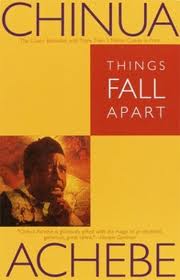
‘Things Fall Apart’ by Chinua Achebe
He wrote: “You see we, the little people of the world, are ever expendable.”
“It is sometimes good to be brave and courageous, but sometimes it is better to be a coward. We often stand in the compound of the fool and point at the ruins where a brave man used to live. He who has never submitted to anything will one day submit to his burial mat.” – Things fall apart.
“While we do our good works let us not forget that the real solution lies in a world in which charity will have become unnecessary.” – Anthills of the Savannah.
“To me, being an intellectual doesn’t mean knowing about intellectual issues; it means taking pleasure in them.”
“Nobody can teach me who I am. You can describe parts of me, but who I am – and what I need – is something I have to find out myself.”
“One of the truest tests of integrity is its blunt refusal to be compromised. ”
“We cannot trample upon the humanity of others without devaluing our own. The Igbo, always practical, put it concretely in their proverb Onye ji onye n’ani ji onwe ya: “He who will hold another down in the mud must stay in the mud to keep him down.” – The Education of a British-Protected Child: Essays.
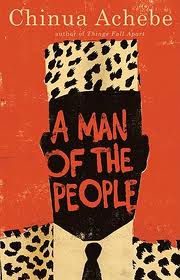
‘A Man of the People’ by Chinua Achebe
“‘It’s true that a child belongs to its father. But when a father beats his child, it seeks sympathy in its mother’s hut. A man belongs to his fatherland when things are good and life is sweet. But when there is sorrow and bitterness he finds refuge in his motherland. Your mother is there to protect you. She is buried there. And that is why we say that mother is supreme.” – Things fall Apart.
“Unfortunately, oppression does not automatically produce only meaningful struggle. It has the ability to call into being a wide range of responses between partial acceptance and violent rebellion. In between you can have, for instance, a vague, unfocused dissatisfaction; or, worst of all, savage infighting among the oppressed, a fierce love-hate entanglement with one another like crabs inside the fisherman’s bucket, which ensures that no crab gets away. This is a serious issue for African-American deliberation…. To answer oppression with appropriate resistance requires knowledge of two kinds: in the first place, self-knowledge by the victim, which means awareness that oppression exists, an awareness that the victim has fallen from a great height of glory or promise into the present depths; secondly, the victim must know who the enemy is.He must know his oppressor’s real name, not an alias, a pseudonym, or a nom de plume!” – The Education of a British-Protected Child: Essays.
“Women and music should not be dated.” – No Longer at Ease
“A man who pays respect to the great, paves the way for his own greatness.”
‘No Longer at Ease’ by Chinua Achebe
“I would be quite satisfied if my novels (especially the ones I set in the past) did no more than teach my readers that their past – with all its imperfections – was not one long night of savagery from which the first Europeans acting on God’s behalf delivered them.”
“Procrastination is a lazy man’s apology.” – Anthills of the Savannah
About his gift of writing, he said: “There is that great proverb — that until the lions have their own historians, the history of the hunt will always glorify the hunter. … Once I realized that, I had to be a writer. I had to be that historian.”… “It’s not one man’s job. It’s not one person’s job. But it is something we have to do, so that the story of the hunt will also reflect the agony, the travail — the bravery, even, of the lions.”
Tributes are pouring out from all corners of the world. Truly to have written a book which has been translated in over 50 languages is a great achievement for an African, and for anybody in this world. To boast over 20 literary works is amazing. As the Igbo proverb says: ” it is simply impossible for an iroko tree to fall and the forest to remain quiet.” A giant left us today, but his fingerprints will remain forever.
If the nobel prize was made to celebrate excellence, Chinua Achebe, should have certainly gotten it. Today his work is celebrated in every corner of the world!
Today, We will look at a poem by the most celebrated Ivorian writer Bernard Binlin Dadié. The poem below is titled “Dry your Tears Afrika” or “Sèche Tes Pleurs“. Published in 1967, this poem is basically about Africa and her sons and daughters returning home. It is about healing the wounds of slavery, colonialism, and neo-colonialism. This poem was actually translated into Mende, a language spoken by ~ 46% of Sierra Leone. It was also set to music by American composer John Williams for the Steven Spielberg movie, Amistad. Below is the original poem in French, written by Dadié. The English version can be found below. Enjoy the text, and the video of the poem sung in Mende with the English translation.
Sèche tes pleurs Afrique! Tes enfants te reviennent dans l’orage et la tempête des voyages infructueux. Sur le ris de l’onde et le babil de la brise, Sur l’or des levants Et la pourpre des couchants des cimes des monts orgueilleux Et des savanes abreuvées de lumière Ils te reviennent dans l’orage et la tempête des voyages infructueux. Sèche tes pleurs, Afrique Ayant bu À toutes les fontaines d’infortune et de gloire, Nos sens se sont ouverts à la splendeur de ta beauté à la senteur de tes forêts, à l’enchantement de tes eaux à la limpidité de ton ciel à la caresse de ton soleil Et au charme de ta verdure emperlée de rosée.
Sèche tes pleurs, Afrique! Tes enfants te reviennent Les mains pleines de jouets Et le coeur plein d’amour. Ils reviennent te vêtir De leurs rêves et de leurs espoirs.
Bee ya ma yee ah, bee len geisia bee gammah. Bee ya ma yee ah, bee len geisia tee yamanga. Baa wo, kah ung biah woie yaa. Baa wo, kah ung biah woie yah, yah. Oo be ya ma yee ah, bee len geisia tee yamanga. Mu ya mah mu yeh, Mu ya mah mu yeh, Mu ya mah mu yeh, Afrika. Mu ya mah mu yeh, Mu ya mah mu yeh, Mu ya mah mu yeh, Afrika.Bee ya ma yee ah, bee len geisia tee yamanga. Mu ya mah mu yeh, bee len geisia bee gammah. Oo bee ya mah yee ah Bee len geisia tee yamanga. Mu ya mah mu yeh, Mu ya mah mu yeh, Mu ya mah mu yeh, Afrika. Mu ya mah mu yah, Mu ya mah mu yah, Mu ya mah mu yeh, Afrika.
Be ya mah yee ah, bee len geisia tee yamanga. Be ya mah yee ah, bee len geisia bee gammah. Mu ya mah mu yeh, Mu ya mah mu yeh, Mu ya mah mu yeh, Afrika. Mu ya mah mu yeh, Mu ya mah mu yeh, Mu ya mah mu yeh, Afrika. Mu ya mah mu yeh, Mu ya mah mu yeh, Mu ya mah mu yeh, Afrika.
This really good article by the Kenyan writer Binyavanga Wainaina on ‘How to Write about Africa‘ was recently shared with me. It was published by Granta magazine. One will be surprised to see that this is exactly the way Africa is depicted in Western televisions, magazines, news, and books. Such an interesting read, very satirical, and yes very thought-provoking. This is not the Africa I know, but this is the Africa sold on Western media. The entire article can be found on Granta.com.
==========
Always use the word ‘Africa’ or ‘Darkness’ or ‘Safari’ in your title. Subtitles may include the words ‘Zanzibar’, ‘Masai’, ‘Zulu’, ‘Zambezi’, ‘Congo’, ‘Nile’, ‘Big’, ‘Sky’, ‘Shadow’, ‘Drum’, ‘Sun’ or ‘Bygone’. Also useful are words such as ‘Guerrillas’, ‘Timeless’, ‘Primordial’ and ‘Tribal’. …
Never have a picture of a well-adjusted African on the cover of your book, or in it, unless that African has won the Nobel Prize. An AK-47, prominent ribs, naked breasts: use these. If you must include an African, make sure you get one in Masai or Zulu or Dogon dress.
Africa
In your text, treat Africa as if it were one country. It is hot and dusty with rolling grasslands and huge herds of animals and tall, thin people who are starving. Or it is hot and steamy with very short people who eat primates. Don’t get bogged down with precise descriptions. Africa is big: fifty-four countries, 900 million people who are too busy starving and dying and warring and emigrating to read your book. The continent is full of deserts, jungles, highlands, savannahs and many other things, but your reader doesn’t care about all that, so keep your descriptions romantic and evocative and unparticular. […] Continue reading “How to Write about Africa, by Binyavanga Wainaina”→
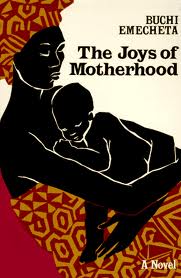
Today I would like to talk about a strong woman… a determined woman… an independent African female writer: Buchi Emecheta. Dr.Buchi Emechetais an established Nigerian author who has published over 20 books. She wrote such books asSlave Girl, The Joys of Motherhood, Second Class Citizen, The Bride Price, and more recentlyKehinde. Her themes have always revolved around motherhood, child slavery, and women independence. Buchi got married at the tender age of 16, and by the age of 22 was the mother of five children (they had moved to London after the birth of the first child for her husband to pursue higher education). Her marriage was unhappy and oftentimes violent. She used writing as an escape, to keep her sanity.The day her husband burnt her first manuscript marked Buchi’s rebirth. As she watched him burn her novel, she said ‘I am going to leave this marriage‘ and the man replied ‘what for? that stupid book?‘, and she told him, ‘I just feel you just burn my child.‘ (Source:Buchi Emecheta BBC). That was really her turning point. At the age of 22, she left her husband, raised her 5 children by herself, got a degree in sociology studying at night, andwrote 4 novels in the space of 5 years. She would often rise at dawn to pursue her dream of becoming a writer. She wore several hats: mother, student, writer, and worker.
'The Joys of Motherhood' by Buchi Emecheta
Like her Nigerian ancestors, she uses storytelling to teach morals, to entertain and to instruct. She brings to her writing the Igbo qualities of vividness, economy and directness. She speaks for the marginalized woman. Some of her first novels, such asIn the DitchandSecond Class Citizen, were quite autobiographical. She views her writing as the “release for all my anger, all my bitterness, my disappointments, my questions and my joy.”Please help me acclaim Buchi Emecheta, a powerful woman, a powerful writer, and a proud daughter of Africa. In her own words, Buchi advises ‘whatever you want to do with your life. “Just keep trying and trying. If you have the determination and commitment you will succeed.”‘(Source: ‘Just’ an Igbo Woman Interview by Julie Holmes in The Voice July 9, 1996.) Check out some of Buchi’s quotes on GoodReads.com.









 African Heritage