To wish you all a happy Valentine’s day, I decided to share with you a classic love song by two outstanding African singers: the late Cesaria Evora: the Barefoot Diva– the Love of Cape Verde, and the great Malian singer Salif Keita. It was shared with me this morning. I love you mi Amore… too much! Enjoy! and do share with those special ones, even if it is not love the Valentine way, share it with the precious ones in your life.
There are more brothers and sisters of African descent competing at these Olympics as well: 7 from the United States (with the multiple champion Shani Davis who has been a joy to watch in speed skating since the 2006 Turin Olympics), 4 from France (including 2 in figure skating), 3 from Brazil (all in bobsleigh), 5 from Canada (all in bobsleigh), 3 from Jamaica (with Jamaica first female bobsleigh team ever) and 5 from Great Britain (all in bobsleigh). I may have missed some, and if you see one I did not account for, let me know. We raise our hats to those athletes proudly representing their nations, and cheer them to victory!
I really enjoyed Godfrey Nzamujo‘s TEDx talk. Nzamujo is the founder of the Songhai Center in Benin and has been implementing, for over 30 years now, sustainable agriculture to address Africa’s food problems, and also to fight against rural exodus which forces youths to leave their villages to go to the city. One of his center’s aim is promotes entrepreneurship in agriculture aimed at making the poor producers, actors and managers of their own future. His main goal is to erect green rural towns where nothing is wasted. His approach is fully 100% re-use, recycle agriculture, zero-waste emission! Watch, listen, share, and enjoy!
Imagine an organic farm where nothing is wasted: from the crops, the chicken, everything is generated in house, even the energy for the farm is generated with the bio-gas from the animal waste. I recently came across the Songhai Center, and loved the idea that Godfrey Nzamujo has implemented in Porto-Novo, Benin. Created in 1985 by Godfrey Nzamujo, a Dominican priest with doctorate degrees in electronics, development science and microbiology, the Songhai Center is an NGO which promotes entrepreneurship in agriculture aimed at making the poor producers, actors and managers of their own future. His main goal is to erect green rural towns where nothing is wasted. Have rural people be proud of staying and enriching their villages / towns. Songhai has found recognition beyond Benin. The UNDP (2008) regards its approach as successful in the promotion of agricultural entrepreneurship and the creation of decent jobs in rural areas.
A farm
His farm is centered around agriculture, animal husbandry, and core production. The waste from one sector becomes an input in another sector. The waste from the animal production is used to produce maggots that feed the fish, and the wastewater from fish ponds is used to irrigate the crops where vegetables and grains are produced, and the waste from the crops are used for bio-gas or to feed the animals (grains for the animals), and the droppings from the animals are used for compost. And the products, meat, eggs, fruits, etc, are eaten by men. Everything is bio: fertilizers are from compost, no chemicals are used! Natural fertilizers are used. No pesticides are used: pest management is implemented using plants themselves via inter-cropping or integrated pest management. The pure clean water used for drinking comes from a deep well; the water from the rain is also harvested, and water from sewage is purified using plants and various organisms to be used in the agriculture and plants. Part of the electricity comes from the bio-gas, some from the diesel, and some from the national grid. Even the plastic bottles containers for the juices produced in-house are made from plastic waste used at the center, while the machinery for the farm is built in-house as well! Watch, Enjoy, and get Inspired!
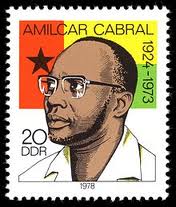
Amilcar Cabral on a stamp with the flag of Guinea Bissau
“The colonists usually say that it was they who brought us into history: today we show that this is not so. They made us leave history, our history, to follow them, right at the back, to follow the progress of their history. Today, in taking up arms to liberate ourselves, in following the example of other peoples who have taken up arms to liberate themselves, we want to return to our history, on our own feet, by our own means and through our own sacrifices.” Amilcar Cabral
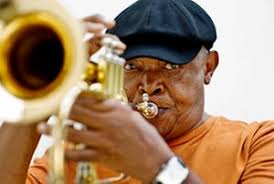
Bra Hugh was involved in African heritage restoration. He gave a talk at the TEDx about African culture, and restoration. So I am leaving you here with his TEDx talk. He used to say, ” I’ve got to where am in life not because of something I brought to the world but through something I found – the wealth of African culture.” Enjoy!
This past Sunday, Hugh Masekela was honoured with a musical tribute at the University of Johannesburg (UJ)’s Soweto Campus. Various musicians performed at this final public tribute to the legendary artist, activist and composer.
Waiting for Rain (for Hugh Masekela) by Niyi Osundare
Your trumpet pumps the wind into a bold, metallic roar; the universe throbs in awe a worsted thunder whines in a blue corner of the sky
Waiting, waiting for the Rain
…
Memory hides in your song in the sepia folds of a tune which remembers its tongue in the throat which bakes the bread for our common feast
…
The Nile’s long-limbed gallop the limpid lyric of the Limp, the Limp, the Limpopo the Kukuruku’s tall whisper in the ears of the Kilimanjaro the sun never sets in the empire of your song your garland a forest of flowers and dappled murmurs
…
Niyi Osundare (from Pages from the Book of the Sun: New & Selected Poems, 2002, pp. 42-43
George Weah delivering his inaugural speech at the Samuel Doe stadium
On Monday, January 22nd, Former Football star and Ballon d’Or George Weah was sworn in as the 25thPresident of Liberia, in the country’s first democratic transfer of power in over 70 years. Weah, a decorated football star, took over from Africa’s first female president, Ellen Johnson Sirleaf. Liberians of all ages formed long lines outside the Samuel Kanyon Doe Stadium, near the capital, Monrovia, to watch Weah’s inauguration.
Moved by the population’s love, Weah said in his inaugural speech, “I have spent many years of my life in stadiums, but today is a feeling like no other. I am overwhelmed with the crowd and the energy here today, … Today, we all wear the jersey of Liberia, and the victory belongs to the people, to peace, and to democracy.”
Flag of Liberia
He added: “I promise to do everything in my power to be the agent of positive change. But I cannot do it alone. … […] And so, My Fellow Citizens, I want to admonish you, that the foundation of the New Liberia must be reinforced by the steel of integrity. We need men and women, boys and girls, whose integrity provides the foundation of the trust that is required for Liberian society to benefit her people.”
Brother Weah, we wish you the very best in governing the beautiful country of Liberia. We know that your getting there stems for your great love of your country, and our prayers will carry you throughout this journey!
For the full speech, watch the video below, and read The Patriotic Vanguard Patriotic Vanguard for the full transcript of President George Weah’s inaugural speech. Enjoy!
As a child, my mother had all of Hugh Masekela‘s CDs, and so I grew up listening to his music. A few years back, I was fortunate enough to attend one of his concerts when he was on tour in the US. As his colleague and friend Yvonne Chaka Chaka said in the interview below, Masekela was very down to earth. After his concert, he came out, and greeted us… so I queued up and even got a chance to talk to him! Imagine that! I talked to the great Hugh Masekela! His enthusiasm was contagious! I particularly loved what he could do with his trumpet and his voice: simply amazing! Some of my favorite tracks were ‘Chileshe,’ ‘Strawberries‘ (not sure why, maybe because of the children’s chorus or the fact that as a child I could taste those juicy strawberries), ‘Coal Train (Stimela),’ ‘Khawuleza,’ ‘ The Boyz doin’ it‘, and countless others. Maybe it was his voice, slightly cracked and full of power, or the magic that came out of his trumpet, or the mix of African sounds,… all of it combined made Hugh Masekela, a genius African Jazz Trumpeter and musician.
Ramopolo Hugh Masekela was born on April 4, 1939, in Witbank, South Africa, a coal-mining town near Johannesburg. His father, Thomas Selema Masekela, was a health inspector and noted sculptor; his mother, Pauline Bowers Masekela, was a social worker. From a young age, he developed an early affinity to music, and was encouraged by his mentors to further the study of it. During an early trip to the US, he met Louis Armstrong, who offered his band a gift: a trumpet.
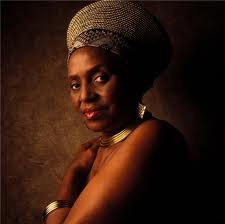
A true African beauty: Mama Africa, Miriam Makeba
Hugh Masekela was not just a musician, but he was also a political activist who fought against that hateful system called apartheid. Throughout his career, he performed with great names such as Jimi Hendrix, Janis Joplin, Otis Redding, and collaborated with Harry Belafonte, Herb Alpert, Bob Marley, Fela Kuti, Paul Simon — and his ex-wife, Miriam Makeba. For almost 30 years, “Bra Hugh,” as he was fondly known, was exiled from his native country.
And almost despite himself — as he struggled for decades with copious drug and alcohol abuse — Masekela became a leading international voice against apartheid. In that sense,Masekela was like the prodigal son, whom God greatly loved, and who despite the drugs, was redeemed and even founded an organization, the Musicians and Artists Assistance Program of South Africa, to help South Africans artists battle substance abuse.
He sought solace on his home continent. “For me, songs come like a tidal wave,” he said. “At this low point, for some reason, the tidal wave that whooshed in on me came all the way from the other side of the Atlantic: from Africa, from home.” Indeed, when one listens to songs like ‘Khawuleza’full of energy, one does feel the tidal wave!
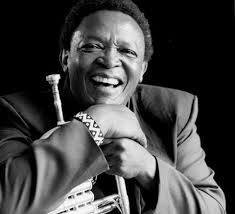
Hugh Masekela
Now Bra Hugh has taken his tidal wave and trumpet to the angels, who will be rocking to the sounds of ‘Chileshe‘ in heaven. I can clearly say that Hugh Masekela was one of the greatest, if not the greatest African Trumpeter of all. The New York Times published a very good article on him, the NPR as well, and the Guardian did a beautiful photo-Journal article on him: Hugh Masekela: life and career of the jazz trumpeter – in pictures. I live you with another great African singer, Yvonne Chaka Chaka, tribute to Bra Hugh. Enjoy!


 We have evolved since the days of the









 African Heritage