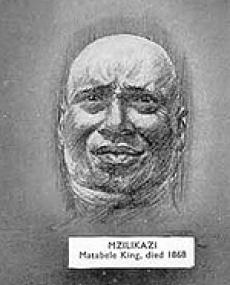
Mzilikazi (meaning The Great Road), was a Southern African king who founded the Matabele kingdom (Mthwakazi), Matabeleland, in what became Rhodesia and is now Zimbabwe. He was born ca. 1790 near Mkuze, Zulu Kingdom (now part of South Africa). The son of Matshobana whom many had considered to be the greatest Southern African military leader after the Zulu king, Shaka. In his autobiography, David Livingstone referred to him as the second most impressive leader he encountered on the African Continent. He was also the father of Lobengula.
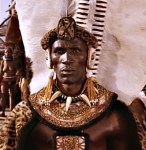
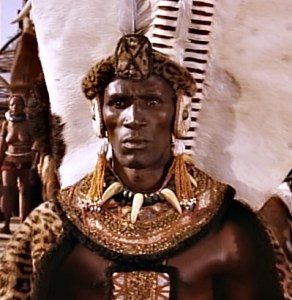
King Shaka
The territory of the Northern Khumalo was located near the Black Umfolozi River, squeezed between the lands of two strong rival groups: the expanding Mthethwa empire of Dingiswayo and the land of the equally ambitious and much more ferocious Zwide of the Ndwandwe. Mzilikazi’s boyhood was spent in the household of his grandfather Zwide. Inevitably, as he grew to manhood he observed the less powerful Khumalo being drawn into the conflict between Dingiswayo and Zwide.
Bayethe! Ndebele Nation! You are the knobkerrie that menaced Tshaka. You are the big one who is as big as his father Matshobana. You are the string of Mntinti and Simangele Simangele son of Ndaba. You are the string of Mntitni and Ndaba The string they made until they wet tears You are the sun that rose from the ear of the elephant, It rose where upon the birds announced to each other. You are the son of Simangele who was kicked! Who was kicked by long feet and by the short ones. You refused to eat the gift of meat in Bulawayo. You are the fighter who has marks of fighting, You are the cattle that opened the closed pen with their horns, Because they opened the Ngome forests and left. You are the moon the people said had set Yet it was just rising; It rose in the year of Mpeyana. You are the cow that showed its face from the crowd. You are the log from which the Zulus cut firewood until they left it. You are the cow that, while it was just emerging made progress.
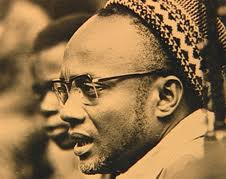
« Always bear in mind that people are not fighting for ideas, for the things in anyone’s head. They are fighting to win material benefits, to live better and in peace, to see their lives go forward, to guarantee the future of their children.» (Amilcar Cabral).
Here is a poem by Patrice Lumumba (1925–1961), published on Pambazuka News. Patrice Lumumba was elected the first prime minister of the Democratic Republic of the Congo (DRC). Assassinated by Belgian colonialists and the CIA, Lumumba was a founder member of the Movement National Congolais (MNC), which led the Congo to independence. Patrice Lumumba is the symbol of aspirations of an entire continent, and he continues to serve as an inspiration to contemporary Congolese and African politicians. His spirit lives on, and his pride is ours!
=======
Dawn in the Heart of Africa
For a thousand years, you, African, suffered like beast, Your ashes strewn to the wind that roams the desert. Your tyrants built the lustrous, magic temples To preserve your soul, reserve your suffering. Barbaric right of fist and the white right to a whip, You had the right to die, you also could weep. On your totem they carved endless hunger, endless bonds, And even in the cover of the woods a ghastly cruel death Was watching, snaky, crawling to you Like branches from the holes and heads of trees Embraced your body and your ailing soul. Then they put a treacherous big viper on your chest: On your neck they laid the yoke of fire-water, They took your sweet wife for glitter of cheap pearls, Your incredible riches that nobody could measure. From your hut, the tom-toms sounded into dark of night Carrying cruel laments up mighty black rivers About abused girls, streams of tears and blood, About ships that sailed to countries where the little man Wallows in an ant hill and the dollar is king, To that damned land which they called a motherland. There your child, your wife were ground, day and night In a frightful, merciless mill, crushing them in dreadful pain. You are a man like others. They preach you to believe That good white God will reconcile all men at last. By fire you grieved and sang the moaning songs Of a homeless beggar that sinks at strangers’ doors. And when a craze possessed you And your blood boiled through he night You danced, you moaned, obsessed by father’s passion. Like furry of a storm to lyrics of a manly tune From a thousand years of misery a strength burst out of you In metallic voice of jazz, in uncovered outcry That thunders through the continent like gigantic surf. The whole world surprised , wakes up in panic To the violent rhythm of blood, to the violent rhythm of jazz, The white man turning pallid over this new song That carries torch of purple through the dark of night.
The dawn is here, my brother! Dawn! Look in our faces, A new morning breaks in our old Africa. Ours alone will now be the land, the water, mighty rivers Poor African surrendered for a thousand years. Hard torches of the sun will shine for us again They’ll dry the tears in eyes and spittle on your face. The moment when you break the chains, the heavy fetters, The evil cruel times will go never to come again. A free and gallant Congo will rise from black soil, A free and gallant Congo-black blossom from black seed!
Here is a description of the Market of the city of Djenné, another one of the crown jewels of the Empire of Mali, by the French explorer René Caillié. Bear in mind that René Caillié was the first westerner to return from Timbuktu, Mali. Also note the description of Suya by a European in 1825!
====
“The Kolamerchants stand at one end of the market, placed in two lines, each having in front of them a small basket of Kola nuts that they sell in retail, eight or ten cowries* each : the low price came from the large quantity of these fruits found in the entire country ; but they are normally worth fifteen to twenty cowries.
La grande mosquee de Djenne (Mali – heritage du grand empire du Mali)
A few Butchers were established in the market; they lay their meat like in Europe: they also put in skewers small pieces of meat that they dry with smoke, and which they sell in retail. There is in this market a lot of fresh fish and dry ; earthen pots, calabashes, mats, and salt which is sold in retail, because that which is sold wholesale stays in shops.
René Caillié’s house in Timbuktu
We see an infinite number of merchants in the streets carrying their merchandise and yelling like it is done in Europe : these are fabrics of the country, things homemade, kola nuts, honey, vegetable butter and animal, milk, firewood. This last item is rare here; women bring it from 12 to 15 miles around. Millet stubble is also sold in the market; during my stay in this city, every night I saw negro women who had bought this fuel for 10 cowries, to cook their supper …”
René Caillé, Journal d’un voyage à Tombouctou et à Jenné dans l’Afrique centrale. Tome 2, P. 199 et s. English translation by Dr. Y., Afrolegends.com
*Cowry: small white sea shells used as trade money in Africa up until a recent times.
Le serpent dit qu’il arrangera ses pattes quand it sera grand (Proverbe Bamiléké – Cameroun). – Une occasion manquée ne revient plus (pour le paresseux).
The snake says that it will arrange its legs when it gets big (Bamileke proverb – Cameroon). – An opportunity missed does not come back (for the lazy one).
A short father and a short mother gave birth to 4 tall children. But these children weren’t just tall – they were vain. When they got old enough to think for themselves, they looked down their noses at their parents and said, “These people cannot be our parents. We are too big to have come from such little things.”
So they left their parents and went to ask the King to provide them with a new set. They knew he would never give them new parents if he knew they already had some, no matter how short they were; so they lied, and told him that they were orphans.
You should know that these children were planning on making a living by baking.
The King listened carefully, and then he said; “I will give you parents. But in return you must give me 2 sacks of charcoal. But this charcoal must not come from wood. You must make it out of pure fire.”
Charcoal
The tall children had no idea how to do this, so they went back to ask their short parents for advice. Of course, they did not want to tell them how they were trying to get new parents, more befitting to their tall stature; so they lied again, and told them they went to the King only to ask for food.
“We asked him nicely, but he told us to make some charcoal from nothing but fire! How do we do it?”
Of course the parents wanted to help their children, so they agreed. “Okay. Go back and tell him that the charcoal is cooking, but that in order to prepare it properly you need to have jars filled with the King’s tears.”
Fire
They went back to the king and did as their parents had asked. The King said, “I have no tears. But I now know you have not been telling the truth. You are being too clever. Someone must have told you to play this trick. The only people who would help you in this way must be your parents.”
And so the tall children had to go back and live with their short parents.
So what is the lesson of this story? Whether they are rich or poor, or tall or short, strong or weak, you must love your parents as they are. They are irreplaceable in your life. You can search the whole world but you will never find anyone else who will be parents for you.
In order to remember the 16 June 1976 Soweto uprising, I decided to share with you these images and song from the movie Sarafina! which focused on the 1976 Soweto riots. It is simply beautiful! The character says: “They fear you because you are young, they fear you because you are the future; How fearful they must be that they shoot you children? How powerful you must be that they fear you so much. You are powerful because you are the generation that will be free. The violence, the beatings, the torture, the killings, all this is the bad pain of our free nation. … Freedom is coming tomorrow!” In essence, this is a message for all the youth around the world: You are the future, you are strong, take hold of it, and do the best!
Today, the whole world will be transported to the land of the Matryoshka dolls, and the entire globe will vibrate at the start of the biggest planetary sport event … Yes today, the 2018 FIFA World Cup will start in Russia, and 32 of the best soccer nations will compete at this great event. This will be one month of soccer, pure joy, fun, and above all talent. Zabivaka, the mascot’s name means “the one who scores” in Russian, and we are looking forward to great goals and top scorers. This month, legends will be made, new talents discovered, and dreams will take off.
Five African teams will grace the tournament: Egypt, Nigeria, Morocco, Senegal, and Tunisia. We do hope that at least one African team will advance into the round of 16, and beyond. Here are some of the African stars to watch out for.
The Pharaohs of Egypt are among Africa’s best teams, being 7th time African Cup of Nations champions. This year, the big star is Mohamed Salah who, with his Premier League Golden Boot award and more prowess, has become a legend in his home country. Egypt is in a relatively easy group with the home team Russia, Saudi Arabia and Uruguay. Their goalkeeper, Essam El-Hadary, at 45 is also the oldest player at the World cup this year, and has been a favorite to watch during all the African Cup of Nations, in par due to his charisma, discipline, and sheer determination.
Morocco’s Lions of the Atlas are in group B with Spain, Portugal, and Iran. The group looks tough with Spain and Portugal, but we do wish them the very best. This is their first participation in 20 years, Medhi Benatia and his teammates do hope to have a great world cup.
Throughout the years, I have placed high hopes on African teams and have been often disappointed. I might once again be disappointed. However, this is a planetary tournament, and the fun of it makes one root for any good team. To make for a fun event with great home support, we hope that the host team, Russia, makes it to the second round. For the world cup winner, Germany, the previous winner has as strong squad, as well as a pool of great talents, and they will be eyeing their 5th world cup. We hope the Mannschaft is very well-oiled, because there are 31 good teams to contend with! Overall, let the world cup start, with all the fun, and may the best team win!!!
Last month, we talked about the griot tradition of West Africa. This African tradition of long lineages of storytellers, historians, and history repositories of the society, extends beyond West Africa, to all over the continent. For the Ndebele of Zimbabwe, the griot is known as the imbongi.
Below is a praise poem celebrating the Ndebele King Lobengula. The poem was recited in Ndebele by imbongi(griot/poet) Mtshede Ndhovu to T.J. Hemans around c.1970. Mtshede Ndhlovu was born when Mzilikazi (Lobengula’s father) was still on the throne, that is, before 1868, making him some 105 years old. His son, Bova Ndhlovu, acted as interpreter, assisting Hemans with the translation.
For the entire poem, with the Ndebele version, please check out African Poems .
====
King Lobengula of Matabeleland
Praise Poem for Lobengula
It roared like a calf. (1) He who has books is at the river crossing. (2) The cumulus cloud which rains from overcast sky. (3) The words of a mountain, King of Mgabi Ndwandwe. (4) The bird that builds with its beak pointing to a pool of water, some say catch it some say leave it that it the way it builds. (5) The black lion of Mabindela. Grass does not burn in the Kalahari, some burns and bends. (6) He was furious and then the tribes and commissioners were angry. (7) Spoor of the leopard that disappears in rivers. (8) The bush buck that strikes with its hooves and damaged the stones. (9) Watch him, the destroyer, because he destroyed the commoners. (10) He who is food they feed from for many many years, when he dies where will they feed from, they will eat jackals and roots. He whose majesty is like that of his father Matshobana. Cattle have popularity, they are lowing and attract afar. He whose path is winding like that of ants. The small bird of the spear, so small it can sit on the spear.
Praises Given to the Kings of the Amandebele, T.J. Hemans, Nada X, 3 (n.p., 1971).
The Ruud Concession
(1) This praise-poem was recorded c.1970, when a new war for Zimbabwe was in progress. Lobengula is contrasted with Mzilikazi for failing to protect the nation. He is a calf compared to a bull and his roaring is not impressive.
(2) Lobengula signed the Rudd Concession in 30 October 1888, granting mining rights to the British South African Company. He assumed the miners would accept his kingship, but it was soon evident that the BSA were coming as colonizers. He who has books is Charles Rudd, the treaty bearer, and the river crossing is the Limpopo, the southern border to Ndebele territory.
(3) A reference to Lobengula’s responsibility as rainmaker. Later in praise [line] 12, he comes food they feed from.
(4) Unlike Mzilikazi, Lobengula drew his legitimacy as chief from his ancestry. See also praises 6 and 13.
(5) Lobengula’s succession was controversial, and his performance as king was disputed.
(6) Mzilikazi was called the tall grass in the Kalahari desert that will burn with men’s leather loin cloths (praise 6). Lobengula is the grass that does not burn.
King Shaka of the Zulu people
(7) The signing of the Rudd Concession led to anger on all sides, culminating the war of 1893.
(8) Lobengula’s policies were difficult to follow. See also praise 15, where his course iswinding like that of ants.
(9) Again, this contrasts with Mzilikazi, the bush buck that steps carefully on the rocks, implying diplomatic skills such as wariness.
(10) Mzilikazi’s victories, starting with Shaka, were against enemies of stature. Lobengula is credited with no military virtues and his anger is directed at commoners.




 On ne conduit pas chez le coiffeur un enfant qui n’est pas encore né



 Throughout the years, I have placed high hopes on African teams and have been often disappointed. I might once again be disappointed. However, this is a planetary tournament, and the fun of it makes one root for any good team. To make for a fun event with great home support, we hope that the host team,



 African Heritage