Le crocodile sort du fleuve et lèche la rosée (Proverbe Kirundi – Burundi). – Il n’a jamais assez. 
The crocodile comes out of the river and licks the dew (Kirundi proverb – Burundi). – There is never enough.

Le crocodile sort du fleuve et lèche la rosée (Proverbe Kirundi – Burundi). – Il n’a jamais assez.
The crocodile comes out of the river and licks the dew (Kirundi proverb – Burundi). – There is never enough.
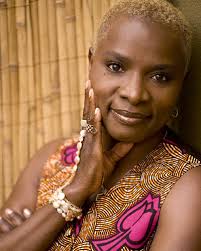 “We cannot hurt ourselves just for the sake of it. When you hurt somebody you hurt yourself. Down the line, the ripple of it comes back to you.” Angélique Kidjo
 Si tu ne me connais pas, tu ne peux m’estimer (proverbe Maure – Mauritanie, Algérie, Tunisie, Maroc, Niger, Mali, Sahara Occidental).
If you don’t know me, you cannot esteem me (Moor proverb – Mauritania, Algeria, Morocco, Tunisia, Niger, Mali, Western Sahara).

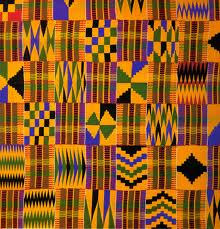
In recent years, the textile industry in African countries has taken a hit because of second-hand clothes from the Western world. Remembering the great and rich African Fabrics and Textiles industry of years and centuries prior, many have thus decided to stop accepting these to keep building or rather re-building their own textile industry. Over 30 years ago, President Thomas Sankara of Burkina Faso instituted the Faso Dan Fani in the workplace to encourage the local textile workers. Today, our wish is that other African countries will follow suit, and that throughout the world there will now be clothes worn with the label ‘Made in Senegal,’ or ‘Made in Mali,’ or ‘Made in Tanzania,’ or simply ‘Made in … [the African country’s name]’. Below is the excerpt of the article from the BBC. For the full article, go to The BBC.
====

Claim: Donating second-hand clothes has had a negative effect on textile industries in African countries.
The Rwandan President, Paul Kagame, has said: “We are put in a situation where we have to choose – you choose to be a recipient of used clothes… or choose to grow our textile industries.”
Rwanda is planning to ban the import of second-hand clothes by 2019 and has already put up tariffs.
Verdict: Imports of cheap second-hand clothes from the West have had an impact on local clothes manufacturers – but so have changes in world trade policies and the rise of Asian garment producers.
… African countries once had large textile industries – and some critics blame the flood of cheap second-hand clothes from abroad for the continent’s shrunken textile sector.
[…] In 2015, member states of the East African Community (EAC), which comprises Burundi, Kenya, Rwanda, Tanzania, and Uganda, announced they would ban second-hand imports from 2019 to protect their own clothing manufacturers.
East African countries, which account for 13% of the global market in second-hand textiles (worth a total of $274m (£208m) in 2015, began imposing tariffs. But then, under pressure from the United States, countries in the EAC reduced tariffs and withdrew the proposed ban. Rwanda, however, refused to back down.
And in March 2018, the US temporarily suspended Rwanda from an arrangement allowing sub-Saharan countries preferential access to the US market.
But Rwanda stood firm and maintained its import tariffs, saying it wanted to build up its own “Made in Rwanda” textile industry. …

If you are like me, there are many countries whose name you have pondered upon. One of them is Morocco! I have wondered about the name Morocco and its origin: was it a Portuguese or Spanish adaptation? did the French version ‘Maroc‘ derive from a Berber word or Almoravid name? Or was it a European name given to an African land? How did the initial inhabitants call their land?

Well, the word ‘Morocco‘ derives from the Berber Ameṛṛuk, the shortened version of « Amurakuc », the original name « Marrakesh», itself arising from the Berber « amur n ukuc » meaning «land of God» or «sacred land». The full Arabic name al-Mamlakah al-Maghribiyyah translates to “Kingdom of the West” or the “Kingdom where the sun sets.” For historical references, medieval Arab historians and geographers sometimes referred to Morocco as al-Maghrib al-Aqṣá (meaning “The Farthest West“) to distinguish it from neighboring historical regions called al-Maghrib al-Awsaṭ (meaning “The Middle West“) and al-Maghrib al-Adná (meaning “The Nearest West“). Marrakesh was Morocco’s capital under the Almoravid dynasty and Almohad Caliphate. In Turkish, Morocco is known as Fas, a name derived from its ancient capital of Fes. However, this was not the case in other parts of the Islamic world: until the middle of the 20th century, the common name of Morocco in Egyptian and Middle Eastern Arabic literature was Marrakesh; name still used in some languages such as Persian, Urdu and Punjabi. The English name Morocco is an anglicisation of the Spanish and Portuguese Marruecos and Marrocos respectively; which all derived from Marrakesh.

Morocco’s capital, Rabat (Source: visitMorocco.com)
Morocco was known as the Kingdom of Marrakesh under the three dynasties that made Marrakesh their capital. Then, it was known as the Kingdom of Fes, after the dynasties which had Fez as their capital. In the 19th century, European cartographers still mentioned a “Kingdom of Morocco“, indicating the ancient capital “Morocco” (for Marrakesh). Under the Alaouite dynasty, the country moved from the appellation to the Empire of Sharif in the 19th century, to that of Kingdom of Morocco.

Morocco is a monarchy, and is governed today by the King of Morocco, Mohammed VI, who holds executive and legislative powers, especially over the military, foreign policy and religious affairs.
Morocco has a coast by the Atlantic Ocean that reaches past the Strait of Gibraltar into the Mediterranean Sea. It is bordered by Spain to the north (a water border through the Strait and land borders with three small Spanish-controlled exclaves, Ceuta, Melilla, and Peñón de Vélez de la Gomera), Algeria to the east, and the annexed Western Sahara to the south. Since Morocco controls most of Western Sahara, its de facto southern boundary is with Mauritania.
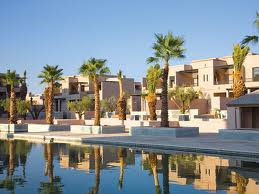
The capital of Morocco is Rabat; and its largest city is its main port, Casablanca. Other major Moroccan cities are Fes, Marrakesh, Meknes, Salé and Tangier. Morocco has become a major player in African economic affairs, and is the 5th African economy by GDP (PPP). Tourism accounts for a big part of its economy. Morocco is an ethnically diverse country with a rich culture and civilisation; and this diversity can be seen in its architecture, and cuisine as well.
Next time you visit Morocco, do not forget to enjoy its rich culture, cuisine, beautiful scenery, and remember that its name stands for the Land of God or the Sacred land, and enjoy its sacred treasures.
 L’autruche, quand il faut voler, dit: “Je suis chameau”; et quand il faut porter un fardeau, elle dit: “je suis oiseau” (Proverbe Arabe – Mauritanie, Maroc, Algerie, Tunisie, Libye, Soudan). – Un paresseux avance toujours des raisons pour fuir le travail.
 The ostrich, when it is time to fly, says: “I am a camel”; and when it is time to carry a burden, she says, “I am a bird” (Arabic proverb – Mauritania, Egypt, Algeria, Morocco, Tunisia, Libya, Sudan). A lazy person always gives reasons for fleeing work.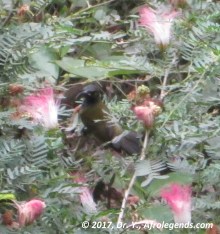

I answered a dating ad on the internet, and I was getting ready to go on my first date with this girl that I had never met before.
I was anxious, so I told my friend Usuofia about it: “What do I do if she is ugly? We are supposed to meet at the restaurant, and I will be stuck with her for the entire evening … Don’t you have an idea to get me out of this, if she is ugly?”
My friend Usuofia replied: “Don’t worry. When you enter the restaurant, simply move towards her. If you like what you see, no problem for your evening. But if she is ugly, then you will just fall on the floor, and fake an epileptic seizure, screaming « Aaaaaauuuggghhh ! ».”
That night, I enter the restaurant, and quickly spot the young lady who is wearing a clear sign for the date.
She is gorgeous! I can’t believe my luck, she is so beautiful! I get close and when I am about to talk to her… the girl falls on the ground and screams « Aaaaaauuuggghhh ! »
She is taken to the emergency room. And that’s when I scream Gwééééééééééééééééé !!!
I really do not understand what happened! Could somebody tell me what that means?
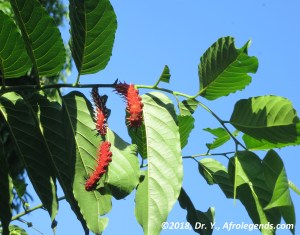
Un tronc d’arbre avec un mille-pattes dedans (Proverbe Zulu – Afrique du Sud). – Se dit de quelqu’un qui est haineux.
A tree trunk with a centipede in it (Zulu proverb – South Africa). – Said of someone who is hateful.
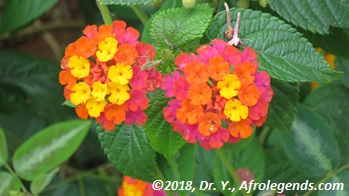
When I was younger, in my village, in some cases when someone had a high fever, the person will be given a hot tea with Lantana flowers (infused) to drop the fever; it was very efficient. Now, not all Lantana plants were used, there was a particular species of it… but I love the idea of using our own medicinal herbs for our use. So it is a mistake today, after having had the Kahun Gynecological Papyrus, or the Ebers papyrus centuries ago, to assume or act as if African traditional medicine is all bogus or full of charlatanism, and that the only alternatives for us Africans, are the pills that we buy in pharmacy made abroad in some laboratories in the Western hemisphere to address mostly their needs with no respect for our environments and realities. I am not saying to go out and cut all the plants out there, or not to buy drugs in pharmacies, but I am saying that African traditional medicine is rich, and we should also cherish and enhance it. I am sure there is so much that African herbs and medicine could add to the world. We just have to develop it, and to develop it, we need to start cherishing and valuing what we have, not leaving that to Western tourists on visit to claim to have discovered something that was ours and was there all along! African, start loving who you are, appreciating what you have, and enhancing what nature gave you (when it is good, of course)!
Solar-powered electric cars made in Africa by Africans for Africans. I love these ideas, and I had to share with you. Check out the first electric solar cars made in Togo by Togolese for Togolese. I love the intervention of the company’s founders who talked about providing farmers with ways to take their harvest to the market efficiently without having to worry fuel prices. They make tricycles and pickups for the transport of goods. The rechargeable car batteries have an autonomy of 180 km, and the solar panel a power of about 250 W; inside there is also a mini-fan and a camera for reverse parking. I salute their work which is full of ingenuity, determination, and above all is environmentally friendly! Bravo!


 African Heritage