Angelique Kidjo : First African Singer to get a Star on the Hollywood Walk of Fame

Angelique Kidjo

Last week, the world-renowned singer Angelique Kidjo became the first Black African to get a star on the Hollywood Walk of Fame, thus joining another African, South African actress Charlize Theron. The legendary singer, five-time Grammy award winner of Beninese origins known for Wombo Lombo, We We, Agolo, has been inducted into the Hollywood Walk of Fame, an honor granted to only a few in the world. She has cemented her place in history. Have you ever been to a Kidjo’s concert? I have been quite fortunate to attend one of them: the energy is electrifying, carried over by her strong voice which is rooted in ancestral sounds. Her career spans four decades, fusing elements of different African genres, Jazz, R&B, and Latin music, collaborating with some of the greats of this world, and crossing over continents. She has reinvented herself, releasing a total of 16 albums, earning 15 Grammy nominations and securing 5 wins.  She is also one of the few who started under the tutelage of another legend of the continent, the Cameroonian Ekambi Brillant.

Excerpts below are from AfricaNews, for the full article check it out. For other articles, please check out The Citizen and DW.

=====

Benin with its map and flag

Music icon Angélique Kidjo has cemented her place in history, becoming the first black African artist to be awarded a star on the Hollywood Walk of Fame. …

The Beninese singer, known for her electrifying voice and genre-blending sound, is no stranger to acclaim. With five Grammy Awards and a global fanbase, Kidjo has long been recognized as one of Africa’s most influential musical exports.

Over the course of her four-decade career, she has released 16 albums, fusing Afrobeat with elements of jazz, R&B, funk, and Latin music. Her collaborations read like a who’s who of the music industry, including the likes of Burna Boy, Alicia Keys, Carlos Santana, and Philip Glass.

… Her star on the Hollywood Walk of Fame is more than a personal achievement — it’s a historic recognition of African artistry on one of the world’s most iconic stages.

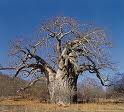
Grand n’est pas toujours plus fort / Big is not Always Stronger

Baobab
Baobab

Le baobab est un grand arbre, mais le lubota est plus fort (Proverbe Bayombe – République Démocratique du Congo (RDC)). – Les plus grands ne sont pas toujours les plus forts.

The baobab is a big tree, but the lubota is stronger (Bayombe proverb – Democratic Republic of Congo (DRC)). – The biggest are not always the strongest.

Celebrating the Centennial of Frantz Fanon’s Birth

Frantz Fanon
Frantz Fanon

This year, we are celebrating the centennial of the birth of Frantz Fanon, the great revolutionary psychiatrist, philosopher, and anti-colonial French author from Martinique. His work explored the psychological effects of colonization and the struggles of decolonization, and inspired liberation movements across Africa, Latin America, the Caribbean, and even the United States. To date, his works,  Black Skin, White Masks (1952) and The Wretched of the Earth (1961) remain essential reading in postcolonial studies and political philosophy. He died quite young at the age of 36, but he left his imprints everywhere, particularly on the African continent, and in particularly Algeria where he lived and fought for the liberation of the Algerian people.

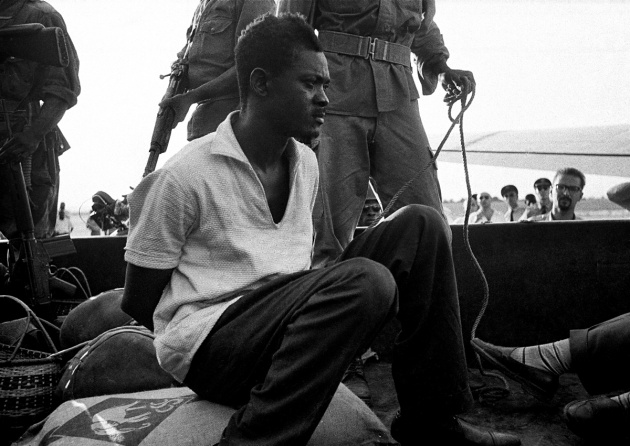
Lumumba detained
Lumumba detained

Fanon saw Congo, then Belgian Congo, clearly, as the center for pan-african solidarity, and believed that the assassination of its prime minister, Patrice Emery Lumumba, was a blow not just to Congo, but to the entire African liberation movement. When Lumumba was alive, he had invited Fanon to attend the inter-African Conference in 1960, thus showing his active engagement in Congo’s political future.   He wrote on Congo, Lumumba’s death: Could we (Africans) have acted differently? Like Amilcar Cabral, he warned of the presence of “traitors from within” seeing that the greatest threat to African independence was not just Western imperialism, but also African elites who had internalized colonial values and acted against their own people; like Moise Tshombe who played a great role in Lumumba’s demise.

Please join the Frantz Fanon Foundation in celebrating Fanon’s life and impacts on African liberation. There will be events throughout the year. Below are some excerpts from Fanon’s article, Lumumba’s death: Could we (Africans) have acted differently? For more, check it out. His words still ring true!

Patrice Lumumba

The great success of the enemies of Africa is to have corrupted the Africans themselves.  It is true that these Africans had vested interest in the murder of Lumumba.  Heads of puppet governments, in a fake independence, faced everyday by massive opposition from their peoples, it did not take long to convince themselves that the real independence of the Congo would put them personally at risk.

And first by Lumumba when he sought the intervention of the UN.  He should have never called on the United Nations.  The UN has never been able to properly solve problems brought to man’s consciousness by colonialism, and whenever it has intervened, it was to actually come to the aid of the colonial power to the oppressed country [see … think about MONUSCO].

In reality the UN is the legal card used by imperialist interests when brute force has failed.  The sharing, the mixed controlled joint committees, under guardianship are international means of torture to break the will of the people, cultivating anarchy, banditry and misery.

Lumumba’s fault was then initially to believe in the impartiality of the UN. He forgot that the UN, particularly in the current state, is only a reserve assembly established by the Greats to continue, between two armed conflicts, the “peaceful struggle” for the balkanization of the world.

Africans should remember this lesson.  If outside help is necessary to us, let us call on our friends.  Only they can truly and fully help us achieve our goals precisely because the friendship between us is a friendship of struggles. [The AES should remember this].

Peace Agreement between the Democratic Republic of Congo (DRC) and Rwanda: Is this for Real?

Map of the Democratic Republic of Congo

We have been told to applaud the recent “peace” agreement between the Democratic Republic of Congo (DRC) and Rwanda. It can be accessed on the US Department of State website both in English and French

Last week, on

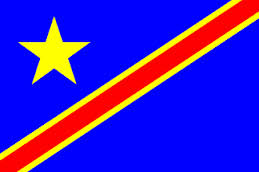
Flag of the Democratic Republic of Congo

June 27, 2025, the Foreign ministers of the DRC and Rwanda, Therese Kayikwamba Wagner and Olivier Nduhungirehe, respectively, in the presence of United States President Donald Trump in the Oval Office of the White House signed a peace agreement. Some of the key points of this peace agreement are : 1) Territorial integrity and prohibition of hostilities: both nations pledge to respect the territorial integrity of the other and its sovereignty – not sure why both, since the Rwanda of Paul Kagame has always been the aggressor and the one not respecting and violating the DRC territory and people. 2) Disengagement, disarmament, and integration of non-state armed groups – End state support to armed groups, thus committing both governments to halt military support for non-state armed groups – again, not sure why both when we all know that Rwanda is the culprit. Does that mean that the DRC government will now be working against its patriotic forces who have been trying to fight the Rwandan-backed groups in the East? 3) Joint security coordination mechanism.  4) Refugees, internally displaced persons, and humanitarian considerations – return of refugees and displaced populations – how? when the culprits have not even been openly named? 5) MONUSCO and other multilateral support – how can someone trust this organization of the United Nations which has produced zero results (more like negative results) in over 30 years in eastern DRC? and which has instead been an accomplice to the worst atrocities in Congo? 6) Regional economic integration framework – … this framework… shall ensure… both parties derive greater prosperity… the parties shall launch and/or expand cooperation on … national park management; hydropower development; derisking of mineral supply chains; joint management of resources in Lake Kivu; and transparent, formalized end-to-end mineral value chains (from mine to processed metal) that link both countries, in partnership, as appropriate with the US government and US investors – What an abomination! Why is this not signed with Burundi, Tanzania, or Zambia too? Don’t they share borders with the DRC? So Congo needs to share its resources with the resource-less Rwanda, and together they will manage Congo’s resources! Unbelievable! – the US have always been in the great lakes region funding Rwanda against the DRC under Clinton and subsequent governments; what changes now? 7) Implementation and dispute resolution – any dispute arising for the implementation of this agreement shall be resolved amicably between the parties with the facilitation of the Joint Oversight Committee upon request of either party – what the heck is JOC: African Union facilitator, Qatar, and the United States.

Flag of Rwanda

As pointed out before in The Declaration of Principles between the Democratic Republic of Congo (DRC) and Rwanda, how can a peace agreement be signed which does not clearly state that Rwanda is the aggressor of the DRC? which does not even mention its guilt or its actions against the DRC? How can there be a peace agreement, if Rwanda does not admit to its crimes against the Congolese people? Why is there no mention of the close to 10 million dead Congolese from this 30-year-old conflict? What sort of a peace is that if there is no justice? What is this? No punishment? No accountability? No responsibility? Only for Africa could they sign such a piece of toilet paper! And we are supposed to applaud? Not too long ago, we have heard of a 100-year-old former guard at a Nazi concentration camp accused of “aiding and abetting” the murder of over 3,300 prisoners during world war II who is going to face a German court. When it comes to Congo, not even a trial for Paul Kagame, or any of his cronies! Not even a sorry?

Democratic Republic of Congo (DRC) mineral map (Source: Atlas du continent africain, Jeune Afrique et editions Jaguar, 2000)

In point 6, all resources of Congo now belong to the entire region: Rwanda with no resources, and Congo with the resources. Thus, DRC needs to keep feeding Rwanda (and Uganda – the other co-aggressor), and all the controllers, until they are filled to the brim! What is Rwanda doing in the management of Congolese national parks? or the hydropower? why should Rwanda be involved in the management of the mines and exploitation of minerals (gold, diamond, cobalt, uranium, etc) in the DRC? Why? What gives them the right? Can you imagine, now, the resources of Congo should mutually benefit its agressor Rwanda (and Uganda) equitably so that the DRC will have peace! What sort of garbage is this? Rwanda benefits 100%, while DRC keeps feeding the neighbor! In essence, the theft and expropriation of the DRC resources has now been fully legalized. Does this mean that for each exploration in Congo, Rwanda needs to be consulted? Corruption is even mentioned, what is Rwanda doing in the fight against corruption in Congo’s resources?

DRC cobalt

Thus, in this “peace” agreement, Rwanda got everything, while Congo got nothing … not even peace! How can one get peace, if the culprit has not even been cited openly? or punished? no justice? Even Kagame after the Rwandan genocide had the International Criminal Tribunal for Rwanda (ICTR) in Arusha Tanzania, and the gacaca courts (community-based justice)… the DRC got nothing, not even a whisper about the crimes committed against its populations for 30 years! Moreover, its resources are now “regional” resources! Not sure if this should be called a peace agreement! Honestly, Africans should never dream of peace without fighting… it can never work! The predator will never let go until it is beaten to the ground! 

Proverbe Peul / Fula Proverb

Lait / Milk

Crème et lait proviennent d’un même pis; mais après avoir battu le lait, on obtient le beurre (Proverbe Peul – Afrique de l’Ouest et Afrique Centrale). – Les enfants seront différents plus tard d’après leur éducation.

Cream and milk come from the same udder; but after beating the milk, we obtain the butter (Fula proverb – West Africa and Central Africa). – Children will be different later depending on their upbringing.

Niger to Nationalize Uranium Mining

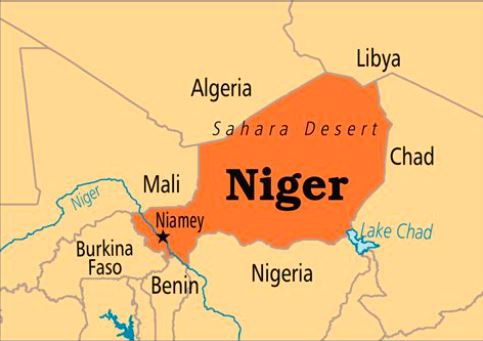
Map of Niger

Last week, on June 19th, Niger announced plans to nationalize its uranium venture which until now had been operated by the French company Orano. By this, the Niger government has decided to gain control over its resources from France. For many years, the French state owned company Orano, which was previously Areva, has been extracting uranium in Niger, enjoying a full monopoly, paying barely anything to the country including no taxes (Mali and Niger end Long-Standing Tax Treaties with France). This quest for freedom or rather fairness by Niger is not something new which started with the government of President Abdourahamane Tchiani, but rather the culmination of years of an unfair treatment based on an unbalanced relationship with the French company and government. In the 2000s, then President Mamadou Tandja had sought to re-negotiate the partnership with then Areva (now Orano) which until then had enjoyed a de facto 4 decade monopoly in the country paying almost nothing to the locals; he tried to curb the French influence by striking a deal with the China Nuclear International Uranium Corporation in 2007 to develop a uranium mine. As expected, Tandja was deposed in a coup in 2010, coup financed by the metropolis. Niger Takes Control of its Uranium, and Niger and Orano: Disagreement.

Below are excerpts from People’s Dispatch

=====

Uranium

In yet another assertion of sovereignty, the government of Niger announced on Thursday, June 19, that it would nationalize the Somaïr uranium venture, wresting control from the multinational nuclear fuel cycle corporation Orano.

Orano is owned by the French state, which, the government noted, has been “openly hostile toward Niger since July 26, 2023”, when the then president Mohamed Bazoum, domestically perceived as a French puppet, was ousted in a popularly supported coup.

Without yielding to French threats of war, the military government replacing Bazoum’s regime consolidated widespread support by expelling French troops, fulfilling the demand for which mass protests had been underway in the lead-up to his removal.

Flag of Niger

France has long exerted a monopoly over Niger’s uranium, which is among the highest grade in Africa. It has been fueling French nuclear power plants, lighting up a third of its light bulbs, while over 85% of Nigeriens lacked connection to the electricity grid.

… The nationalization changing this neo-colonial arrangement “will allow for healthier and more sustainable management of the company and, consequently, optimal enjoyment of the wealth from mining resources by Nigeriens,” its statement added.

Threatening Niger with “legal actions, including criminal proceedings if necessary”, Orano said it “intends to seek full compensation for the damages suffered and will assert its rights to the stock corresponding to Somaïr’s production to date.”

Large Gold Deposit found in Ivory Coast

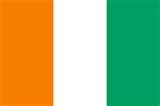
Flag of Cote D'Ivoire
Flag of Cote D’Ivoire

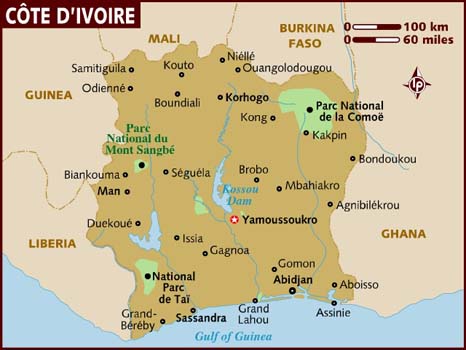
In Ivory Coast, the Australian company Resolute Mining announced on Monday, June 16, the discovery of a significant gold deposit in the department of Doropo, in the northeast of Ivory Coast, near the border with Burkina Faso. This new deposit has large reserves which are estimated at over 100 tons of gold, and represents a major advancement for the Ivorian mining sector.

During a meeting with Ivorian Prime Minister Robert Beugré Mambé, the CEO of Resolute Mining, Chris Eger, specified that the construction of the mine will begin in the first quarter of 2026, for a duration of two years. The planned investment amounts to 300 billion CFA francs (approximately 530 million USD).

Map of Cote d'Ivoire
Map of Cote d’Ivoire

Hummm, Isn’t it a bit suspicious that this large deposit is right near the border with Burkina Faso? We all know that these people plan over decades, so what if the location of the mine in the northeast is not only used for gold extraction, but also as a base for attacks in the neighboring country (U.S. military posture in Africa shifts while terrorist threats intensify)? It is no secret that Côte d’Ivoire is being used as a Western base against the countries of the AES (Mali, Burkina Faso, Niger). Moreover, for many years, people have mentioned the geological survey conducted by the UNESCO (or one of the UN-organization) on Africa which was never made public to African countries. Are we to think that the same Resolute Mining which owns the Syama gold mine in Mali or the Mako gold mine in Senegal, with mining permits in Guinea, never did a geological survey into neighboring Côte d’Ivoire before? Lastly, this is the same Resolute Mining which refused to pay taxes to Mali for years Mali wins $160m in Gold Mining Dispute; Has Côte d’Ivoire negotiated well, or were they too excited by the gold findings? Again, this is where unity would significantly help our countries… here Resolute Mining is signing in Côte d’Ivoire, if they were to sign with a smaller country, less developed, the government maybe so happy that they sign anything or do not negotiate well enough for their populations to benefit from this manna… and these contracts lasts for many many years!

Anyways, we applaud the findings in Côte d’Ivoire, and wish that the government would think of opening a refinery in their own country as well, and train its youths, like in Mali… oh wait… the government of Côte d’Ivoire does not like the Mali of Assimi Goïta!

Zimbabwe Bans Exports of Lithium

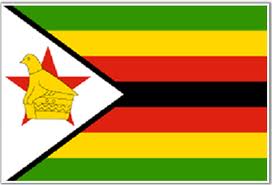
Flag of Zimbabwe
Flag of Zimbabwe

As of June 2025, the Zimbabwean government has announced that exports of raw lithium concentrate will be banned starting in January 2027. This move is meant to push mining companies to build local processing plants and keep more of the value chain within the country, thus helping towards the country’s development, and stopping the cycle of exports of raw materials and barely anything (The Lithium of Zimbabwe). This should also create employment for the locals.

Lithium

Several Chinese firms—like Sinomine and Zhejiang Huayou Cobalt—are already building lithium sulfate plants at the Bikita and Arcadia mines. These facilities will refine lithium concentrate into lithium sulfate, a key ingredient for battery-grade chemicals like lithium carbonate and hydroxide.

There is not yet a full refinery built, but this ban indicates Zimbabwe’s clear shift from being just a raw exporter of lithium. Given the importance of lithium in the electric car revolution as a material for batteries, this is really a game changer. We applaud Zimbabwe, and call other countries to learn from Zimbabwe, Mali, Burkina Faso, and Niger.

Kwame Nkrumah
Kwame Nkrumah

This is where the dream of Kwame Nkrumah, of a real African Union, comes back; we are not talking about the current union which is just a puppet organization serving the interest of the Western powers. Kwame Nkrumah: African Visionary and Ghana’s First President. Currently, each country is negotiating individually, which may yield good or not so good results, if they do not have good negotiators or good mining lawyers in the case of lithium for instance. However, some would end up being taken advantage of just because they are not exposed to the new changes, don’t know, and could accept really low prices which may affect even their neighbors. Being United would insure good negotiations across the board learning from others, and also ensure that the multinationals respect the local governments and populations; and if they are kicked out of one country because of law or contract infringements, that they do not just run to another to perpetuate the cycle. This is what the AES is doing (The AES Creates a Joint Military Force), and all African countries should. 

Mali Launches a State Gold Refinery

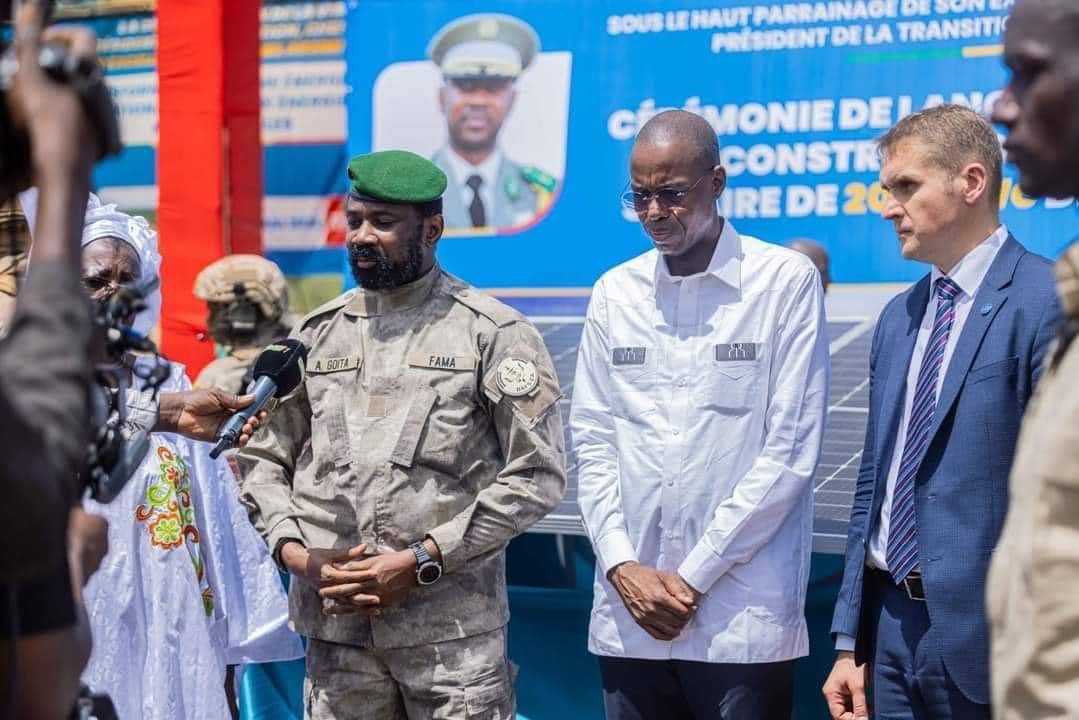
President Assimi Goita of Mali during the launching of a public gold refinery (Source: akondanews.net)

Today, June 17, 2025, Mali has begun the construction of a new state-controlled gold refinery. The facility, built in partnership with Russia’s company Yadran Group, is expected to process up to 200 metric tons of gold annually, significantly increasing Mali’s refining capacity. The refinery is part of the broader mining reforms taken by the government of Assimi Goïta to keep more gold processing within the country rather than exporting raw materials. This should, in principle, help develop the local manpower. The state will hold a 62% stake, with Yadran Group owning the remaining 38%. This refinery is intended to serve as a regional hub, processing gold not only for Mali, but in the long term for neighboring countries like Burkina Faso as well. This project reflects the wider trend in the Sahel, and particularly in the AES, where countries are revising mining laws so as to keep more value-added processing at home.

Flag of Mali
Flag of Mali

It is about time that Mali, and other African countries learn to process their materials at home, instead of exporting the raw materials to later on import the same things, or letting the others reap fruits from our raw materials. Just imagine for a second if the Democratic Republic of Congo had the power to develop its cobalt, tantalum, tin, uranium, etc., at home, wouldn’t it impact its populations for better? Or just imagine if Ivory Coast, the number one world producer of cocoa was processing its cocoa at home, instead of exporting the raw beans to Europe for Europeans to process, how would this fundamentally change the Ivorian economy?

Djenné
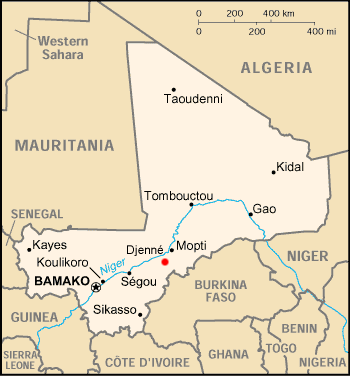
Map of Mali

Of course, when you read the MSM magazines, they will title Junta-led Mali begins construction of gold refinery in partnership with Russia; instead of the Malian government begins the construction of a gold refinery! They are upset that Mali, and all the other countries of the AES, Burkina Faso and Niger, are taking steps to nationalize, to improve, and to build factories to refine their God-given resources in their own lands, thus taking a step towards lifting their nations out of poverty! This, of course, would not help the West which would rather have a weak African government or puppet governments.

Moreover, yesterday 06/16, the Malian courts ordered that the Loulo-Gounkoto gold mine be placed under provisional administration for six months. The deposit has been the subject of a tug-of-war between the Malian government and the Canadian mining group Barrick Gold for the past two years, over tax dispute (Mali wins $160m in Gold Mining Dispute). The Malian authorities hope to resume production operations halted in January at this strategic gold site, while gold prices are at their highest.

Tout le monde a un don / Everybody has a Gift

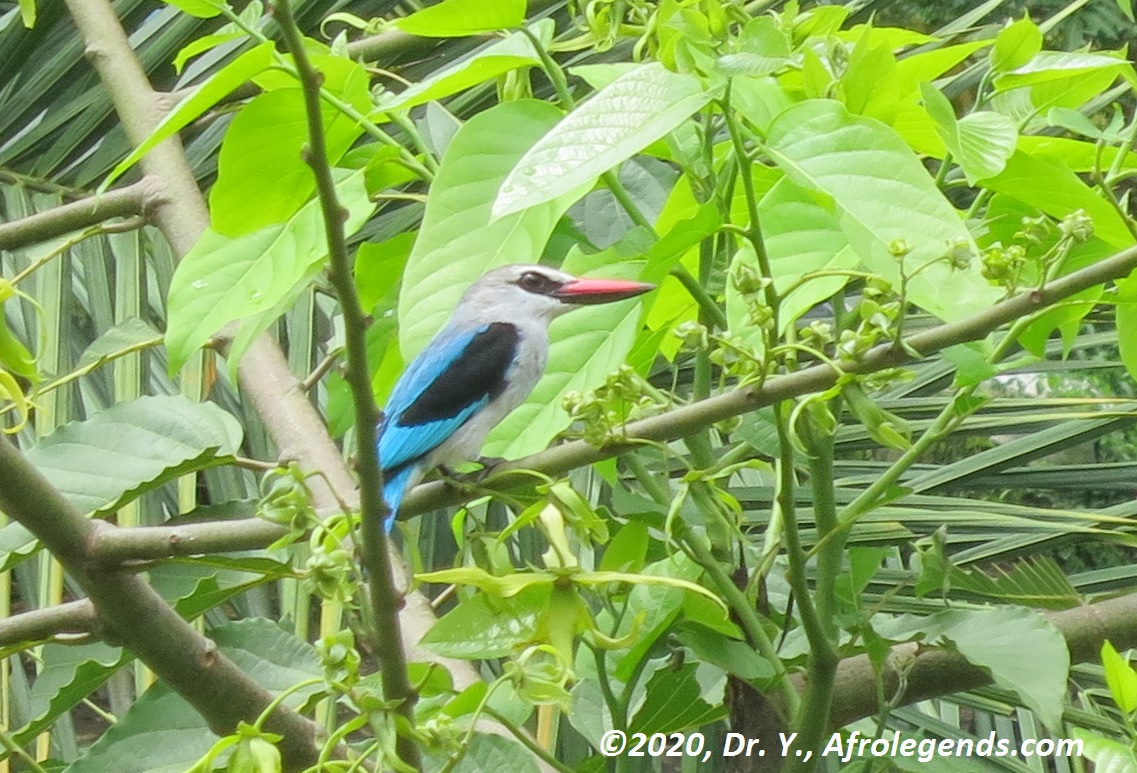
African Kingfisher / Martin-pecheur Africain

Même le petit oiseau a des plumes à la queue (Proverbe Shambala – Tanzanie). – Le pauvre aussi a quelque chose.

Even the little bird has feathers on its tail (Shambaa proverb – Tanzania). – The poor also has a something.