If you are like me, you have probably thought that the city of Johannesburg, the largest city of South Africa, was named after some dude named Johannes, and that Johannesburgtranslates to something like “the town or city of Johannes.” How far are we from the truth?
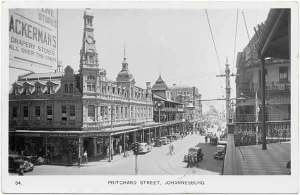
Pritchard St in Johannesburg, ca 1910
Not too far actually! There are some controversies around the naming, i.e. whose name it was. After all, the name Johanneswas quite common in the Dutch community in the 19th century, and simply translates to ‘John’ in English; in this day and age, think of how many Johns there are…, then think about 19th century: numerous, not to say ubiquitous! To get back to Johannesburg, there were quite a few people with the name ‘Johannes‘ involved in the early history of the city. Among them was Christiaan Johannes Joubert who was a member of the Volksraad and was Republic’s chief of mining. Another was Stephanus Johannes Paulus Kruger (better known as Paul Kruger), president of the South African Republic (ZAR) from 1883 – 1900. Johannes Meyer, the first government official in the area is another possibility. Precise records for the choice of the name for the city have been ‘conveniently’ lost. Most likely it came from Johannes Rissik and Christiaan Johannes Joubert who were members of a delegation sent to England to obtain mining rights for the area. Joubert had a park in the city named after him and Rissik had his name on one of the main streets in the city. So it was probably a joint appeal between these 2 Johanneses, Joubert and Rissik, that gave rise to the name of the city of Johannesburg.
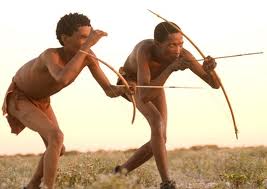
San (Basarwa/Bushmen) hunters
The region surrounding Johannesburg was originally inhabited by San people. By the 13th century, groups of Bantu-speaking people started moving southwards from central Africa and encroached on the indigenous San population. By the mid-18th century, the broader region was largely settled by various Sotho–Tswana communities, whose villages, towns and kingdoms stretched from what is now Botswana in the west, to present day Lesotho in the south, to the present day Pedi areas of the Northern Province. More specifically, the stone-walled ruins of Sotho–Tswana towns and villages are scattered around the parts of the former Transvaal province in which Johannesburg is situated.
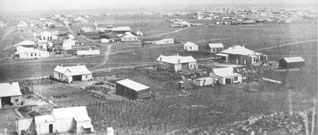
Aerial view of Johannesburg in 1911
The Witwatersrand Gold Rush triggered the founding of Johannesburg in 1886. As everywhere in the world, the discovery of gold rapidly attracted people to the area. Within ten years, the city of Johannesburg included 100,000 people; in that sense, it is quite similar to the California gold rush which saw the boom of the city of San Francisco. In 1917, Johannesburg became the headquarters of the Anglo-American Corporation, which ultimately became one of the world’s largest corporations, dominating both gold-mining and diamond-mining in South Africa. Major building developments took place in the 1930s, after South Africa went off the gold standard. In the 1950s and early 1960s, the apartheid government constructed the massive agglomeration of townships that became known as Soweto to house their cheap black labor.
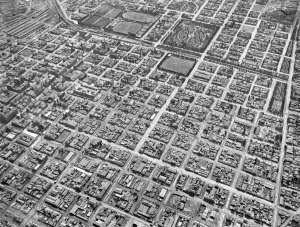
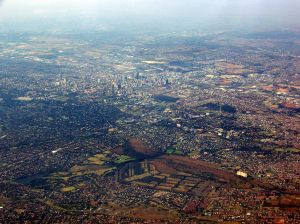
Aerial view of Johannesburg in 2008
Locals have several names for their city: Jozi, Joburg, and eGoli(“the city of gold” in Zulu). Located in the Witwatersrand (“white waters ridge” in Afrikaans) hills at the center of the large-scale gold and diamond trade, Johannesburg is the largest city in South Africa and one of the 50 largest urban areas in the world. It is the capital city of South Africa’s wealthiest province, Gauteng. So as you visit Johannesburg, and enjoy its popular museums, theme parks, and rich history. Enjoy the gold hills, or rather those mounds covered with gold dusts scattered around the city. Enjoy eGoli!
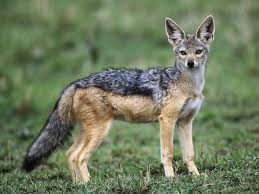
“Oh, Gogo,” little Sipho asked one evening, “could you tell us the story of clever Jackal again?” Sipho, whose nickname was Mpungushe “jackal,” never tired of hearing tales of his beloved namesake.
“Hawu, Sipho,” moaned several of his siblings, “Not again, little Jackal! You will wear out our ears with stories of Mpungushe!”
Gogo laughed her deep, round laugh. Soon each of her grandchildren were laughing along with her.
“I, too, love the stories of the Jackal!” Gogo looked at Sipho. “But we do not want to cause your brothers and sisters to become deaf. I think there is another tale that I can tell you of an animal who tried to be as clever as Jackal!”
Kwasuka sukela …
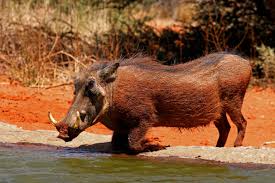
Warthog
WartHog had made himself a lovely, spacious home in an old termite mound that an aardvark had cleared out. He had built it up and made a wide entrance. He thought it was the most magnificent home in Africa and would often stand at the entrance of his dwelling with his snout in the air as the giraffe, wildebeest and zebra passed on their way to the watering hole. “Hah,” he thought to himself, “no one has such a fine home!“
One day as he looked out from the entrance of his cave he was horrified to see a huge lion stealthily stalking toward him. He started to back away, but because he had made the entrance to his place so grand, the lion would have no difficulty in following WartHog right in. “Ahhhh,” panicked WartHog, “Bhubesi will eat me in my own lounge! What will I do?“
WartHog decided to use an old trick he’d heard Jackal bragging about. WartHog pretended to be supporting the roof of his hole with his strong back, pushing up with his tusks. “Help!” he cried to the lion, “I am going to be crushed! The roof is caving in! Flee, oh, mighty Bhubesi, before you are crushed along with me!“
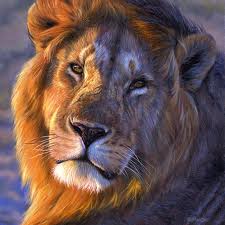
Now Lion is no fool. He recognized Jackal’s old ploy straight away (“Do you remember that story, children?”), and he wasn’t going to be caught out again. He roared so fiercely that WartHog dropped to his knees, trembling. WartHog begged for mercy. Luckily for him, Lion was not too hungry. So he pardoned WartHog and left, saying,
Lion
“Stay on your knees, you foolish beast!“
Lion laughed to himself and shook his shaggy head as he walked away. Imagine, slow-witted WartHog trying to copy Jackal’s trick! WartHog took Lion’s order to heart. That is why, to this day, you will see Wart Hog feeding on his knees, in a very undignified position, with his bottom up in the air and his snout snuffling in the dust.
Here is an anonymous poem I thought of sharing with all; it reflects the life of so many in the workplace in the West. Enjoy!
=====
Being Black in the Work Place
They take my kindness for weakness. They take my silence for speechless. They consider my uniqueness strange. They call my language slang. They see my confidence as conceit. They see my mistakes as defeat. They consider my success accidental. They minimize my intelligence to “potential”. My questions mean I’m unaware. My advancement is somehow unfair. Any praise is preferential treatment. To voice concern is discontentment. If I stand up for myself, I’m too defensive. If I don’t trust them, I am too apprehensive. I’m defiant if I separate. Yet, I am fake if I assimilate. So, constantly I am faced with work place hate. My character is constantly under attack. Pride for my race makes me “TOO BLACK”. Yet, I can only be me. And who am I you might ask? I am that Strong Black Person… Who stands on the backs of my ancestors. Achievements, with an erect spine pointing to the stars with pride, Dignity and respect which lets the work place in America know, that I not only possess the ability to play by the rules, but I can make them as Well!
Black History 365
Good, Better, Best, Never rest until YOUR Good is Better and YOUR Better is Best!
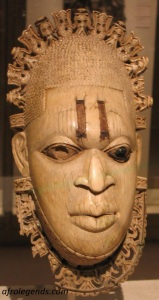
Pendant Ivory mask representing Queen Idia, Iyoba of Benin City (16th Century) – exposed at the MET
France, like so many European countries, is being urged to return looted art to Africa. Below is the article. For the full article, go to the Guardian.
=====
A report commissioned by Emmanuel Macron will call for thousands of African artworks in French museums taken without consent during the colonial period to be returned to the continent.
Unless it could be proven that objects were obtained legitimately, they should be returned to Africa permanently, not on long-term loan, said the authors of the report, the Senegalese writer and economist Felwine Sarr and the French historian Bénédicte Savoy.
They have recommended changing French law to allow the restitution of cultural works to Africa, after Macron announced that he wanted it to begin within five years.
… “I cannot accept that a large part of the cultural heritage of several African countries is in France,” the French president said last year in Ouagadougou, the capital of Burkina Faso. “There are historical explanations for this but there is no valid, lasting and unconditional justification. African heritage cannot be only in private collections and European museums – it must be showcased in Paris but also in Dakar, Lagos and Cotonou. This will be one of my priorities.” [Politicians always make promises, but never deliver. Let’s wait and see if Macron can do anything. In 2015, Francois Hollande, then French President Acknowledged French Genocide in Cameroonwhile in visit in Cameroon, without ever apologizing!]
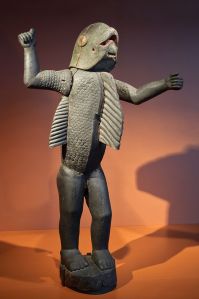
Fon statue symbolizing King Behanzin, the Man-Shark by Sossa Dede (c. 1890) – currently exposed at the Musee du quai Branly in Paris
The extent to which France, Britain and Germany looted Africa of its artefacts during colonialism is not known, but according to the report, which will be released this Friday, about 90% of Africa’s cultural heritage currently lies outside the continent.
… The report’s authors travelled to Mali, Senegal, Cameroon and Benin and looked through the works held by the Musée du quai Branly, a museum focused on non-European cultures in Paris, and found that about 46,000 of its 90,000 African works were “acquired” between 1885 and 1960 and may have to be returned.
Cast Bronze figurine from Benin City at the MET museum
Unbelievable! I had to share this article about European museums loaning looted African artifacts back to Africans. It sounds so mind-boggling! How can someone steal from you, steal your cultural work, the work of your ancestors, your sweat, and then several years later loan it back to you, not even return it? and they call that progress! For the entire article, go to Europe’s Largest Museums Will Loan Looted Benin Bronzes to Nigeria and What do you know about Africa’s looted art treasures.
=======
Major museums across Europe have agreed to loan important artifacts back to Nigeria for a new museum the country plans to open in2021. The African nation’s Royal Museum will house a rotating display of artifacts, including the Benin bronzes that were looted during the Benin Expedition of1897. The agreement marks a significant step after years of negotiations among European institutions and Nigerian authorities.
Benin City art exposed at the MET Museum, NYC
… Together, museum leaders from Austria, Germany, the Netherlands, Sweden, and Britain agreed to facilitate a display at the planned institution within three years. Further specifics—including which objects will be loaned over what period of time—have yet to be confirmed.
… The objects in question were looted by the British army during a so-called “punitive expedition” in1897. The army took around4,000intricate sculptures, including bronze works now known as the Benin bronzes, from the king’s palace in the former Kingdom of Benin.
A lady dozed off during the pastor’s preaching… Suddenly, she wakes up and hears the pastor say “Stand up.”
She gets up and sees the entire assembly turn toward her. Everyone is in shock, including her husband who is sitting next to her. She looks around and realizes that she is the only one standing. The pastor looks at her and tells her, “Thank you Madam, please remain standing, we will pray for you … We already have one person standing. She is courageous… Anyone else? Nobody? Let me repeat myself, in case you did not hear me well. I asked you to stand if you are unfaithful, if you are committing adultery; if you cannot stop cheating on your partner at each of his missions… Stand up so that we can pray for you.”
In the old days, monkey went to see God and asked him to be like man. God asked him:
Awô, but can you stay locked 100 days in a cage?
Awô answered monkey, I can, I swear !
God locked him up in a box as agreed.
On the morning of the 99th day, monkey looked through a small hole and saw wonders: flowers, ripe mangoes, bananas, a blue sky, expanse of water, a golden light, branches swinging.
Then, with all his strength, monkey broke the door and said:
The world gets beautiful while I am locked up! No way, all these movements outside invite me to the party, I go, I go !!!
Régime de banane plantain
He does not finish his monologue and he jumps outside in the open air to live freely like everyone.
That’s why he stayed half-way between man and animal.







 “Your brain is your greatest weapon. Connect it to your heart, and you can go anywhere.”


 In the old days, monkey went to see God and asked him to be like man. God asked him:

 African Heritage