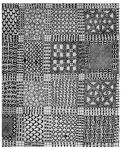
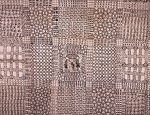
Very often, Africans are depicted on old pictures as naked people, walking around without any clothing. This seems to be quite at odd with the fact that the Dutch textile company VLISCO has been installed in Africa, more precisely in Togo, since 1846. So how could pictures from the 1800s and early 1900s only show naked Africans? The BBC recently ran a story on VLISCO and African textile tradition actually being European. The New York Times claimed that Africa’s fabric was entirely Dutch. I find this quite appalling, and I call this a falsification of history.
For starters, before VLISCO, Africa had a very rich textile industry as noted by Kankan Moussa‘s entire delegation being clothed from cotton woven with golden threads in 1300s during his pilgrimage to the Mecca (this will be a story for another day), or the Kanembu clothing tradition which dates as far…
This is yet another favorite on the African Heritage blog.
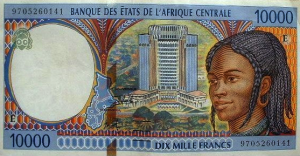
Please take a moment to reflect on this colonial tax African countries have been made to pay for the past 70+ years, particularly in view of the new West African money ECO which is trying to come to life. We applaud the idea of a common currency in West Africa, and in Africa as a whole… remember that this was Kwame Nkrumah‘s dream and the forefathers of the African Union, but when we hear France’s puppet Alassane Ouattara of Côted’Ivoire say that the ECO will be just another name for the FCFA, we can only scream against it, or rather against France’s scheming yet again to impoverish African countries. What France is doing to African countries, by getting over 500 billion dollars every year for free (Africa is funding Europe!), is the same thing that Nazi Germany did to France with their currency at the time of World War II: the FCFA was inspired from it. Yet… after pillaging Africa yearly and raping her daily, they do not seem to hold their economy down, dealing with unemployment, and the Yellow Vests! Free money is always like that: because you did not work for it, it always seems to run out quickly! It’s about time they think of a partnership… but then it is France, so that will probably never happen!
African countries continue to pay colonial tax to France 50 years after their independence. This system is an abomination destined to keep African countries poor forever! Here are some excerpts from the article by Mawuna R. Koutonin. For the full article, go to France Colonial Tax , and do not forget to check out the article I wrote a while back on the Franc CFA: slave currency! Also, please read the book by Pr. Nicolas Agbohou on the subject: ‘Le Franc CFA et l’Euro contre l’Afrique.’
===========
Did you know that many African countries continue to pay colonial tax to France since their independence till today?
Sekou Toure, Cover Time Magazine, Feb. 16, 1959
Sékou Touré of Guinea decided in 1958 to get out of french colonial empire, and opted for the country’s independence, the french colonial elite in Paris got so…
Reblogging this all-time favorite poem on the African Heritage Blog.
A few questions for the readers: what do you like the most about this poem by Sandile Dikeni? What is special? And what made you connect to it? What in this poem describes your country or is there something in it which describes your country?
In the past I have always wished that we, Africans, could be patriotic. I came across this beautiful poem ‘Love poem for my country‘ by South African writer Sandile Dikeni. I really enjoy the way the author describes his country, the valleys, the birds, the ancient rivers, and its beauty. He feels the peace, the wealth, and the health his country brings. He is one with hiscountry.He is at home! His country is not just words or food, or friends, or family, it is more, it is his essence! That is true patriotism, the bond that links us to the bone to our motherland. Enjoy!
My country is for love so say its valleys where ancient rivers flow the full circle of life under the proud eye of birds adorning the…
This is another all-time favorite… The second-most popular post on Afrolegends.com: the history of Adinkra symbols and the Rich Akan culture of the Akan people of Ghana and Côte d’Ivoire. Enjoy!
As we revisit this favorite, please let us know if there are other things you would like to learn on the topic, and we will try to add more.
The Adinkra symbols are believed to originate in Gyaman, a former kingdom in modern day Côte d’Ivoire. According to an Ashanti (Asante) legend, Adinkra was the name of a king of the Gyaman kingdom, Nana Kofi Adinkra. King Adinkra was defeated and captured in a battle. According to the legend, Nana Adinkra wore patterned cloth, which was interpreted as a way of expressing his sorrow on being taken to Kumasi, the capital of Asante. He was finally killed and his territory was annexed to the kingdom of Asante. The Asante people, around the 19th century, took to painting of traditional symbols of the Gyamans onto cloth, a tradition which has remained to this day.
Nobel laureate and Pulitzer Prize-Winning Author Toni Morrison, the first Black woman to win a Nobel prize in literature, has passed away at the age of 88. I have read some of her books: “The Bluest Eye” which was part of my Dad’s collection and which I devoured, “Beloved” (I saw the movie, and was left with a ‘What just happened?’ feeling at the end of it), “Song of Solomon,” and “Sula“… I have to admit that I started “Jazz” but never finished it for lack of time. To be honest, Toni Morrison and I did not jive… I read the books, but I always felt like I needed to read them more than once to actually understand them. I believe that was her signature: her books were no cookie-cutter type-literature, but profound, heartbreaking, and conscience shakers; they had this earth-shattering effect, where you really walked a mile in the protagonist’s shoes. They also always had this musical and poetic feel to them, … maybe that’s why I kept coming for more?
‘Beloved’ by Toni Morrison
Toni Morrison had an outstanding career. She started late as a writer at age 39 and was editor of textbooks at Random House before fiction: she was the first African American editor there. She then became one of the world acclaimed writer, and professor at some of the best universities in the world: Cornell University and Princeton University. She won the Nobel laureate in Literature in 1993, thereby becoming the first and only Black woman to win it to date. She was even on the cover of Time Magazine in 1998, only the second female writer of fiction and second black writer of fiction to appear on one of the most significant U.S. magazine covers of the era. And … she of course, benefited from the Oprah effect!
“Her writing was not just beautiful but meaningful — a challenge to our conscience and a call to greater empathy,” President Obama wrote Tuesday on his Facebook page. “She was as good a storyteller, as captivating, in person as she was on the page.”
“Narrative has never been merely entertainment for me,” she said in her Nobel lecture. “It is, I believe, one of the principal ways in which we absorb knowledge.”
She also said, “If there is a book that you want to read, but it hasn’t been written yet, you must be the one to write it.” So get ready… it’s your turn to carry Toni Morrison’s torch!
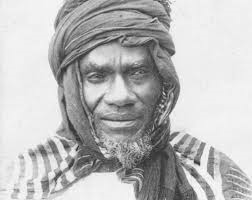
This post on Samori Touré has been an all-time favorite post on Afrolegends.com . I am reblogging it here, because on this 10-year anniversary of the African Heritage Blog, it has been the most viewed and loved article. As you know, Samori Touré, grandfather to the African president Sekou Touré (another resistant to French imperialism – Guinea: the country who dared say ‘NO’ to France), was a leader and ruled over a vast empire which spanned big areas of West Africa from Guinea all the way to modern-day Côte d’Ivoire. He was a strong fighter to France imperialism in Africa, and opposed a great resistance to the French several times. This is to one of Africa’s great kings, warriors, and resistant.
One of the great kings, and fighters of African freedom was the great Samori Touré. Over 100 years ago, Samori Touré was captured by the French and deported to Gabon where he died of pneumonia.
But who was Samori Touré?
Well, Samori Touré was born in 1830 in Manyambaladugu (some texts mentionSanankoro instead), a village southeast of Kankan in present-day Guinea. Samori was a great warrior who fought imperialism in the 19th century such as many leaders today. He refused to submit to French colonization and thus chose the path of confrontation using warfare and diplomacy.
Until the age of 20, Samori was a trader. After his mother was captured in a slave raid by the king Sori Birama, he offered to serve in his army and excelled by his military prowess and skills.
Samori Touré had a vision of unity for the Malinké people, and…
Yesterday, August 1, the African Heritage blog passed the 2 million views cap. This is particularly moving, and coincidental with the fact that this August will also mark a significant milestone: the 10 years anniversary of blogging on Afrolegends.com, the African Heritage blog. Time flies! Goodness Gracious, time flies! It has been a fun and tough 10-years ride. I could fill another blog just to tell you how these past 10-years have been, but I will spare you the details for now. All I can tell you is that YOU, the readers and subscribers, have made it possible with your constant support, comments, corrections, and contributions. This is truly a celebration to you, and to your readership! A big thanks to all of you.
I have always been stunned by the beautyof the flower below (growing up, I was always enthralled by its beauty) because of its vibrancy, its distinction, its determination, and above all its uniqueness… so in upcoming years, this will be our motto here on Afrolegends. As we embark on this new journey, we promise to bring you more good content and stories, and of course capture great memories for the African continent. As you know, the past 10 years have been tough years for Africa, but they have also been years of learning, growth, and rebirth. Like always, “A luta continua e la vitoria e certa.”
To celebrate this milestone, for the month of August, we will feature the top articles on the blogfor the past 10 years, and bring out the all-time favorites.
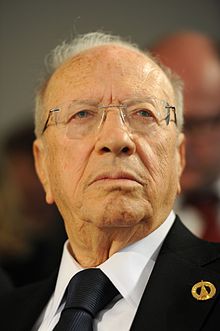
This past Saturday, July 28 2019, millions of Tunisians bid farewell to their first democratically elected president Mohamed Béji Caïd Essebsi at a state funeral attended by numerous foreign leaders including French President Emanuel Macron, Qatari EmirSheikh Tamim bin Hamad Al Thani, Palestinian President Mahmoud Abbas and Felipe VI of Spain. Essebsi passed away this past Thursday, July 25 at 92 years old. His was a great life of public service, and determination to serve the Tunisian people to the best of his ability.
Essebsi was a seasoned politician whose career spanned over six decades. His first involvement in politics started in 1941, when he joined the Neo Destour youth organization in Hammam-Lif. He was known for his integrity, exceptional public service, and served under Tunisia’s first president Habib Bourguiba, at different positions, including chief of the regional administration, general director of the Sûreté nationale, Interior Minister, Minister-Delegate to the Prime Minister, Defense Minister, and then Ambassador to Paris. The coincidence of him dying on the anniversary of the republic reminded people of the role he played in nation-building since independence.
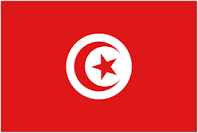
Flag of Tunisia
In recent years, Essebsi rose to prominence after the overthrow of veteran autocrat Zine El Abidine Ben Ali, which was followed by “Arab Spring” revolts against authoritarian leaders across the Middle East and North Africa, including in Libya and Egypt. He was seen as a unifying figure. He founded the Nidaa Tounes political party, which won a plurality in the 2014 parliamentary election. In December 2014, he won the first regular presidential election following the Tunisian Revolution, becoming Tunisia’s first freely elected president.
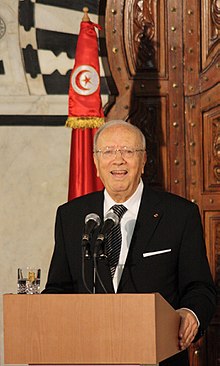
Essebsi in 2011 (Wikipedia)
Hours after Essebsi’s death, parliament speaker Mohamed Ennaceur was sworn in as interim president in line with the constitution in a smooth transition of power. The presidential election is scheduled for Sept. 15, as stated in the constitution which gives 90-days after the death of the president for new elections to take place; this comes two months earlier than scheduled.
The interim President stated, “[Mohamed Beji Caid Essebsi] spent his life in the service of Tunisia, preserving its gains and defending its values.” “He was a man of consensus, dialogue and national unity.” Don’t we all need dialogue and national unity?
Please take some time to read the good article The Arab Weekly wrote on the life of this great man who always put the interest of the Tunisian people first.


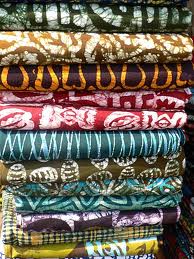 Wax Hollandais
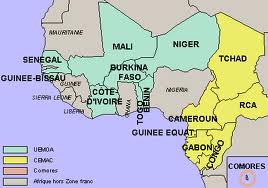 Carte des pays de la zone CFA
 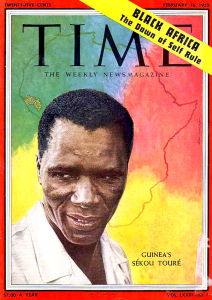 Sekou Toure, Cover Time Magazine, Feb. 16, 1959






 Yesterday, August 1, the




 African Heritage