Rooibos and Recognition for the Indigenous KhoiSan People

Rooibos_1
Prepared rooibos (source: Wikipedia)

Have you ever heard of rooibos ? Have you ever tasted rooibos tea? Well, as it is named, rooibos stands for red bush in Afrikaans, as denoted by its color. It is very popular in Southern Africa and has been consumed for centuries by the local indigenous Sān and  Khoi people. It grows exclusively in South Africa, in the Cederberg mountains north of the city of Cape Town. The leaves are used in a herbal tea, whose color is red like that of hibiscus tea. Traditionally, the local Sān people would climb the mountains and cut the fine, needle-like leaves from wild rooibos plants. They then rolled the bunches of leaves and brought them down the steep slopes using donkeys. The leaves were then chopped with axes and bruised with hammers, before being left to dry in the sun. Later on, once the European settlers had taken over the trade, no recognition to the indigenous people knowledge and input was given… until last week! Check out excerpts from the article published on South Africa’s Mail and Guardian below, and do not forget to follow the link for the full article.

=====
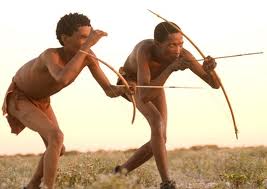
San (Basarwa/Bushmen) hunters

Transformation in the rooibos sector has been slow. The genocide of the indigenous San people and the virtual enslavement of the Khoi people in rooibos-growing landscapes of the Cape centuries ago, coupled with a government-controlled monopoly during the apartheid years, has led to a highly skewed and fractured industry.

Today, this R300-million local enterprise remains in the hands of about 300 white commercial farmers who cultivate 93% of the planted area. About 200 small-scale coloured farmers — largely confined to the dryer, more marginal parts of the winter rainfall fynbos region — produce only 2% of all rooibos tea.

A benefit-sharing agreement announced today by the minister of environmental affairs — between the rooibos industry and representatives of San and Khoi organisations — could signal the beginning of a change. 
More than R10-million a year — depending on weather, volumes and the price of rooibos — is likely to be distributed to trusts set up by San and Khoi organisations.
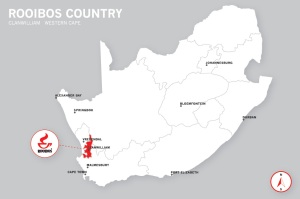
rooibos-country
Rooibos region in South Africa (source: rooibosltd.co.za)

If implemented judiciously and strategically, this could well change the face of rooibos in South Africa.

[…] At the agreement’s core is an annual traditional knowledge levy of 1.5% of the price that is paid by processors to farmers per kilogram of harvested rooibos. After being deposited into the government’s bioprospecting trust fund, the levy will be paid in equal parts to the San Council and National  KhoiSan Council. “Rooibos indigenous farming communities” — defined as “rural farming communities in rooibos growing areas who consist of descendants of original Khoi-Khoi peoples” — are to receive a portion from the trust set up for the Khoi people although the exact proportion has not yet been determined.

Non-monetary benefits will also be “explored” and could include the creation of employment opportunities, bursaries, development schemes, mentoring and the facilitation of livelihoods.

rooibos-tea
A cup of rooibos tea (source: MedicalNewsToday)

The agreement is a landmark, not only because it acknowledges the indisputable contribution made by traditional knowledge holders towards the establishment of the industry, but also because it could bring significant material benefits to indigenous San and Khoi people, many of whom remain marginalised and poverty stricken.

That the agreement offers restorative justice is undeniable, but the road ahead is far from smooth. Questions of how exactly benefits will be shared at a local level remain unresolved, and could result in conflicts. The long and troubled history of these oppressed communities has included dislocation, fracturing of family and community structures, and the undermining of people’s own initiatives.

The presence of strong, effective and transparent governance structures and sound external support will be essential to manage conflicting priorities proactively and ethically so that real benefits can be derived by all of the intended beneficiaries. …

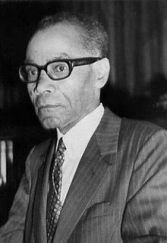
“Ils sont venus ce soir” / “They Came Tonight” by Leon Gontran Damas

Léon_Damas
Léon-Gontran Damas

They Came Tonight” is a poem by the celebrated French Guyanese author Léon-Gontran Damas. He is renowned as one of the founders of the Négritude movement, along Aimé Césaire and Leopold Senghor. In 1935, the three men published the first issue of the literary review L’Étudiant Noir (The Black Student), which provided the foundation for what is now known as the Négritude Movement, a literary and ideological movement of French-speaking black intellectuals, writers, and politicians of the African diaspora during the 1930s, aimed at raising and cultivating “Black consciousness” across Africa and its diaspora; this movement rejected the political, social and moral domination of the West.

Slavery_Ship1
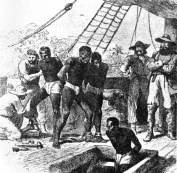
Slaves on board a ship

They Came Tonight” is a poem similar to ‘Ils Sont Venus’ de François Sengat-Kuo / ‘They Came’ by François Sengat-Kuo. In this case, it talks about when the Europeans came during slavery time, one night as the drums were thundering, and after that many Africans were taken away from their homes, from their loved ones, many were captured, and the day was never the same, history was never the same, families were destroyed, kingdoms destroyed, and to this day, Africa has not recovered for 400 years of slavery. This poem was first published in Pigments 1937, and later in Présence africaine, 1962.


Ils sont venus ce soir (Pour Léopold-Sedar Senghor)

ils sont venus ce soir où le
tam
tam
roulait de
rythme en
rythme
la frénésie

des yeux
la frénésie des mains
la frénésie
des pieds de statues
DEPUIS
combien de MOI MOI MOI
sont morts
depuis qu’ils sont venus ce soir où le
tam
tam
roulait de
rythme en
rythme
la frénésie
des yeux
la frénésie
des mains
la frénésie
des pieds de statues

They Came Tonight
for Léopold-Sedar Senghor

They came the night the
drums
spun from
rhythm
to
rhythm
the frenzy

of eyes
the frenzy of hands
the frenzy
of the feet of statues
SINCE
how many of ME ME ME
are dead
since they came that night when the
drums
spun from
rhythm
to
rhythm
frenzy
of eyes
frenzy
of hands
frenzy
of the feet of statues

Kais Saied aka ‘The Robot’: The Political Outsider Who Won the Tunisian Presidential Election

Tunisia_Saied
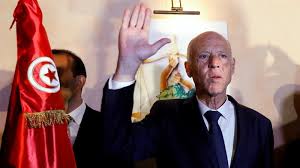
Kais Saied, new president of Tunisia getting sworn in (Source: Al Jazeera)

Last week marked another big step towards democracy for Tunisia. Kais Saied, a political outsider and retired law professor, won the presidential election with a landslide victory. The Robot, as he is affectionately called, was sworn in as Tunisian president on Wednesday, 23rd of October. His win delivered a heavy blow to a governing elite accused of failing to improve living standards or end corruption since the 2011 revolution that introduced democracy after years of authoritarian rule. Below are excerpts of an article from Al Jazeera.  Enjoy!

=====

Kais Saied has been sworn in as Tunisia‘s new president. 

The 61-year-old law professor has no prior political experience, never held office and barely ran a campaign.

Saied sealed a resounding victory in a runoff election on October 13, largely buoyed by a groundswell of support from young voters. He won just over 72 percent of the votes, with about 27 percent of ballots cast for his media-mogul opponent Nabil Karoui.

Tunisia_Essebsi_1
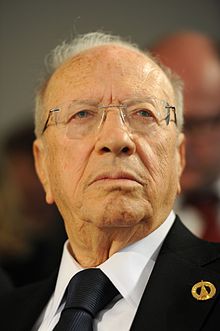
Beji Essebsi, Former president of Tunisia (Source: Wikipedia)

He succeeds former President Beji Caïd Essebsi, Tunisia’s First Democratically Elected Presidentwho died in office in July. 

A perhaps unlikely aspiring leader in the Arab world, the austere and scholarly Saied stood apart from the other 25 candidates in the first round of Tunisia’s presidential election.

After winning that round, he announced he would not campaign ahead of the run-off election against then-imprisoned Karoui, saying it would give him an “unfair advantage”.

Observers say it’s that openness and obsession with equity that has connected with Tunisia’s youth, who, above all, see Saied as an honest leader offering them the keys to the nation’s future

During his meteoric rise, Saied vowed to fight corruption and promote social justice, while saying access to healthcare and water is part of national security and that education would “immunise” youth against extremism

[…] Selim Kharrat, president of Tunisian NGO Al Bawsala, said Saied’s popularity was in part fuelled by disenfranchisement with a political system that has failed to address core economic needs.

Tunisia_Flag
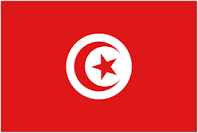
Flag of Tunisia

“The current atmosphere where many politicians are caught up in corruption scandals has helped this seemingly simple man,” Kharrat told Al Jazeera after the first round of elections.

Saied’s unadorned profile has stood in stark contrast to that of Karoui, who was arrested in late August on money-laundering and tax evasion charges, Kharrat said.

“He’s received no funding from any of the big parties or abroad, notably the better-off Arab Gulf countries, and this has shielded him from any suspicion,” he added.

….

Proverb Marocain sur son Pays / Moroccan Proverb about Home

stone1Une pierre de chez soi vaut dix fois mieux que celle de la rivière. (Proverbe Berbère Tachelhit – Maroc).

A stone from home is worth ten from the riverbed. (Southern Tashlhiyt Berber – Morocco)


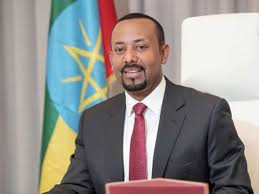
Abiy Ahmed, the Prime Minister of Ethiopia is Awarded the Nobel Peace Prize

Ethiopia_Abiy Ahmed
Prime Minister Abiy Ahmed (Source: sa.breakingnews.co.za)

A year after the Congolese doctor, Denis Mukwege shared the  Nobel Peace Prize 2018, another African has won it again: Abiy Ahmed Ali, Ethiopia’s prime minister was awarded the  Nobel Peace Prize last week for his work in ending the 20-year post-war territorial stalemate between Ethiopia and Eritrea.

Abiy Ahmed became prime minister of Ethiopia at a time of profound strife, and through a serious of deft political gestures, including the release of thousands of political prisoners and overturning highly repressive restrictions on civil society and political groups, he probably averted a civil war. Last year, he was the first Ethiopian leader to meet with his Eritrean counterpart in over 2 decades , and both countries signed a “Joint Declaration of Peace and Friendship.”

Nobel prize
Nobel Prize medal (Wikipedia)

Berit Reiss-Andersen, the chairwoman of the five-member committee that made the decision to award the Nobel Peace Prize, credited Abiy with a peace initiative aimed at ending two decades of conflict between the two east-African neighbors that began over border disputes in 1998 only a few years after Eritrea gained independence.

When Abiy Ahmed became prime minster in April 2018, he made it clear he wishes to resume pace talks with Eritrea,” she said. “In close cooperation with the president of Eritrea, Abiy Ahmed quickly worked out the principles for a peace agreement to end the long no peace stalemate between the two countries.”

When Abiy took office, he freed political prisoners and managed in the same year to sign a peace deal with the Eritrean leader, Isaias Afwerki — agreeing in the process to cede disputed land to his country’s erstwhile enemy.

Peace does not arise from the actions of one party alone,” Reiss-Andersen said. “When Prime Minister Abiy reached out his hand, President Afwerki grasped it, and helped to formalize the peace process between the two countries.

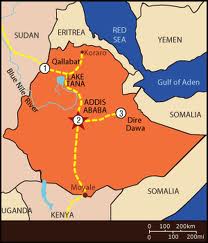
Map of Ethiopia
Map of Ethiopia

Additionally, Abiy Ahmed has sought to mediate between Kenya and Somalia in their protracted conflict over rights to a disputed marine area. There is now hope for a resolution to this conflict,” she said.

In Sudan, the military regime and the opposition have returned to the negotiating table. On the 17th of August, they released a joint draft of a new constitution intended to secure a peaceful transition to civil rule in the country. Prime Minister Abiy played a key role in the process that led to the agreement,” Reiss-Andersen added.

Ethiopia Eritrea
Map of Ethiopia and Eritrea, the two sisters

Although it is quite early in his career – after all, it has only been one year since he became prime minister – I think his is more justified than the one given to Obama for his speeches. Ever since I have grown to understand politics, I am always skeptical of these prizes anyway. However, this prize should encourage African and world leaders to work towards peace for their people at all times. We congratulate prime minister Abiy Ahmed, and wish him well in continuing to lead Ethiopia with a steady head.

A Weekend of Firsts in Sports set by … Africans and Afro-Descendants

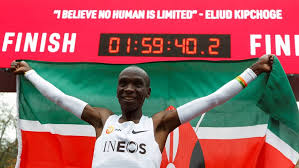
Kipchoge_INEOS 2019
Eliud Kipchoge after crossing the sub-2hour marathon line (Source: Standard.co.uk)

This past weekend was a weekend of firsts in sports, firsts set by African and Afro-descendant athletes. It was also a strong weekend for Black female athletes, with dominant, outstanding, and even historic performances by world record marathoner Brigid Kosgei, tennis champion Coco Gauff and Simone Biles, the greatest gymnast in the history of the sport. We watched with great joy when:


Eliud Kipchoge of Kenya ran a sub-2 hour marathon to become the first person in recorded history to run a marathon in such times. On 12 October 2019, Kipchoge ran the marathon distance on a special course in Vienna, Austria, achieving a time of 1:59:40 in the Ineos 1:59 Challenge. However, his record will not go down as a world record, because this technical feat required unprecedented planning and support, and was heavily engineered. We nonetheless celebrate the history and meaning for mankind.


Simone Biles2
Simone Biles breaking all records at the World championships in Stuttgart (Source: time.com)

Simone Biles became the most decorated gymnast of all times. The four-time Olympic gold medalist, at 22, broke a world championships record with her medals on Sunday. Winning gold medals for both her floor routine and the balance beam, Biles became the most-decorated gymnast at the world championship amassing 25 medals, breaking the long-held record of 23, which was set by male gymnast Vitaly Scherbo back in the 1990s. She is not only the most decorated in history, but the highest and fastest champion the sport has ever seen.


Kosgei_Chicago2019
Brigid Kosgei at the Chicago Marathon showing her record (Source: Reuters)

Kenya’s Brigid Kosgei set a jaw-dropping new women’s world record in Chicago over the weekend with a time of 2:14:04, breaking the record set by British runner Paula Radcliffe in 2003, 16 years ago. Unlike Kipchoge’s record, whose effort employed rotating pacers and just one “racer,” this one will count as a world record. Kosgei removed 81 seconds from the previous record, an unprecedented feat!


Gauff1
Coco Gauff after winning her first WTA title (Source: cbc.ca)

Tennis player Coco Gauff  became the youngest singles champion, at 15, in 15 years and the youngest American to win a singles title on the tour since 1991. She became the youngest woman to win Women’s Tennis Association (WTA) title since 2004 (and the youngest American to do so in 28 years) by winning Austria’s Linz Open on Sunday. I love the advice her dad who is her coach gave her: “Just relax, you’re not going to sprint to the finish line,… We’re going to walk to the finish line, OK?” And relaxed she got, in order to cruise to victory.


It was truly a weekend of Firsts, unprecedented, and of course Outstanding performances!!!


Proverbe sur les menteurs / Proverb on Liars

LiarEvitez la compagnie d’un menteur. Et si vous ne pouvez pas l’éviter, ne le croyez pas. (Proverbe Maure – Algeria, Libya Mauritania, Morocco, Tunisia).

Avoid the company of a liar. And if you can’t avoid him, don’t believe him. (Moor proverb – Algeria, Libya Mauritania, Morocco, Tunisia).

Why the Name: Annaba ?

Annaba_Ancient city of Hippo Regius
Ruins of the Ancient city of Hippo Regius, modern-day Annaba (Source: Wikipedia)

I always loved the name of the city Annaba in Algeria. From the name, one could think that we are talking about a city in subsaharan Africa. I used to think that the origin of its name would be Berber or from somewhere in sub-Saharan Africa.

Annaba is the 4th largest city of Algeria, after AlgiersOran, and Constantine. It is a coastal city which has grown tremendously, like most cities around the globe, in the 20th century. Present-day Annaba grew up on the site of Aphrodisium, the seaport of the Roman city Hippo Regius. The modern city has since expanded south over Hippo’s ruins as well. Its former names Bône and Bona derived from “Ubbo“, a local form of the name Hippo. Its informal name “Land of the Jujubes” derives from that abundance of that fruit in the region.

Algeria_Annaba
Bona, Algeria in 1899 (modern-day Annaba)

Annaba, as one of the most ancient cities of Algeria, founded in 1295 BC, has had different names during her life: Ubbo, Hippo Regius, Hippone, Bona, Bled El Aneb, Bône, and nowadays Annaba. It was known as Balad al-Unnab or the “Land of the jujubes” from which the name Annaba is derived, because of the abundance of that fruit in the region.

During the rule of France (empire and republics), the city was called Bône. It was one of the main French settlements, and it still has a sizeable minority of the “Pied-Noir” to this day. During World War II in 1943, Bône was a crucial highway and sea location for the invasion of Tunisia, and thence the driving of the Axis Powers (Germany and Italy) out of Africa in May 1943. Bône remained in Allied hands until the end of the war in 1945, and then it remained a part of French Algeria until the independence of Algeria in 1962.

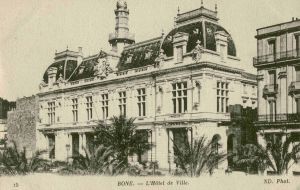
Annaba_Bone Hotel de ville epoque coloniale
Bone, Hotel de Ville during the colonial period

The city is an important hub of the world steel industry with the steel complex of El Hadjar, eight kilometres south of the city. It is the largest in Africa. Phosphate and metal industries are also prominent in the area. Other industrial sectors, private, focus on agri-food, metal processing, wood products, and construction.

Annaba is an important centre for tourism, and is one of the major tourist attractions in the western Mediterranean. It is located in the north east of the country, at 536 km east of Algiers and 105 km from the Tunisian border.

Annaba_panorama sea front
Panoramic view of Annaba’s sea front (Source: Wikipedia)

The downtown district of Annaba is on the sea-front, and includes the promenade called the Concours de la Revolution (previously called Le Cours Bertagna) which is a lively area, brimming with arcades and all kinds of covered restaurants, terraced cafes and kiosks. If you visit Annaba, remember to taste the Jujubes and enjoy the sea!!!

18th Century Ethiopian Crown to be Returned Home from Netherlands

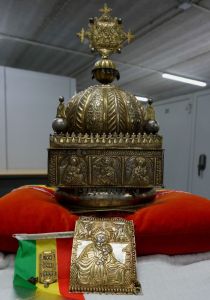
Ethiopian Crown 18th Century
The crown is currently being stored in a highly secured facility in the Netherlands (Source: BBC/AFP/Getty)

This was a good news and had to be shared. Enjoy! It is from the BBC.


=====

An 18th Century Ethiopian crown will finally be returned home after being hidden in a Dutch flat for 21 years.

Ethiopian Sirak Asfaw, who fled to the Netherlands in the late 1970s, discovered the crown in the suitcase of a visitor and realised it was stolen.

The management consultant has protected it until he felt safe to send it back.

Finally it is the right time to bring back the crown to its owners – and the owners of the crown are all Ethiopians,” he told the BBC.

Ethiopian crown netherlands
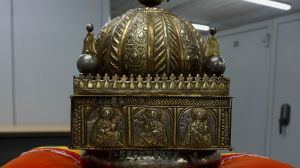
18th Century Ethiopian crown with depictions of Jesus Christ (Source: SkyNews)

The crown is thought to be one of just 20 in existence. It has depictions of Jesus Christ, God and the Holy Spirit, as well as Jesus’ disciples, and was likely gifted to a church by the powerful warlord Welde Sellase hundreds of years ago.

It is currently being stored at a high security facility until it can be safely returned.

… “I want this crown to be a symbol of unity and togetherness,” Mr Sirak said. “The crown will be celebrated by all of us Ethiopians, even Africans.”

Quote by Toni Morrison

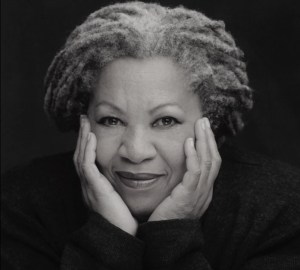
Toni Morrison_1
Toni Morrison (Source: OvationTV.com)

You wanna fly, you got to give up the shit that weighs you down.” Toni Morrison in Song of Solomon