Meet Dan Abisi, a Kenyan music teacher who makes his own trombones from scratch. I was moved by his love and passion for music which has made him consider cheaper alternatives such as building his own trombone, and thus making it widely available in Kenya. Given that in Kenya, and probably in many African countries, there are very few shops selling these brass instruments (and they are not cheap!), manufacturing it locally is definitely a winner. I don’t know what it takes to manufacture a musical instrument, but I bet spending hours trying to make it sound right is important. Kudos to Dan Abisi who has been making his own trombones and sharing his love of music and the instrument with local Kenyan children!
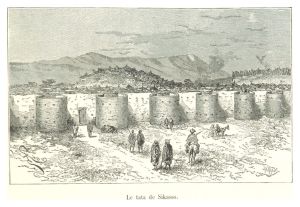
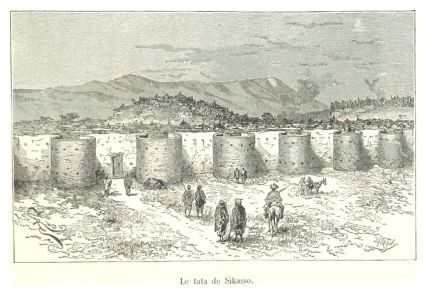
The tata of Sikasso, illustration by Édouard Riou published in Du Niger au golfe de Guinée, Hachette, 1892, by L.G Binger, p. 95
In 1898, the French colonial forces attacked the Tata of Sikasso which had resisted the tireless assaults of Samori Touré and his army for 15 months a decade earlier. Despite strong resistance from Babemba Traoré and his people, they could barely resist the French canons and barbary, and succumbed on May 1, 1898. As always, the French used treachery: the French colonel Marie Michel Alexandre René Audéoud wanted to install a garrison at Sikasso; but Babemba Traoré flatly refused. This resulted in a war between the French colonial forces and the people of Sikasso, which lasted 2 days. In the end, Babemba Traoré, the king, ended his life, abiding by the famous Bamanankan saying “Saya ka fisa ni maloya ye” (literally: death is preferable to shame). The city was then ransacked and plundered.
Below is an account of the barbary of the French colonel Audéoud and his men after their victory in Sikasso. The original in French can be found here on Jacques Morel’s page; the translation to English is brought to you by Dr. Y., Afrolegends.com .
====
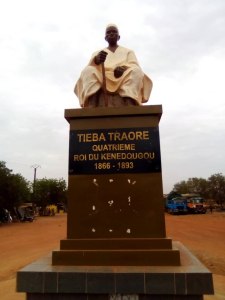
Monument of Tieba Traoréin Sikasso (Source: Wikipedia)
In April 1898, the colonel Audéoudwho is looking for a boost for his promotion, sends captain Morisson demand from Babemba, Tieba’s successor, the “Fama” of Sikasso (in modern-day Mali), and ally – imprudent – of the French in their war against Samori, the establishment of a French garrison in his capital. Babemba refuses. It is war, and the siege of Sikasso where violent counter-attacks of the besieged repeatedly endanger the French troops. But with only three remaining enclosures still standing after resisting for fifteen months to Samori, “the fortress does not last two days when faced with modern artillery,” says Gilbert Comte.
Sikasso resists street by street. A French officer, taking part in the capture of Sikasso, describes the city as such:
“After the siege, the assault. Babemba kills himself. We give the order to plunder. Everything is taken or killed. All the captives, roughly 4000, are herded together.
The colonel [Audéoud] starts the distribution. He himself used to write in a notebook, then gave it up saying, “Share this among yourselves!”. The sharing took place with arguments and blows. Then back on our way! Each European is given a wife of his choice… On our way back we did intervals of forty kilometers with these captives. Children and all those who are tired are killed with the butt of the gun and the bayonet…
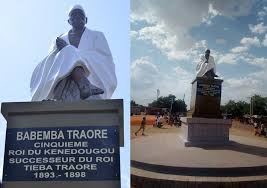
Monument of Babemba Traoré in Sikasso (Source: Face2FaceAfrica.com)
The corpses were left by the roadsides. A woman is found crouching. She is pregnant. We push her with the butt of the gun. She gives birth standing while walking. Has cut the umbilical cord and abandoned the child without looking back to see whether it’s a boy or a girl.
During those intervals, the men requisitioned on the way to carry millet stay five days without rations; receive fifty strokes of rope if they take a handful of the millet they are carrying.
The sharpshooters got so many captives that it was impossible to house and feed them.”
Sources: P. Vigné d’Octon, La Gloire du sabre, Paris, Flammarion, 1900; cité par Jean Suret-Canale, Afrique Noire, Occidentale et Centrale, Éditions sociales, 1968, page 274-275; Gilbert Comte, L’empire triomphant, Denoël, 1988, page 85-86.
The tata of Sikasso, illustration by Édouard Riou published in Du Niger au golfe de Guinée, Hachette, 1892, by L.G Binger, p. 95
Have you ever heard about the Tata of Sikasso or Sikasso Tata, a fortifying wall built in Mali which sustained attacks by some of the greatest conquerors of its time, including none other than the great Samori Touré ? and which was destroyed by the French colonial army ? This structure was probably stronger than some forts found in Europe. This defensive wall is quite reminiscent of the Great Wall of China.
Monument of Tieba Traore in Sikasso (Source: Wikipedia)
The Tata of Sikasso, locally known as Tarakoko, is a fortress built during the reign of King Tieba Traoré between 1877 and 1897, in modern Mali. Tieba Traoré, whose mother came from Sikasso, became King of the Kénédougou Empire and moved its capital to the city of Sikasso. He established his palace on the sacred Mamelon hill and constructed a tataor fortifying wall to defend against the attacks of both the Malinke conqueror Samori Touré and the Frenchcolonial army. The city withstood a long siege from 1887 to 1888 but fell to the French in 1898. This fortified wall was reinforced by Babemba Traoré, Tieba Traoré’s brother, who had succeeded him as king.
The Tata of Sikasso was built for the protection of the city, in a military style. It used to extend through an area of 41 hectares, with its walls reinforced with the addition of earthen walls, bars, and alternate stone beds; the intervals of which were filled with ferrous gravel, earth, and stones. At the time of Samori Touré’s unsuccessful siege, which lasted 15 months from March 1887 to June 1888, the tatahad three concentric enclosures.
The exterior of the tatawas 9 km long, 6 m (∼20 ft) wide at the base and 2 m (∼7 ft) high at the summit. Its height varies between 4 to 6 m.
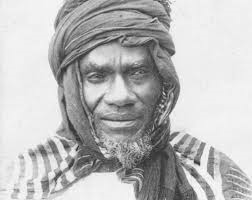
Samori Touré
The intermediary tatawalls were not as big, and also not as wide. Those were meant for merchants, soldiers and nobles.
The inner enclosure encircled the Dionfoutou, which was the part of the city inhabited by the king and his family.
The fortress is still visible today in the actual landscape of the city of Sikasso in neighborhoods such as Mancourani, Medina, Wayerma, Bougoula city and Fulasso. Seven monuments, in the shape of doors, have been built with modern materials on the site of the passages of yesteryear to preserve their memory.
The Tata of Sikasso has been inscribed in the UNESCO World Heritage Tentative list: « Le Tata de Sikasso ».
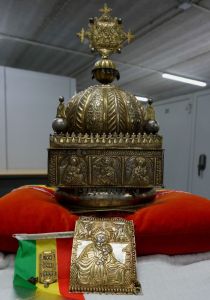
The Ethiopian government has received an18th Centurycrown that had been stolen then hidden in a flat in the Netherlands for21 years.
The crown is thought to beone of just 20 in existence. It has depictions of Jesus Christ, God and the Holy Spirit, as well as Jesus’ disciples, and was likely gifted to a church by the powerful warlordWelde Sellasehundreds of years ago.
Ethiopian Sirak Asfaw, who lives in the Netherlands, discovered the crown in the suitcase of a visitor he was hosting.
Upon realising that it was stolen he held onto it until 2018 when Prime Minister Abiy Ahmed was elected to office. He then reached out to art historian Arthur Brand and Dutch police to help keep it safe until its return home to Ethiopia.
On Thursday, Mr Abiy tweeted photos of him receiving the crown from a delegation that included Dutch Minister for Foreign Trade and Development Cooperation Sigrid Kaag.
Given that we talked about Ladysmith Black Mambazo and Joseph Shabalala, I thought it befitting to celebrate this year’s valentine’s day, by introducing you to “Hello My Baby” by Ladysmith Black Mambazo. I particularly love the beginning of the song, the harmony, and the message. When the singer says ‘come along, come along, come along, to kiss me,‘ one can clearly hear the sound of the kisses… amazing! Impressive when you think that this is all done a cappella! So for this Valentine’s day, ring up your baby… and send them those kisses you can hear so loudly in the song … and if there are no Valentine one… send kisses out to the world, plenty of them!
Even though I love the original version better, which I have included here, I have also added the recent re-make Ladysmith Black Mambazo did with the late giant Oliver Mtukudzi which is also outstanding.
Ladysmith Black Mambazo with its leader Joseph Shabalala at the center (Source: US.Napster.com)
A few years ago, I had the privilege to attend a concert offered by Ladysmith Black Mambazo. To say that I am a fan is an understatement… I have always danced to the tunes of Ladysmith Black Mambazo. It was special in so many ways because I saw the entire group including their leader Joseph Shabalala, I heard their harmony which had been part of my life, and I also danced to some South African music (extra, extra bonus)… For those who are not familiar with the group, Ladysmith Black Mambazo is an a capella group of male vocalists founded in the early 1960s by Joseph Shabalala in South Africa. The group fuses indigenous Zulu songs and dances with South African isicathamiya, an a capella tradition that is frequently accompanied by a soft, shuffling style of dance. The name of the group can be broken down as: Ladysmithfor the city where they grew up in KwaZulu-Natal, South Africa; Blackfor the black oxen who is the strongest animal on the farm; and Mambazowhich is Zulu for an axe which represents the ability for the group to cut down competition.
Poster of the movie Michael Jackson Moonwalker (Wikipedia)
They were introduced to the global stage by Paul Simon with their collaboration on his 1986 Graceland album. They are seen dancing and singing in the last scene of Michael Jackson‘s movie ‘Moonwalker,’ where their entrancing song goes as, “Come and see. The moon is dancing.” Not to be in awe of their amazing songs, the harmony, their voices, is truly not possible.
Ladysmith Black Mambazo in a move (Source: Timeslive.co.za)
It is with great sadness that I heard of the passing of the founder of Ladysmith Black Mambazo, Joseph Shabalala. I am just so glad that his legacy, the Ladysmith Black Mambazo, leaves on, and that his voice will still serenade countless people around the globe. Long Live Joseph Shabalala’s legacy! Long Live Ladysmith Black Mambazo!
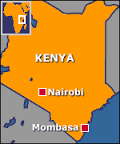
Pollution, overpopulation of some areas, as well as over-fishing have wreaked all sorts of havoc for the ecosystem of our planet. One such ecosystem being destroyed is the coral reef along the coasts of Africa. Below are excerpts from an article from the Guardian about Kenyan efforts to reclaim their coral reefs, and bring back the lobsters and octopuses. As the marine life is re-established, let’s hope the industrial fishermen stay away!
====
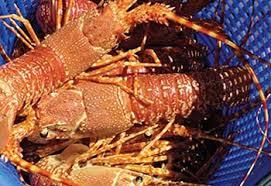
African Lobsters (From South Africa – Source: WildOceans.com.au)
Three years ago, coral reef along the Kenyan coastline was almost totally destroyed in some areas. Rising surface sea temperatures had triggered devastating bleaching episodes for the fourth time in less than two decades, and with the whitening of coral came a dwindling of marine life. Overfishing only exacerbated the problem.
For coastal communities dependent on the sea for their livelihoods, the degradation of the coral reef and its effect on the marine ecosystem threatened to overturn an entire way of life. In some areas surveyed by theKenyaMarine and Fisheries Research Institute (KMFRI), as much as 60-90% of coral was destroyed.
A fightback was needed and so the institute began working with local communities to rehabilitate degraded coral reefs along the country’s coastline. Among the areas targeted was Wasini Island, a tiny strip of land off Kenya’s south-east coast. The results have been startling.
Women on the island have led an initiative to restore degraded coral that has shown how coral restoration techniques can revive marine ecosystems and create sustainable livelihoods for communities that depend on fishing and eco-tourism.
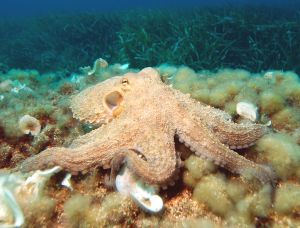
Octopus (Source: Wikipedia)
“The fish have started coming back since the restoration activities began,” says Nasura Ali, of the Wasini Beach Management Unit, which has about 250 members, of whom roughly 150 are women. More than 40 people have been trained in restoration techniques.
A year-long study by the KMFRI had tested the viability of raising coral fragments from areas affected by bleaching events, explains Jelvas Mwaura at the KMFRI’s department of marine environment and ecology. Many of the corals transplanted from coral gardens to degraded reef areas for the study survived, providing new habitats for fish species including jacks, groupers, emperors and sweetlips.
This success led to funding from the Kenya Coastal Development project (KCDP). Locals on Wasini Island have since grown more than 3,000 corals.
Coral reefs provide shelter and breeding grounds for hundreds of species of marine life. Fish populations in waters around the island have increased three times as much as in other areas, says the KMFRI.
Kenyan flag
… The women of Wasini Island have also been restoring fish populations by cultivating seagrass. Overfishing of certain species, such as trigger fish, had led to the disappearance of seagrass because trigger fish fed on the sea urchins that devoured it. Using gunny bags made of sisal to protect the seedlings and prevent them from getting washed away, the women replanted seagrass seedlings on the ocean floor.
In addition to providing food, seagrass plays a key role in the overall coral reef ecosystem, providing shelter to juvenile fish after they hatch by shielding them from strong waves until they mature and move into the coral reefs.
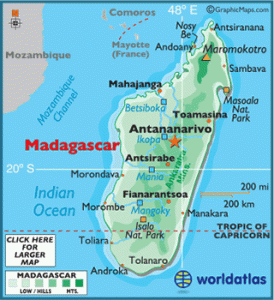
In a village not too far from Antsirabe, lived a man named Rakoto who grew katrony (hashish) in big quantity. Since he liked the katrony too much, he smoked a lot of it every day. He also made clothes (rongony) from it, and made a lot of money that way.
He stacked the grains of katrony and ate them with rice and meat. Every day when he went to his farm to milk his cows, he first smoked 5 stems of katrony and ate a bowl of rice mixed with katrony powder. One day after he had smoked too much before milking the cow, he got the wrong cow and tied the bull. But the bull charged him and cut his left leg.
Since then, all his descendants, the Antsirabe people, are prohibited from touching or smoking the katrony.
Malagasy tale translated to English by Dr. Y., Afrolegends.com

















 African Heritage