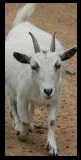
Une chèvre galeuse infecte les autres (Proverbe Sotho – Lesotho, Afrique du Sud).
A scabby goat infects others (Sotho Proverb – Lesotho, South Africa).

Une chèvre galeuse infecte les autres (Proverbe Sotho – Lesotho, Afrique du Sud).
A scabby goat infects others (Sotho Proverb – Lesotho, South Africa).
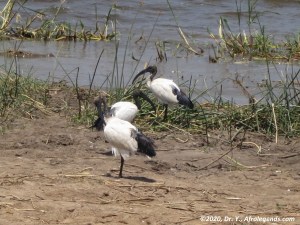
Did you know that ancient Egyptians did not only mummify humans, but animals also? Animals such as cats, crocodiles, mongooses, and ibises have been found in Egyptian pyramids. In ancient Egypt, the ibis was a special bird who represented the god Thoth, god of wisdom, magic, writing, hieroglyphs, science, art, judgment, and the dead. For the longest times, scientists could not understand where millions of ibises which had been mummified came from. Now, they seemingly have cracked this mystery.
Excerpts below are from the The Guardian.
=====
DNA analysis helps work out origin of nearly 6 million mummified ibises
An ancient Egyptian mystery has been solved, according to researchers, who say they have cracked the conundrum of where millions of mummified birds came from.
Pharaohs and members of the nobility were often mummified, but the practice was not reserved for humans – cats, crocodiles, mice and mongooses are among the mummified animals that have been found.
While some have been discovered alongside human burials, others – most notably the sacred ibis bird – were mummified as part of rituals designed to curry favour with the gods.
More than 4 million sacred ibis mummies have been found in the catacombs of Tuna el-Gebel and 1.75 million have been discovered in the ancient burial ground of Saqqara. The vast majority were votive offerings to the god Thoth, a practice that had its heyday between 450BC and 250BC.
“The ibis was considered [to represent] the god Thoth, the god of wisdom, the god of magic, the god of judgment, writing all sorts of things,” said Sally Wasef, a research fellow at Griffith University in Australia and first author of the research.
“If you had a boss that annoys you and you don’t feel like you are getting a good judgment from him or you want fairness and justice, you go and ask Thoth to interfere and in return you promise to offer him an ibis, a mummified ibis, in his annual feast.”
But the sheer quantity of mummified ibises left experts scratching their heads – where did all these birds come from?
One suggestion is that they were reared on an industrial scale in hatcheries. That idea appears to have some support in ancient texts, such as the writings of Hor of Sebennytos, a priest and scribe in the second century BC, who wrote about feeding tens of thousands of sacred ibis with bread and clover.

To explore the possibility, Wasef and colleagues analysed DNA from 14 mummified sacred ibises found in ancient Egypt and 26 modern samples from across Africa.
… The results, published in the journal Plos One, reveal the level of diversity in the mitochondrial DNA among the ancient birds is similar to that among modern wild birds, and have similar levels of potentially harmful mutations. However, the team says if the ancient Egyptians farmed sacred ibises, the genetic diversity in ancient birds would probably be lower due to high levels of inbreeding.
Wasef said this suggested that, rather than being bred in a mass-farming situation, sacred ibises were tempted to local areas and kept in a natural habitat – or perhaps captured and kept in farms for a short time, ready for sacrifice.
“[The most likely thing is ] next to each temple there was like a lake or a wetland – it is a natural habitat for the ibis to live in and if you are giving them food they will keep coming,” she said. Indeed, she notes, there was a swamp near Tuna el-Gebel and the Lake of the Pharaoh near Saqqara. …
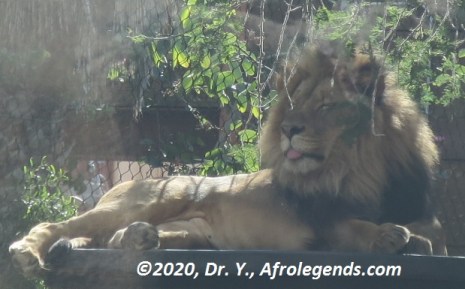
The image of this lion made me think so much of peace and serenity that I had to share with you all. In these uncertain times, there is not so much we can do… fretting might not add much… but some tranquility, calm, peace, and quiet might do us all some good.
 Sur l’oeil on gratte doucement (Proverbe Burundais – Burundi).
On the eye, scratch gently (Burundian proverb – Burundi).

Today I am sharing a poem by the great Egyptian feminist Huda Sha’arawi. As we saw earlier, Sha’arawi’s work was immense in redefining the place of the woman in Egyptian society, and led to a new dawn for Egyptian women. This woman who influenced millions of Egyptian and Arabic women was also a poet with a great love for her country and its people. She dedicated her life for the betterment of women in the Egyptian society, and immensely loved the land of her forefathers.
The poem “A ma Patrie” was published in L’Égyptienne number 69, Mai 1931. Translated to English by Dr. Y. Afrolegends.com.
| A ma Patrie
J’ai fait voeu de t’offrir tout ce qui m’appartient O ma belle Patrie, Mon bras, mon coeur, mon âme ainsi que tous mes biens Sans excepter ma vie. J’ai fait voeu de peiner, de lutter, de souffrir, De braver l’infamie. Sans froncer le sourcil, sans poser au martyre, Sans même une aide amie. J’ai juré de franchir les frontières des mers Si ton honneur l’exige, Afin de rehausser, aux yeux de l’univers, Ton nom et ton prestige. J’ai juré d’oublier les affronts des déments Et la haine et l’insulte Que l’envie incita, contre mon dévouement A ta cause et ton culte. Peu m’importe l’exil, leur courroux, la prison, J’accepte la mort même. Puisque leurs vils exploits n’auront jamais raison De l’humble coeur qui t’aime. |
To my Homeland
I made a wish to offer you all that I have O my beautiful homeland, My arm, my heart, my soul, as well as all my belongings Not excepting my life. I vowed to struggle, to fight, to suffer, To brave infamy. Without frowning, without asking for martyrdom, Without even a friend’s help. I have sworn to cross the borders of the seas If your honor depends on it, To enhance, in the eyes of the universe, Your name and your prestige. I have sworn to forget the offenses of the demented And the hatred and insult Which prompted envy, against my dedication To your cause and your worship. I do not care about exile, their anger, the prison, I will accept even death. Because their vile deeds will never win over The humble heart that loves you. |

Le mensonge a des ailes (Proverbe Ngbandi – République Centrafricaine (RCA) et République Démocratique du Congo (RDC)).
The lie has wings (Ngbandi proverb – Central African Republic (CAR) and Democratic Republic of Congo (DRC)).
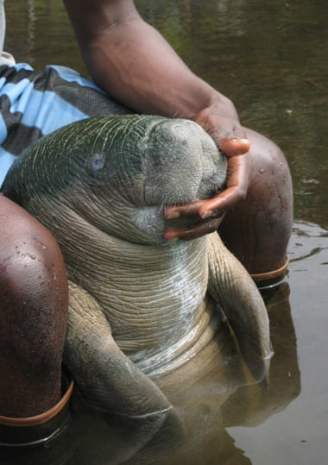
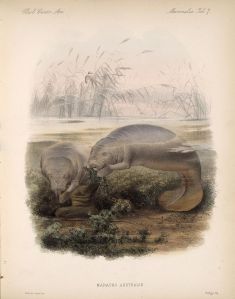
In many African countries, from Senegal down to Angola, the manatee is known as Mamy-Wata or the Sirena or a water spirit. It is a sea creature which can also be found in lakes, as well as on the ocean. There is a lot of myths surrounding the creature, and how difficult they are to find. There is also a lot of ideas surrounding their use in local medicines, with a high demand coming from Asia, to the point that they have now become endangered. This article on conservation efforts to save the manatee is from The Guardian. Enjoy!
====
Once branded ‘rogue animals’, the elusive creatures were on the brink of extinction, but hope is rising for their survival
… For the past 14 years Keith-Diagne has been on a mission to protect the African manatee. There are an estimated 10,000 left, spread across 21 African countries, from the coast of Senegal down to Angola and inland to Chad. …
African manatees are classified as a vulnerable species on the International Union for Conservation of Nature’s Red List. They face many threats, including entanglement in fishing nets and entrapment in dams. In some countries they are heavily poached.
… The animals are so elusive that many locals know them only from myths. In countries such as Senegal, where the animals are revered as auspicious water spirits, poaching is rare. But dams still pose a major threat: the cumbersome mammals can get trapped in narrow passageways and drown.
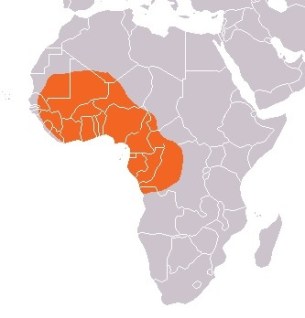
Keith-Diagne said local dam authorities have been receptive to her proposed modifications of the structures. Politicians have also come on board. In 2014, her husband, Tomas Diagne, also a biologist, successfully petitioned the government to set aside 275 hectares (679 acres) for an aquatic reserve. The area is now home to an estimated 100 manatees as well as hundreds of Adanson’s mud turtles – a species unique to the local lake. The couple are also helping the surrounding communities to develop an ecotourism industry.
Keith-Diagne’s conservation work has extended into other parts of Africa. With the help of a Pew Marine fellowship, she formed a network of nine biologists in Senegal, Gambia, Nigeria, Cameroon and Democratic Republic of Congo to document every manatee captured or killed over three years. The project has already identified one clear trend: Nigeria is a leader in manatee mortality.
Hunters can make up to $2,000 (£1,626) from a single catch in the country, where manatee meat is said to be beneficial for diabetics and their oil is thought to be cholesterol-free. In addition, their penises are believed to cure impotence, their ear bones to ward off bullets, and eyes believed to possess magical powers. The faeces left over in manatee intestines are dried and used to mend broken bones.
According to Nigerian myth, upon encountering a human, a manatee will tickle them until they laugh so hard they drown.
Rumours of manatees breaking fishing nets and capsizing canoes led to their classification as a “rogue animal” in the 1970s – an official classification for animals that threaten human livelihoods, such as crocodiles and hippopotami.
… [Edem] Eniang, [a professor of wildlife resource management at the University of Uyo in Nigeria] and his team often go undercover, posing as buyers to keep tabs on poachers and document manatee killings. They visit schools to teach the importance of conservation and they run TV and radio information campaigns. Such campaigns can and have made a difference. In Cameroon, education and awareness initiatives have pushed manatee hunting to its lowest level.
Aristide Takoukam, the director of the African Marine Mammal Conservation Organisation in Cameroon, gives frequent presentations at schools and organises field trips to Lake Ossa, a wildlife reserve created in 1948.
“I want to teach them to see nature in a different way than their parents,” he says. “I want to show them that in animals, they can also find beauty.”
He also trains fishermen in how to make a living from bee farming and soap making instead of manatee hunting and with the help of an American ecotourism expert, is developing an industry around manatee sightseeing, complete with lakeside bungalows, kayaking and bird watching.
“I want to show them that a manatee is worth more alive than dead,” he says. …
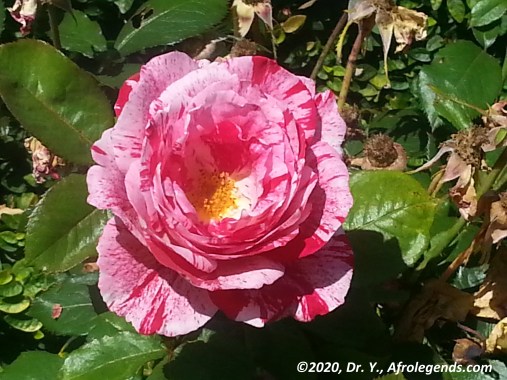
In this era of lockdown, one thing is for sure: flowers are blooming! Everywhere you look, flowers are blooming, birds are singing, and now we can actually hear them amidst the silence! Yes… people… birds’ arias have replaced the car horns, and the blasting sounds of traffic and modernity. And now, the flowers display their beauty. They always did… but it was sometimes clouded by unknown fumes or we simply had no time to see it! So today, I will share with you a bright image of a gorgeous flower… This is simply to remind you to smile at the beauty outside, even if you cannot go outside. Enjoy!
Nier l’existence de Dieu, c’est sauter les yeux fermés (proverbe malgache – Madagascar).
Denying the existence of God, is like jumping eyes closed (Malagasy proverb – Madagascar).
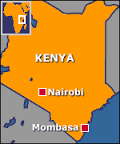
In this era of the coronavirus and social distancing, many local vendors in some countries of Africa are seeing bigger profits than ever because of the slower competition from imported products. This should be the time to encourage local economies, and rebuilt local industries. In the article below, you will be appalled to find out that Kenya was importing fish from China (which has probably been fished on African coasts anyway) when they have a fishing industry! Why not eat local products? Why are our governments allowing these imported products to be cheaper than the local ones (it is true of Senegal and countless other African countries with products from France and the EU)? Why are foreign products not taxed properly so as to allow for the local industry to grow? I know this time is short, but it is always important to start somewhere. It is important to take advantage of these uncertain times to strengthen ourselves as all other countries are doing! This article is from the BBC: Fishermen cash in as Chinese imports drop.
=====
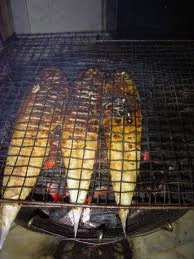
Sales of fresh fish in Kenya have risen as imports from China have dropped amid the coronavirus pandemic.
Sellers in Dunga Beach on the shores of Lake Victoria report a jump in trade of about 40% over two weeks.
“The fishermen are really now smiling at the Lake Victoria region because we are receiving more visitors. Dunga is really crowded with a lot of the residents of Kisumu coming to buy the fresh fish because people fear the Chinese boxed fish due to the coronavirus,” says Maurice Misodhi, a fisherman and leader at the Dunga Beach Management Unit.
Local fish costs about twice as frozen fish from China, of which Kenya imported more than $23m (£19m) worth in 2018.
Chinese fish used to make up about 50% of the market but this has fallen since imports stopped in November and the virus outbreak later took hold.
Before the coronavirus outbreak, local fishermen complained that cheap imports harmed local trade so much that they often resorted to eating their catch themselves or giving much of it away.

But the scarcity of Chinese fish isn’t good news for everyone. Caroline Ochieng, a fish seller says she is struggling to make a decent profit because Chinese fish is cheaper than local lake fish.
“That is the reason we want the China fish to be in supply as well as that from our own lake – so that as we do business we don’t feel the burden.“
There are worries that local fishermen won’t be able to keep up with new demand for fresh fish. But for now at least, they are making the most of the surge in trade.


 African Heritage