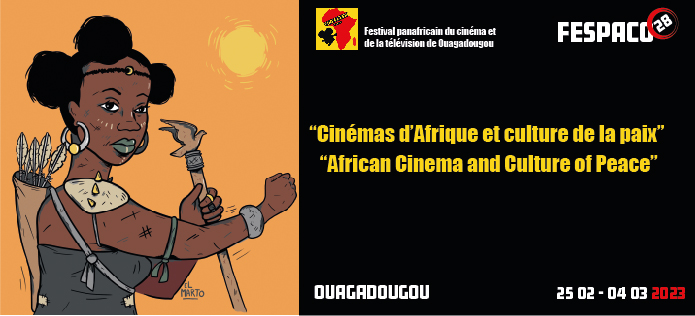
FESPACO 2023 theme ‘African Cinema and Culture of Peace’
The biennial African film festival, FESPACO, took place this year from 25 February to March 4. On March 4, the winner was announced, and Tunisian Youssef Chebbi won the Golden Stallion of Yennenga (Etalon d’or de Yennenga) for his film ‘Ashkal‘ which centres on the investigation into the killing of a caretaker on a construction site at Carthage on the outskirts of his hometown. He won the first prize over Burkinabe filmwriter Apolline Traore, who picked up the Silver Stallion of Yennenga for the film ‘Sira‘, while the Bronze Stallion was awarded to Kenya’s Angela Wamai for ‘Shimoni‘.
FESPACO 2023
The Festival Panafricain du cinema et de la television de Ouagadougou (FESPACO) is the Panafrican Film and Television Festival of Ouagadougou, which happens to be the largest African film festival. It is held biennially in Ouagadougou, the capital of Burkina Faso. First established in 1969, and boasting some of Africa’s greatest writers and filmmakers (like Ousmane Sembene), the FESPACO offers a chance for African filmmakers and professionals to showcase their work, exchange ideas, and meet other filmmakers, and sponsors.
The Golden Stallion of Yennenga
There were a total of 170 entries selected for the FESPACO festival in the capital Ouagadougou, including 15 fiction feature films in contention for the Yennenga Golden Stallion award and a prize of around $30,000. A big win for women filmmakers, with the second and third prizes won by Apolline Traore and Angela Wamai respectively. Burkinabe filmmaker Apolline Traore won the Silver Stallion for Sira, about a woman kidnapped by Jihadists, and Kenyan director Angela Wamai took home the Bronze Stallion forShimoni, about a schoolteacher rebuilding his life in his remote village after a harsh stint in jail. In 2019, Burkinabe director Apolline Traore had said that any award had to be earned, not considered a token gesture; we are glad for the recognition her work and that of others is getting recognized.
The film, ‘Cuba in Africa‘ produced by Negash Abdurahman won the Thomas Sankara Prize. The film talks about the altruism of Cubans who sacrificed their sons and daughters on behalf of Africa; Cuban volunteers gave their lives to help Angola, Namibia, Guinea Bissau and Cape Verde, and others win independence, and contributed to the fall of apartheid in South Africa. It is a story all Africans should learn.
The 29th edition of Fespaco will be held from 22 February to 1 March 2025, also in Ouagadougou, Burkina Faso.
March 8th marks International Women’s Day (IWD). Every year around the world it is commemorated in a variety of ways: it is a public holiday in over 25 countries, and is observed socially or locally in others to celebrate and promote the achievements of women, and address key issues pertaining such as women’s rights, gender equality, equal pay, reproductive rights, violence against women, and many others. In some countries, women march on that, while in others it is customary for men and women to give their female colleagues and loved ones flowers and gifts and show equality towards the other gender. This year, we are posting this beautiful musical collaboration from Tanzania titled “Superwoman“. It is truly an amazing work of art, which celebrates women of all walks of life in song, and highlights Tanzanian and African cultures as a whole. Enjoy and share by telling the ladies around you how awesome they are, and superwomen!
King Mandume ya Ndemufayo, portrait extracted from a photograph of the King with British representatives in South Africa
I found this Kwanyama poem written in honor of King Mandume. It is simple, and rich in culture. It emphasizes the Kwanyama culture: how can one cowardly abandon his king? the only son of his mother? A mother’s only son is everything, so he needs to be protected by those around. It also shows the respect given to the king, as to him were extended leather carpets. From this poem, it is clear that Mandume was a very good rider, a fearless knight, and a fine gunman. The term soba, is the term for king in Kwanyama (Cuanhama in Angola) culture. The reference to the “ragged brother” is based upon the fact that from Kwanyama accounts, Mandume used to “disguise himself in poor clothing and walk about the country to listen to what the people were saying, to see if they were satisfied by his laws” (Loeb, 1962:35), given that he had made significant positive changes to laws; while the Portuguese account on the other hand, state that Mandume used to dress in rags to trick those who would not recognize him as the king, “picking quarrels and exacting cruel vengeance to those who responded to his provocations with crude insults” (Estermann, 1960: 221). When living in the desert, water is crucial to survival; thus, water finds its way into this poem: why would anyone share the little they have with an enemy who has been trying to crush them and force them off their land? Enjoy the poem, translated to English by Dr. Y., Afrolegends.com. To learn more, read “Lyrical Nationalism in Post-Apartheid Namibia” by W. A. Haugh, Lexington Books (2014).
King Mandume ya Ndemufayo, portrait extracted from a photograph of the King with British representatives in South Africa
Mandume, king of the Cuanhama (Oukwanyama) principal subgroup of the Ovambo in Southern Angola, was one of the last and most important resistance leader against Portuguese conquest in Angola. By the size of his army, he could be compared to Samori Touré, but he did not have the same historic aura or military genius and given his very short life, he has remained unknown to many. Yet, in 1915, he held in his hands for 10 days the scourge of the balance of power in Southern Angola directly, and indirectly in Angola as a whole. Mandume is celebrated by many nationalists in Luanda as one of their heroes because he fought against Portuguese advances inside Angolan territory. He was a leader of the Ovambo resistance, defending the independence of his people, the Cuanhama so as not to get absorbed within Angola. Given European drawing of African boundaries during the 1884Berlin Conference, the Cuanhama found themselves between areas of Portuguese West Africa (Angola) and German South West Africa (Namibia); thus Mandume has also entered the pantheon of the Namibian resistance. Who was Mandume?
King Mandume ya Ndemufayo, probably in Oihole, sometime before 1916
Mandume ya Ndemufayo was a simple ethno-nationalist, who refused to be colonized and had about 35,000 to 40,000 armed fighters; more than any Angolan nationalists ever had before 1974. He took over the reins of the Cuanhama kingdom in 1911 and his reign lasted until 1917 when he died of either suicide or machine gun fire while under attack from South African forces. Ya Ndemufayo grew up during a time of significant upheaval in the Oukwanyama kingdom due to the presence of European merchants and missionaries. As King Nande’s nephew (his mother was the king’s sister), he was third in line for succession to the Kwanyama throne. To protect his life as royal child heir to the throne, Mandume had to live in various homesteads. King Nande died on 5 February 1911 and Mandume succeeded him at barely 18 years old. Immediately upon ascending the throne, he moved the royal residence to Ondjiva (now in Angola). He could be thought of as a neo-traditionalist leader, who, even though he studied in the German mission schools, he spoke German, and a bit of Portuguese, and championed the independence of his people. Strongly anti-European, he expelled Portuguese traders from Kwanyama territory to denounce price inflation. Given the great drought and famine which lasted from 1911 to 1916, Mandume issued decrees prohibiting the picking of unripened fruits to protect against droughts and the unneeded use of firearms, an important commodity obtained from European traders. Significantly, he also issued harsh penalties for the crime of rape and allowed women to own cattle, which was previously illegal. Overall, King Mandume sought to restore previous Kwanyama wealth and prosperity against a decaying system of local leadership. Ya Ndemufayo had a reputation for expelling Christians within the Oukwanyama kingdom. Numerous Christian families fled to the Ondonga kingdom of the Ovambos. Ya Ndemufayo did not favor Portuguese Roman Catholic missionaries as well as German Rhenish Missionary Society Protestants within his kingdom. In some European archives, it is said that he was a tyrant, but it is unclear whether it is European propaganda (a case of the hunter telling the story of the hunt) or reality.
Flag of Ovamboland
Before Mandume, previous Cuanhama kings had fought valiantly against Portuguese invasion of their land, King Weyulu from 1885 – 1904, his brother King Nande (1904 – 1911); unfortunately, they all in the end saw no choice to the inevitable Portuguese colonization. Mandume rejected the idea of Portuguese colonial rule and demanded to be on equal terms with the colonial rulers in their distant capitals.
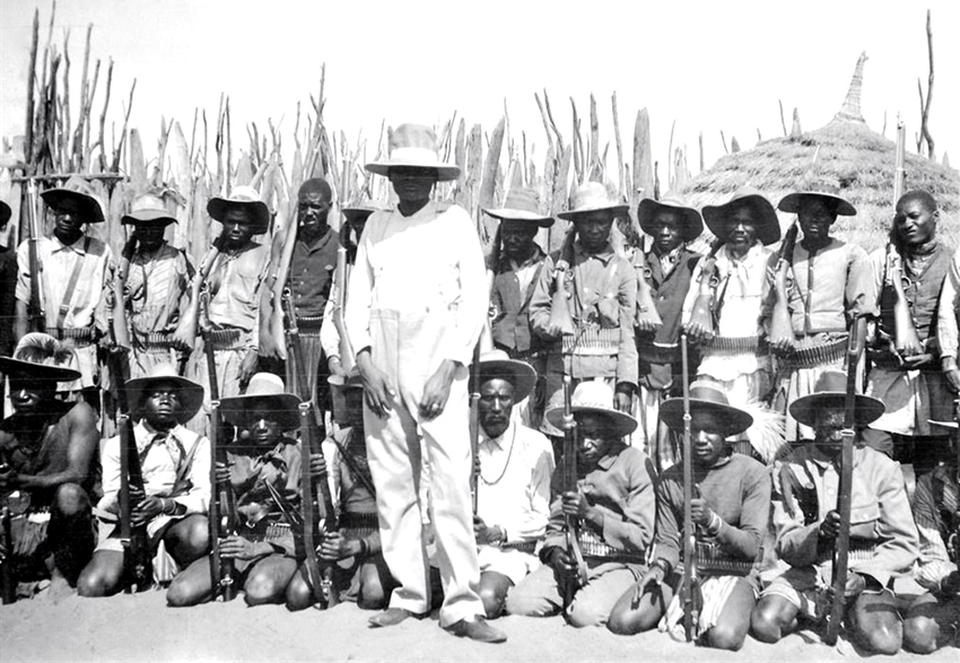
King Mandume with his warriors in Oihole in 1916
No European colonizer seriously challenged the well-organized and well-armed Ovambo kingdoms until 1915 and the beginning of World War I which coincided with a massive local drought. During the Battle of Omongwa in August 1915, ya Ndemufayo and the Kwanyama’s resisted a Portuguese attack led by Pereira de’Eça for three days. On 20 August, Mandume assembled several thousand men and attacked the Portuguese camp shouting “The land does not belong to the white[s]!”. After 10 hours of fighting, the Ovambo were forced to retreat due to a lack of supplies including the water which they had lost. In total, the Portuguese took 35 casualties and 57 wounded; while the Ovambo lost 25 and had 100 wounded. After the battle, the Portuguese also started claiming that German forces were helping the Ovambo because it was unimaginable to them that Africans were able to wage war like Europeans. Simultaneously, the South African forces peacefully conquered the portion of the Oukwanyama kingdom formerly located in German South West Africa; this was at a time when Germany lost the first world war, and thus all its African colonies. German South West Africa’s administration was taken over by the Union of South Africa (part of the British Empire) and the territory was administered as South West Africa under a League of Nationsmandate. Due to losses and lack of water, ya Ndemufayo first relocated the Kwanyama capital to an area south called Oihole, and then later into South West Africa. He used the border line to conduct attacks against Portuguese who were encroaching on his old territory in Southern Angola. However his attacks of Portuguese interests from his territory in South West Africa were not appreciated by the South African authorities who summoned him to Windhoek where he refused to go. In February 1917, after ya Ndemufayo refused to submit to South African control, he died in battle against the South Africans who had mounted an attack against him. The cause of his death is disputed; South African records show his death from machine-gun fire, while oral and popular history described his death as suicide, after being wounded so he could not be taken in by enemy forces. After his death, the South African administration abolished the Kwanyama-Kingship which was only restored in 1998, after over 8 decades.
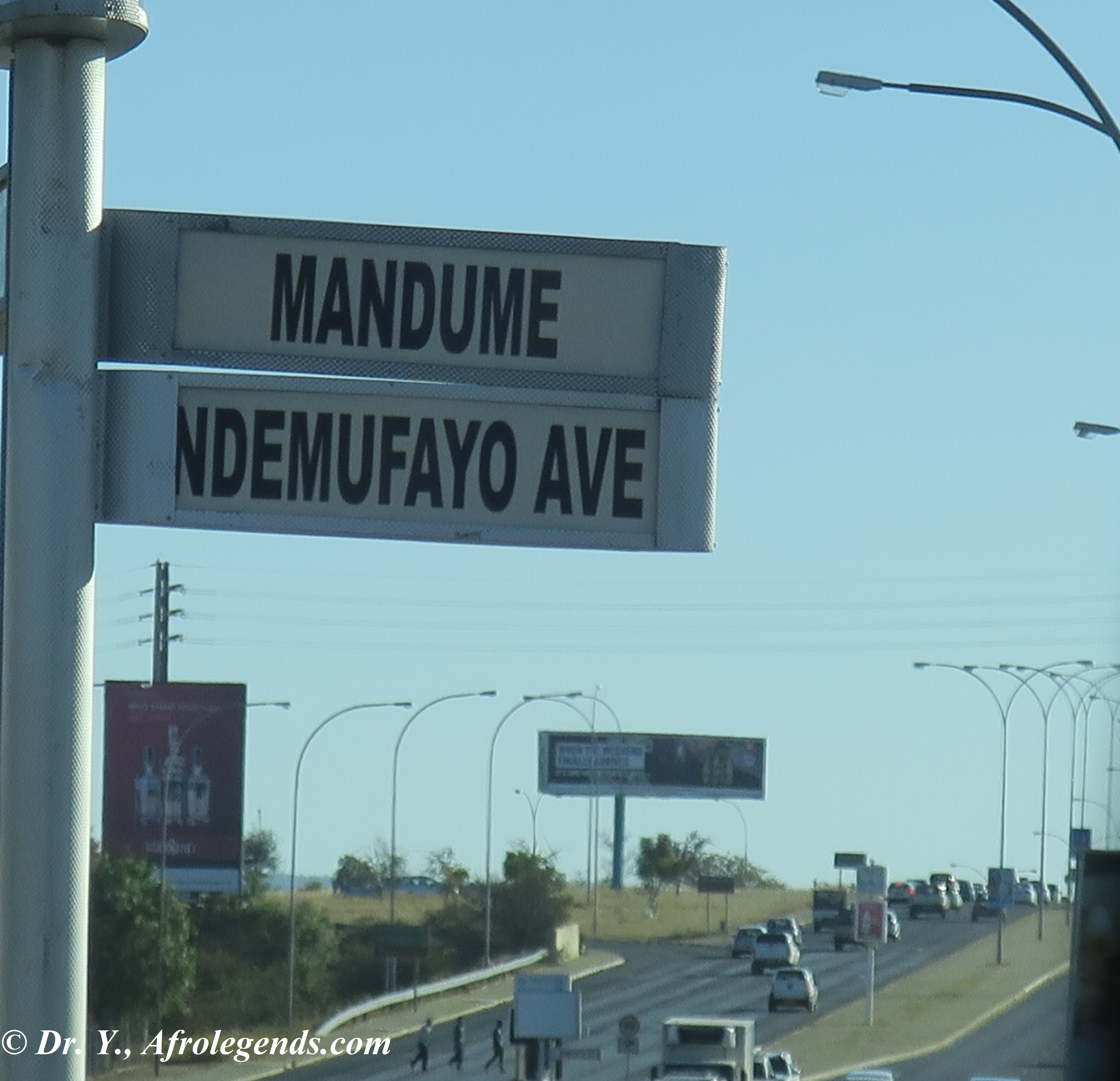
Mandume Ndemufayo Ave in Windhoek, Namibia
Today, Mandume Ya Ndemufayo is honored as a national hero in both Angola and Namibia. He is one of nine national heroes of Namibia that were identified at the inauguration of the country’s Heroes’ Acre near Windhoek. Namibia’s Founding President Sam Nujoma remarked in his inauguration speech on 26 August 2002 that: “It is better to die fighting than to become a slave of the colonial forces.” — These were the defiant words of one of Namibia’s foremost anti-colonialist fighters. He said these words in defiance when the combined [European] colonial forces insisted he should surrender. […] To his revolutionary spirit and his visionary memory we humbly offer our honor and respect.
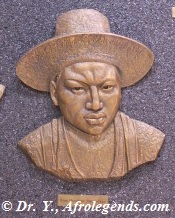
Early resistant, bronze plaque for King Mandume ya Ndemufayo at the Independence Museum in Windhoek, Namibia
The 100th anniversary of the death of Oukwanyama King Mandume ya Ndemufayo on February 2017 was attended by thousands of Namibians at Omhedi in the Ohangwena region including former Namibian presidents, where President Hage Geingob unveiled a bust of King Mandume. If you ever visit Windhoek, Namibia, make sure to walk along the street named after King Mandume, or visit the Universidade Mandume ya Ndemufayo in Angola. Please check out the article “The Legacy of legendary Oukwanyama King still vivid“, the article from The Namibian, Order out of chaos: Mandume Ya Ndemufayo and Oral History by Patricia Hayes, and lastly Les Africains Tome 8, editions J.A. p.207 (1977) to learn more about this great last resistant to Portuguese colonial advances in Southern Angola and Northern Namibia.
Le coassement des grenouilles n’empêche pas l’éléphant de boire (Proverbe Mandingue – Guinée, Mali, Gambie, Sénégal). – Vous ne m’empêcherez pas d’agir; les chiens aboient, la caravane passe.
The croaking of frogs does not prevent the elephant from drinking (Mandinka proverb – Guinea, Mali, The Gambia, Senegal). – You will not prevent me from acting; dogs bark, but the caravan moves.
It is no secret that 14 African countries today are still under the French colonial tax (The 11 Components of the French Colonial Tax in Africa), and that every year, France takes home upwards of 500 billion dollars (Africa is funding Europe!) from its currency imposed upon those countries. After all, France has no gold mines on its soil but yet is the 4th world producer of gold, gold coming from Mali, while Mali is among the world’s poorest countries on the planet. It is also no secret that Mali has been trying to free itself from this colonial tax (The French Colonial Tax at the Heart of Mali-France Tensions), and has been working tirelessly to revoke at least 8 of the 11 rules. With the unrest in Burkina Faso brought by the Jihadists from the north who were well protected by the French army brought in to protect Burkinabe interests, but who instead have created further unrest in the area, it is no surprise that Burkina Faso has joined forces with Mali, and now Guinea, to create a strategic axis which will focus on military and trade agreements between the 3 countries. Although we do not particularly trust the Guinean leader, we applaud the union between the two brothers Mali and Burkina Faso, faced with sanctions from the puppet organization that is ECOWAS. We also applaud this ‘federation’ which will give Mali and Burkina Faso access to the sea via Guinea, thus opening up these land-locked territories to further trade. Enjoy excerpts below from the People’s Dispatch; check out also the write-up on AfricaNews.
Like Thomas Sankara said, “La patrie ou la mort, nous vaincrons!”
====
Burkina Faso
The three West African countries, all of whom have recently undergone military takeovers amid rising public anger against France, have agreed to a Bamako-Conakry -Ouagadougou axis, with enhanced cooperation on matters ranging from trade to the fight against insecurity.
As France is getting ready to withdraw its troops from Burkina Faso by the end of the month, signs of a possible realignment in the region are emerging with a tripartite meeting between the foreign ministers of Burkina Faso, Mali, and Guinea—Olivia Ragnaghnewendé, Morissanda Kouyate, and Abdoulaye Diop—held in Burkina Faso’s capital Ouagadougou on February 8 and 9.
The leaders discussed a range of issues, “in particular the success of the transition processes leading to a return to a peaceful and secure constitutional order,” and, importantly, the “revitalization of the Bamako-Conakry-Ouagadougou axis” to make it a “strategic and priority area” on matters including trade and economic exchanges, mining, transport, roads and railway links, and the “fight against insecurity.”
…
Guinea-Conakry
The communique issued following last week’s tripartite meeting condemned the “mechanical imposition of sanctions which often fail to take into account the deep and complex causes of political change,” adding that these measures “affected populations already battered by insecurity and political instability,” “undermine sub-regional and African solidarity,” and “deprive ECOWAS and the AU of the contribution of the three countries needed to meet their major challenges.”
While calling for “technical, financial, concrete, and consistent support” for security efforts and the return to a normal constitutional order, the three countries have agreed to “pool their efforts and undertake joint initiatives for the lifting of the suspension measures and other restrictions.”
Today, I will share with you a beautiful poem by author Esmeralda Yitamben, “Love, the African Way.” As you remember, I shared the poem‘African Hair’ by Esmeralda Yitambenwhich, in my humble opinion, should be published in school books… and which I dearly love. Here is another one, for the lovers out there, and the historians as well. Every part of this poem is rich in history, history of the African continent, of the race, and combines the ancient and the modern faces of Africa : from the scholarly city ofTimbuktu, one of the first universities of the world, to the second longest river ofAfrica, the Congo River and the great Congo Empire, to the libraries ofAlexandria, to the sandy beaches of Senegal, from the dunes ofThe forgotten kingdom of Nubiato the streets ofDouala. Imagine climbing the tallest mountain of Africa for someone you love, going to battle likeShaka Zulu, and winning them all like Menelik II (Battle of Adwa)… Imagine a love founded on the rock of the great Egyptian pyramids, and rising like the sphinx, never faltering. No doubt that this is a celebration of victory, of wealth, of the conquest of all battles, and above all… of love. The original poem can be found on Kalaharireview.com. Enjoy!










 African Heritage