Yesterday saw new turns in the situation in Niger with the airspace closure, and the rebuffing of the west’s puppet organizations that are the AU, ECOWAS, and the UN by Niger. One thing is for sure, everyone is watching carefully, and no one wants a regional spillover; after all, there are a lot of presidents installed to serve foreign interests in many bordering African countries, and many are starting to sweat. As a side note, the U.S., along with France has about 1,500 troops in Niger and Germany with about 100 (and even Italy) use facilities in that country to “combat jihadi groups” (that the West created to destabilize the entire region). The US with Secretary of State Antony Blinken said that Wagner (and thus Russia) is misleading the people of Niger… he told the BBC’s Focus on Africa programme, “I think what happened, and what continues to happen in Niger was not instigated by Russia or by Wagner, but… they tried to take advantage of it. … Every single place that this Wagner group has gone, death, destruction and exploitation have followed,” said Mr Blinken. “Insecurity has gone up, not down“. And where the US has gone there has not been insecurity, death, or destruction? It is like the pot calling the kettle black! US Acting Deputy Secretary of State Victoria Nuland flew to Niamey on Monday but was denied permission to meet with current president Abdourahamane Tchiani, coup leader, or with former president Bazoum, who is in detention. Instead, she spoke for two hours with other army officers. “These conversations were extremely frank and at times quite difficult because, again, we’re pushing for a negotiated solution. … They are quite firm in their view of how they want to proceed, and it does not comport with the Constitution of Niger,” Nuland told reporters. So when it serves the West’s interests, the constitution of a country is a valid piece of paper, but when it does not like in Ivory Coast in 2010, it is just toilet paper?
… Despite the international pressure, [Niger] coup leaders have seemed unwilling to back down, and on Sunday night, they closed Niger’s airspace until further notice, citing the threat of military intervention.
“In the face of the threat of intervention that is becoming more apparent … Nigerien airspace is closed effective from today,” a junta representative said in a statement on national television on Sunday evening [when Africans fight for their freedoms, they are called junta; but when in other countries people fight for their people’s freedoms, they are called patriots] .
He said there had been a pre-deployment of forces in two central African countries in preparation for an intervention, but did not give details. “Niger’s armed forces and all our defence and security forces, backed by the unfailing support of our people, are ready to defend the integrity of our territory,” the representative said.
The coup leaders warned any attempt to violate Niger’s airspace would face “an energetic and instant response”.
Ecowas defence officials agreed a possible military action plan, including when and where to strike, if Bazoum was not released and reinstated by the Sunday deadline.
On Monday, an Ecowas spokesperson, Emos Lungu, said the bloc would hold an extraordinary summit to discuss Niger on Thursday at the organisation’s headquarters in Abuja.
However, the bloc’s unity has been shattered by support for the coup leaders from the ruling juntas in Mali and Burkina Faso, both [sanctioned] members of Ecowas, and a pledge to come to Niger’s defence if necessary.
Flag of Burkina Faso
The Malian army said it would send a delegation to Niamey to show solidarity and a military plane from Burkina Faso was reported to have landed in the Niger capital at about 11.20am GMT.
The coup, the seventh in west and central Africa in three years, has rocked the Sahel region, one of the poorest in the world. Given its uranium and oil riches and its pivotal role in a war with Islamist militants, Niger holds great importance for the US, Europe, China and Russia.
… Gen Dominique Trinquand, a former French military representative at the UN, said the junta was “totally isolated” [yeah right! so why is the West afraid of this seemingly “isolated” force?].
He added: “Nigeria, which supplies 70% of Niger’s electricity, has cut the supply. All aid has been cut while Niger is one of the poorest countries in the world.”
On Sunday, Paris announced it was suspending its €482m (£416m) development aid programme to neighbouring Burkina Faso, which – along with Mali – has expressed its support for the junta. [And Burkina Faso told Paris to shove it!]
Last week Niger revoked military cooperation agreements with France, which has between 1,000 and 1,500 troops in the country.
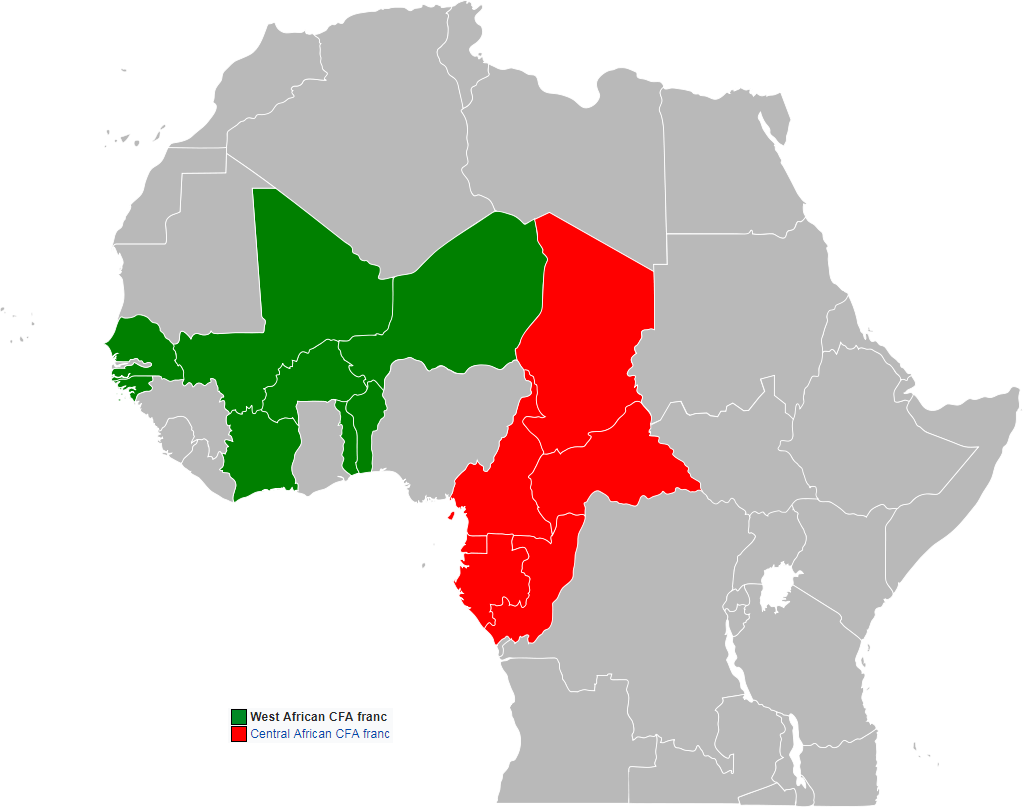
In the Lion King, the song goes as “Can you feel the love tonight?” The recent events in Niger have made us, Africans, sing, “Can you feel the wind of change tonight?” A hurricane is passing through West Africa. It has now landed in Niger! Oh yes! Niger! France is seeing red! Over 1/3 of its uranium is coming from Niger. France, the great country of nuclear energy, has been pillaging Niger, taking over the uranium without so much as building simple roads for Niger people; Niger is still the second poorest country in the world. Did you know that France’s nuclear power is funded by the uranium of Niger? and that Niger gets nothing for it? When Mamadou Tandja, one of the former presidents of Niger asked that the French nuclear company Areva start to pay something to Niger, as Areva had enjoyed a de facto four-decades monopoly in the country, he was deposed in a coup. Remember The 11 Components of the French Colonial Tax in Africa which gives France monopoly over riches, resources and mines, in 15 countries?
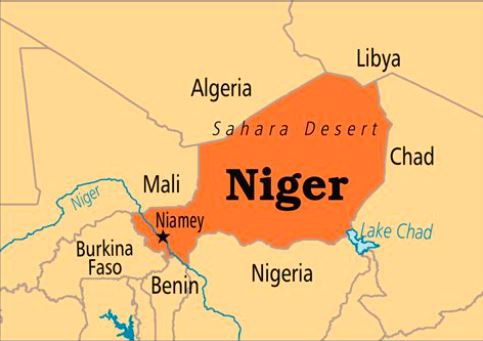
Map of Niger
The International community, France and its cronies the EU, US, etc, have all condemned the 26 July 2023 coup in Niger. They are all panicking! Let’s just say that this might be the start of a big world War reminiscent of the cold war. Why do I say that? Remember how the Cold War between the East and the West was not really played on their soils but rather on African, Latin American, and even Asian soils? This is it! The war in Ukraine is too close to Russia, and the West has put too much in trying to, unsuccessfully, asphyxiate Russia. Now their new energy routes are in jeopardy of being cut off! This is an energetic war! The great oil pipeline that was supposed to go from Nigeria all the way to Europe passes through Niger [Europe turns to Africa for Energetic Needs to Reduce Reliance on Russia].
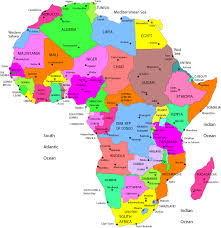
Can you feel the wind of change? Oh yes! It is blowing through the Sahara. The West asked ECOWAS to militarily intervene in Niger, which it at first agreed to (president Tinubu of Nigeria who is presiding over ECOWAS agreed), but the Nigerian senate said that they would emphasize dialogue over military intervention. Algeria, Niger’s northern neighbor, was tapped in, but they too, prefer dialogue. Chad was called in to intervene in Niger, but Chad said “how can I fight my brother?” The military governments in Mali and Burkina Faso told ECOWAS that an armed intervention in Niger would be met with force. Guinea also sided Mali and Burkina Faso. All three countries plus Niger are suspended from ECOWAS, and form part of a military-led belt spanning Africa’s Sahel from Guinea in the west to Sudan in the east. After the destabilization of Libya by NATO (led by France of Sarkozy, and the US), the entire Sahel region has been unstable. After all, why should neighbors be asked to fight neighbors for foreign interests? We are all African brothers, the fact that we were colonized by different powers does not change the fact that we were colonized by foreigners. One colonizer is not better than another, and we cannot continue to fall over stupid divisions. We are all brothers, the enemy is the same (in the eyes of the colonizer, we are all the same anyways). We have been enslaved for far too long. How can a country like Niger with some of the world’s largest deposits of uranium be the second poorest country in the world (In 2021, Niger was the main supplier of uranium to the EU)? How can it be France’s entire backyard? How can France exploit the country, without so much as building roads, or paying for it? France who has no uranium, no gold, yet is top world producer of all these resources, and gets annually $500 billion from Africa [Africa is funding Europe!] while Africans are impoverished! As you think about it, there comes a time when Bob Marley’s prophetic words ring true “You can fool some people sometimes, but you can’t fool all the people all the time… Now [we] see the light… [we will] stand up for [our] rights!” Enough is enough! Niger O Bosso! As Agostinho Neto said, “A luta continua, e la vitoria e certa.” Brothers and sisters, let us all unite for the freedom of Niger, and Africa as a whole.
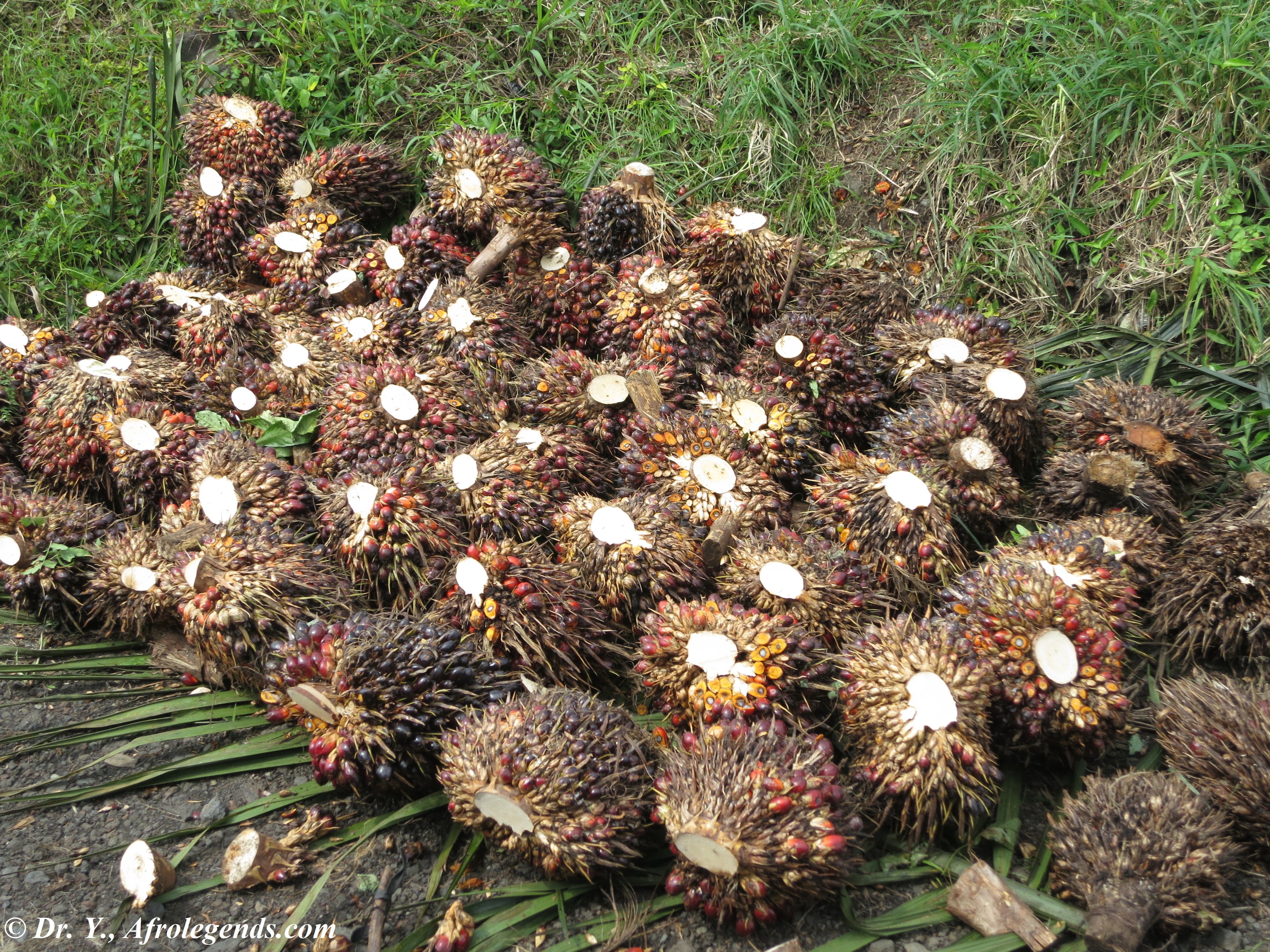
Deux écureuils se rendent facilement maîtres d’un régime de noix palmistes (Proverbe Ivili – République du Congo, République Démocratique du Congo (RDC), Angola, Gabon).
Two squirrels quickly master a bunch of palm nuts (Ivili proverb – Republic of Congo, Democratic Republic of Congo (DRC), Angola, Gabon).
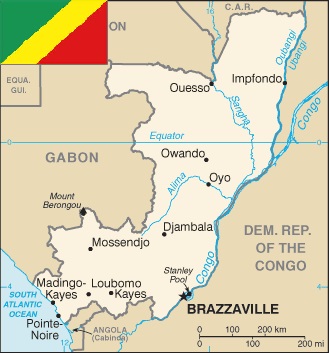
Have you ever wondered why the second city of the Republic of the Congo‘s name is Pointe-Noire? After all, why would a city in Congo be named Black point? Is there a volcanic mountain in the city, whose tip is black? Or does the city extend through the bay while making it so hard to distinguish that sailors of the past could have called it Black point, because maybe they could not see it, and just crashed into its coasts? Or is it the French translation to a local word? All those questions are quite valid ones.
It turns out that the city of Pointe-Noire got its name from the Portuguese navigators who saw a block of black rocks on the headland in 1484. They named the place Ponta Negra (as it first appeared on maps), which became Punta Negra in Spanish, which later became Pointe Noire in French. It became a maritime point of reference for the Portuguese sailors, and later in 1883 it became a small fishing village, after the French signed a treaty with the local Loangos people. Pointe-Noire is nicknamed Pontonor Pontoonby its inhabitants, or Ndji-Ndji or Njinji, in reference to the ancient village of fishermen on which the city is built. It is located between the small bay of Pointe-Noire Bay and the Atlantic Ocean
Wharf of Pointe-Noire in 1924 (Wikipedia)
Over the years, the city of Pointe-Noire overtook the place of Loango located about 15 km away, which used to be the capital of the great Loango empire (story for another day). First in 1910, the French Equatorial Africa (Afrique équatoriale française, AEF) was created, and French companies started exploiting the Middle Congo (modern-day Congo Brazzaville) in that region, then there was a need for the creation of a railroad that could link Brazzaville inland to the Atlantic ocean. In 1923, Pointe-Noire was chosen to be the
Railway Station of Pointe-Noire in 1947 (Wikipedia)
terminus of the Congo-Ocean Railway, instead of Libreville. The city was also chosen to be the AEF seaport as opposed to Loango (this marked the forever decline of Loango). In 1950, Pointe-Noire had 20,000 inhabitants, and became the capital of the Middle Congo, while Brazzaville was the capital city of the AEF. It was the most modern city in Congo by 1960. Oil discoveries and the implantation of Elf Aquitaine (now Total Energies) in the 1980 have created an economic boom for the city, and influx of populations especially after the civil war of 1997 between Pascal Lissouba and Denis Sassou Nguesso. It is good to note that the oil of Congo belongs to France, and this was the reason of the 1997 war between Lissouba and Sassou Nguesso, because Lissouba wanted fair compensation for Congolese oil, and sought an American company to exploit oil (The 11 Components of the French Colonial Tax in Africa).
Today, Pointe-Noire is a very modern city whose main industries are still oil, the seaport, railway, and fishing; it also has a large potash industry as well. Pointe-Noire is the economic lung of the country. A while back, we visited Pointe-Noire, and were amazed by the difference between Pointe-Noire and Brazzaville; it is better built, and organized. It also has a large expatriate community. In the past it was left untouched by the civil unrest that shook the entire country. The city has two distinct sides, with the European quarter and the African quarter (La Cité) offering wholly different feels – Pointe-Noire is a great example of urban dimorphism if there ever was one. As you visit Pointe-Noire, and walk on its sandy beaches, enjoy the city, and if you have time, try to look for that Black Point after which it was named.
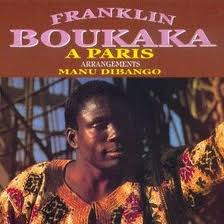
As stated earlier in the week, Franklin Boukaka was a visionary ahead of his time, and his songs are very politically engaged. His most acclaimed song is “Le Bûcheron” / “The Woodcutter” which has been timeless and covered by many singers over the years. Most know the song as “Aye Africa”. “Le Bûcheron” (the woodcutter; the Kenyan version of the single was titled “Le Bûcheron (Africa)”), is a complaint about the state of Africa and its poor, the refrain lamenting “Oh, Africa, where is your independence? … where is your liberty?” Boukaka even goes further, showing that the politicians of today who have replaced yesterday’s colonizers cannot really be differentiated from them. He laments the fact that some he believed in, have turned their back on the people and instead developed greed for power, only showing good sides during election times (isn’t this true of politicians around the globe, who only remember the people come election time with empty promises?), ” Some to whom I gave my voice, have developed the greed of power and cars; When the elections come I become important then in front of them.” Lastly, it is impossible to hear the saxophone notes coming from Manu Dibango.
As you read the lyrics and listen to the song, why do you think Franklin Boukaka titled his song The Woodcutter?
Ayé Africa eh … Ayé Africa eh Eh Africa oh Lipanda … Eh Africa oh where is your independence? Ayé Africa eh … Ayé Africa eh Eh Africa oh liberté … Ayé Africa eh where is your freedom?
Ko kata koni pasi … Cutting firewood is hard work Soki na kati, ko teka pasi … To sell this wood is another Na pasi oyo ya boye … With this lot of misfortunes and children Ngaï na bana mawa na koka te … I’m far from getting out
Basusu oyo na ponaka … Some to whom I gave my voice Bawela bonkonzi mpe na ba voitures … Have developed the greed of power and cars Ba voti tango e komaka … When the elections come Ngaï na komi moto mpo na bango … I become important then in front of them
Na ko mituna mondele a kende … I wonder: has the colonizer gone, Lipanda to zuaka, oh ya nani eh? … For whom did we obtain independence? Africa eh … Oh Africa
Ayé Africa eh … Ayé Africa eh Oh Africa oh Lipanda … Eh Africa oh where is your independence? Ayé Africa eh … Ayé Africa eh Oh Africa oh liberté … Ayé Africa eh where is your freedom?
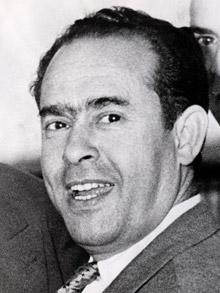
Let’s do a trip down memory lane. Several years ago we published a post on the song “Les Immortels” / “The Immortals“ written and composed by the late Congolese singer Franklin Boukaka. The song honored the great Moroccan leader Mehdi Ben Barka, African resistants, and world revolutionaries. For those who do not know or remember Franklin Boukaka, you have probably heard his song “Aye Africa” which has been repeated by so many singers on the continent (one of my favorite renditions is the one by the group Bisso na Bisso). Franklin Boukaka was a freedom fighter, a poet, composer, activist, and fought for the independence of Africa both politically and in all his songs. He was ahead of his time, and a new patriot. So sad that he was murdered during the coup that deposed Ange Diawara during the night of 23-24 February 1972. He was clearly a threat to many.
Mehdi Ben Barka
As the title says it all, The Immortals honors our great leaders of the past, those who fought for our liberties, and who have become martyrs. They are now immortal. The song was so popular in those days that it was sung in schools. No wonder Boukaka was murdered for this. Please find below, the English version. Enjoy!
« The Immortals » by Franklin Boukaka
Africa mobimba e ……… The whole of Africa Tokangi maboko e …….. crossed her arms Tozali kotala e …….. We observed powerless Bana basili na kokende … The loss of her children Bana basili na kotekama e … The traffic of her children Na banguna a ……………… near ennemies Tolati mokuya ata maloba te … Silent, we have carried the black veil of mourning Congo na bana Africa baleli … Congo and Africa burst into tears
(2X) Oh O Mehdi Ben Barka … Oh ! Mehdi Ben Barka Mehdi nzela na yo ya bato nyonso … Mehdi, your way is that of all humanity Mehdi nzela na yo ya Lumumba … Mehdi, your way is that of Lumumba Mehdi nzela na yo ya Che Guevara … Mehdi, your way is that of Che Guevara Mehdi nzela na yo ya Malcolm X … Mehdi, your way is that of Malcolm X Mehdi nzela na yo ya Um Nyobé … Mehdi, your way is that of Um Nyobé Mehdi nzela na yo ya Felix Moumié … Mehdi, your way is that of Felix Moumié Mehdi nzela na yo ya Nguyen Van Choi … Mehdi, your way is that of Nguyen Van Choi Mehdi nzela na yo ya Tsoroki … Mehdi, your way is that of Tsoroki Mehdi nzela na yo ya Camilo CienFuegos … Mehdi, your way is that of Camilo CienFuegos Mehdi nzela na yo ya Hoji Ya Henda … Mehdi, your way is that of Hoji Ya Henda Mehdi nzela na yo ya Camilo Torres … Mehdi, your way is that of Camilo Torres Mehdi nzela na yo ya Abdel Kader … Mehdi, your way is that of Abdel Kader Mehdi nzela na yo ya Coulibaly … Mehdi, your way is that of Coulibaly Mehdi nzela na yo ya André Matsoua … Mehdi, your way is that of André Matsoua Mehdi nzela na yo ya Simon Kibangu… Mehdi, your way is that of Simon Kibangu Mehdi nzela na yo ya Albert Luthuli… Mehdi, your way is that of Albert Luthuli Mehdi nzela na yo ya Boganda … Mehdi, your way is that of Boganda Oh ya Tiers-monde … Oh ! Third world Oh ya libération ya ba peuple … Oh ! that of the liberation of the people
Words: An old man, whom I consider always young, said to me one day : « My son, all men should die one day ; but not all deaths have the same meaning »
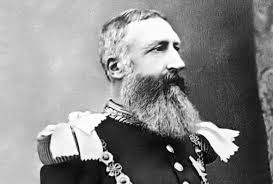
In1890, George Washington Williams wrote an open letter to King Leopold II about the atrocities being committed in his name in the Congo in the exploitation of rubber: it took the proportions of a genocide, as almost15 million peoplewere maimed or murdered at the hands of King Leopold II. To read the full letter, please consultBlackPast. Below are some excerpts from the letter.
=====
George Washington Williams, “An Open Letter to His Serene Majesty Leopold II, King of the Belgians and Sovereign of the Independent State of Congo By Colonel, The Honorable Geo. W. Williams, of the United States of America,” 1890
Good and Great Friend,
King Leopold II
I have the honour to submit for your Majesty’s consideration some reflections respecting the Independent State of Congo, based upon a careful study and inspection of the country and character of the personal Government you have established upon the African Continent.
It afforded me great pleasure to avail myself of the opportunity afforded me last year, of visiting your State in Africa; and how thoroughly I have been disenchanted, disappointed and disheartened, it is now my painful duty to make known to your Majesty in plain but respectful language. Every charge which I am about to bring against your Majesty’s personal Government in the Congo has been carefully investigated; a list of competent and veracious witnesses, documents, letters, official records and datahas been faithfully prepared, which will be deposited with Her Britannic Majesty’s Secretary of State for Foreign Affairs, until such time as an International Commission can be created with power to send for persons and papers, to administer oaths, and attest the truth or falsity of these charges.
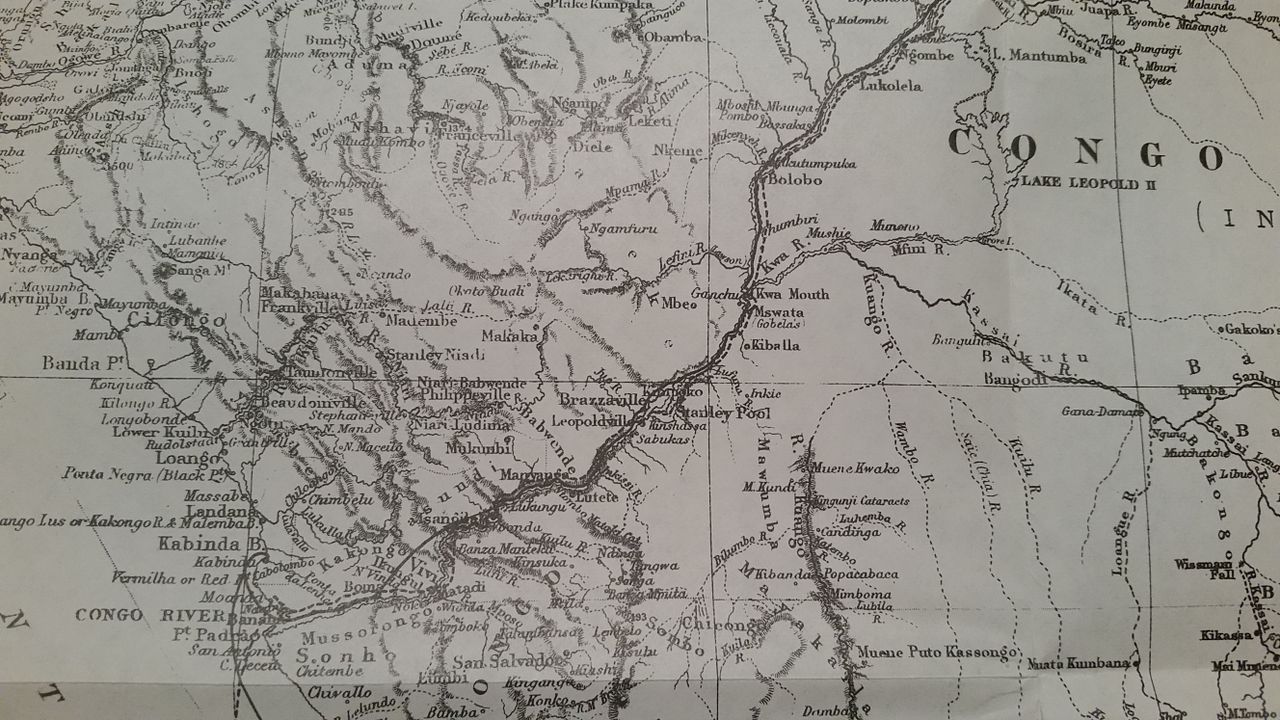
Map of Congo by Stanley
… When I arrived in the Congo, I naturally sought for the results of the brilliant programme: “fostering care”, “benevolent enterprise”, an “honest and practical effort” to increase the knowledge of the natives “and secure their welfare”. I had never been able to conceive of Europeans, establishing a government in a tropical country, without building a hospital; and yet from the mouth of the Congo River to its head-waters, here at the seventh cataract, a distance of 1,448 miles, there is not a solitary hospital for Europeans, and only three sheds for sick Africans in the service of the State, not fit to be occupied by a horse [“Afrique 50” The First French Anti-Colonization Documentary]. …
I was anxious to see to what extent the natives had “adopted the fostering care” of your Majesty’s “benevolent enterprise” (?), and I was doomed to bitter disappointment. Instead of the natives of the Congo “adopting the fostering care” of your Majesty’s Government, they everywhere complain that their land has been taken from them by force; that the Government is cruel and arbitrary, and declare that they neither love nor respect the Government and its flag. Your Majesty’s Government has sequestered their land, burned their towns, stolen their property, enslaved their women and children, and committed other crimes too numerous to mention in detail. It is natural that they everywhere shrink from “the fostering care” your Majesty’s Government so eagerly proffers them.
There has been, to my absolute knowledge, no “honest and practical effort made to increase their knowledge and secure their welfare.” Your Majesty’s Government has never spent one franc for educational purposes, nor instituted any practical system of industrialism. Indeed the most unpractical measures have been adopted against the natives in nearly every respect; and in the capital of your Majesty’s Government at Boma there is not a native employed. …
… From these general observations I wish now to pass to specific charges against your Majesty’s Government.
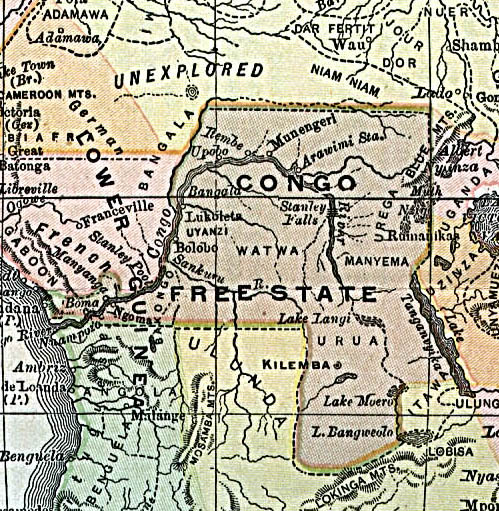
Map of the Congo Free State in 1892
FIRST.—Your Majesty’s Government is deficient in the moral military and financial strength, necessary to govern a territory of 1,508,000 square miles, 7,251 miles of navigation, and 31,694 square miles of lake surface. In the Lower Congo River there is but One post, in the cataract region one. From Leopoldville to N’Gombe, a distance of more than 300 miles, there is not a single soldier or civilian. Not one out of every twenty State-officials know the language of the natives, although they are constantly issuing laws, difficult even for Europeans, and expect the natives to comprehend and obey them. …
SECOND.—Your Majesty’s Government has established nearly fifty posts, consisting of from two to eight mercenary slave-soldiers from the East Coast. … These piratical, buccaneering posts compel the natives to furnish them with fish, goats, fowls, and vegetables at the mouths of their muskets; and whenever the natives refuse to feed these vampires, they report to the main station and white officers come with an expeditionary force and burn away the homes of the natives. These black soldiers, many of whom are slaves, exercise the power of life and death. They are ignorant and cruel, because they do not comprehend the natives; they are imposed upon them by the State. They make no report as to the number of robberies they commit, or the number of lives they take; they are only required to subsist upon the natives and thus relieve your Majesty’s Government of the cost of feeding them. They are the greatest curse the country suffers now.
THIRD.—Your Majesty’s Government is guilty of violating its contracts made with its soldiers, mechanics and workmen, many of whom are subjects of other Governments. Their letters never reach home.
FOURTH.—The Courts of your Majesty’s Government are abortive, unjust, partial and delinquent. I have personally witnessed and examined their clumsy operations. The laws printed and circulated in Europe “for the Protection of the blacks” in the Congo, are a dead letter and a fraud. …
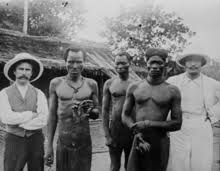
Picture of men holding cut-off hands (image by Alice S. Harris in Baringa 1904)
FIFTH—Your Majesty’s Government is excessively cruel to its prisoners, condemning them, for the slightest offences, to the chain gang, the like of which can not be seen in any other Government in the civilized or uncivilized world. … But the cruelties visited upon soldiers and workmen are not to be compared with the sufferings of the poor natives who, upon the slightest pretext, are thrust into the wretched prisons here in the Upper River. …
SIXTH.—Women are imported into your Majesty’s Government for immoral purposes. They are introduced by two methods, viz., black men are dispatched to the Portuguese coast where they engage these women as mistresses of white men, who pay to the procurer a monthly sum. The other method is by capturing native women and condemning them to seven years’ servitude for some imaginary crime against the State with which the villages of these women are charged. The State then hires these women out to the highest bidder, the officers having the first choice and then the men. Whenever children are born of such relations, the State maintains that the women being its property the child belongs to it also. …
SEVENTH.—Your Majesty’s Government is engaged in trade and commerce, competing with the organised trade companies of Belgium, England, France, Portugal and Holland. It taxes all trading companies and exempts its own goods from export-duty, and makes many of its officers ivory-traders, with the promise of a liberal commission upon all they can buy or get for the State. State soldiers patrol many villages forbidding the natives to trade with any person but a State official, and when the natives refuse to accept the price of the State, their goods are seized by the Government that promised them “protection”. When natives have persisted in trading with the trade-companies the State has punished their independence by burning the villages in the vicinity of the trading houses and driving the natives away.
EIGHTH.—Your Majesty’s Government has violated the General Act of the Conference of Berlin by firing upon native canoes; by confiscating the property of natives; by intimidating native traders, and preventing them from trading with white trading companies; by quartering troops in native villages when there is no war; … by permitting the natives to carry on the slave- trade, and by engaging in the wholesale and retail slave-trade itself.
NINTH.—-Your Majesty’s Government has been, and is now, guilty of waging unjust and cruel wars against natives, with the hope of securing slaves and women, to minister to the behests of the officers of your Government. In such slave-hunting raids one village is armed by the State against the other, and the force thus secured is incorporated with the regular troops. …
TENTH.—Your Majesty’s Government is engaged in the slave-trade, wholesale and retail. It buys and sells and steals slaves. … The labour force at the stations of your Majesty’s Government in the Upper River is composed of slaves of all ages and both sexes.
ELEVENTH.—Your Majesty’s Government has concluded a contract with the Arab Governor at this place for the establishment of a line of military posts from the Seventh Cataract to Lake Tanganyika territory to which your Majesty has no more legal claim, than I have to be Commander-in-Chief of the Belgian army. …
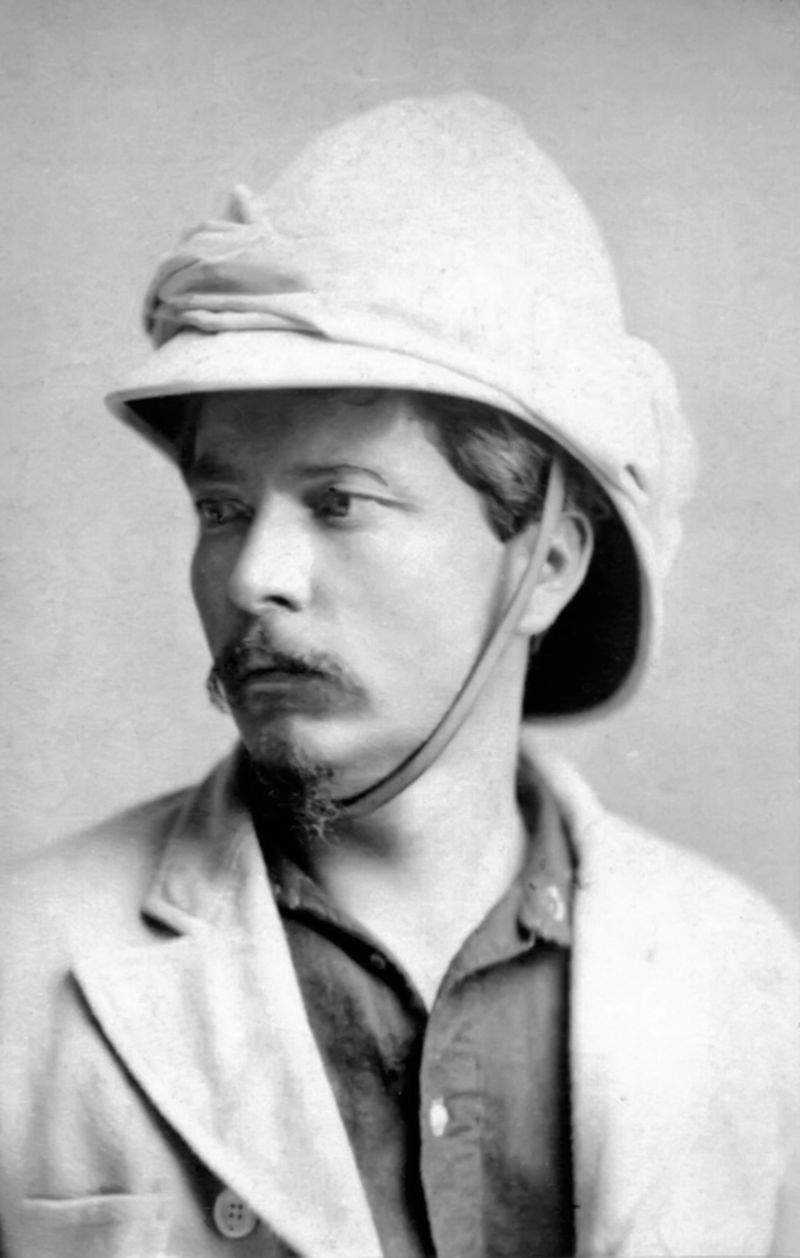
Henry Morton Stanley, whose exploration of the Congo region at Leopold’s invitation led to the establishment of the Congo Free State under personal sovereignty
TWELFTH—The agents of your Majesty’s Government have misrepresented the Congo country and the Congo railway. Mr. H. M. STANLEY, the man who was your chief agent in setting up your authority in this country, has grossly misrepresented the character of the country. Instead of it being fertile and productive it is sterile and unproductive. The natives can scarcely subsist upon the vegetable life produced in some parts of the country. … HENRY M. STANLEY’S name produces a shudder among this simple folk when mentioned; they remember his broken promises, his copious profanity, his hot temper, his heavy blows, his severe and rigorous measures, by which they were mulcted of their lands. His last appearance in the Congo produced a profound sensation among them, … the only thing they found in the wake of his march was misery. …
CONCLUSIONS Against the deceit, fraud, robberies, arson, murder, slave-raiding, and general policy of cruelty of your Majesty’s Government to the natives, stands their record of unexampled patience, long-suffering and forgiving spirit, which put the boasted civilisation and professed religion of your Majesty’s Government to the blush. …
All the crimes perpetrated in the Congo have been done in your name, and you must answer at the bar of Public Sentiment for the misgovernment of a people, whose lives and fortunes were entrusted to you by the august Conference of Berlin, 1884—1 885. I now appeal to the Powers which committed this infant State to your Majesty’s charge, and to the great States which gave it international being; and whose majestic law you have scorned and trampled upon, to call and create an International Commission to investigate the charges herein preferred in the name of Humanity, Commerce, Constitutional Government and Christian Civilisation.
I base this appeal upon the terms of Article 36 of Chapter VII of the General Act of the Conference of Berlin, in which that august assembly of Sovereign States reserved to themselves the right “to introduce into it later and by common accord the modifications or ameliorations, the utility of which may be demonstrated experience”.
Painting of George Washington Williams addressing the Ohio State Legislature. Williams was the first African-American elected to the Ohio State Legislature, serving one term 1880 to 1881 (Source: Ohio Statehouse, Wikipedia)
I appeal to the Belgian people and to their Constitutional Government, so proud of its traditions, replete with the song and story of its champions of human liberty, and so jealous of its present position in the sisterhood of European States—to cleanse itself from the imputation of the crimes with which your Majesty’s personal State of Congo is polluted.
I appeal to Anti-Slavery Societies in all parts of Christendom, to Philanthropists, Christians, Statesmen, and to the great mass of people everywhere, to call upon the Governments of Europe, to hasten the close of the tragedy your Majesty’s unlimited Monarchy is enacting in the Congo.
I appeal to our Heavenly Father, whose service is perfect love, in witness of the purity of my motives and the integrity of my aims; and to history and mankind I appeal for the demonstration and vindication of the truthfulness of the charge I have herein briefly outlined.
And all this upon the word of honour of a gentleman, I subscribe myself your Majesty’s humble and obedient servant,
The world came to know the truth about King Leopold II, the Belgian King who killed millions of Congolese, thanks to George Washington Williams, an African American missionary, lawyer, and writer, who visited the Congo. It is said that King Leopold II must have executed and maimed over 15 million Congolese people!
Painting of George Washington Williams addressing the Ohio State Legislature. Williams was the first African-American elected to the Ohio State Legislature, serving one term 1880 to 1881 (Source: Ohio Statehouse, Wikipedia)
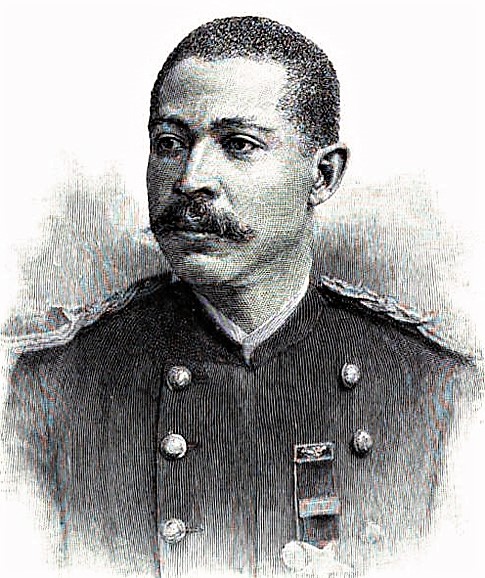
George Washington Williams is an unsung hero who in today’s terms would be called a whistle blower. He was born free in 1849 in the state of Pennsylvania in America to free African American parents. He ran away at an early age and served in the Union Army during the Civil War. He was an American soldier, historian, Baptist clergyman, politician, lawyer, and lecturer. He served in the Ohio General Assembly from 1880 to 1881, becoming the first African American to be elected to the Ohio State Legislature. He was the first person to write an objective, researched history of Blacks in America. His first book, History of the Negro Race in America (1882), is one of the most important contributions any American has made to the field, as he showed African American participation and contributions from the earliest days of the colonies. He wrote other books on the history of the United States Colored Troops and African-American participation in the American Civil War, A History of Negro Troops in the War of Rebellion (1887).
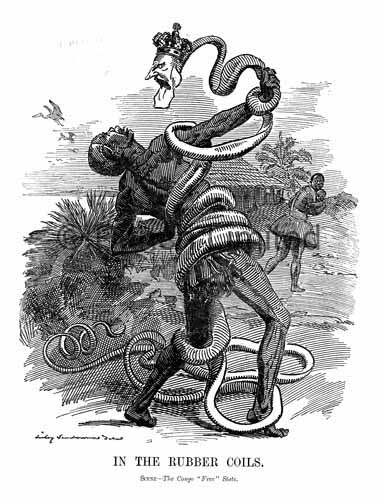
In The Rubber Coils. Scene – The Congo ‘Free’ State” Linley Sambourne depicts King Leopold II of Belgium as a snake entangling a congolese rubber collector
In the late 1880s, after meeting King Leopold II of Belgium in Europe and being impressed by his ‘benevolent enterprise’ in the Congo, Williams traveled to the Congo Free State, then a property of the King, in 1890. He was shocked by the widespread brutal abuses, atrocities, forced labor, torture, murder, kidnapping, physical mutilation, and slavery imposed on the Congolese for the rubber quota. The king employed a private militia to enforce rubber production, back then rubber was like gold. What Williams witnessed was so outrageous that he wrote “An Open Letter to His Serene Majesty Leopold II, King of the Belgians and Sovereign of the Independent State of Congo” on July 18, 1890 about the suffering of the Congolese people. In his letter, he used the term “crimes against humanity,” term used for the first time, and it became a catalyst for an international outcry against the brutality of King Leopold II. He followed the open letter by “A Report Upon the Congo-State and Country to the President of the Republic of the United States.” In the letter, he mentioned the role played by explorer Henry Morton Stanley in deceiving and maltreating the local Congolese; to think that some places were even named after Stanley such as Stanleyville – now Kisangani and Stanley Falls – now Boyoma Falls! Williams reminded the King that the crimes committed were all committed in his name, making him as guilty as the perpetrators. He appealed to the international community of the day to “call and create an International Commission to investigate the charges herein preferred in the name of Humanity …“.
George Washington Williams (Source: Wikipedia)
Like with all whistle blowers in history, King Leopold II and his supporters tried to discredit Williams, but Williams continued to speak out about the abuses in the Congo Free State, helping to generate actions in Belgium and the international community. Unfortunately, George Washington Williams died just a year after, in 1891, while traveling from Africa to England. However, the seeds he planted with his open letter led the Belgian government to take over supervising the Congo Free State and to try to improve treatment of the Congolese. The Congo Free State was then reconstituted as a new territory, the Belgian Congo, which as history goes did not fare much better.

















 African Heritage