 Quem faz muitas perguntas nunca compra nada (provérbio ovimbundu – Angola)
Celui qui pose trop de questions, n’achète jamais rien (proverbe Ovimbundu – Angola)
The one who asks too many questions never buys anything (Ovimbundu proverb – Angola)

Quem faz muitas perguntas nunca compra nada (provérbio ovimbundu – Angola)
Celui qui pose trop de questions, n’achète jamais rien (proverbe Ovimbundu – Angola)
The one who asks too many questions never buys anything (Ovimbundu proverb – Angola)
For the past few days, I have received several messages about Iwájú, the first pan-African series to premiere on Disney+. I congratulate the authors, and send them encouraging messages to keep up the great work.
Excerpts below are from AfricaNews.
=====
Video on demand service Disney+ has collaborated with pan–African studio Kugali Media for a innovative animated series set in futuristic Lagos – Nigeria.
…
The series which is expected to premiere globally on February 28 explores themes of class and defiance. …
Iwájú’s casted Nigerian vocal talents Simisola Gbadamosi as Tola, a young girl from the wealthy island, and Siji Soetan as her best friend Kole, a self-taught tech expert.
The duo explore the dangerous tapestry of a neo-futuristic Lagos filled with greed and corruption alongside voice actors Femi Branch, Dayo Okeniyi, and Weruche Opia.
The soundtrack, out March 1st, will feature African-influenced music by renowned Nigerian composer Ré Olunuga. “I rarely bring my own emotions into writing a score. In this case, it couldn’t be avoided,” Olunuga said in a press release.
“In addition to Tola’s adventurous spirit, Kole’s ingenuity, and the many other fun and beautiful emotional threads explored in Iwájú – the score is steeped in my own very deep love for Lagos and its multiplicitous layers.”
 Below is ‘Ma vie est une chanson‘ or ‘My Life is a Song‘, a love poem by Cameroonian author Francis Bebey, a poem celebrating his love for the African woman, in this case for his lover. As we remember that Francis Bebey was multi-talented as a journalist, writer, sculptor and musician, it is no surprise that the title of his poem is “My Life is a Song”. He even headed the UNESCO music department researching and documenting traditional African music. In the poem, he highlights that he was born from the love of the earth with the sun, thus a birth that was very celebrated and a life full of love. As we read the poem, Bebey’s love for his country is abundantly clear as he dreams of taking his lover there, and not only that, but lets her know that his country is where to find the love between the earth and the sun; it is almost as if he was telling all that he was born on the equator. Moreover, let’s face it, the link between the earth and the sun is undeniable, unbreakable, unavoidable, constant, and forever omnipresent. He is so taken by the love so much so that his life is a song that he will sing everyday to his precious one. Wouldn’t you all like to be loved like that? Enjoy!
The poem ‘Ma vie est une chanson‘ by Francis Bebey, was published in Anthologie africaine: poésie, Jacques Chevrier, Collection Monde Noir Poche, Hatier 1988. Translated to English by Dr. Y. Afrolegends.com.
| Ma vie est une chansonOn me demande parfois d’où je viens
Et je reponds “je n’en sais rien Depuis longtemps je suis sur le chemin Qui me conduit jusqu’ici Mais je sais que je suis né de l’amour De la terre avec le soleil” Toute ma vie est une chanson Que je chante pour dire combien je t’aime Toute ma vie est une chanson Que je fredonne auprès de toi Ce soir il a plu, la route est mouillée Mais je veux rester près de toi Et t’emmener au pays d’où je viens Ou j’ai caché mon secret Et toi aussi tu naîtras de l’amour de la terre avec le soleil Toute ma vie est une chanson Que je chante pour dire combien je t’aime Toute ma vie est une chanson Que je fredonne auprès de toi. |
My Life is a SongI am sometimes asked where I come from
And I answer “I don’t know For a long time I have been on the way That leads me here But I know that I was born from the love between the land and the sun” My whole life is a song That I sing to tell you how much I love you My whole life is a song That I hum next to you Tonight it has rained, the road is wet But I want to stay close to you And take you to the land where I come from Where I hid my secret And you too will be born from the love of the earth with the sun My whole life is a song That I sing to tell you how much I love you My whole life is a song That I hum next to you. |

The 2023 Africa Cup of Nations or Coupe d’Afrique des Nations CAN2023 has ended with a new champion: the Elephants of Côte d’Ivoire, the host country, which took home the trophy for the third time in its history, defeating the Super Eagles of Nigeria 2-1. The Elephants have really given us a thrill from being redeemed in the knockout stage with 2 defeats (among which a 4-0 loss against Equatorial Guinea) that left them open to elimination, and a redemption that came from being one of the four best 3rd-placed team, a coach sacking, and a coach change. The change in coach, and the redemption really made the Elephants more serious. The Ivorians add to their previous Nations Cup wins in 1992 and 2015 (Côte d’Ivoire wins the 2015 Africa Cup of Nations) and become the first tournament hosts to triumph since Egypt lifted the trophy in 2006. The Elephants pick up $7m (£5.54m) in prize money, while the Super Eagles get $4m by the Confederation of African Football (CAF). The Bafana Bafana of South Africa took home the third place after defeating the Leopards of the Democratic Republic of Congo (DRC).

This year’s mascot, the elephant, named “Akwaba“, which means “Welcome” in Baoulé language, has been a testimony to the welcome and legendary Ivorian hospitality felt by teams and visitors throughout the tournament. There were quite a few upsets in the competition’s group stage, Algeria, Tunisia, and Ghana were the big ones, getting knocked out in the first round. The cup also allowed us to see or reveal some strong teams like Cape Verde, Mali, Angola, Mauritania, Equatorial Guinea, and Democratic Republic of Congo. It was a tournament that uncovered some great teams and plays.

Ivory Coast’s unlikely progression through the knockout stage as it overcame setback after setback convinced many devout Ivorians that God was on the team’s side. As the naming goes, the team inherited the nickname “Zombies” as they really came from behind to win, never giving up, to triumph as the 34th edition of the Africa Cup of Nations. Interim coach Emerse Faé, who took the head of the team after the French coach was sacked due to the very poor results in the group stage knockout, rightfully said, “It was an extraordinary tournament.” Indeed, it was an extraordinary tournament, and we salute all the teams that made us vibrate for the whole month, and ultimately congratulate the Elephants on their win.
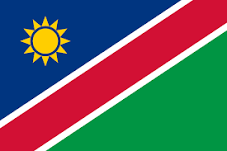
A few weeks ago, the Namibian government then represented by President Hage Geingob issued one of the strongest expressions of solidarity to the Palestinians facing the blows of Israel’s ongoing destruction of Gaza on January 13, in support of South Africa’s case bringing the charge of genocide against Israel to the International Court of Justice. It issued the following statement in response to the German government’s decision to officially support Israel’s denial of these charges [Namibia criticizes Germany]:
Namibia rejects Germany’s support of the genocidal intent of the racist Israeli state against innocent civilians in Gaza. Germany committed the first genocide of the twentieth century in 1904–1908, in which tens of thousands of innocent Namibians died in the most inhumane and brutal conditions . . . President [Hage] Geingob appeals to the German Government to reconsider its untimely decision to intervene as a third-party in defense and support of the genocidal acts of Israel before the International Court of Justice.
The German Government is yet to fully atone for the genocide it committed on Namibian soil…
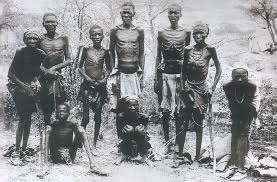
It is no secret that the first genocide of the 20th century was perpetrated by Germany on African soil, in Namibia. It was extremely brutal and almost wiped out all Nama and Herero people. It was a campaign of racial extermination and collective punishment that the German Empire undertook in German South-West Africa (modern-day Namibia) against the Herero and Nama people [Germany in Namibia: the First Genocide of the 20th Century, Germany Returns Skulls of Namibians Genocide Victims, Namibia Rightfully Rejects 10 million Euros Compensation for Genocide].

La terre est la reine de tous les lits (proverbe Nama – Namibia).
Earth is the queen of beds. — (Nama proverb – Namibia)

The third president of Namibia, Hage Geingob, passed away this past Sunday in Windhoek, Namibia, from cancer. As a strong freedom and anti-apartheid activist, in his early years, he fought to set the international stage for the South West Africa People’s Organization (SWAPO) and the Namibian fight for independence from South Africa. After exile in Botswana, and the United States where he studied, he advocated for the acceptance of SWAPO which was ultimately recognized by the United Nations General Assembly as the sole and authentic representative of the people of Namibia. Namibians’ struggle at the international fora, and their armed struggle launched in 1966, eventually led to the independence of Namibia in 1990 from South Africa. Like Cameroon, Togo, or Tanzania, Namibia had been a German colony known as German South West Africa established in 1884, until Germany lost world War I, after which the League of Nations gave the country to the United Kingdom as a mandate under the administration of South Africa; it was simply like a de facto fifth province of South Africa.
Geingob had served the country as its first prime minister from 1990 to 2002, and then later from 2012 to 2015. Between 2008 and 2012, Geingob served as Minister of Trade and Industry. In 2015, after elections, he became president of the nation, and was set to finish his second and final term this year. Upon his passing on February 4, his deputy, Vice President Nangolo Mbumba, was sworn in as acting president in the capital, Windhoek, to complete the term as allowed by the constitution. Mbumba will be in office until next year, when the winner of this year’s November election will take office.
“The Namibian nation has lost a distinguished servant of the people, a liberation struggle icon, the chief architect of our constitution and the pillar of the Namibian house,” the office of the presidency said.
South African President Cyril Ramaphosa described Geingob as “a towering veteran of Namibia’s liberation from colonialism and apartheid.”
Kenyan President William Ruto said Geingob “strongly promoted the continent’s voice and visibility at the global arena.”
Zimbabwe’s President Emmerson Mnangagwa posted on X that Geingob’s “leadership and resilience will be remembered.”

President Sekou Touré of Guinea was the first president of a country in what was then colonial French Africa to say ‘NO’ to France by asking for its independence [Guinea: the country who dared say ‘NO’ to France]. 66 years later, his words still ring true, especially as we watch the struggle for freedom of Mali, Burkina Faso, and Niger [Mali – Burkina Faso – Guinea Agree to form a Tri-Country Axis, Mali and Niger end Long-Standing Tax Treaties with France, Mali, Burkina Faso, and Niger Sign a Mutual Defence Pact]. Africans are still not free of their own destinies [The 11 Components of the French Colonial Tax in Africa, Africa is funding Europe!], and it is only normal to fight for it.
On 25 August 1958, Sekou Touré said: “Il n’ya pas de dignité sans liberté. Nous préférons la liberté dans la pauvreté à la richesse dans l’esclavage.”
[There is no dignity without freedom. We prefer freedom in poverty to wealth in slavery].

The authorities of Mali, Burkina Faso, and Niger have announced simultaneously on 28 January 2024, their decision “in complete sovereignty on the immediate withdrawal” from the regional economic bloc that is the Economic Community of West African States (ECOWAS). Mali, Burkina Faso, and Niger stated, ECOWAS “under the influence of foreign powers, betraying its founding principles, has become a threat to its member states and its population.” The three countries have accused the regional bloc of failing to support their fight against “terrorism and insecurity,” while imposing “illegal, illegitimate, inhumane, and irresponsible sanctions.” All three countries were founding members of ECOWAS over 50 years ago.

In reality, this comes as no surprise as it is the normal evolution of the state of things. After the coup in their respective countries, the ECOWAS has suffocated these countries by suspending all three countries and imposing heavy sanctions on Mali and Niger that have only served to exacerbate the populations’ sentiments that it is a puppet organization serving foreign interests. Niger even tried to amend the situations by inviting ECOWAS representatives to the country last week, but only the member from Togo showed up. Why should anybody remain a member of an organization that punishes the populations? Are they trying to pressurize the three landlocked countries? It is sad that we, Africans, have organizations that only work to serve the interests of others. It should not even be allowed for coastal countries to use sea access to landlocked ones as a pressure point! That is totally inhumane!
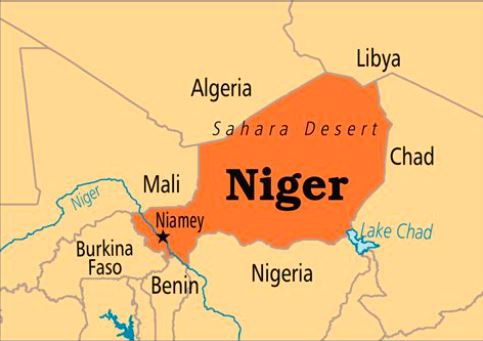
We all joined these organizations thinking that they would serve common African goals…. unfortunately, under external orders, they instead impose heavy sanctions on sister states. It is about time that we, Africans, unite around the cause of Burkina Faso, Mali, and Niger, to free our continent. Their fight should be our fight, as they are fighting for our freedom, particularly that of Francophone Africa. Since the coup in Niger and rupture with France, Niger’s economy has been doing better even with all the sanctions, than since independence. Does that not tell us something? No wonder, all the European generals have been having meetings in West Africa in recent weeks, and even the American Secretary of State Anthony Blinken was in Cote d’Ivoire just a few days ago, while the populations are focused on the African Cup of Nations. We should not forget that now is the New Scramble for Africa, and Africans should not allow history to repeat itself!
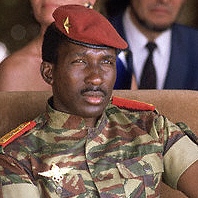
And of course, the Western media predict all doom to these countries. Freedom is not cheap, but it is best to be free of one’s destiny than being a slave at the mercy of someone else… Like Thomas Sankara said, “… the slave who is not capable of assuming his rebellion does not deserve that we feel sorry for himself. This slave will respond only to his misfortune if he is deluding himself about the suspect condescension of a master who claims to free him. Only struggle liberates …” [«… l’esclave qui n’est pas capable d’assumer sa révolte ne mérite pas que l’on s’apitoie sur son sort. Cet esclave répondra seul de son malheur s’il se fait des illusions sur la condescendance suspecte d’un maître qui prétend l’affranchir. Seule la lutte libère … »] Discours de Sankara à l’ONU le 4 octobre 1984 (texte intégral)

The news is everywhere, Asante gold artifacts are returning home after 150 years … on loan from the UK to Ghana. Let’s repeat that, Ghanaian artifacts looted 150 years by British forces in modern-day Ghana, are now being returned to Ghana on a loan from the UK. What the heck? So someone comes to your house, steals from you, and then years later, after you have begged, says “I am returning some of the stuff I stole from you on loan only!” How does that make sense? People say, “it is a step forward, we need to acknowledge it, and be grateful for progress.” Grateful? Grateful for what? Because the British are loaning things they stole from the Asante kingdom of Ghana, back to Ghana? Some of these loaned items are like the crown jewels of the kingdom, and have high spiritual values as well. And this comes after Ghanaians have negotiated for very long … can you imagine? … a loan!
Excerpts below are from the BBC.
=====
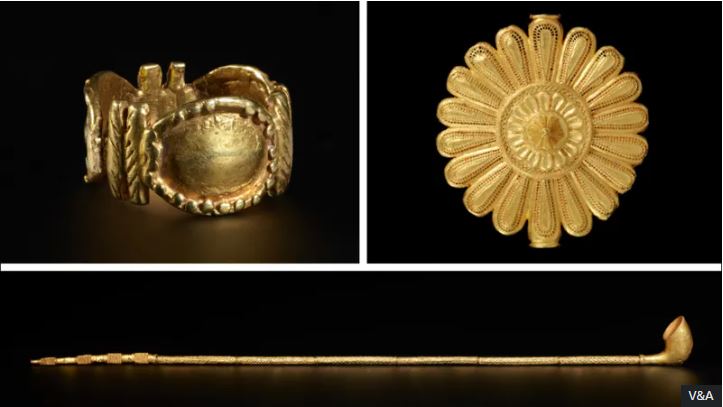
The UK is sending some of Ghana’s “crown jewels” back home, 150 years after looting them from the court of the Asante king.
A gold peace pipe is among 32 items returning under long-term loan deals, the BBC can reveal.
The Victoria & Albert Museum (V&A) is lending 17 pieces and 15 are from the British Museum.
Ghana’s chief negotiator said he hoped for “a new sense of cultural co-operation” after generations of anger.
Some national museums in the UK – including the V&A and the British Museum – are banned by law from permanently giving back contested items in their collections [somehow, they are not banned by law from taking stolen goods], and loan deals such as this are seen as a way to allow objects to return to their countries of origin .
But some countries laying claim to disputed artefacts fear that loans may be used to imply they accept the UK’s ownership. Tristram Hunt, director of the V&A, told the BBC that the gold items of court regalia are the equivalent of “our Crown Jewels“.
The items to be loaned, most of which were taken during 19th-Century wars between the British and the Asante [known as the Anglo-Ashanti wars, series of conflict wars which lasted from 1824 to 1900], include a sword of state and gold badges worn by officials charged with cleansing the soul of the king.

Mr Hunt said when museums hold “objects with origins in war and looting in military campaigns, we have a responsibility to the countries of origin to think about how we can share those more fairly today. It doesn’t seem to me that all of our museums will fall down if we build up these kind of partnerships and exchanges.” [that’s why they only loan a minuscule number at a time … so their museums don’t fall apart].
However, Mr Hunt insisted the new cultural partnership “is not restitution by the back door” – meaning it is not a way to return permanent ownership back to Ghana. [The UK are still the owners of these Ghanaian artifacts stolen from Ghana].
The three-year loan agreements, with an option to extend for a further three years, are not with the Ghanaian government but with Otumfo Osei Tutu II – the current Asante king known as the Asantehene – who attended the Coronation of King Charles last year. [Did the negotiation include attending the British King’s coronation, as a condition for loaning?]
… The items will go on display at the Manhyia Palace Museum in Kumasi, the capital of the Asante region, to celebrate the Asantehene’s silver jubilee.
The Asante gold artefacts are the ultimate symbol of the Asante royal government and are believed to be invested with the spirits of former Asante kings.
They have an importance to Ghana comparable to the Benin Bronzes – thousands of sculptures and plaques looted by Britain from the palace of the Kingdom of Benin (Benin City: the Majestic City the British burnt to the ground), in modern-day southern Nigeria. Nigeria has been calling for their return for decades.
Nana Oforiatta Ayim, special adviser to Ghana’s culture minister, told the BBC: “They’re not just objects, they have spiritual importance as well. They are part of the soul of the nation. It’s pieces of ourselves returning.” She said the loan was “a good starting point” on the anniversary of the looting and “a sign of some kind of healing and commemoration for the violence that happened“.
UK museums hold many more items taken from Ghana, including a gold trophy head that is among the most famous pieces of Asante regalia. The Asante built what was once one of the most powerful and formidable states in west Africa, trading in, among others, gold, textiles and enslaved people. The kingdom was famed for its military might and wealth. …

Europeans were attracted to what they later named the Gold Coast by the stories of African wealth and Britain fought repeated battles with the Asante in the 19th Century. In 1874 after an Asante attack, British troops launched a “punitive expedition”, in the colonial language of the time, ransacking Kumasi and taking many of the palace treasures.
[The items on loan] include three heavy cast-gold items known as soul washers’ badges (Akrafokonmu), which were worn around the necks of high ranking officials at court who were responsible for cleansing the soul of the king. …
The British Museum is also returning on loan a total of 15 items, some of them looted during a later conflict in 1895-96, including a sword of state known as the Mpomponsuo.
…


 African Heritage