Here is part of a Malagasy tale which is several hundred years old: it is part of the Ibonia, an epic Malagasy poem told in various forms across Madagascar. The Ibonia is like Homer‘s epic poem the Odyssey for the people of Madagascar. One could say that it is the story of creation. You can find more about it here.
=========
Ibonia and Joy-Giving Girl stayed married about ten years. About three years before his death, he gave his will to his father and mother, his wife and children, and all the people in an around Long-Standing. He said,“This I declare to you: soon I am to return to the place of lying down.’ Close at hand is the day when Ibonia will be removed, and Inabo [another of his names] will go the way of all those whose doors face west [the dead]. That is a fate to take down one’s manhood. For to the earth we return and lie in state. Inabo is not to be buried to rot; he is to be planted to grow — to die by day and live by night.
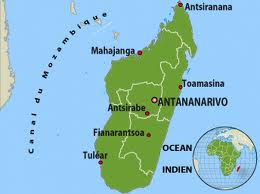
Madagascar
“I declare that Inabo’s return is coming. These then are the orders I leave you.
“The first and most important thing is marriage.
If you are a prince,
if you are a ruler,
if you are a governor,
if you are a spokesman,
do not untie the bonds of marriage.
The road of marriage is binding even unto death.
Do not divide it.” (This admonition, they say, strengthened people’s marriages.) “Second: listen. I shall change my name, for one’s name on earth does not got back to heaven. Before the lord of heaven all things are new. My grandfather is holy. These will be my names:
Spouts-from-Half-the-Earth,
Pierced Earth,
Sound-of-his-Steps-Deafens-Even-the Distant. Now, listen, all of you.
When there is thunder,
when the skies weep,
and when the rain falls,
lament, O Beautiful-Rich,
for that will be your son,
whose footsteps deafen even the distant.” (That, they say, was the first time it was said, “It is a bad day for old women,” when it thunders.) And when the three years had passed — Ibonia had said, “I will die when three years have passed” — then he died.
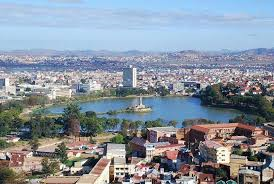
Ever wondered about the meaning of the name Antananarivo, the capital of Madagascar? Like: why does the ‘na‘ repeat itself twice (nana)? or whether this ‘nana‘ could mean mother or father or grandmother or grandfather as in many African languages, or ‘girl‘ in French? or could the ‘rivo‘ have something to do with river? or have you simply wondered why such a long name for a capital city?
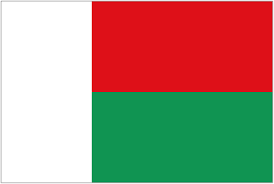
Flag of Madagascar
Well, I have often wondered about Antananarivo because of the way its name falls from my mouth as if I was in a hurry, and then being rushed to say it quickly so as not to stumble. I have also wondered about its name, because it reminds me of the beauty of its country, Madagascar, the big island. Moreover, numerous neighborhoods in Cameroon have been renamed after the country because of its beauty and also I imagine, by respect for its people’s struggle for independence which was similar for the people of Cameroon.
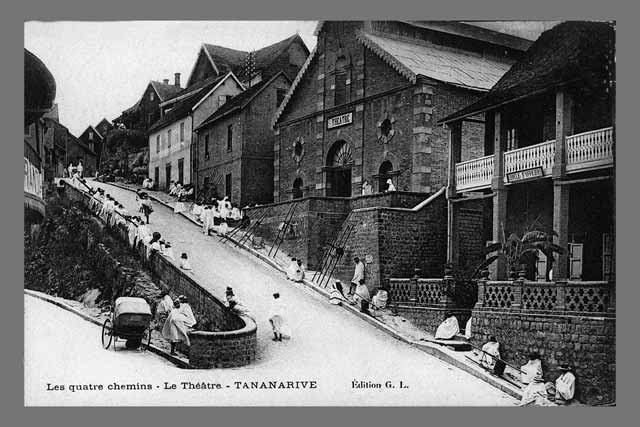
Antananarivo in 1905
The name Antananarivomeans “the City of Thousand” with an meaning ‘to‘ or ‘at‘, tananmeaning ‘city‘, and (a)rivomeaning ‘thousand‘. Some think the ‘thousand’ is in reference to ‘thousandhills‘ or ‘thousandsoldiers‘ in reference to the important royal Merina guard. In reality, Antananarivo was the site of a town called Analamanga, meaning ‘BlueForest‘ in Malagasy. Analamangawas founded by the Vazimba people, the island’s first occupants. When King Andrianjaka of the Merina people moved into the area between 1610 and 1625, he deployed a garrison of 1,000 soldiers to successfully capture the city and guard the site. Declaring it his capital, Andrianjaka built a rova (fortified royal dwelling) that expanded to become the royal palaces of the Kingdom of Imerina. The site maintained its name Analamangauntil it was renamed almost fifty years later by King Andriamasinavalona as Antananarivo, “City of the Thousand“, in honor of King Andrianjaka’s soldiers. People of Madagascar affectionately call it “Tana“, the city, and its named was frenchified during colonial time into Tananarive.
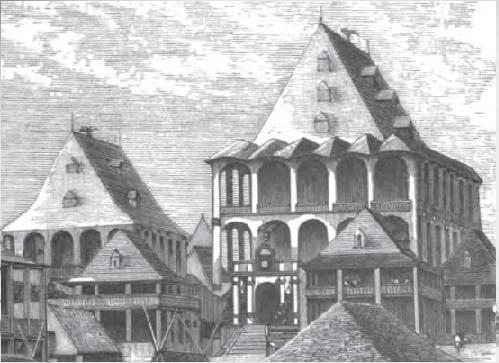
Manjakamiadana, the Royal compound built for Queen Ranavalona I
The city was first built as a fortress by the Merina Kings at the beginning of the 17th century, who made it the capital of the united Kingdom of Imerina in 1794. The community grew rapidly under the Merina Kings, and particularly under King Radama I whose control ultimately extended over a major part of the island, leading him to be considered the King of Madagascar by European diplomats, with Antananarivo as the island’s capital. Antananarivoremained the island’s capital after Madagascar was colonized by the French in 1897 , after the French military invaded Antananarivo on September 1894 causing major casualties amongst the Malagasy people, and causing queen Ranavalona III to surrender. Claiming the island as a colony, the French administration retained Antananarivo as its capital and transcribed its name as Tananarive. Antananarivo remained the capital of Madagascar after independence in 1960.
Antananarivo today (Wikipedia)
Today, Antananarivo is a vibrant city full of life, culture, and immense history. The city’s skyline is dominated by the rova of Antananarivo, which was destroyed in a 1995 fire but is under reconstruction. The nearby Andafiavaratra Palace was the home of 19th century Prime Minister Rainilaiarivony and currently contains a museum featuring historic artifacts of the Kingdom of Imerina. Downhill from the palaces is Andohalo square, where Merina kings and queens delivered speeches to the public. Tsimbazaza Zoo displays many of the island’s unique animal species and a complete skeleton of the now-extinct elephant bird. Other historic buildings include the Ambatondrafandrana tribunal where Ranavalona I dispensed judgement, the second residence of Rainilaiarivony with its indigenous medicinal plant garden, the recently renovated Soarano railroad station, four late 19th century memorial churches built to commemorate early Malagasy Christian martyrs, the tomb of Prime Minister Rainiharo, and the early 20th century pavilions of the Analakely market. Enjoy the video below, and if you are ever in Madagascar, please do visit the beautiful Tana, the capital of the great Merina Kings, named to celebrate a thousand courageous soldiers and the beautiful hills of the central highlands.
Le singe gambade tellement qu’un jour il trouvera une branche morte(Proverbe Bayombe – République Démocratique du Congo (RDC)). – Qui joue trop, s’expose au danger.
The monkey leaps so much so that one day it will find a dead branch(Bayombe proverb – Democratic Republic of Congo (DRC)). – Who plays too much, exposes oneself to danger.
Deux Européens sont en safari en Afrique. Soudain, un lion sort de la brousse et se jette sur un des gars. Après une dure bataille il réussit à se dégager de la bête et à la faire fuir. Il rejoint alors son ami tout ensanglanté et les vêtements en lambeaux.
– Espèce d’idiot, pourquoi tu n’as pas tiré? Ce lion a failli me tuer.
– Mais tu m’as dit que c’était un fusil pour les éléphants…
=======
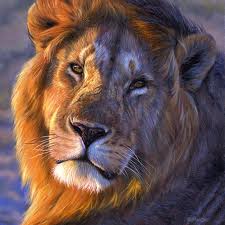
Lion
Two Europeans on a safari trip in Africa. All of a sudden a lion comes out of the forest and attacks one of the guys. After a hard battle, he manages to free himself from the beast, and makes it flee. He then joins his friend all bloodied up, with his clothes in tatters.
– You Idiot, why didn’t you open fire? This lion almost killed me.
– But you told me this was a gun only for elephants…
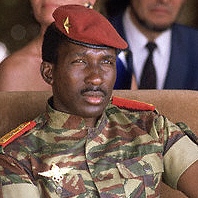
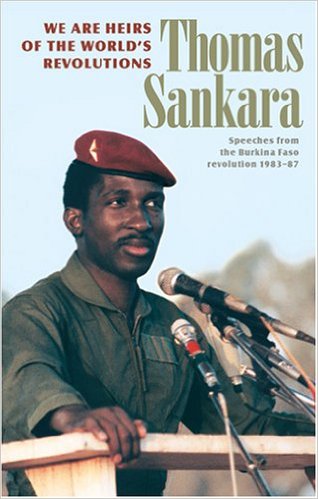
On October 4th, 1984, Thomas Sankara addressed the General Assembly of the United Nations. It was a historical speech, as only he, the great orator, could speak. It was moving, it was strong, and it was good. Below is an extract of his speech. For the whole speech, go to thomassankara.net. Enjoy!!!
============
“I speak on behalf of the millions of human beings … thrown out of work by a system that is structurally unjust and periodically unhinged, who are reduced to only glimpsing in life a reflection of the lives of the affluent. I speak on behalf of women the world over, who suffer from a male-imposed system of exploitation. … Women who struggle and who proclaim with us that the slave who is not able to take charge of his own revolt deserves no pity for his lot. This harbors illusions in the dubious generosity of a master pretending to set him free. Freedom can be won only through struggle, and we call on all our sisters of all races to go on the offensive to conquer their rights.
I speak on behalf of the mothers of our destitute countries who watch their children die of malaria or diarrhea, unaware that simple means to save them exist. The science of the multinationals does not offer them these means, preferring to invest in cosmetics laboratories and plastic surgery to satisfy the whims of a few women or men whose smart appearance is threatened by too many calories in their overly rich meals, the regularity of which would make you—or rather us from the Sahel—dizzy. We have decided to adopt and popularize these simple means, recommended by the WHO and UNICEF.
I speak, too, on behalf of the child. The child of a poor man who is hungry and who furtively eyes the accumulation of abundance in a store for the rich. The store protected by a thick plate glass window. The window protected by impregnable shutters. The shutters guarded by a policeman with a helmet, gloves, and armed with a billy club. The policeman posted there by the father of another child, who will come and serve himself—or rather be served—because he offers guarantees of representing the capitalistic norms of the system, which he corresponds to.
“We are heirs of the revolution” by Thomas Sankara
I speak on behalf of artists—poets, painters, sculptors, musicians, and actors—good men who see their art prostituted by the alchemy of show-business tricks.
I cry out on behalf of journalists who are either reduced to silence or to lies in order to not suffer the harsh low of unemployment.
I protest on behalf of the athletes of the entire world whose muscles are exploited by political systems or by modern-day slave merchants.
Burkina Faso
My country is brimming with all the misfortunes of the people of the world, a painful synthesis of all humanity’s suffering, but also—and above all—of the promise of our struggles. This is why my heart beats naturally on behalf of the sick who anxiously scan the horizons of science monopolized by arms merchants. My thoughts go out to all of those affected by the destruction of nature and to those 30 million who will die as they do each year, struck down by the formidable weapon of hunger. As a military man, I cannot forget the soldier who is obeying orders, his finger on the trigger, who knows the bullet being fired bears only the message of death. …. I protest on behalf of all those who vainly seek a forum in this world where they can make their voice heard and have it genuinely taken into consideration. Many have preceded me at this podium and others will follow. But only a few will make the decisions. Yet we are officially presented as being equals. Well, I am acting as spokesperson for all those who vainly see a forum in this world where they can make themselves heard. So yes, I wish to speak on behalf of all “those left behind,” for “I am human, nothing that is human is alien to me.”
Flag of Burkina Faso
Our revolution in Burkina Faso embraces misfortunes of all peoples. It also draws inspiration from all of man’s experiences since his first breath. We wish to be the heirs of all the world’s revolutions and all the liberation struggles of the peoples of the Third World. Our eyes are on the profound upheavals that have transformed the world. We draw the lessons of the American Revolution, the lessons of its victory over colonial domination and the consequences of that victory. We adopt as our own the affirmation of the Doctrine whereby Europeans must not intervene in American affairs, nor Americans in European affairs. Just as Monroe proclaimed “America to the Americans” in 1823, we echo this today by saying “Africa to the Africans,” “Burkina to the Burkinabè.”
This is what Thomas Sankara uttered on April 21, 1982 in opposition to the regime’s anti-labor drift: “Misfortune to those who gag the people (Malheur à ceux qui baîllonnent le peuple)”. Funny how 33 years later, general Diendéré, one of those complicit of killing Sankara himself, had to face the people’s wrath. Indeed, Diendéré‘s coup and presidency lasted 7 days: 7 days when he took and gagged the people of Burkina Faso. At the beginning of the week when he took over, many ‘international’ newspapers (as usual, supporters of coups against the liberty of the African people) were writing about him, praising him as
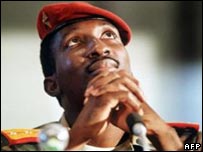
Thomas Sankara a Ouagadougou
one of Compaoré‘s boys, very calm, charismatic, courageous, etc. At the end of the 7 days, after the people of Burkina Faso, backed up by their army, rose up as a single man against the ugly coup, the same newspapers were calling him a ‘stupid’ general. Diendéré thought he could gag the people again and again and again. That time is long gone, because the people of Burkina Faso have decided against it, and have said, like Sankara: “Homeland or death, we shall overcome!” I used to wonder, sadly, why the people of Burkina Faso, who had had the great Sankara, could not rise against Compaoré… well it took them 27 years to overtake the tyrannical system, but they overtook it and now they are rising as a single man! “La patrie ou la mort, nous vaincrons!”
In view of recent events in Burkina Faso, and to continue our fight for democracy, for equal rights, for the right of a nation to choose its leaders without military/external forces dictating it, I live you with a quote by President Thomas Sankara, president of Burkina Faso. It was previously published in a “prayer for Cote d’Ivoire.” As the quote goes:
================
La patrie ou la mort nous vaincrons!
Telle était la devise de Thomas Sankara, notre grand Che africain, ce grand maitre de la révolution Burkinabé, le president du Faso. Telle est la devise que nous nous devons de garder dans nos coeurs en ce moment pour le Burkina Faso: savoir que nous nous battons pour notre liberté, pour notre patrie, pour la seule terre que le bon Dieu a bien voulu nous donner! Amandla!… Ngawethu!
Flag of Burkina Faso
Homeland or death, we shall overcome!
Such was the motto of Thomas Sankara, our great African Che, this great master of the Burkinabe revolution, the president of Burkina Faso. This is the motto that we must keep in our hearts for Burkina Faso right now: to know that we are fighting for our freedom, for our country, for the only land God ever gave us! Amandla! …Ngawethu! Power to the People!
Patria o muerte, venceremos!
Tal era el lema de Thomas Sankara, nuestro gran Che de África, este gran maestro de la revolución de Burkina Faso, el presidente de Burkina Faso. Este es el lema que debemos tener en nuestros corazones para Burkina Faso en este momento: saber que estamos luchando por nuestra libertad, para nuestro país, por la tierra sólo Dios nunca nos dio! Amandla!… Ngawethu!
Burkina Faso
Pátria ou morte, venceremos!
Esse foi o lema de Thomas Sankara, o nosso grande Africano Che, este grande mestre da revolução burkinabe, o presidente do Burkina Faso. Este é o lema que devemos ter em nossos corações para Burkina Faso agora: saber que estamos lutando por nossa liberdade, para o nosso país, para a única terra que Deus já nos deu! Amandla!… Ngawethu!
Image of a young woman’s face (agnautacouture.com)
These days, many of my fellow African brothers and sisters sport tattoos of some European or foreign symbols on their skins. These symbols are usually alien to our cultures, traditions, thinking, and history. So I thought about talking about scarification, which could be called an “ancient” African culture of tattoos.
For starters, Africa has a rich culture of scarification. Many cite HIV, and ugliness as being the reason why they would not do scarification and why the practice has been abandoned. I neither agree nor disagree with them, but I would like to give a history of scarification and why, this is something to be cherished as part of our history, even if it is no longer practiced and/or needed today.
Sculpture of a Mangbetu person, in Congo (exposed at the MET)
In the past, a woman or man would have scarification marks that will distinguish her/him from anyone else, tell her/his rank in society, family, clan, and tribe, and symbolize her beauty or strength. In some African tribes, it was like wearing your identity card on your face. True, some may hate that, but this was a mark of pride, not shame. In most African cultures, it was a major aesthetic and cultural componentas can be seen on sculptures in museums around the world. Scarification patterns on sculptures are not only marks of beauty, but marks of one’s lineage as well, and in some cases protection against evil spirits. Lastly, in Africa like in Polynesia, scarification is more visible on darker skinned people than say, tattoos.
Diamond and Rectangular patterns on the forehead and temples of a Tikar mask from Cameroon (exposed at the MET)
What is scarification? Scarification is the practice of incising the skin with a sharp instrument such as a knife, glass, stone, or coconut shell, in such a way as to control the shape of the scar tissue on various parts of the body. Cicatrisation is a special form of scarification where a gash is made in the skin with a sharp instrument, and irritation of the skin caused by applying caustic plant juices forms permanent blisters. Dark pigments such as ground charcoal are sometimes rubbed into the wound for emphasis. These cuts, when healed, form raised scars, known as keloids. The most complicated cicatrisation was probably found in the Congo Basin and neighboring regions, and among the Akan people of West Africa.
Pendant Ivory mask representing Queen Idia, Iyoba of Benin City (16th Century)
Scarification is a long and painful process, and a permanent modification of the body, transmitting complex messages about identity and social status. Permanent body markings emphasize social, political, and religious roles.Beautiful and complex designs depend on the artist’s skills but also on a person’s tolerance to pain. Facial scarification in West Africa was used for identification of ethnic groups, families, individuals but also to express beauty; scars were thought to beautify the body. It was also performed on girls to mark stages of life: puberty, marriage, etc. These marks assisted in making women more attractive to men, as the scars were regarded as appealing to touch as well as to look at, but also as testimony that women could withstand the pain of childbirth. Princesses in many places, including West Cameroon, used to sport amazingly beautiful and intricate marks. The sculpted face of Queen Idia of Benin Kingdom sports two marks on her forehead. For the Karo people of Ethiopia, men scar their chests to represent killing enemies from other tribes; women with scarred torsos and chests are considered particularly sensual and attractive.
Intricate patterns on a Dogon mask from Mali (exposed at the MET)
Today, the art of scarification is changing in Africa, and can mostly be spotted on elders. Mostly because of fears of HIV transmission via blades, and also because of the shame encountered. It is a culture which was once loved and is now despised. Ironically, people in western societies go under the knife to perfect their bodies; they prefer to hide their scars (it is also not on their faces)! Moreover, with the advent of identification cards, the need for scarification has also reduced.
I just wanted us to cherish and not frown upon an ancient culture which had its purpose, and was an integral part of our society, history, and traditions. For more on scarification in African cultures, check out Ezakwantu.com and RandAfricanArt which have amazing images of scarification in Africa, and these articles on the Huffington Post, National Geographic, and Lars Krutak‘s article on the Bétamarribé people of Benin.













 African Heritage