Have Germans finally acknowledged the Namibian Genocide?

Namibia
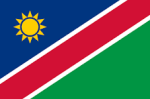
Flag of Namibia

Here is an excerpt of an article by Kwame Opoku from Pambazuka about Germany’s recognition (?) of the Namibian genocide. For the full article, go to Pambazuka.

========

[…] For a long time, successive German governments have sought to avoid taking responsibility for the genocide of the Herero and Nama of South-West Africa, now Namibia, in 1904-1908. …
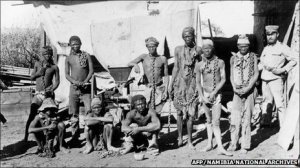
_55970031_namacc
Herero people being enslaved in Namibia by Germans (Source: AFP/Namibia National Archives)

The attempt to deny historical evidence of German genocide was bound to fail in so far as all the elements of German responsibility have been fully documented in German official papers and writings of German scholars. The extermination order of the German General in South West Africa, General von Lothar should have been sufficient evidence of the declared intention to exterminate Herero and Nama: ” I say to the people: anyone who hands over one of the chiefs to one of our stations as prisoner shall receive 1,000 marks and whoever delivers Samuel Maharero will receive 5,000 marks. The Herero people must however leave the land. If the people refuse to do so, I shall force them with the Great Rohr [cannon”>. Any Herero found within the German borders, with or without a gun, with or without cattle, will be shot. I no longer receive women or children. I will drive them back to their people or order them to be shot. These are my words to the Herero people. ‘The great General of the mighty German Kaiser.” Vernichtungsbefehl (Extermination Order) by the German commander, General Lothar von Trotha.
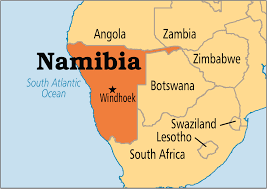
Nambia2[…] After what has been written above, Lammert concludes that: “According to present day international law, the suppression of the Herero uprising was genocide. International law stipulates that if acts are committed with intent “to destroy, in whole or in part, a national, ethnical, racial or religious group, as such ”the criminal act of genocide has occurred Such is the interpretation of many, also German historians.”

At a Government press conference on 10 July, 2015, the question was raised as to whether, in view of the various pressures on the German government to define the massacres of the Herero and Nama as genocide, there was a chance the government might modify its position. Dr Schafer, Spokesperson of the Foreign Ministry, defined the Governments position as follows: “Firstly, the basis of all actions and for our political motivation is the guiding principle that the Federal Government-against the background of the brutal colonial war of Imperial Germany in South West Africa acknowledges Germany’s special historical responsibility towards Namibia and its citizens and especially towards the Herero, Nama, San and Damara. … “We Germans accept our historical-political and moral-ethical responsibility and the guilt incurred by Germans at that time. The atrocities committed at that time would today be termed genocide”.
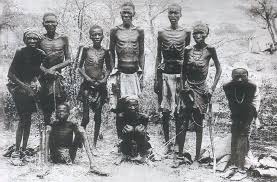
Herero
Survivors of the herero genocide (Wikimedia)

[…] Frankly, I was surprised and worried by the various statements indicating that the Germans and the Namibians have been having negotiations and discussions aimed at finding “a common position and common language in dealing with the cruel colonial war of 1904-1908”. This is a remarkable statement. Does anybody really believe Germans and Namibians can find a common position and a common language regarding the cruel and inhuman atrocities of the Germans in South –West Africa? Is this really serious or is this intended to persuade the Namibians to get involved in a dangerous rewriting of history that would present the Germany in a less inhuman light? There are probably fewer aspects of recent African history that are as well documented as the German presence and atrocities in Namibia. What is there more for non-historians and politicians to discover and present as a common position and common language of the colonized and the colonizer, of the oppressor and the oppressed?

This can only be an attempt to modify the role of the perpetrator of atrocities and to make the victims partially responsible for the heinous crimes committed against them. The victim becomes involved in the criminal acts against him. Colonized victims cannot evaluate the events of which they were victims in the same way as the oppressive colonizers. …
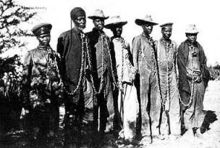
Herero_chained
Chained Herero men (Wikimedia)

Could it be that the Germans, supported by the French, British, and Belgians and other former colonial powers are frightened about the effect of German recognition of genocide in Namibia? They would all like to avoid having to pay adequate compensation to their African victims and so urge the Germans to avoid setting a precedent; they are probably trying to find a formula, short of admitting genocide in Namibia that allows them to pay some compensation, less than what they would have to pay under the application of normal rules.

[…] Given what the Herero, Nama, San, Damara and all the Namibian peoples have gone through in their encounter with German colonial rule, it is amazing that these issues still remain unsolved. There is no way the Government of Germany can continue to evade assuming openly and fully the consequences of the 1904-1908 exterminations wars.

Germany in Namibia: the First Genocide of the 20th Century

Herero
Survivors of the Herero genocide (Wikimedia)

How many think that the first big genocide of the 20th century happened during world war II, and was the holocaust? If you thought so, then think again. The Holocaust was not Germany’s first genocide. The very first genocide of the 20th century occurred in Namibia, on the African continent. It was perpetrated by Germans on the Herero and Nama people of Namibia. It was extremely brutal and almost wiped out all Herero people. It was a campaign of racial extermination and collective punishment that the German Empire undertook in German South-West Africa (modern-day Namibia) against the Herero and Nama people. It took place between 1904 and 1907 during the Herero Wars. Today it is known as the Namibian genocide or the Herero and Namaqua genocide. For the longest time, the German government denied it until 2004 when they finally acknowledged and recognized for the atrocities they perpetrated to wipe out an entire race. However, they ruled out financial compensation for the victims’ descendants. They still refuse to officially name these actions as “genocide”.

Herero_chained
Chained Herero men

In total, between 24,000 and 100,000 Herero and 10,000 Nama died. The genocide was characterized by widespread death from starvation and dehydration due to the prevention of the retreating Herero from leaving the Namib Desert by German forces. Some sources also state that the German colonial army systematically poisoned desert water wells. Moreover, the Germans also tested the very first use of concentration camps on the Herero and Nama people.

Before the genocide, the tribe numbered 80,000; after it, only 15,000 remained. Enjoy the video below which tells it all.

A Quote by Dr. Martin Luther King Jr.

Dr. Martin Luther King Jr.If you are called to be a street sweeper, sweep streets even as Michelangelo painted, or Beethoven composed music or Shakespeare wrote poetry. Sweep streets so well that all hosts of heaven and earth will pause to say,Here lived a great sweeper who did his job well.”

Dr. Martin Luther King, Jr

Bamileke Proverb on Honesty / Proverbe Bamiléké sur l’Honnêteté

mudWhen we fall in the mud, we do not deny getting soiled (Bamileke proverb – Cameroon). – When we are actually wrong, do not deny it.

Quand on fait une chute dans la boue, on ne nie pas qu’on s’est sali (Proverbe Bamiléké – Cameroun). – Quand on a réellement tort, il ne faut pas nier.

The Power of the Passport: Discrimination against Third-World Countries?

Passport4I really liked this Pambazuka article on the brief history of the passport. For those of us coming from ‘third-world’ countries, the act of applying for visas is both quite expensive and time-consuming. I always wondered why citizens of the ‘developed’ world could enter most countries in the world free of charge, while citizens of underdeveloped countries needed visas. The logic always seemed twisted to me, especially given that the converse was not true. For instance, a South African citizen needs a visa to enter the USA for tourism/business, but an American citizen does not need a visa to enter South Africa for the same reasons, and the list goes on. The article below goes over it. For the full article go to: Pambazuka . Here are some excerpts.

=========

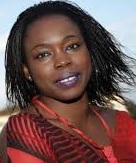
Fatou Diome1
Fatou Diome

[…] In spring 2015, Senegalese author Fatou Diome, whose works include The Belly of the Atlantic, caused a stir during the French talk show Ce soir ou jamais!. Only a month earlier, over 1,000 had drowned in one week in the Mediterranean Sea after their boat had capsized en route from the Tunisian coast to Italy. Diome vented her anger about the current European perspective and discourse on migration. And she expressed her belief that there is an underlying global problem that is rooted in the privileged treatment of a small percentage of the world’s population that depends on a document:

Europeans see Africans arriving, ok. This migratory movement of populations is tracked and visible. But you don’t see the migratory movement of Europeans going to other countries. This is the migratory movement of those with power, with money. Those who have the right kind of passport. You go to Senegal, you go to Mali, you go to any country in the world, to Canada, to the U.S. Everywhere I go […], I meet French people, German people and Dutch people. I run into them everywhere on this planet because they have the right kind of passport.” (translated from French) (Diome 2015)

Fatou Diome2
‘The Belly of the Atlantic’ by Fatou Diome

Apart from unmasking a very selective European perception and use of the word ‘migration’, Diome addressed an apparent inequality. There is a structural force which privileged nationals can ignore while the unprivileged are confronted with it every day, namely the power of a passport. Clearly, this inequality is not a natural development, but has evolved over time, as a look at the history of this small document shows.

[…]  The focus here will be on the international passport. This document is used to control the departure from the home country, entering a foreign country and returning to the home country. All those who have crossed a national border know the process of handing his or her passport to a border official behind a glass panel. This guard checks you and your passport very thoroughly and sometimes asks questions about your purpose of travelling.

Passport5Nonetheless, a German passport allows the holder to enter 172 of the Earth’s 192 countries without a visa. Reversely, people from only 81 countries can enter Germany without a visa – an imbalance that quantifies a passport’s power. The development of a passport hierarchy is an advanced process, which has only been taking place for some decades. It leaves citizens from countries such as Somalia, Eritrea, Sudan, South-Sudan, Ethiopia, Congo or Liberia at the bottom of this hierarchy and enforces a restrictive and often arbitrary system of visa issuance on them. This system allows economically and politically powerful nations to use people’s mobility as a bargaining resource and reinforces their dominance. An example of this mechanism is the 2014 FIFA world cup in Brazil: European countries had a keen interest in granting their football-mad citizens free access to the host country. Brazil managed to secure liberalized visa regulations for its own citizens traveling to Europe in return. In this instance, the cultural event gave Brazil negotiating power and that in turn increased its economic and political power. When states lack these material and symbolic resources, they are less able to give their populations access to international networks, exchanges, education and jobs.

World_map
World map (Wikipedia)

Alternatives become possible when we start deconstructing the perceived ‘naturalness’ of the status quo. A growing number of intellectuals, scholars, artists and political activists are pointing to the historical development of borders and making us aware of their violence and their arbitrariness. They argue in favor of social and economic advantages that non-existent borders might yield…a world in which we can claim that the passport was just an episode that lasted for little more than a century. It would be a world in which Diome’s statement would ring true for everyone:

We live in a globalized world in which an Indian might live and make a living in Dakar, someone from Dakar in New York, someone from Gabon might live and make a living in Paris. Whether you like it or not, this is an irreversible fact. So let’s find a collective solution, or move away from Europe, because I intend to stay.” (translated from French) (Diome 2015)

Papa Wemba in his Own Words

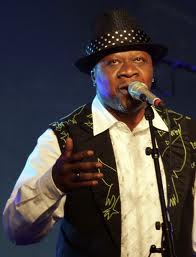
Papa Wemba
Papa Wemba

Papa Wemba was not only a star, a musician, and artist, but he was also a father, a husband, and a son. He had been married to his wife, Marie-Rose ‘Amazone’ Luzolo, for almost 50 years; they had met when he was 20, and she was 14. They had 6 children. In this world, very few celebrities have been married to only one person for almost 50 years.

Here are a few words of Papa Wemba, le rossignol (the nightingale), the King of Rumba and SAPE.

About his mother who was a professional ‘wailing woman’: “My mother was my first teacher and my first public. … I grew up with my mother’s melancholic singing. … When I will sing, she will saymy son, block here, and now project your voice“… when I did well, she will clap for me“(source: Tv5 – Africanité). For his mother, he composed Mama and Maria Valencia.

Papa Wemba11
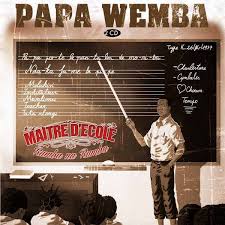
Papa Wemba’s last album ‘Maitre d’Ecole’

His daughter, Victoire, said that after Papa Wemba was convicted by the Belgian justice, “Dad prayed a lot. Dad was a champion, and he was victorious“(source: TV5 – Africanité).

About his wife, he said: “For my first trip to Japan, I said I will never go alone… my first long trip,… 13h long…, I brought my tender spouse and one of my children to experience it with me” (source: RFI- Dernière interview avec Claudy Siar). For his wife, he sang 4 min 29 secondes d’adoration, Phrase, and Ma Rosa.

He was a compassionate being: during one of his concert, he asked the audience for one minute of silence for one of his band members, Patrick Bebey, who had lost his father the week before (source: TV5- Edition spéciale – Hommage Papa Wemba).

Papa Wemba3
Papa Wemba’s album ‘Emotion’

He was a generous soul: a neighbor in Matonge said: « Je me souviens qu’une fois, je l’ai juste salué en passant. Il m’a rétorqué. Albert pourquoi tu fais le pied. Je lui ai expliqué que mon véhicule était tombé en panne. Il m’a donné à l’instant même l’argent que j’avais besoin pour réparer ma voiture. » “I remember that one time, I just greeted him [Papa Wemba] in passing. He asked me. Albert, why are you walking. I told him that my car was broken. Instantly, he gave me to money to fix my car.” (source: Radio Okapi).

Papa Wemba was known for his legendary humility: «  A l’annonce d’un cas de décès à Matonge et surtout dans notre avenue ici Kandakanda, il s’arrangeait toujours pour envoyer sa contribution lorsqu’il n’était pas au pays. Dans les cas où le décès intervenait et qu’il se trouvait sur place à Kinshasa, il venait personnellement conduire la quête pour soutenir la famille éprouvée. Bien sûr, sa contribution était toujours largement au-dessus par rapport à ce que nous autres pouvions bien volontiers donner » témoigne Francine, une voisine de Papa Wemba à Matonge. “At the announce of a death in Matonge, and particularly on our avenue here in Kandakanda, he always made sure to send in his contribution when he was outside the country. When the announcement happened and he was in Kinshasa, he personally came to lead the quest for people’s contribution to support the bereaved family. Of course, his contribution was way bigger than anything we could gladly contribute” (source: Radio Okapi).

Papa Wemba9I was lucky to cross all the oceans with my voice.” … “I was lucky to belong to a country with a musical genre such as Rumba.”
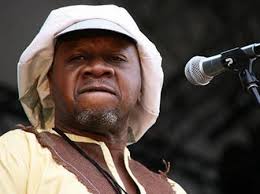
Papa Wemba defined Rumba as “the maternity of the African music” (source: TV5 – Africanité).

He said: “I am Rumba, it is thanks to Rumba that I have made a name for myself in the world” (source: TV5 – Africanité, RFI- Dernière interview avec Claudy Siar).

About la SAPE and his influence around the world: “Today even great politicians sapent (are dandy)… Before Mr. Obama steps out, he first takes a look in his mirror to make sure that he looks good… La SAPE is international“(source: TV5 – Africanité).

About SAPE: “La vie est trop courte pour s’habiller triste. [Life is too short to dress sadly]” (source: Oeil d’Afrique).

Papa Wemba6About leading: “Il ne faut pas tenir la queue, il faut être devant le peloton.” [Don’t be at the back of the queue, You must lead the pack.] (source: RFI- Dernière interview avec Claudy Siar).

About retirement: “Moi, Papa Wemba, N-O-N, jamais je ne parlerais de retraite. A moins que le Bon Dieu lui-même ne me dise ‘ta voix n’y est plus’… Tant que je serais un homme debout, tant j’aurais toujours ma belle voix, je serais toujours sur scène.” [I, Papa Wemba, N-O, I will never talk of retirement. Unless God says ‘your voice is no longer there’… as long as I will still stand, as long as I still have my beautiful voice, I will always be on stage.](source: RFI- Dernière interview avec Claudy Siar).

And lastly about his gift, his voice, and God: “My voice is my gift. … I have the grace of God, God loves me very much, and He always puts His hand on me” (source: RFI- Dernière interview avec Claudy Siar).

Papa Wemba: Africa’s Planetary Star

Papa Wemba1Very few in this world have had a chance to ‘depart’ while doing something they loved, while in the midst of doing something they’ve always been passionate about. Papa Wemba’s departure was sudden, but it was in the midst of doing what he loved. This man had been at the forefront of African music for over 40 years. He was truly an African global star. He loved Rumba and introduced the world to the Rumba Rock. Japanese fans created bands and sang in Lingala in Japan, thanks to Papa Wemba’s touring the country. Papa Wemba toured the United States with artists such as Peter Gabriel. People in Colombia and in other countries across the world danced to the rhythm of Papa Wemba. He was truly a global star, and Africa just lost a legend.
Papa Wemba: The King of Rumba and King of La SAPE

Papa Wemba1
Papa Wemba

In high school, while on our way to school, my father would play Papa Wemba‘s album in the car: Emotion. Rightfully titled ‘Emotion‘, Wemba’s album featured a whole range of emotions which added to his unique ‘Rooster-like‘ voice to  make me, as a teenager, feel those emotions, and go to school happy. Try it… listen to the up-beat Yolele, or Fafafa-fa, Sala Keba, or Awa Y’ Okeyi,  … and tell me how you feel, truly, because Papa Wemba rocked my childhood.

Papa Wemba3
The album ‘Emotion’ by Papa Wemba

So when I learnt that this great man, Papa Wemba, the one who had accompanied me with his voice to school every day, this man who had made me so proud of music, Congolese music, African music, this flamboyant stylish man who had introduced the world to SAPE, the King of Congolese Rumba, this man whose words I still quote “Y a pas match, Kaokokokorobo” had collapsed on stage and was no longer… I was devastated. Oh Papa Wemba, I thought you were going to ride with my kids to school, the way you did with me…. I thought I would always dance to the rhythm of O’Koningana,…Ye te oh, Wake Up, …

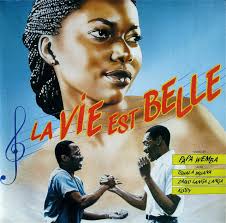
When life was hard, I would hum to the tune of your song in the movie ” La Vie est Belle” and instantly life became beautiful again. And ‘Mama‘ was just a loving song to a mother. When I felt lost, I would sing “Show me the way.”

Papa Wemba5
The movie ‘La Vie est Belle’ starring Papa Wemba

Yes… Papa Wemba was truly a genius. He was born Shungu Wembadio Pene Kikumba in June 1949 in Lubefu, in the Democratic Republic of Congo. His love of music can be attributed to his mother, who was a professional “wailing woman” at funerals. Mixing traditional African music with Western rock, he and his successive bands – Zaiko Langa LangaIsifi Lokole, Yoka Lokole, and Viva la Musica – enjoyed hit after hit, including L’Esclave, Maria Valencia, Analengo, and Le Voyageur. He shaped Congolese music in the 1970s -90s, he made Soukous the most popular sound across Africa, and attracted international music figures like Peter Gabriel. I am not sure if there is a great African star he had not sung or collaborated with: from Brenda Fassie, Tabu Ley Rochereau, Pepe Kalle, Lokua Kanza, Barbara Kanam, Manu Dibango, Koffi Olomidé, Bisso Na Bisso, JB Mpiana, Angélique Kidjo, Salif Keïta, Alpha Blondy, Singuila, to Youssou N’dour, and countless others. He also collaborated with the great diva Aretha Franklin. He was a talented man, and he also sought to reveal young talents. He loved to share his gift, his voice, with all.

Papa Wemba
Papa Wemba, the King of Sape

So I was sad… But then I realized that Papa Wemba had trained generations of musicians, had inspired numerous people, sang his lungs out for so many of us… then I realized that his flamboyant spirit lives on. His music keeps on… The dress style he created, la SAPE,  still goes on. And yes, I will keep playing Yolele. So is Papa Wemba really gone? Is this great African baobab really gone? No, he has just changed his postal address. However, his music stays with us, and will lead some of us to school or work… always.


How Malawi Technology is teaching UK Children

This is a continuation to the previous post, Technology helping students in Malawi, where the technology used to teach children in Malawi, is helping children in the  United Kingdom (UK). Educators found out that the apps used to teach primary school children in Malawi was helpful to improve the education of children in the UK. Talk about globalization!

Technology helping students in Malawi

I really like the way technology is revolutionizing lives across the globe. Today, we will talk about education in Malawi. Actually, this could be any school in many African countries, where teachers very often have 60-80 students in their classrooms. So it is hard to control the students, and let’s face it, it is hard for the teacher to assess their students’ learning and to grade homework. The video below shows how technology is helping teachers in Malawi ensure proper learning of English, mathematics, and Chichewa. Enjoy!