Why the Name: Malabo?

Malabo7
View of Malabo (3rdWorldProfashional.com)

How many Spanish cities do you know have a British heritage? How many do you know were named after English kings? How many cities do you know have had three different names in their history? Malabo, the capital of the Equatorial Guinea is such a city.

Since its origin, Malabo has been known by three different names: Port Clarence or Clarence City from 1827 to 1846 under British occupation; Santa Isabel from 1846 to 1973, under Spanish occupation; and Malabo since 1973 as the capital of the independent country of Equatorial Guinea.

Malabo is located on the northern part of the island of Bioko (island previously known as Fernando Po), 32 km from the coasts of Cameroon. Similar to the island of La Réunion, the island of Bioko is volcanic with its mountain Pico Basile towering at 3000 m, which can be seen from Limbe in Cameroon on a clear day.

Malabo4In 1472, in an attempt to find a new route to India, the Portuguese navigator Fernão do Pó, discovered the island of Bioko, which he called “Fermosa“. Later the island was named after its discoverer, Fernando Poo. In 1507, the Portuguese Ramos de Esquivel made a first attempt at colonization on the island of Fernando Poo. He established a factory in Concepción (currently Riaba) and developed plantations of sugarcane, but the hostility of the insular Bubis people and diseases ended this experience quickly.

With the treaties of San Ildefonso in 1777 and El Pardo in 1778, the Portuguese gave to the Spanish the island of Fernando Poo, Annobon, and the right to conduct trade in the mainland, an area of influence approximately of 800,000 km² in Africa, in exchange for the Colonia del Sacramento in the River Plate and the Santa Catalina Island off the Brazilian coast.

Malabo5
Island of Annobon from the skies (3rdWorldProfashional.com)

Later, Spain lost interest in Spanish Guinea (Equatorial Guinea), and authorized the British to use the island as a base for stopping the Slave Trade (this was before the creation of Sierra Leone as a colony for freed slaves).  Thus, on 25 December 1827, Port Clarence was born on the ruins of a previous Portuguese settlement. The name was chosen in honor of the Duke of Clarence, who later became King William IV. The Bubis indigenous to the island called it “Ripotó (place of the foreigners). The city was also known as Clarence City. Descendents from freed slaves mixed in with the local Bubi tribe speaking an afro-anglo-spanish pidgin or creole called « Fernandino ».  At first the British dreamt of turning Port Clarence into a great commercial port like those of Lagos and the Cape. However, the installation into the colony was deemed too costly, and isolated. In 1845, with the abolition of slavery, the British negociated with the Spanish, and gave them back control over the city, while still maintaining a stop for their commercial ships. Spain agreed to preserve British interests and to allow free passage to British ships as well advantages, which lasted until the country’s independence in 1968. Spain even maintained the British cultural heritage, Spanish will only become majoritarily spoken around 1920.

Spain regained control of the island in 1855 and the capital Port Clarence was renamed Santa Isabel, in honor of Queen Isabel II. In 1969, one year after independence, Santa Isabel became the capital of Equatorial Guinea.

Malabo Lopelo Malabo I on Bioko 1930
King Malabo Lopelo Melaka

Its present name, Malabo, was given in 1973 by President Macías Nguema in honor of King Malabo Lopelo Melaka, the last Bubi king.

Today, Malabo is the commercial and financial center of Equatorial Guinea. The main industry of the city is fish, while cacao and coffee are the main products of export. With its recent discovery over the past decade, oil has become a big industry. Malabo has a port of high tonnage connected mainly to the ports of Douala (Cameroon) and Bata (Equatorial Guinea) and air linked via an international airport. Oil has brought in a lot of investments and development to the country and particularly to the city, which has seen tremendous growth over the past few years.

Malabo6
View of Malabo Cathedral (3rdWorldProfashional.com)

Given that Malabo is the oldest city in Equatorial Guinea, many buildings within the city are built in colonial architecture style remnants of Spanish rule, and coexist today with modern architecture. It is a mix of old and modern, with a reliable road system. In the coastal region north of the city are the bays and capes. Provisions are hard to find, given that it is an island, and the cost of living is high.


Aerial view of Malabo´s harbour
Malabo’s harbor on the island of Bioko, Equatorial Guinea (Libreville-airport.com)

With only 1,180 hours of sunshine per year, Malabo, is one of the gloomiest capitals in the world and experiences much fog even when it is not raining. So, it is a lot like London… funny that the British didn’t like it ! Enjoy reading from 3rdWorldProFashional.com and FemmeExpat.com.


Note: 27 Jun 2019 – I have amended the article, as it has been brought to my attention that image 3 is the island of Annobon and not the island of Bioko where Malabo is located. Thank you Apolonio.

The Egg Lover

poule3
La poule / The hen

There once was a man who loved eggs above all. He bought several chickens and went to pay a visit to his fiancée. She was invited to cook rice. He gave her the chickens and a great quantity of rice. Once she was done cooking, all the young girls from the village showed up, responding to her invitation; it was a true feast. After the feast, the young girls all left. From a corner in the bedroom, near a drinking pot, a hen came out, capturing the visitor’s attention. He then thought to himself:

If there is a hen, then there are eggs!

It was then impossible for him to stand still in the room, given that he wanted to take the eggs. He thus decided to leave, and told his beloved, who tried to stop him from leaving. His horse was readied, but before mounting, he told the young girl:

Hold my horse, I will go drink a little before leaving.”

egg
La poule / The hen

He advanced toward the pot, grabbed all the eggs, and put them in his pants. He then went out with his fragile cargo. But just as he climbed on his horse, one egg fell from his pants, then a second one, then a third, and so on.

Oh! What is it? What is coming out of your pants, my honorable host?” says the girl.

It is nothing,” replies the man, “in my country, this is the time of the day when men lay eggs.”

Told by Tamsir Dieye, Contes Wolof du Baol, J. Copans and P. Couty, Ed. Karthala, 1988, p. 64. Translated to English by Dr. Y., Afrolegends.com


Proverbe Akan / Akan proverb

feu3
Fire

On ne fait pas du feu sous un arbre en fleurs (proverbe Akan – Côte d’Ivoire, Ghana).

African tree at dusk
Fire

Do not light up a fire under a flowering tree (Akan proverb – Côte d’Ivoire, Ghana)

Queen Abla Pokou

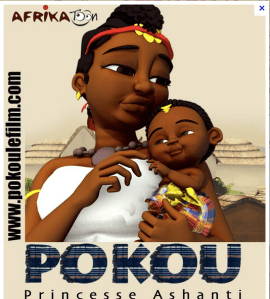
Pokou1Just to add a bit more to the story of Queen Abla Pokou, the outstanding queen who led a group of the Ashanti people who later became the Baoule people of Cote d’Ivoire, I leave you here with a snipet of the 3D movie: POKOU Princesse Ashanti.
Queen Abla Pokou and the Origin of the Baoule People

Abla Pokou
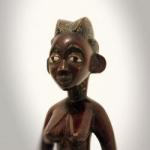
Baoule mask representing Queen Abla Pokou

The story of Queen Abla Pokou (Abla Poku in English) is the story of the creation of the Baoule people of Côte d’Ivoire. She was a strong and loving queen who made a profound sacrifice for the well-being of her people, and thus was granted their deep love.

In the 17th century, King Osei Kofi Tutu I founds the Ashanti Empîre of Ghana. Given that in the Ashanti culture the law is matrilineal, when King Oseï Tutu dies, his nephew succeeds him. However, when his nephew dies shortly after, a war for the throne starts in Kumasi, the capital of the kingdom; this war opposes an old uncle of the royal family named Itsa, and Dakon, the second brother of the future queen Abla Pokou (born at the beginning of the 18th century). Dakon will also die in this fratricide war. Quickly, Abla Pokou, understanding that she and her followers will be next to die, decides to flee. Led by her, they walk for several days and nights, fleeing from those threatening to kill them. They soon arrive on the shores of the Comoé River, located on the frontier between Ghana and Côte d’Ivoire. But the river is unsurmountable, its waters are dangerous, and their enemies are getting closer. After having overcome so many obstacles, and walked for days, it is impossible to stop there.

AblaPokou2Queen Pokou looks to her court wizard for advice, saying, “wizard, tell us what the genie of the river wants from us in order to cross its treacherous waters!” The wizard replies, “Queen, the river is quite irritated, and would only stop once an offering of what is most dear to us is made to it.” Thus, the women of the court start taking off their gold and ivory jewelry, and the men bring their cattle for offering. But the wizard, shaking his head sadly, states “What is most dear to us is our sons!
Looking upon her people, the queen decides to make the most difficult sacrifice ever: that of her toddler son wrapped on her back. After untying him, she says to him, “Kouakou(‘Kwaku’ in English), my only child, forgive me, but I have understood that I need to offer you to the river for the survival of our people. More than a woman or mother, a queen is first a queen!” She then stoically, without shedding a tear, offers her son as a sacrifice to the Comoé River.

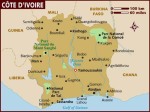
Map of Cote d'Ivoire

Once the offering made, a path quickly appears within the waters of the Comoé river allowing the queen and her people to cross it. Once the river crossed, the queen finally cries, “BA OULI!” meaning “the child is dead.” This will become the name of the people “Baoulé”. Once they arrived in a good place, the tribe holds a funeral for the sacrificed child. In memory of this, the place will be called Sakassou, meaning “place of funerals.” Queen Abla Pokou will rule over her people for many years, and news of her good reign will travel very far. She will die around 1760.

Pokou1
Poster for the 3D movie: Pokou Ashanti Princess

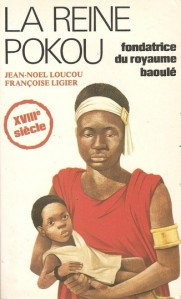
Some historians claim that a big tree bent over to let the Queen and her people cross, while others maintain that a group of hippopotamuses lined up a path across the river for the queen. Either way, the story of the queen’s great courage remains the same. Queen Abla Pokou, the founder of the Baoulé people of Côte d’Ivoire, was a great queen and woman who sacrificed what she held most dear for the well-being of her people. Many African presidents would learn a lot from Queen Abla Pokou’s courage, determination, and love of her people. Today in Côte d’Ivoire, her story has just been made into a 3D movie: POKOU Princesse Ashanti. The Ivorian author Véronique Tadjo has also published a book Reine Pokou: concerto pour un sacrifice in 2005. The story of Queen Pokou and the Baoule was retold by Maximilien Quenum in his Légendes africaines. Check out the websites Naforo-Ba and Matricien.org to learn more about it.

Why Behanzin should stay in Blida

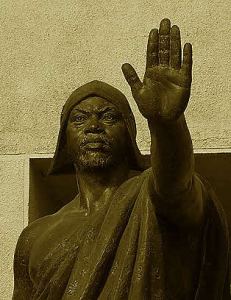
Statue of Behanzin in Abomey, Benin

The article below is from 1906 giving reasons why the French government refused to return Béhanzin to his country. The English translation is brought to you by Dr. Y., Afrolegends.com .

===========

Under this title, La Petite République published an article from which we extract the following conclusions:

What will be the effect of Béhanzin’s return in his country?

The Dahomeans, who in the old days, used to raid their neighbors have been transformed under 10 years, into a population of peaceful docile peasants and easy to be led. No troops are stationed in the ancient kingdom of Behanzin and the administration is working amazingly.

Do not for one instant believe that the negroes have forgotten their old master and here is what M. Francois, ancient chief of cabinet of the governor of Dahomey, says about this in the volume he published three months ago on this colony.

Behanzin_18 Juillet 1906
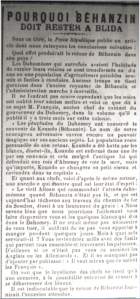
The original article from La Petite Republique, in French

The people of Dahomey have kept the memory of Kondo (Béhanzin). The name of our courageous adversary still exerts a magical power on his old subjects. The population remains certain of his return. They say, Kondo was defeated by the whites, Kondo is imprisoned on an island by his enemies and this despite the ancient law which guards the Kings of Abomey from seeing the sea, but anyhow, Kondo will transform himself into a small bird and will come back to his capital.

As for the chiefs, here is, from the same author, an anecdote which shows their state of mind:

“The old Alloan who used to command the Dahomean army when Béhanzin was not here, and who today is a worker on the Sudan railroad, was telling one of the engineers, “We know well that we could easily make you disappear, you and the other white people who are in the Dahomey. It would not even be necessary to kill you, it will suffice not to bring you any food for a few days. But what will be the point of this? You will come back, by the thousand, with guns which fire all at once and traverse palm trees. Moreover, if it wasn’t you, it will be the British or the Germans.” And he politely added, “better if it is the French.”

One can see that the loyalty of the chiefs holds onto a fine thread, an occasion, a possibility, to rid their land of the whites.

It is undeniable that the return of Béhanzin will provide this anticipated occasion.

Muhammad Ali: Integrity and Africa

It is important to cultivate integrity in all our actions. Muhammad Ali, born Cassius Clay, was a man of great integrity. What do I mean by that? When drafted to go to war, he said NO. He said he could not understand why he was being made to fight a people who had done nothing to him. He thought, how could he, a Black man in America with newly acquired rights, could go kill people (the Vietnamese people), who were victim of the white man’s greed? He probably thought, “they did nothing to me, why should I kill them? Who gives me the right to kill them?” He stood his ground, and refused to serve. For this, he was punished, banned for 5 years. For many, this could have been a descent into depression, alcoholism, drugs, etc… for he had lost his source of income; he was eventually arrested, found guilty of draft evasion charges and stripped of his boxing titles. He successfully appealed in the US Supreme Court, which overturned his conviction in 1971, by which time he had not fought for nearly four years—losing a period of peak performance as an athlete. Many thought he was arrogant, but he stood for his beliefs. Instead of falling down, he stood up, he became an activist, and worked tirelessly to end the war in Vietnam… he rallied masses.

Muhammad Ali was also the first international boxer of his stature to fight in Africa. Who has not heard of “The Rumble in the Jungle” the 1974 fight which took place in Kinshasa, Zaire (now Democratic Republic of Congo)? This was a historic game not only because it was deemed the fight of the century, and featured Ali vs. Foreman, but also because it took place on African soil. It brought in representatives from all over the continent, and singers from around the world. In the emission on the Origin of Rumba, the late Papa Wemba clearly stated that he had been at that game and met several legends of music James Brown, Celia Cruz and the Fania All-Stars, B.B. King, Miriam Makeba, Johnny Pacheco, and it had been an experience like none other.

So let us remember Muhammad Ali, a man of integrity, who inspired so many by his spirit, strength, determination, and courage. So long Ali… the Greatest.

Chaînes de Bernard Dadié /Chains by Bernard Dadie

Dadie_1
Bernard Dadie (Abidjan.net)

Today, I thought that this poem by Bernard Dadié will be very appropriate. We wear a lot of chains, and the oppressed people of this world may want all the gags removed. Enjoy!

Chaînes

 Quelles sont lourdes, lourdes, les chaînes,

Que le Nègre met au cou du Nègre.

Pour complaire aux maîtres de l’heure.


De grâce n’arrêtez pas l’élan d’un peuple !

Brisons les chaînes, les carcans, les barrières, les digues.


Pour inonder l’univers en eaux puissantes qui balaient les iniquités.


Quelles sont lourdes, lourdes les chaînes

Que le Nègre met aux pieds de Nègre

Pour complaire aux maîtres du jour !


Lourdes, les chaînes,

lourdes, lourdes,

les chaînes que je porte aux mains.


Que tombent tous les baîllons du monde !!


Chains

 They are so heavy, heavy, the chains,

That the negro puts on the neck of the negro.

To please the masters of the hour.


Please do not stop the momentum of a people!

Let us break the chains, the shackles, the barriers, the dams.


To flood the universe with powerful waters that will sweep away iniquities.


They are so heavy, heavy, the chains

That the negro puts on the feet of the negro

To please the masters of the day!


Heavy, the chains,

Heavy, heavy,

The chains that I wear on my hands.


May all the gags of this world fall!


Blague Africaine: Grain de Sable / African Joke: Grain of Sand

sable1C’est un grain de sable qui dit à un autre grain de sable
” Je crois qu’on est suivi “

============

A grain of sand tells another grain of sand, “I think we are being followed”.

The Diisa : Malian Men’s Life Scarf

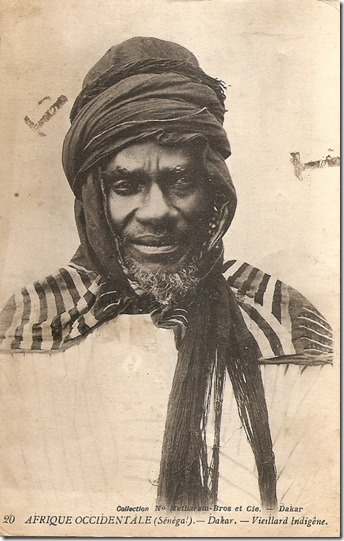
I recently learned about the Diisa, a long fringed indigo shawl worn by men in Mali, and men across the Sahara Desert. I knew of the  shawl, but never knew its name. I also knew of the shawl and always wondered why it was always blue, and not any other color. The Diisa has been worn by African men for centuries. Its ‘blue-ness’ comes from the ‘diisatogène‘ which is one of the strongest artificial component of Indigo dye.The shawl itself takes a long time to weave, and is later on indigo dyed. Our ancestors probably knew all this chemistry that I just learned today, and probably honed down the recipe. Samori Toure, the great African leader, can be seen wearing his diisa shawl on several occasions.

The excerpt below is from the Adire African Textiles blog. Enjoy!

============

Malian artist and master dyer Aboubakar Fofana commented:

mali003
Samori Toure wearing his diisa

… The dissa shawl was such an important piece for a man from this region. It was given to a young man by his mother when he got married. She would have saved for this shawl since her son was very young they were a lot of work and were worth the same as 10 head of cattle. They were indigo dyed, and when the man died, this shawl would be his shroud. The celestial blue of indigo would help him pass from this world to heaven. I’m very proud to be making a modern interpretation of the dissa, with its long fringes, and I hope I am carrying on the tradition of something important in my culture.

And Belgian art historian Patricia Gerimont, who is working on a book on indigo dyeing in Mali, supplied this information on indigo in Burkina Faso (my translation): “the indigo shawls and wrappers in Burkina are dyed by a specific group called the Yarsé, and also by other groups of Marka dyers. The Yarsé speak Mossi but are of Marka origin, you also find them in Dogon country under the name Yélin.