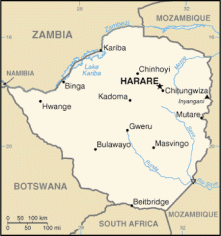
Many cities around the globe have had their names changed during colonization times (by Europeans colonizers) and were made to carry names foreign to the local people, as denoted in Bombay (Mumbai), Léopoldville (Kinshasa), and Canton (Guangdong) to name just a few. Ever since independence, many of these cities and countries have been renamed to reflect the local culture. Harare is one such city. Harare, the capital of Zimbabwe (which used to be Rhodesia during colonial times), used to be named Salisbury.
So what’s in a name? Well, a name is everything, and characterizes who you are, and your connection to the place. So why shouldn’t Bombay remain Bombay…. Why the need to change it back to Mumbai after over a century as Bombay? Well simply because Mumbai or Guangdong is the way the local people call it, and these cities and their names should be seen through their eyes and not those of a foreigner who oftentimes loathes the local people, and sees them as inferior.
Harare’s skyline today (Wikipedia)
Back to Harare… During the time that the British with the infamous Barbarian Cecil Rhodes ‘colonized’ the place, it was known as Fort Salisbury. The city was founded in 1890 by the Pioneer Column, a small military force in the service of the British South Africa Company, and named Fort Salisbury after the British Prime Minister Lord Salisbury. It retained the name Salisbury until 1982, when it was renamed Harare on the second anniversary of Zimbabwean independence.
So Harare, the most populous, and capital city of Zimbabwe owes its present-day name to a local Shona chief by the name of Ne-Harawa, whose name meant “He who does notsleep.” The name of the city was changed to Harareon 18 April 1982, taking its name from the village near Harare Kopje of the Shona chief Ne-Harawa. Prior to independence, “Harare” was the name of the black residential area (indigenous area where the Black locals where allowed to live) now known as Mbare. It used to also be known as the Sunshine City.
A Conical tower at Great Zimbabwe
Situated at an elevation of 1,483 metres (4,865 feet) above sea level, Harare’s climate falls into the subtropical highland category. Administratively, Harare is a metropolitanprovince. It is Zimbabwe’s leading financial, commercial, and communications centre, and a trade centre for tobacco, maize, cotton, and citrus fruits. Manufactured goods include textiles, steel and chemicals, and gold is mined in the area.
National Heroes Acre (ZimbabweTourism.org)
My Dad visited Harare in the early 90s and loved every part of it. So if you ever visit Harare, remember that its name is for “He who does not sleep”, and enjoy its streets full of Msasa trees which color neighborhoods wine red in late August, and other streets filled with Jacaranda and Flamboyant trees. If you love colonial architecture, you will have your fill. If you are in search of African arts, visit the National Gallery (a side note, if you ever visit the Atlanta airport, one of the transition corridors is filled with Zimbabwean Shona sculptures); for flora lovers, the botanic garden is full of species only found there. The Mukuvisi Woodlands reserve is not too far, and you can visit the Shona village of Chapungu Kraal, as well as check out the Epworth rocks, the National Archives, and the Heroes Cemetery.
To celebrate this upcoming Mother’s day, I wanted to share Patience Dabany‘s “L’Amour d’Une Mère” (A Mother’s Love) which is a classic. Patience Dabany is a baronness of African music with a career which has spun over several decades. She also served as the First Lady of Gabon from 1967 to 1988, at which time she boldly divorced her husband, the late Gabonese President Omar Bongo Ondimba. This song, “L’Amour d’Une Mère” is quite special and I dedicate it to all the mothers out there! I have translated the words to English here: Translation Dr. Y., Afrolegends.com. Happy Mother’s Day 2017!
A Mother’s Love (byPatience Dabany)
The first time you opened your eyes
at that moment, God granted my wish
Holding you against me was my only comfort
oh yes my baby, it was you my gold
when the time came for you to take off
I prayed a long time for you to never fall
and if you ever, hesitate to re-open my door
remember that Mommy will always love you
Yes
Even if you went to other loves
you always have a place in my yard
we will find the strength to overcome obstacles
and if you ever stumble, I will work miracles
and since that time, when you took off
I prayed for a long time that you never fall
and if you have hairs, do not hesitate to re-open my door
You know very well, that my heart will always be open to you
A Mother’s love, never goes out
A Mommy’s love, never goes out, never, never
A Mother’s love, never goes out
A Mommy’s love, never goes out, never, never
I raised you with love, from the day you were born
And I will always give you love, love you only as mother can love
A Mother’s love, never goes out
A Mommy’s love, never goes out
even if you fly on your own wings
even if obligations call you
your place will always be in my heart, because Mommy will always love you
A Mother’s love, never goes out
A Mommy’s love, never goes out
and if life teaches you things, and that you can’t take her blows
Eight little girls liked to play in the surrounding fields. One day, while out picking flowers, it started to rain. They sought a shelter, and found a cave. They got in. It was the house of Surukuba, the Hyena.
A few moments later, Hyena arrived galloping.
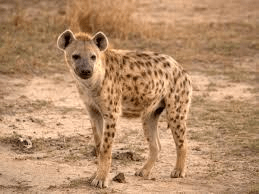
Hyene
As soon as she got near the cave, she stopped and exclaimed:
Hum ! It smells like a little girl here !
Then she got close to the the cave, and looking inside, exclaimed:
How many are you, little girls ?
The eight girls answered with a single voice singing:
Eight little girls !
We are indeed eight little girls, to fill Hyena’s mouth !
Overjoyed, Hyena jumped up, and galloped away. She wanted to tell another hyena. If she ate them right away, and then told that one day she had found eight little girls in her house, nobody would believe her ! She had to find a witness.
She galloped away, repeating the the little girls’ song:
Eight little girls, to fill Hyena’s mouth .
She found a comrade and invited her to come see what she had found in her cave. In her very own house : eight little chubby girls ! But before their arrival, two little girls ran out of the cave and went back to the village.
The remaining 6 little girls
The remaining six answered:
Yes, we are really eight little girls to amuse the fangs of eight hyenas !
The two hyenas went away galloping. They needed to find a third one ? Why not a fourth one ? Then a fifth one ? Then … after all, there were really eight little girls.
But when the hyenas got back and asked:
How many are you ? Girls ?
2 hyenas
Only one voice replied. And when the hyenas ran into the cave, they only found a small ring that the oldest of the little girls had put down. It was this little ring which had replied.
Furious, they ran after the little girls. They arrived in the village, as the oldest of the little girls was climbing the fence. A hyena grabbed her foot:
I got you, little cunning one. And I am going to eat you !
The oldest of the little girls burst out laughing :
Oh! Big moron ! It is not my foot that you hold there, but a wood on the fence .
The hyena let go of the girl’s foot and grabbed the wood. The little girl then jumped into the village and alerted the hunters.
The French original can be found on Ouologuem Blog. Translated to English by Dr. Y., Afrolegends.com
Ne saisis pas le talon avant que la fourmi ne t’aie mordu(Proverbe Ekonda – RDC). – Ne pas se faire des soucis inutiles pour ce qui pourrait arriver demain ou plus tard: à chaque jour suffit sa peine.
Fourmi / Ant
Do not grab the heel before the ant has bitten you (Ekonda proverb – DRC). – Do not worry unnecessarily about what might happen tomorrow or later: each day has enough trouble of its own.
I share with you a poem by the late Congolese writer Tchicaya U Tam’si, “Vos yeux prophétisent une douleur”/”Your Eyes Prophesy a Pain.” Gérald-Félix Tchicaya is mostly known by his pseudonym Tchicaya U Tam’si, where U Tam’si means ‘the one who speaks for his country‘. Born in Mpili in the former French Congo (Republic of Congo), he was a poet, journalist, and an activist. He is considered by many as one of the greatest poets of his generation.
Patrice Emery Lumumba
U Tam’si’s poetry uses symbolism, dark humor, and surrealist, corporeal imagery to explore cultural identity in a politically unstable society. A member of the Congolese independence movement, a friend of Patrice Lumumba, U Tam’si creates work on the nature of African identity that is sometimes connected to Aimé Césaire’s Negritude movement, which advocated for the protection of a distinct African culture in the face of French colonialism and European exploitation.
To me, the pain U Tam’si talks about in this poem is that of slavery, of colonialism, of neo-colonialism, of tribalism. He talks as if he was in the 1600s, during slavery times, and predicting more pain.What do you think? What pain is U Tam’si talking about? The original poem was published in Anthologie Africaine: Poésie Vol2, Jacques Chevrier, Collection Monde Noir Poche, 1988; the English translation is brought to you by Dr. Y., Afrolegends.com.
Vos yeux prophétisent une douleur…
Comme trois terrils, trois collines de cendres!
Mais dites-moi de qui sont ces cendres?
La mer obéissait déjà aux seuls négriers
Des négres s’y laissaient prendre
Malgré les sortilèges de leurs sourires
On sonnait le tocsin
A coups de pied au ventre
De passantes enceintes:
Il y a un couvre-feu pour faisander leur agonie
Les feux de brousse surtout donnent de mauvais rêves
“Greatness is indestructible when it is not built on terror, envy, and suspicion, nor gained at the expense of others, but rather based on hope, trust, friendship, and directed for the good of all humanity.”Kwame Nkrumah, first President of Ghana.
African countries continue to pay colonial tax to France 50 years after their independence. This system is an abomination destined to keep African countries poor forever! Here are some excerpts from the article by Mawuna R. Koutonin. For the full article, go to France Colonial Tax , and do not forget to check out the article I wrote a while back on the Franc CFA: slave currency! Also, please read the book by Pr. Nicolas Agbohou on the subject: ‘Le Franc CFA et l’Euro contre l’Afrique.’
===========
Did you know that many African countries continue to pay colonial tax to France since their independence till today?
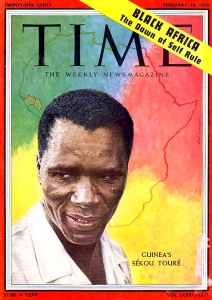
Sekou Toure, Cover Time Magazine, Feb. 16, 1959
Sékou Touré of Guinea decided in 1958 to get out of french colonial empire, and opted for the country’s independence, the french colonial elite in Paris got so furious, and in a historic act of fury the french administration in Guinea destroyed everything in the country which represented what they called the benefits from french colonization. …
Slowly fear spread through the African elite, and none after the Guinea events ever found the courage to follow the example of Sékou Touré, whose slogan was “We prefer freedom in poverty to opulence in slavery.”
[…] In March 2008, former French PresidentJacques Chiracsaid: “Without Africa, France will slide down into the rank of a third [world] power.”
Chirac’s predecessorFrançois Mitterandalready prophesied in 1957 that: “Without Africa, France will have no history in the 21st century”
At this very moment I’m writing this article,14 african countriesare obliged by France, trough a colonial pact, to put85%of their foreign reserve into France central bank under French minister of Finance control. Until now, [2017],Togo and about 13 other african countries still have to pay colonial debt to France.African leaders who refuse are killed or victim of a coup. Those who obey are supported and rewarded by France with lavish lifestyle while their people endure extreme poverty, and desperation.
It’s such an evil system even denounced by the European Union, but France is not ready to move from that colonial system which puts about 500 billions dollars from Africa to its treasury year in year out.
[…] Below are the 11 main components of the Colonisation continuation pact since 1950s:
#1. Colonial Debt for the benefits of France colonization
The newly “independent” countries should pay for the infrastructure built by France in the country during colonization. …
1000 Fcfa_BEAO
#2. Automatic confiscation of national reserves
The African countries should deposit their national monetary reserves into France Central bank.
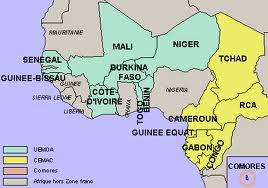
France has been holding the national reserves of fourteen African countries since 1961: Benin, Burkina Faso, Guinea-Bissau, Ivory Coast, Mali, Niger, Senegal, Togo, Cameroon, Central African Republic, Chad, Congo-Brazzaville, Equatorial Guinea and Gabon.
“The monetary policy governing such a diverse aggregation of countries is …operated by the French Treasury, without reference to the central fiscal authorities of any of the WAEMU or the CEMAC. Under the terms of the agreement which set up these banks and the CFA the Central Bank of each African country is obliged to keepat least 65%of its foreign exchange reservesin an “operations account” held at the French Treasury, as well as another20% to cover financial liabilities.
The CFA central banks also imposea cap on credit extended to each member country equivalent to 20%of that country’s public revenue in the preceding year. Even though the BEAC and the BCEAO have an overdraft facility with the French Treasury,the drawdowns on those overdraft facilities are subject to the consent of the French Treasury. The final say is that of the French Treasury which has invested the foreign reserves of the African countries in its own name on the Paris Bourse.
In short,more than 80% of the foreign reserves of these African countries are deposited in the “operations accounts” controlled by the French Treasury. …” Wrote Dr. Gary K. Busch.
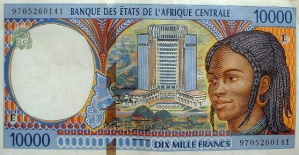
10,000FCFA (BEAC-1992)
It’s now estimated thatFrance is holding close to $500 billions African countries money in its treasury, and would do anything to fight anyone who want to shed a light on this dark side of the old empire.
The African countries don’t have access to that money.
France allows them to access only 15% of the money in any given year. If they need more than that, they have to borrow the extra money from their own 65% from the French Treasury at commercial rates.
To make things more tragic,France impose a cap on the amount of money the countries could borrow from the reserve. The cap is fixed at 20% of their public revenue in the preceding year.If the countries need to borrow more than 20% of their own money, France has a veto. …
#3. Right of first refusal on any raw or natural resource discovered in the country
France has the first right to buy any natural resources found in the land of its ex-colonies. It’s only after France would say, “I’m not interested”, that the African countries are allowed to seek other partners.
#4. Priority to French interests and companies in public procurement and public biding
In the award of government contracts, French companies must be considered first, and only after that these countries could look elsewhere. It doesn’t matter if the african countries can obtain better value for money elsewhere. …
As a consequence, in many of the french ex-colonies, all the majors economical assets of the countries are in the hand of french expatriates. …
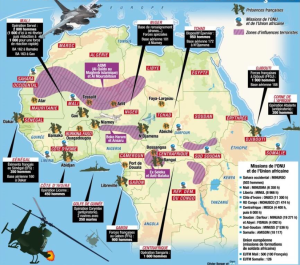
French military bases in Africa (Source: Olivier Berger, SiliconAfrica.com)
#5. Exclusive right to supply military equipment and Train the country military officers
Through a sophisticated scheme of scholarships, grants, and “Defense Agreements” attached to the Colonial Pact, the Africans should send their senior military officers for training in France or French ran-training facilities. …
… France has trained hundreds, even thousands of traitors and nourish them. They are dormant when they are not needed, and activated when needed for a coup or any other purpose!
#6. Right for France to pre-deploy troops and intervene military in the country to defend its interests
Under something called “Defense Agreements” attached to the Colonial Pact, France had the legal right to intervene militarily in the African countries, and also to station troops permanently in bases and military facilities in those countries, run entirely by the French….
#7. Obligation to make French the official language of the country and the language for education
Oui, Monsieur. Vous devez parlez français, la langue de Molière! …
1000 FCFA (BCEAO)
#8. Obligation to use France colonial money FCFA
That’s the real milk cow for France, but it’s such an evil system even denounced by the European Union, butFrance is not ready to move from that colonial system which puts about 500 billions dollars from Africa to its treasury.
#9. Obligation to send France annual balance and reserve report.
Without the report, no money. …
#10. Renunciation to enter into military alliance with any other country unless authorized by France
… In the case France ex-colonies, France forbid them to seek other military alliance except the one it offered them.
#11. Obligation to ally with France in situation of war or global crisis
Over onemillion africans soldiersfought for the defeat of nazism and fascism during the second world war.
Their contribution is often ignored or minimized, but when you think that it took only 6 weeks for Germany to defeat France in 1940, France knows that Africans could be useful for fighting for la “Grandeur de la France” in the future.
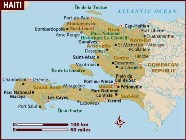
Map of Haiti
There is something almost psychopathic in the relation of France with Africa.
France is severely addicted to looting and exploitation of Africa since the time of slavery. …
It’s up to us as African to free ourselves, without asking for permission, …
For historical comparison, France madeHaitito pay the modern equivalent of$21 billionfrom1804till1947(almost one century and half) for the losses caused to french slave traders by the abolition of slavery and the liberation of the Haitian slaves.
“Sometimes it falls upon a generation to be great. You be that great generation. Let your greatness blossom. Of course the task will not be easy. But not to do this would be a crime against humanity, against which I ask all humanity now to rise up.” Nelson Mandela, Message to the Live 8 Concert in Edinburgh, July 2005
Here is your call to greatness! Whatever you do, do it well, be great, let your greatness blossom! The flower below looks like the stems are coming out, just like a generation blossoming!Just like this flower, let your stems come out, and be the very best you can be!



 So Harare, the most populous, and capital city of Zimbabwe owes its present-day name to a local Shona chief by the name of Ne-Harawa, whose name meant “He who does not sleep.” The name of the city was changed to Harare on 18 April 1982, taking its name from the village near Harare Kopje of the Shona chief Ne-Harawa. Prior to independence, “Harare” was the name of the black residential area (indigenous area where the Black locals where allowed to live) now known as Mbare. It used to also be known as the Sunshine City.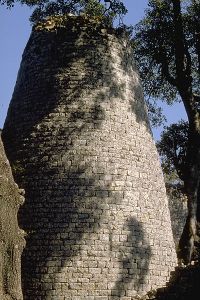


 To celebrate this upcoming Mother’s day, I wanted to share







 It’s such an evil system even denounced by the European Union, but France is not ready to move from that colonial system which puts about 500 billions dollars from Africa to its treasury year in year out.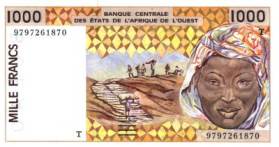



 C’est par ses paroles qu’on entre dans les pensées d’un autre
 African Heritage