Why the name: Asmara?

Asmara
Asmara, Little Rome

Ever since I was a child, I always loved the sound of the name ‘Asmara,’ not knowing that it was feminine by nature (which might explain my fascination with it).  Asmara, the capital of Eritrea, was an Italian built colonial city whose origins date back to 800 BC and 400 BC.  The Tigrinya and Tigre people live around there.  Originally, there were four clans living in the Asmara area on the Kebessa plateau: the Gheza Gurtom, the Gheza Shelele, the Gheza Serenser, and the Gheza Asmae.  These clans fought each other until the women of each clan decided that to preserve peace, the four clans should unite. The men accepted, hence the name Arbaete Asmera.  Arbaete Asmera literally means in Tigrinya language, “the four (feminine plural) made them unite.”  Eventually Arbaete was dropped and it has been called Asmera, which means “they [feminine, thus referring to the women] made them unite.”  Majority of non-Eritreans call it by the Italianized version of the word: Asmara.  Only Eritreans, and their neighbors remain loyal to the original pronunciation, Asmera.
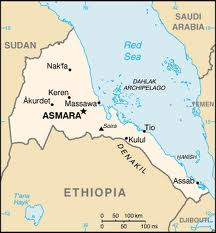
Map of Eritrea
Map of Eritrea

In the early days, Asmara was part of the kingdom of Medri Bahri, a medieval kingdom in the Horn of Africa, whose capital was Debarwa.  On October 9th, 1876, the Emperor of Ethiopia, Yohannes IV, made his greatest war general Ras Alula, governor of Medri Bahri.  Once Ras Alula became governor of this province, he moved the capital from Debarwa to Asmara.  He built a palace on top of a hill in the center of Asmara; from there, he devoted himself to defending the northern borders of Ethiopia against Italian, and Anglo-Egyptian aggressors.  In 1889, Asmara was occupied by the Italy, and was made the capital city of Eritrea by Governor Martini in 1897.
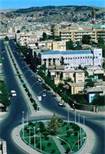
Blvd in Asmara
Blvd in Asmara

Since then, Asmara has benefited from a strong Italian architecture, and was called Piccola Roma (Little Rome) because of its strong resemblance to Rome.  Asmara represents perhaps one of the most concentrated and intact assemblage of Modernist architecture anywhere in the world.  Not built for Eritreans, Italians built Asmara primarily for themselves, as indicated by separate areas designated for Italians and Eritreans, each disproportionately sized. Enjoy this video telling you about the Little Rome of East Africa, Asmara, the beautiful city embodying feminine grace and beauty.

Tunis: Why the Name?

Tunis
Tunis

Today, we will be talking about the beautiful city of Tunis, the capital of TunisiaWhere does the name Tunis come from?  Is Tunisia, the name of the country whose capital is Tunis, just a derivative of the name Tunis?

Well for starters the city of Tunis is built on a set of hills that go down towards the lake of Tunis.  Tunis was born at the crossroads between the basins of lake Tunis and the Séjoumi.  Situated on a large Mediterranean Sea gulf (the Gulf of Tunis), behind the Lake of Tunis and the port of La Goulette (Halq al Wadi), the city extends along the coastal plain and the hills that surround it.  At the centre of more modern development (from the colonial era and later) lies the old medina.  Beyond this district lie the suburbs of Carthage, La Marsa, and Sidi Bou Said.

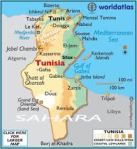
Map of Tunisia
Map of Tunisia (from World Atlas)

Tunis is the French transcription of a name, which is pronounced tûnus, tûnas or tûnis (with û sounding like an ‘ou’ in French) in Arabic.  The three pronunciations were indicated by the arab geographer Yaqout al-Rumi in his book Mu’jam al-Buldan (Dictionary of countries).  The last pronunciation tûnis is the most used of the city’s name tûnisi ou tûnusiThis vocable is defined to mean “to lie down” or “lying down”, and by extension “spending the night,” or “spending the night at”, or “getting somewhere and spending the night.” Among many of the derivatives of this term, one can find tinés (pluriel de ténésé) which indicate “the idea of lying down,” and by extension “the fact of spending the night.”

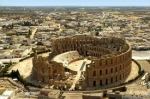
Ancient Tunisia
Ancient Tunisia

Thus the name Tunis probably had the meaning of “night camp” or “bivouac” or “stop.”  In the ancient toponymy of Roman Africa, several towns carry similar names such as: Tuniza (modern-day El Kala), Thunusuda (modern-day Sidi Meskine), Thinissut (modern-day Bir Bouregba), Thunisa (modern-day Ras Jebel) or Cartennae (modern-day Ténès in Algeria).  All these berber localities were located on roman roads, and probably served as road houses, or stops.  From the name Tunis, arose the country name Tunisia.  The name gained prominence among French historians and geographers, by analogy with the word Algeria derived from Algiers. Today Tunis is well-known for its beauty, its people, and its sunny days; it is one of Africa’s best touristic spots. Enjoy the video below, which gives a quick historical view of Tunis and Tunisia.

Sierra Leone: Why the Name?

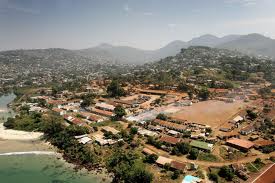
Modern-day Freetown
Modern-day Freetown, the capital of Sierra Leone

I always thought the name of the country Sierra Leone was rather strange: how could a predominantly Muslim, English-speaking, African country have an Italian name?  There was never an Italian presence in that region of Africa.  So why in the world, is an ex-British colony with slaves returning from America, slaves who had fought on the British side during the American revolutionary war from 1775 to 1783, carrying an Italian name, and what does it mean?

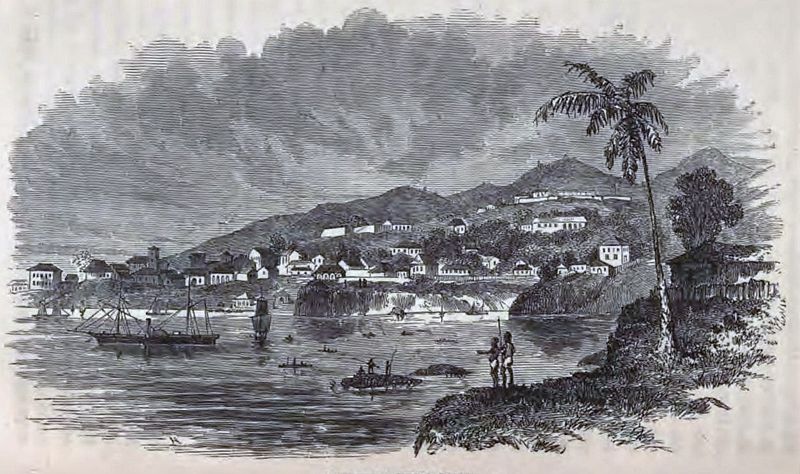
Freetown, Sierra Leone, in 1856

Well, in 1462, the Portuguese explorer Pedro de Sintra sailing down the West African coast, saw the tall mountains rising from what is now Freetown peninsula or harbor, and named the area ‘Serra de Leão,’ which means ‘mountains of the lion’, or ‘hills of the lion,’ because of the shape formed by the hills surrounding the harbor.  The  rendering of this geographic formation is Sierra Leone, Leone being the Italian for Lion, while Sierra is Spanish for hills or mountain, thus the name. In reality, it is said that it was leona in Spanish which was accidentally changed to Leone; so the origin should be Spanish. Sierra Leone has the third largest natural harbor in the world.  Archaeologically, that area has been inhabited continuously for the past 2500 years, from successive movements from other parts of Africa.  In 1495, the Portuguese established a port there, and were later joined by the Dutch and French, who used the area as a slave trading point.  In 1787, a first settlement of those called Black poors was founded in the Province of Freedom.  They were later decimated by the indigenous population.  A second settlement came in composed of Nova Scotian settlers, and Jamaican Maroons.  Sometime, at the beginning of the 19th century, Sierra Leone became a British colony.  Sierra Leone today is a true melting pot of Temne, Mende, Limba, Fula, Mandingo, Kono, and Krio (descendants of African American, West Indies slaves, etc) people.  In 2006, the country was featured in the movie Blood Diamond with Leonardo DiCaprio.

So there goes the story of a British colony, English-speaking country, predominantly Muslim, with an Italian name in an area where no Italian explorer had set foot.  Enjoy this video on Freetown, the capital of Sierra Leone.

Why the name Bangui (Capital of Centrafrique)?

Aerial view of Bangui today

Today, I will be talking about Bangui, the capital of Centrafrique or the Central African Republic (CAR).  Bangui is commonly known to locals as “Bangui, la coquette“, or “Bangui, the coquette“.  Before its independence on August 13 1960, Centrafrique was known as “Oubangui-Chari” (in English: Ubangi-Chari) because its border in the south is formed by the rivers Oubangui (which is the border with the democratic republic of Congo) and Mbomou, while at its northern border is the Chari river which also runs into Chad.  When the French first colonized the area in the 19th century, they adopted the name Oubangui-Chari, since the country is located in the Oubangui-Chari basin.  Thus the city Bangui is located on the right bank of the Oubangui river.  The city was started (I will not use the more common word ‘founded’ as I disagree with its use here) on 26 June 1889 during French colonization, to serve as a base for French expansion in Central Africa.

Downtown Bangui in 1950s

At its creation, it was part of the then French colony of Haut-Oubangui (Upper-Ubangi).  The city grew thanks to its proximity to a French military post (which still exists there today), and became the center of the French colonial administration in the area.  At first, from 1889 to 1912, the population was mostly centered near the river Oubangui; later on, it grew on the northern side. It is also good to mention that the city-center is dominated by the Gbazabangui hills, inside which there is a special forest reserve.

Libreville: Why the Name?

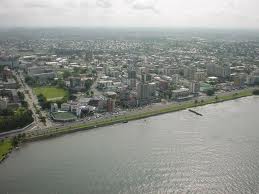
Libreville today
Libreville today, 2012

Two capitals in Africa share the same name: Freetown in Sierra Leone, and Libreville in Gabon; one in English, the other in French.  I always knew that Freetown was named the way it was because it was a city founded in 1792 by freed African American Slaves also called Nova Scotian who had fought on the side of the British during the American Revolutionary war.  The land was named Freetown as a land for freed slaves.

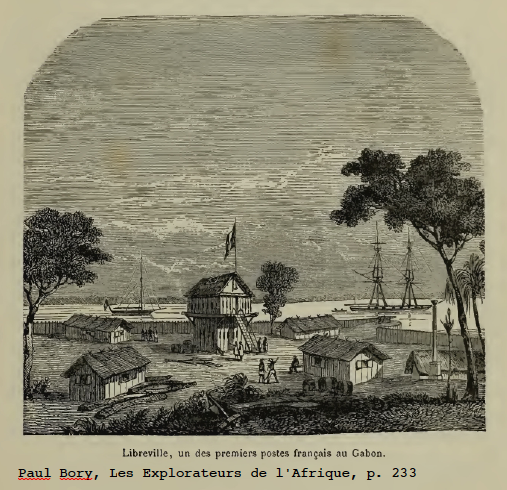
Libreville in 1846
Libreville in 1846

But why on earth is Libreville named free town?  Since, there were apparently no freed slaves returning from the colonies, or running away from slavery?  I recently found out that the story of Libreville is very similar to that of Freetown, as it does involve slaves!  Yes… that’s right!  In the old days, i.e. prior to French occupation (the French acquired land there in 1839), the area that is today Libreville was inhabited by the Mpongwé people since the 11th century.  In 1846, l’Elizia, a slave ship en route for Brazil, carrying slaves for sale was captured by the French navy near Loango, offshore from the Mbongwé’s kingdom.  260 negroes were thus freed and taken to the Island of Gorée in Senegal in 1846.  After an intervention from Paris, 30 – 50 of these slaves will return to Gabon, where the French governor Bouët-Willaumez will take advantage of this, and found Libreville (French for ‘free town’ or ‘free city’) in 1849, in close proximity to Fort d’Aumale, where the French navy was installed to “fight” against slavery.  The small town, Libreville, was then organized as a “French christian village” around 5 places: the Mpongwé’s place, the freedom place, the Bakélé place, the Pahué place, and the Bulu place, after the main tribes in the area at the time.