Quick note: African Olympians thus far…

Chad le Clos during the final 200 m butterfly
Chad le Clos during the final 200 m butterfly at the 2012 Olympics

Yesterday, July 31st, South African Chad le Clos defeated the great Michael Phelps (19 times olympic medalist – with 16 gold medals thus far – cited as being the Greatest olympian of all times) in Men’s 200 m Butterfly, and won the Gold medal.

Alaaedin Aboulkassem
Alaaedin Aboulkassem, after qualifying for the final for fencing at the 2012 Olympics

Last Sunday, July 29th,  South African Cameron van der Burgh won Gold medal in Men’s 100 m Breaststroke.

Watch out for Alaaedin Abouelkassem of Egypt who qualified yesterday for the final in Fencing, and will get either a Gold or a Silver medal in Fencing!

African Athletes to Watch for at the 2012 London Olympics

2012 London Olympics

With the start of the 2012 London Olympics, I thought about giving you a hint as to who to look out for, and who are those brilliant athletes representing the continent at the Olympics.  Here is a list of some of the outstanding ones… There is no particular order.  If I have missed a big one, please send me his/her name.


Athletes Country Discipline Achievements
Kenenisa Bekele Ethiopia 5,000m & 10,000m Reigning world and Olympic champion (male)
Tirunesh Dibaba Ethiopia 5,000m & 10,000m Reigning world and Olympic champion (female)
Cameron van der Burgh South Africa Swimming Gold medalist 100 m breaststroke 2012 olympics
Amantle Montsho Botswana 400 m & 800 m track & field African champion
Jonathan Akinyemi Nigeria Canoe-Kayak
Blessing Okagbare Nigeria 100 m, long and triple jump 2008 Olympics Bronze medalist long jump
Caster Semenya South Africa 800 m, 1500 m 2011 World Champion Silver medal (800m)
Vivian Cheruiyot Kenya 5000 m 2009 world champion
Silas Kiplagat Kenya 1500 m 2010 Commonwealth gold champion
Tosin Oke Nigeria Triple jump 2011 All-African Games gold medalist
Ruddy Zang Milama Gabon 100 m 2012 African champion
Taoufik Makhloufi Algeria 800 m, 1500 m 2012 African champion (800 m)
Alaaedin Abouelkassem Egypt Men’s Fencing 2010 World Junior champion
Ndiss Kaba Badji Senegal Long jump 2012 African champion
Pamela Jelimo Kenya 800 m 2008 Olympic Gold medalist
Kirsty Coventry Zimbabwe Swimming Olympic Gold medalist 2004, 2008 (2 gold, 4 silver, & 1 bronze olympic medals)
Khotso Mokoena South Africa Long jumper 2008 Olympic silver medalist
Antonia de Fatima Faia Angola Judo Bronze medalist World champion
Zersenay Tadese Erithrea 10,000 m 2004 Olympic bronze medalist
Wilson Kipsang Kenya Marathon 2012 London Marathon winner
Mary Keitany Kenya Marathon 2012 London Marathon winner
Amaechi Morton Nigeria 400 m hurdles 2012 African championship gold medalist
Oscar Pistorius South Africa 100m, 200m, 400 m 2004, 2008 paralympic gold medalist
Samuel Kamau Wanjiru Kenya Marathon 2008 Olympic gold medalist
Chad le Clos South Africa Swimming (200 m butterfly) Commonwealth gold medalist
Benjamin Boukpeti Togo Canoe (K-1 Kayak single) 2008 Olympic bronze medalist
Oussama Mellouli Tunisia 1500 m freestyle swimming 2008 olympic Gold medalist

Abebe Bikila: Emperor of the Distance and Running Barefoot

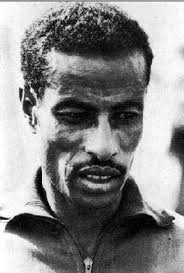
Abebe Bikila
Abebe Bikila

Today I would like to talk about Abebe Bikila, one of Africa’s finest athletes, who marked the entire continent by his strength, endurance, and love of his country, and continent.  Abebe Bikila was an Ethiopian athlete and the very first African to win an Olympic gold medal in 1964 (remember that previous winners like Alain Mimoun from Algeria competed for France, since Algeria was still a French colony).

Coincidentally born on the day of the 1932 Los Angeles Olympics, Abebe Bikila opened his eyes to the world in the small village of Jato, near the town of Mendida in Ethiopia.  As a young adult, one could already sense his determination, as he decided to join the imperial guard, and walked the distance of 130 km separating him from Addis Ababa.  Thereafter he started as a private guard.  Soon after, he was spotted by Onni Niskanen, a Swede, who had been hired by the government to train athletes.

Abebe Bikila on the podium in 1960 Olympics in Rome
Abebe Bikila on the podium during the 1960 Olympics in Rome, after winning the gold medal in the marathon, and surrounded by Rhadi Ben Abdesselam of Morocco (silver) and Barry Magee of New Zealand (Bronze)

He made it to the 1960 Rome Olympics as a replacement to Wami Biratu who had just injured himself.  At the shoe-trial, Adidas, the Olympics sponsor, had very few shoes left, and none of them were comfortable to Bikila.  In the end, Abebe Bikila ran the marathon barefoot in Rome’s cobblestone streets.  He won the marathon in a record time of 2:15:16.2 improving the previous record by 8 min, thus giving Africa its very first gold Olympic medal. When asked why he ran barefoot, he said: “I wanted the world to know that my country, Ethiopia, has always won with determination and heroism.” The symbolic was huge, since there on the track course was the Axum Obelisk, which Mussolini had plundered away from Ethiopia… and 24 years later, Abebe Bikila, a small Ethiopian, from the imperial guard of Emperor Haile Selassie, marched over Rome and conquered!

40 days prior to the 1964 Tokyo Olympics, Abebe was operated for an appendicitis.  His sense of determination was so strong that he would train at night in the hospital courtyard, during the recovery.  Once in Tokyo, Abebe Bikila set a new world record, 2:12:11:2, and won the race far ahead of the pack, and still full of energy. The police estimated that 1 million people lined up the streets to cheer Abebe Bikila. He was the first person in history to win a gold medal for the marathon back-to-back.  Back home, Bikila was given a hero’s return by Emperor Haile Selassie and all of Ethiopia.

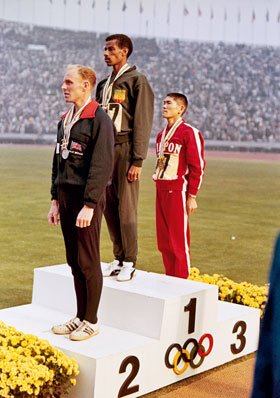
Abebe Bikila on the podium of the 1964 Tokyo Olympics
Abebe Bikila on the podium of the 1964 Tokyo Olympics, after winning gold in the marathon, and surrounded by Basil Heatley of Great Britain (Silver) and Kokichi Tsuburaya of Japan (Bronze)

At the 1968 Mexico City Olympics, Abebe Bikila tried to repeat his win, but had to surrender after 17 km due to a severe injury to his knee. He told his teammate Mamo Wolde, as he was living the race: “The responsibility of winning a gold medal for Ethiopia is in your shoulder.

It pains me to know that this great Olympian finished his life on a wheelchair.  During the civil unrest of 1969, trying to avoid a crowd, he lost control of his car, and landed in a ditch.  He was left paralyzed by the accident, as a quadriplegic.  After several operations, his condition improved to the point where he was a paraplegic.  While in wheels, Abebe’s competitive spirit and desire to see his country’s flag hoisted high and proud helped him compete and win several more races.  In 1970, he participated in a 25 km cross-country sledge competition in Norway where he won the gold medal. Again, in the same tournament, he won a similar 10 km race where he was awarded a special plaque.

Abebe Bikila died in 1973 from complications from his accident, 4 years earlier.  His funeral was attended by more than 75,000 people, and emperor Haile Selassie proclaimed a national day of mourning for Ethiopia’s national hero.  Newspapers throughout Africa eulogized him as an inspiration to their athletes and youths, some of whom won gold medals in future Olympics.  A stadium in Addis Ababa was named in his honor.

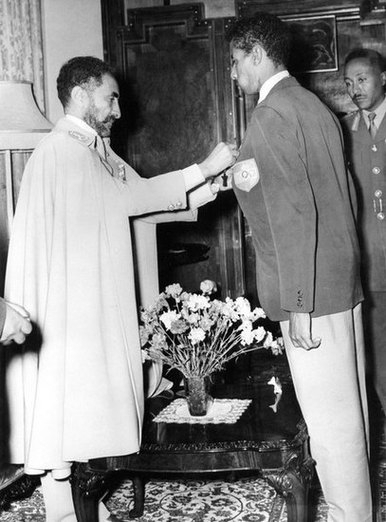
Abebe Bikila honored by Emperor Haile Selassie
Abebe Bikila honored by Emperor Haile Selassie I

Please check out the website dedicated to Abebe Bikila, and this great article on Abebe Bikila on Ethiopians.com,  and enjoy the poem written in praise of Bikila’s great heroism.  The lines I liked were: Abebe Bikila, With you, Our dreams  Never broken … The foot soldier Of forty years Led Ethiopians to run… And this said he in silence: We are the Ethiopians Whose lions made to sleep Need to run twice as fast!” … Running for Victory With that Abe’s Legacy.  Yahoo had a really good article on him, while the The Guardian had a really good photojournal to honor Bikila’s life and legacy.  Lastly, click on this Facebook page and check out the movie Abebe Bikila made in his honor.  Throughout his illustrious athletic career, Bikila had competed in more than 26 major marathon races.  The world championships he won in 1960 and 1962 deserve special recognition, as well as the Osaka marathon of 1961Bikila became the first runner ever to win two Olympic marathon gold medals, and the first African ever to win double gold at the Olympics.  As the olympics approach, please remember this great African athlete who inspired so many, and was so determined that even as a paraplegic he still won gold medals.

Frankie Fredericks: Sprinting to the Finish for Namibia

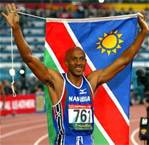
Frankie Fredericks raising the flag of Namibia

The athlete of the week is Frankie Fredericks: the handsome, good-looking, strong, fast, and powerful brother from Namibia.  Yep that’s right, Frankie Fredericks is one of those athletes I loved watching in the 1990s.  Always consistent, always strong, and everpresent, Frankie Fredericks was a force to reckon with.  How many silver medals has he gotten while contending the 100 m and 200 m at the Olympics?  4 Silver medals!  That’s right, an African with 4 silver olympic medals!  He has also won several gold medals at the World Championships, World Indoor Championships, All-Africa Games, and Commonwealth Games.  He is thus far Namibia’s only olympic medalist.

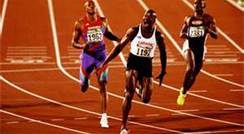
Frankie Fredericks coming 2nd to Donovan Bailey during the 100 m finale at the 1996 Atlanta Olympics

Born in Windhoek, Namibia’s capital, Frankie began running at the age of 13, and particularly loved football (soccer for Americans).  However, when he was awarded a scholarship to attend Brigham Young University, in the USA in 1987, he quickly moved his passion to track and field.  In 1991, as Namibia gained independence from South Africa, Frankie started officially compete for his country.  At the Barcelona Olympics in 1992, Frankie Fredericks won 2 silver medals in 100 m and 200m, giving Namibia its very first olympic medal.  In 1996 at the Atlanta Olympics, Frankie again won 2 silver medals coming 2nd to Donovan Bailey in the 100m, and 2nd to Michael Johnson in the 200 m.  Due to injuries, Frankie was absent at Sydney Olympics in 2000, and Namibia dearly missed him there.  He raced the 200m at the Athens Olympics in 2004, and came out 4th, and finally retired at the end of that year at the age of 37 (Imagine a 37 year-old sprinter coming 4th at the olympics, running against young folks like Shawn Crawford, Justin Gatlin, and Bernard Williams).  At the beginning of that run in Athens, Frankie was given a standing ovation that lasted few minutes, and at the end, he said “It is quite emotional, … I always wanted to go out with a medal, but sometimes in life you don’t get everything you want.” Frankie has run the 100 m under 10 s more consistently than most athletes (he is ranked 4th behind Ato Boldon of Trinidad & TobagoMaurice Greene of the US, and Asafa Powell of Jamaica).

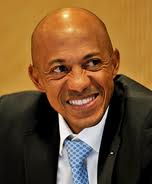
Frankie Fredericks
Frankie Fredericks

Off track, Frankie has a computer science degree and a masters of business administration, and he has created the Frank Fredericks Foundation to foster young Namibian athletes. In 2004, he was  elected by fellow athletes to serve on the board of the International Olympic Committee. Please check out the tribute to Frankie Fredericks given by International Association of Athletics Federations IAAF athletics.

The personable and wildly popular Fredericks spent the greater part of a decade-and-a-half at the pinnacle of his craft, a record for longevity nearly unprecedented in the sprints.  What was always fun about watching Frankie run was his consistency: Frankie was constant on the distance, and a very reliable athlete, training hard to represent his country and continent at the highest level.  I am sure most people had never heard of the country Namibia, but when Frankie was running, the whole world could hear and feel Namibia rising!

Mozambique’s First Gold Medal, and World Greatest 800m Runner: Maria Mutola

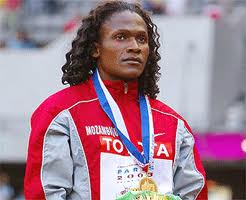
Maria Mutola winning gold in Sydney

With the olympics fast approaching, I have decided to feature one African athlete per week to keep us in Olympics mood. Today, I would like to talk about an athlete hailing from Mozambique: Maria Mutola.

Maria de Lurdes Mutola was born in Maputo, the capital of Mozambique, and was running so fast that she was nicknamed ‘The Maputo Express’.  She specialized in 800 m, and is the 4th athlete to have competed in 6 olympic games (imagine that: the olympic games happen every 4 years… thus it took a total of 24 years of intense competition at the highest level, as a world class athlete).  As a young girl, she excelled in football(soccer), and played with boys.  Later on, she was encouraged by the great

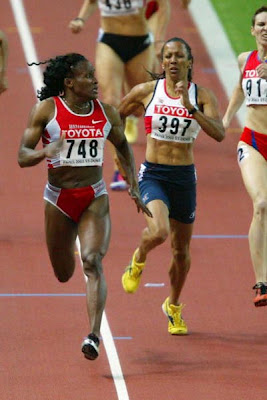
Maria Mutola defeating Kelly Holmes at World Championships

Mozambican writer Jose Craveirinha to pursue track and field.  Her very first olympic was in 1988 at the Seoul Games, at the age of 15.  She finished last, but this made her even stronger.  After that, she dominated the 800 m distance, winning the gold medal at the IAAF World Indoor Championships in 1993 and 1995, and the Stuttgart 1993 IAAF World Championships.  She won the bronze medal in 1996 at the Atlanta Olympic games, and finally won a sweet Gold medal at the Sydney Olympic Games in 2000.  Mutola retired from track and field at the 2008 Beijing Olympics where she sadly finished 5th, after being in contention for a medal.  Mutola is often ranked as the greatest female 800 m runner of all time, since her consistency, her record at major championships and her ability to compete at the highest levels of the sport for well over a decade are unmatched.

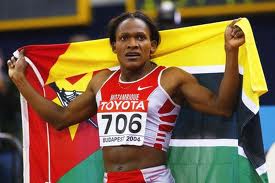
Maria Mutola raising the flag of Mozambique

As a sports fan, I watched Maria at the 1995 World indoor games in Barcelona.  The year 2000 was so special, as we all saw Maria finally lift the Olympic gold medal for Mozambique, at the Sydney games.  In 2003, she became the sole winner of the IAAF $1million Golden league title, for being undefeated throughout that year at all major competitions.  I have always been a big fan of hers, even though I always thought that she had too much of a ‘male’ physique.  With that physique, she ran with power and grace, and raised the flag of Mozambique with pride.  Greatness to you Maria, you’ve made us proud!

La Dernière Lettre de Patrice Lumumba / Patrice Lumumba’s Last Letter

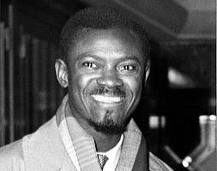
Patrice Emery Lumumba

Avec la commémoration de l’indépendance du Congo Démocratique acquise le 1er Juillet 1960, j’ai trouvé bon de poster cette si belle lettre de Patrice Lumumba à Pauline, sa femme (c’est d’ailleurs sa dernière lettre) était très appropriée, car bien que triste, elle est pleine d’espoir à la pensée qu’un jour le Congo sera libre, à la pensée que les enfants congolais doivent tous s’unir pour re-bâtir le Congo!

Ma compagne chérie, Je t’écris ces mots sans savoir s’ils te parviendront, quand ils te parviendront et si je serai en vie lorsque tu les liras.  Tout au long de ma lutte pour l’indépendance de mon pays, je n’ai jamais douté un seul instant du triomphe final de la cause sacrée à laquelle mes compagnons et moi avons consacré toute notre vie.  Mais ce que nous voulions pour notre pays, son droit à une vie honorable, à une dignité sans tache, à une indépendance sans restrictions, le colonialisme et ses alliés occidentaux—qui ont trouvé des soutiens directs et indirects, délibérés et non délibérés, parmi certains hauts fonctionnaires des Nations, cet organisme en qui nous avons placé toute notre confiance lorsque nous avons fait appel à son assistance—ne l’ont jamais voulu.

Ils ont corrompu certains de nos compatriotes. Ils ont contribué à déformer la vérité et à souiller notre indépendance.  Que pourrai je dire d’autre ? 

Que mort, vivant, libre ou en prison sur ordre des colonialistes, ce n’est pas ma personne qui compte.  C’est le Congo, c’est notre pauvre peuple dont on a transformé l’indépendance en une cage d’où l’on nous regarde du dehors, tantôt avec cette compassion bénévole, tantôt avec joie et plaisir.  Mais ma foi restera inébranlable.  Je sais et je sens au fond de moi même que tôt ou tard mon peuple se débarrassera de tous ses ennemis intérieurs et extérieurs, qu’il se lèvera comme un seul homme pour dire non au capitalisme dégradant et honteux, et pour reprendre sa dignité sous un soleil pur.

Nous ne sommes pas seuls.  L’Afrique, l’Asie et les peuples libres et libérés de tous les coins du monde se trouveront toujours aux côtés de millions de congolais qui n’abandonneront la lutte que le jour où il n’y aura plus de colonisateurs et leurs mercenaires dans notre pays.  A mes enfants que je laisse, et que peut-être je ne reverrai plus, je veux qu’on dise que l’avenir du Congo est beau et qu’il attend d’eux, comme il attend de chaque Congolais, d’accomplir la tâche sacrée de la reconstruction de notre indépendance et de notre souveraineté, car sans dignité il n’y a pas de liberté, sans justice il n’y a pas de dignité, et sans indépendance il n’y a pas d’hommes libres.

Ni brutalités, ni sévices, ni tortures ne m’ont jamais amené à demander la grâce, car je préfère mourir la tête haute, la foi inébranlable et la confiance profonde dans la destinée de mon pays, plutôt que vivre dans la soumission et le mépris des principes sacrés.  L’histoire dira un jour son mot, mais ce ne sera pas l’histoire qu’on enseignera à Bruxelles, Washington, Paris ou aux Nations Unies, mais celle qu’on enseignera dans les pays affranchis du colonialisme et de ses fantoches.  L’Afrique écrira sa propre histoire et elle sera au nord et au sud du Sahara une histoire de gloire et de dignité.

Ne me pleure pas, ma compagne.  Moi je sais que mon pays, qui souffre tant, saura défendre son indépendance et sa liberté.

Vive le Congo !  Vive l’Afrique !

Patrice Lumumba

My beloved companion, I am writing these words not knowing whether they will reach you, when they will reach you, and whether I shall still be alive when you read them.  All through my struggle for the independence of my country, I have never doubted for a single instant the final triumph of the sacred cause to which my companions and I have devoted all our lives.  But what we wished for our country, its right to an honourable life, to unstained dignity, to independence without restrictions, was never desired by the Belgian imperialists and their Western allies, who found direct and indirect support, both deliberate and unintentional, amongst certain high officials of the United Nations, that organization in which we placed all our trust when we called on its assistance.

They have corrupted some of our compatriots and bribed others.  They have helped to distort the truth and bring our independence into dishonour.  How could I speak otherwise? 

Dead or alive, free or in prison by order of the imperialists, it is not myself who counts.  It is the Congo, it is our poor people for whom independence has been transformed into a cage from whose confines the outside world looks on us, sometimes with kindly sympathy, but at other times with joy and pleasure But my faith will remain unshakeable.  I know and I feel in my heart that sooner or later my people will rid themselves of all their enemies, both internal and external, and that they will rise as one man to say No to the degradation and shame of colonialism, and regain their dignity in the clear light of the sun.

We are not alone.  Africa, Asia and the free liberated people from all corners of the world will always be found at the side of the millions of Congolese who will not abandon the struggle until the day when there are no longer any colonialists and their mercenaries in our country.  As to my children whom I leave and whom I may never see again, to be told that the future of the Congo is beautiful and that their country expects them, as it expects every Congolese, to fulfill the sacred task of rebuilding our independence, our sovereignty; for without justice there is no dignity and without independence there are no free men.

Neither brutality, nor cruelty nor torture will ever bring me to ask for mercy, for I prefer to die with my head unbowed, my faith unshakable and with profound trust in the destiny of my country, rather than live under subjection and disregarding sacred principles.  History will one day have its say, but it will not be the history that is taught in Brussels, Paris, Washington or in the United Nations, but the history which will be taught in the countries freed from imperialism and its puppets.  Africa will write its own history, and to the north and south of the Sahara, it will be a glorious and dignified history.

Do not weep for me, my dear wife.  I know that my country, which is suffering so much, will know how to defend its independence and its liberty.

Long live the Congo!  Long live Africa!

Patrice Lumumba

Amanishakheto, Warrior Queen of Nubia

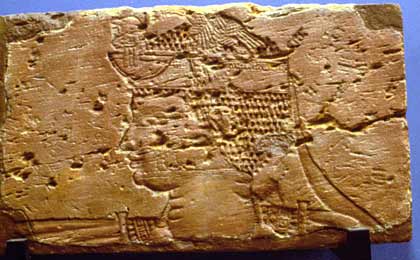
Candace Amanishakheto on a mural

Great women are often left out of history.  Rarely do we hear or read about African queens.  It is already hard enough to read about great African men and leaders in history books, but as for African women… it is more like impossible.  How many have heard of the great warrior queen of Nubia, Amanishakheto, who defeated a Roman army?  Who has heard of this great queen whose pyramid/tomb was leveled to the ground by an Italian treasure hunter, Giuseppe Ferlini, in 1832? Who has heard of this woman who led her people with a strong arm, and built pyramids in Meroë?  Who has heard of this great candace, whose daughter Amanitore, also queen of Nubia, is mentioned in the Bible (Acts 8:27) … yeah the Queen of Sheba is not the only African queen mentioned in the Bible!

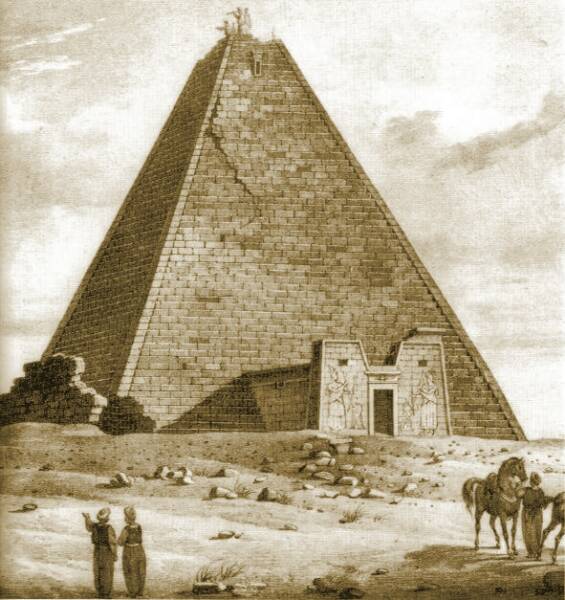
Pyramid N6 of Amanishakheto in Meroe, before its destruction

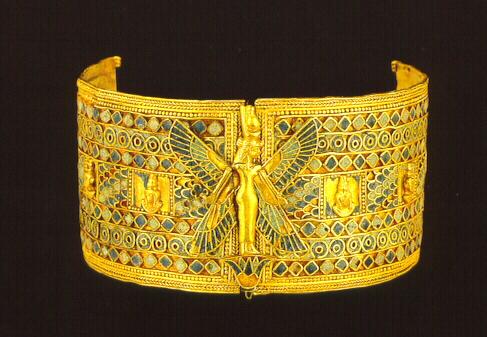
Well, let me tell you about the great Candace (Kandake or queen) of Nubia (present day Sudan), Amanishaketo (also written Amanishaket, or Amanikasheto or Mniskhte in meroitic hieroglyphs) who reigned from around 10 BC to 1 ADCandace Amanishaket was an extremely wealthy and powerful queen.  She succeeded to Candace Amanirenas who was also a great warrior queen (and will be the subject of another post).  She built considerable pyramids and temples at Wad Ban Naqa, where she was buried with great treasures.  Her residence and several temples were based there.  Her palace is one of the largest treasures identified at Wad ban Naqa.  It was 61 m long, and covered an area of  3700 m2 with the ground floor made up of over 60 rooms.  The palace originally had a second floor as indicated by the remains of columns found on the ground floor, and may have contained an atrium or other structure.  Inside Amanishakheto’s grave, the Italian treasure hunter Ferlini discovered an amazing quantity of golden artifacts such as armlets, necklaces.  The treasure found (or what has been recovered) contained ten bracelets, nine shield rings, sixty seven signet rings, two armbands, and an extraordinary number of loose amulets and necklaces, especially made for queen Amanishakheto created by Nubian artists from her kingdom.  Some of her treasures (stolen by Ferlini) are now on display at the Egyptian Museum of Berlin, and at the Egyptian Museum of Munich.

Bracelet of Amanishakheto from the Egyptian Museum of Berlin

Amanishakheto defeated a Roman Army sent by the first emperor of the Roman empire, Augustus, (who broke a peace treaty) to conquer Nubia.  She was a strong, and powerful woman, and a great pyramid builder.  Her tomb at Meroë was one of the largest ever built.  She is often depicted on pyramid murals as a massive, powerful woman, covered with jewels, elaborate fringed, tasseled robes, and carrying weapons in one hand, preparing to lead her army against others. Enjoy the video below on Amanishakheto, the great warrior queen of Nubia, and do not forget to check out The Treasures of Queen Amanishakheto.

Running the Distance, Running for Greatness: Haile Gebrselassie

Haile Gebrselassie
Haile Gebrselassie

Last night I thought about writing a piece on the greatest long-distance runner of all times, the great Haile Gebrselassie.  My interest for Track and field (athletism) has always been big, but my interest for 10,000 m was awaken by Haile Gebrselassie running 10,000 m and taking the gold medal at the 1995 Gothenburg games.  This great athlete hails from Ethiopia and has redefined what it means to run 10,000 m.  He is a long-distance track and road running athlete. Imagine someone who has just run 9600 m, and still has the power to accelerate and sprint through the next 200-400 m as if he was Michael Johnson or Usain Bolt?  If you can imagine this, you have imagined Haile Gebrselassie!  I have enjoyed watching him run with grace, poise, endurance, and strength. I once read that he would train by running 30 km every day, and I thought to myself, no wonder he is a 2-time Gold olympic winner (1996 Atlanta, and 2000 Sydney), 4-times world championship winner, 4-times consecutive Berlin marathon winner, 3-times consecutive Dubai marathon winner (not sure how one could run in Dubai’s heat), broke 61 records in Ethiopia, and 27 world records, and is greatly considered the world’s greatest distance runner in history. He has broken his own record several times, and is a true inspiration to many. He starred as himself in the 1999 movie Endurance.

Haile Gebrselassie, of Ethiopia, defeating Paul Tergat of Kenya in the 10000 m run at the Sydney 2000 Olympics
Haile Gebrselassie, of Ethiopia, defeating Paul Tergat of Kenya in the 10000 m run at the Sydney 2000 Olympics in a historic finish.

I dream of running a 10000 m race one day, just like Haile…  Imagine a non-runner inspired to run?  Yes… that’s being influenced by the greatest of all, Haile Gebrselassie… So many of us in Africa owe to this man who started running 10 km to go to school back when he was just a child; this man from a poor background, who went through all odds to reach the summit.  The current gold olympic title holder is Kenenisa Bekele, a fellow Ethiopian, and a protégé of Haile.  A whole generation of Ethiopian long-distance runners, and African runners, and kids like me, have been inspired by this athlete who is running the distance for greatness (He gave his first gold medal to his church to thank God for his talent).  All praise to the greatest of all: Haile Gebrselassie.  I had hoped to see him at the London 2012 olympic games this summer, but just learnt that he would not be there.  Although I feel sad, I am just grateful that we will be watching Kenenisa Bekele, and many others who have all been inspired by the greatest of all, Haile Gebrselassie.

Behanzin’s Farewell Speech in Dahomey

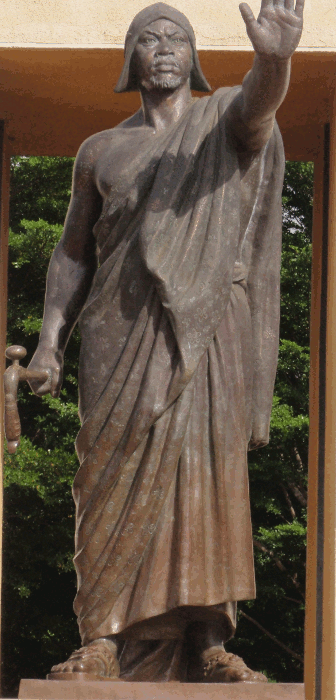
Behanzin, king of Dahomey

This famous speech of King Béhanzin is the last strong message he gave on January 20, 1894, in homage to his army which he always praised the courage, and bravery of the soldiers and amazons. For the original, click here. Since this is such an important piece of African history, I decided to translate his farewell speech into english. Enjoy!

“Fellow sufferers, last faithful friends, you know the circumstances under which, when the French wanted to grab the land of our ancestors, we decided to fight.

We had the certitude to lead our army to victory.  When my warriors rose by the thousand to defend the Danhomè and his king, I recognized with pride the same bravery manifested by those of Agadja, of Tégbessou, of Ghézo, and of Glèlè. I was by their sides in all the battles.

Despite the legitimacy of our cause, and our courage, our compact troops were decimated in an instant. They could not defeat the white enemies whom I also praise the courage and discipline. And already my weeping voice arouses no more echo.

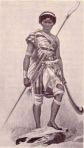
An Amazon warrior ca 1890
An Amazon warrior, ca 1890

Where are now my ardent amazons who were inflamed by a mighty anger?

Where are their indomitable chiefs: Goudémè, Yéwê, Kétungan?

Where are their robust captains: Godogbé, Chachabloukou, Godjila?

Who will praise their splendid sacrifices? Who will tell about their generosity?

Since they sealed the pact of supreme loyalty with their blood, how could I accept any sort of abdication without them?

How could I dare presenting myself in front of you, brave warriors, if I signed the general’s paper?

Continue reading “Behanzin’s Farewell Speech in Dahomey”

Béhanzin, King of Dahomey, one of the last African Resistant to French Colonization

Behanzin, king of Dahomey

Béhanzin (Gbêhanzin) Hossu Bowelle or the ‘King Shark‘ was one the most powerful kings in West Africa at the turn of the 19th century.  He was the eleventh king of Dahomey, and the last independent ruler of Abomey before French colonization.  Who was really Béhanzin?

Born in 1844 in Abomey, Béhanzin was the eleventh king of Dahomey from 1889 to 1894.  His name, Kondo, was changed to Béhanzin after he succeeded to his father GlèlèHis personal symbols were the shark, the egg, and two coconut palm trees, while those of his father were the lion and the ritual knife of Gu.  His name actually meant ‘the egg of the world or the son of the shark‘.  His great love for the freedom of his country, culture, and people led him to courageously and fiercely defend the land of his ancestors.  He led the resistance and fight for the Dahomey’s freedom.

Seh-Dong Hong-Beh, leader of Dahomey Amazons (painted by Frederick Forbes in 1851)
Seh-Dong Hong-Beh, leader of Dahomey Amazons (by Frederick Forbes in 1851)

Dahomey was one of most powerful kingdoms of West Africa, deriving its power from trade and its superior army.  Dahomey’s army was one of the strongest and best-organized armies in West Africa and was comprised of both men and women, including the Amazons, a superior and dreaded fighting force of female warriors.  At the time, Béhanzin masterfully led an army of 15000 men and 5000 amazon women.  One of the Amazon leaders was Seh-Dong Hong-Beh (which means “God speaks true“) who led an army of 6000 amazons against the Egba fortress in Abeokuta in 1851.

In 1882, France declared a protectorate over Porto Novo, a vassal state of Abomey, without consulting with the indigenous people, as was (and still is) the practice with Europeans colons.  By 1885, the French occupied the entire coastal strip West of Porto Novo.  In 1889, King Glèlè and his son Béhanzin, who considered these coastal areas to be part of the kingdom of Dahomey, declared that the Fon people could no longer tolerate France’s actions.

Combat de Dogba au Dahomey le 19 Septembre 1892
Combat de Dogba au Dahomey, 19 September 1892

In February 1890, the French occupied Cotonou; Béhanzin, now king after Glèlè’s sudden death, prepared for war.  Béhanzin’s army, with rifles supplied by the Germans, were getting too strong for neighboring French colonies.  Béhanzin’s forces attacked the French simultaneously on two fronts—militarily at Cotonou and economically by destroying the palm plantations at Porto Novo.  The latter precipitated an early end to the hostilities.  A treaty was signed, with the French continuing to occupy Cotonou, for which Béhanzin exacted an annuity; he made France pay for the use of Cotonou portThe peace lasted for two years.  However, France was determined to annex Dahomey before the British or Germans did.  Béhanzin, knowing that he would have to defend his sovereignty, continued upgrading his army in preparation for renewed war.

le general Alfred-Amedee Dodds
General Alfred-Amedee Dodds on the cover of ‘L’Illustration’ 20 May 1893

He declared a treaty made with France by his father, Glèlè, in 1868 null and void, from this war began.  In 1894, Béhanzin was defeated by Colonel Alfred-Amédée Dodds, a Senegalese mulatto, who was sent to fight against him with powerful French armed forces.  Béhanzin, not wanting his people to be massacred, surrendered his person to Dodds, without signing any instrument of national surrender or treaty.  Béhanzin thought that he will get a chance to talk to the French president and find a way or sign a conciliation agreement for his country, unfortunately, the French tricked him and instead of going to France, Behanzin was exiled to Martinique.  With Béhanzin and his immediate family adamantly refusing to sign a treaty making Dahomey a French protectorate, the French installed their choice, Agoli-Agbo, as king; Agoli Agbo, the puppet, did not last more than 6 years (when he asked for more freedom to rule, he was deported to Gabon).  Dahomey was then placed under France’s protection and it eventually became a French colony.  Béhanzin died in 1906 in Algeria.  In 1928, his son, Ouanilo (who was also France’s first African attorney in 1920) had his body moved to Dahomey. Ouanilo’s remains will be restituted to Benin almost 80 years after his death.

King Behanzin in exile in Algeria

Béhanzin once said: «Vous pouvez arracher l’homme de son pays, mais vous ne pouvez arracher son pays du cœur de l’homme, ni arracher un grand homme de l’histoire.» [You can remove a man from his country, but you can never remove his country from a man’s heart, or erase a great man from history].  Béhanzin truly loved his people, and when he saw that his army was being massacred by the French, he cried for his beautiful and strong amazons, and pronounced the most beautiful ode to them [Où sont maintenant les ardentes amazones qu’enflammait une sainte colère? … Qui chantera leurs splendides sacrifices? Qui dira leur générosité? … comment accepterais-je sans eux une quelconque abdication? Comment oserais-je me présenter devant vous, braves guerriers, si je signais le papier du Général? pour la survie de mon peuple, [j’accepte] de rencontrer dans son pays, selon sa promesse, le président des Français.

Behanzin, the Last King of independent Dahomey

Where are now the ardent amazons who were inflamed by a mighty anger? … Who will praise their splendid sacrifices? … Who will tell about their generosity? … How could I accept any sort of abdication without them? How could I dare presenting myself to you, brave warriors, if I signed the general’s paper?… for the survival of my people, [I agree] to meet in his country, according to his promise, the president of the French].  Please watch this great documentary about the life of Béhanzin, the last king of the Dahomey (part 1 – 4), and one of the last resistant to French colonization.  Why was he defeated?  He said himself: «malgré la justesse de notre cause, notre vaillance et notre détermination, ils n’ont pu l’emporter et s’accaparer de la terre de nos aïeux que par la force de leur science» [despite the legitimacy of our cause, our courage, and determination, they could only win and take the land of our forefathers because of the force of their science].  Check out the website djime.com entirely dedicated to Béhanzin and his heritage.  To learn more about Dahomey’s Amazons, check out the Smithsonian blog.  This facebook page provides details about the organization of the amazons in the army.  Don’t forget to offer your support to the Agongointo Musée du passé vivant dedicated to the kingdom of Dahomey.