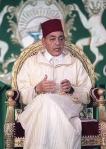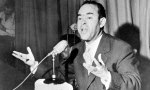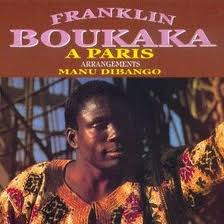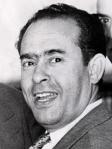
“Les Immortels” is a song written and composed by Franklin Boukaka, the great Congolese singer, to honor the great Moroccan leader Mehdi Ben Barka, African resistants, and world revolutionaries. Franklin Boukaka was a singer ahead of his time who loved his country, and had a passion for liberty. Franklin Boukaka was a freedom fighter, poet, composer, activist, and fought for African independence both politically, but above all by his great songs which today are still sung across Africa (you all have probably heard of “Aye Africa“). Born into music on 10 October 1940, with musician parents, he was murdered during the coup that deposed Ange Diawara during the night of 23-24 February1972. His greatest album was “Le Bucheron” realized with Manu Dibango, which contains “Les Immortels.” With all that is happening in Africa, with the coup against Laurent Gbagbo in Côte d’Ivoire, the crush of Libya and the guide of the revolution Mouammar Khadafi, and with the destruction of Mali, “Les Immortels” is still of actuality. Enjoy!
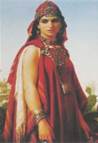
Today’s post will be dedicated to a great resistant and leader of Africa, the great Lalla Fadhma N’Soumer (also known as Lalla Fatma N’Soumer), an important figure of resistance against French invasion in Algeria. Lalla Fadhma N’Soumer has been seen as the embodiment of the Algerian struggle. The war of colonization in Algeria was one of the most brutal and repressive in Africa; it is said that Algeria lost 1/3 of its population between 1830 and 1872. The war was quite atrocious, and very often we are told of the courage and charisma of leaders such as the emir Abdel Kader, but often in history books, the names of heroines like Lalla Fadhma N’Soumer are forgotten or simply erased.
Fadhma N’Soumer
Lalla Fadhma N’Soumer was born in Werja, a village near Ain El Hammam in 1830, the year French occupation started in Algeria. She was from Kabylie. Lalla, the female equivalent of sidi, is an honorific reserved for women of high rank, or who are venerated as saints. Her real name was Fadhma Nat Si Hmed. The title, N’Soumer, was given to her because of her piety and strength and because she lived in the village of Soumer. Fadhma was the daughter of cheikh Ali Ben Aissi, who headed a Qur’anic school, which was linked with the Zawyia Rahmaniya of Sidi Mohamed Ibn Abderrahmane Abu Qabrein. Young Fadhma was extremely gifted, and memorized the Qur’an simply by listening to her father’s disciples when they chanted the various surats. After her father’s death, Fadhma directed the Qur’anic school with her brother Si Mohand Tayeb. She took special care of the children and the poor. She was known for her great piety, notable wisdom, piercing intelligence, and had an excellent reputation throughout the Kabylie region.
Battle of Somah in 1836 (by Horace Vernet)
Fadhma was only 16 when the French occupied Kabylie. In 1847, she joined the resistance leaders of the region: Si Mohamed El-Hachemi and Mohamed El Amdjed Ibn Abdelmalek (nicknamed Bou-Baghla). Bou-Baghla was probably an ex-lieutenant in the army of Emir Abdelkader, defeated for the last time by the French in 1847. Refusing to surrender, Bou Baghla retreated to Kabylie. From there, he began a war against the French armies and their allies, often employing guerilla tactics. He was a relentless fighter, very eloquent, and very religious. Fadhma and Bou-Baghla were kindred spirits fighting for the freedom of their people. After Bou-Baghla’s death in 1854, Fadhma was given command of combat by the great council of combatants and important figures of the Kabylie’s tribes.
She led a strong resistance against Marshal Jacques Louis Randon’s 13,000-strong French army. She gave them a lesson of courage, and determination. Armed with an unshakable faith, Fadhma threw herself in bloody battles to push back the enemy. During the battle of Tachekkirt, led by Bou-Baghla at the time, Randon was captured, but managed to escape later. During the famous battle of Oued Sebaou, Fadhma was only 24 years old, and headed an army of men and women; she took control, and led her people to victory, a victory heralded throughouth Kabylie. The mosques, zawiyas, and Qur’anic schools sang praises in honor of the heroine of the Djurdjura.
Lalla Fadhma N’Soumer during battle (in reality, it is said that she never used weapons)
Not willing to accept defeat, Randon asked for reinforcements, with his forces reaching 35,000 men. He asked the people of Azazga to help him reach Fadhma N’Soumer’s quarters, to end “her legend, and misdeeds.” The response to his emissary was “Go to the one who sent you, and tell him our ears cannot hear the language of him who asks us to betray.” Such was the loyalty and respect of the people for Fadhma. In response, Randon promised the people of Azazga constant exposure to his cannons. One can only imagine the brutality of the French against the Azazga people, which were later defeated. Fadhma did not give up, and mobilized her people to “fight for Islam, the land, and liberty. They are our constant, and they are sacred. They can neither be the object of concessions nor haggling.” Her strong personality and inspirational speeches had a strong influence in all of Kabylie, as shown by the sacrifice and determination of the people during all the battles, especially those of Icherridene and Tachkrit,where the enemy troops were greatly defeated. The latter took place on July 18 – 19, 1854, and resulted in a heavy death toll (over 800 dead) for the French troops.
Monument celebrating Lalla Fadhma N’Soumer, in Algiers
Defeated, Randon finally asked for a ceasefire, which Fadhma N’Soumer agreed to. She was planning to use the ceasefire period to improve her organization and reinforce her troops. Fields were plowed and sowed, and arms factories were installed in all corners of the region. However, just like with Samori Toure, or Behanzin, the French did not respect the ceasefire. In 1857, after only three years, they broke their word (as always) and launched offensives in all large cities which had been hard to overtake until then. History will record that the French were always people of no word during the colonization (and even today); they used every sneaky technique they could find to eliminate others… and even with all their ‘superior’ gunpower, and manpower, they could not have won against our great African leaders without using treachery, and treason.
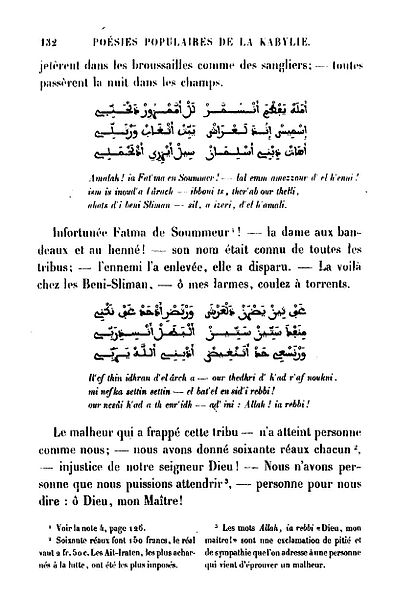
Poem dedicated to Lalla Fadhma N’Soumer (from Poésies populaires de la Kabylie du Jurjura, Paris 1867)
Fadhma N’Soumer, whose influence motivated the freedom fighters, appealed to the people for a last and supreme effort. Surrounded by women of the region, Lalla Fadhma directed the fight and encouraged remaining volunteers. However, they lost the battle, and Fadhma was arrested on 27 July 1857, in the village of Takhlijt Ath Atsou, near Tirourda. The French soldiers destroyed her rich library, which contained a rich source of scientific and religious works from the region. They also spent her fortune, which had been used toward caring for the disciples of her father’s zawiya. Lalla Fadhma N’Soumer died in 1863, from the hardship of incarceration in Béni Slimane, from the news of her brother’s passing, and the frustration from her inability to act against French aggression on her people. She was only 33 years old. The enemy (the French) nicknamed her, the Joan of Ark of theDjurdjura, a comparison that the religious Fadhma never accepted.
To read more about French invasion of Algeria, check out Mediapart. Watch the video below to learn more about Lalla Fadhma N’Soumer (It has 5 parts, and is very instructive). Whenever you think of resistance in Africa, please do remember Lalla Fadhma N’Soumer who by her courage, piety, strength, and charisma was able to defeat the mighty French army, and capture a French marshal/general. Remember that there was a woman who held a rich library of scientific and religious works which was destroyed by the French army (it must have been full of treasures for them to destroy). Remember that this woman served the people, and love them dearly to sacrifice her life for their freedom. Remember, yes, that a woman led men and women to battles, and actually won!
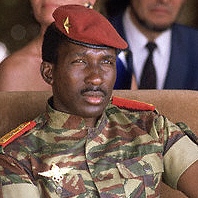
Je n’ai pu m’empêcher de partager avec vous ce pur joyau d’un autre temps: une interview du President Thomas Sankara par Mongo Beti. Cette interview n’avait jamais été publiée auparavant, jusqu’à ce que l’épouse de Mongo Beti, Odile Tobner, la mette sur le site de la Société des Amis de Mongo Beti (SAMBE). En 1985, Mongo Beti eut une entrevue privée avec notre ‘Che’ africain, Thomas Sankara, à la fin de laquelle, il lui envoya d’autres questions auxquelles Thomas répondit. Ci-dessous, vous trouverez quelques extraits de cet entretien, où j’ai mis les questions de Mongo Beti sous formes de thèmes, et les réponses de Sankara suivent juste après (en bleu). Pour l’intégrale, prière de visiter SAMBE.
==========
Sur les attaques ennemies: “Il y a partout aujourd’hui, aux quatre coins du continent, des N’Krumah, des Lumumba, des Mondlane, etc. Que Sankara soit éliminé aujourd’hui physiquement, il y aura des milliers de Sankara qui relèveront le défi face à l’impérialisme. …Toutefois, pour mille et une raison, notre peuple et la jeunesse révolutionnaire africaine restent attachées à Sankara et ne souhaitent jamais que le moindre malheur lui arrive.”
Sur la corruption: “Sans être un sociologue averti, ni un historien des sociétés précapitalistes africaines, je ne pourrai pas affirmer que la corruption est propre aux sociétés africaines. C’est un phénomène lié avant tout au système capitaliste, système socio-économique qui ne peut véritablement évoluer sans développer la corruption. Elle est donc incontestablement un héritage maudit de la colonisation. Ainsi, logiquement, pour combattre valablement la colonisation, le colonialisme et même le néocolonialisme, il faut aussi s’attaquer à la corruption.”
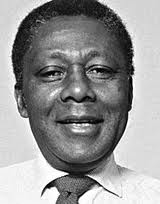
Alexandre Biyidi Awala, a.k.a. Mongo Beti
Sur les traditions africaines et la place de la femme (polygamie, excision): “On ne fait pas de révolution pour régresser dans le temps. C’est pour aller toujours de l’avant. La Révolution ne peut qu’étouffer tous les aspects négatifs de nos traditions. C’est cela notre combat contre toutes les forces rétrogrades, toutes les formes d’obscurantisme, combat légitime et indispensable pour libérer la société de toutes les emprises décadentes et de tous les préjugés, dont celui qui consiste à marginaliser la femme ou à la chosifier. … Nous luttons pour l’égalité de l’homme et de la femme, pas d’une égalité mécanique, mathématique, mais en rendant la femme l’égale de l’homme devant la loi et surtout devant le travail salarié. L’émancipation de la femme passe par son instruction et l’obtention d’un pouvoir économique. Ainsi le travail au même titre que l’homme, à tous les niveaux, la même responsabilisation et les mêmes droits et devoirs sont des armes contre l’excision et la polygamie, armes que la femme n’hésitera pas à utiliser pour se libérer elle-même et non par quelqu’un d’autre.”
Sur la cooperation, et la conference au sommet des chefs d’Etats francophones: “Lutter pour son indépendance face au colonialisme ne veut pas dire que l’on se prépare, une fois celle-ci obtenue, à quitter la terre pour aller s’isoler quelque part dans le cosmos. Quant aux conférences au sommet des chefs d’État francophones, ils servent, chaque fois que nous avons l’occasion d’y prendre part, de tribune, de tremplin pour notre révolution, pour la faire connaître, de dire ouvertement ce qu’elle pense de ces conférences ou instances politiques. Y participer pour dénoncer ce qui ne va pas dans l’intérêt des peuples africains est une stratégie beaucoup plus payante que les sarcasmes envoyés de l’extérieur.”
Sur le franc CFA: “le franc CFA, lié au système monétaire français est une arme de la domination française. L’économie française et, partant, la bourgeoisie capitaliste marchande française bâtit sa fortune sur le dos de nos peuples par le biais de cette liaison, de ce monopole monétaire.”
Sur le panafricanisme et Nkrumah: “Tout le monde constate aujourd’hui avec amertume, face aux méfaits et autres exactions de l’impérialisme en Afrique, que N’krumah avait très bien raison d’aller de tous ses voeux à l’unité du continent. Néanmoins l’idée demeure et il nous appartient, il appartient aux patriotes africains, de lutter partout et toujours pour sa concrétisation. Il appartient à tous les peuples panafricanistes de reprendre le flambeau de N’Krumah pour donner espoir à l’Afrique.”
Sur le parti unique: “Ce qui est discrédité c’est le parti unique bourgeois, parce que obéissant à une idéologie d’injustice, donnant le premier rôle à une minorité au détriment de la majorité. Un parti unique démocratique, c’est-à-dire un parti du peuple, ne peut en aucun cas être discrédité, parce qu’au service d’un peuple, des intérêts de la majorité. C’est sur une telle base qu’il faut voir la question du parti unique, qui est aussi une vision des masses.”
Sur la privatisation de certains secteurs: “La révolution burkinabé considère l’initiative privée comme une dynamique qu’elle prend en compte dans l’étape actuelle de la lutte du peuple burkinabé. … L’État ne peut pas s’engager dans une étatisation tous azimuts, même si le contrôle d’un certain nombre de secteurs vitaux de notre économie s’avère indispensable.”
Au camarade Mongo Beti, 3/11/85 La patrie ou la mort, nous vaincrons !
Today I will be talking about a writer of the caliber of Chinua Achebe and Ngugi wa Thiong’o, a writer often forgotten, a writer who fought with his writings for independence, a Cameroonian writer who wrote about Cameroon’s first freedom fighter Ruben Um Nyobé, and whose writings were banned… you have probably guessed it, I am talking about the great Mongo Beti.
Mongo Beti was born Alexandre Biyidi Awala, on 30 June 1932 in Akométan, near Mbalmayo, south of Yaoundé, the capital of Cameroon. From a young age, Mongo Beti was already exposed to the currents of independence and freedom that were shaking Cameroon, and was exposed to Um Nyobé. He would eventually get expelled from the local missionary school at 14, for being outspoken. As he himself said “At the time, I was very shocked by the idea of confessing my sins to someone else.” He would eventually attend the Lycee Leclerc in Yaoundé, and then move to the Sorbonne in Paris, France, for further studies.
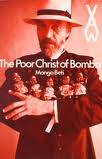
‘The Poor Christ of Bomba’ by Mongo Beti
Mongo Beti claimed that he entered writing through writing political tracts. His first piece was a short story published by Alioune Diop in 1953 in Présence Africaine, “Sans haine et sans amour” (Without hatred or love). He first started writing under the pen name Eza Boto, by fear of retaliation from the French colonial regime. His first book “Ville Cruelle” or “Cruel City” published in 1954, was actually on the school program in all high schools of Cameroon for many years in the 80s to late 90s. His second novel “Le Pauvre Christ de Bomba” (“The Poor Christ of Bomba“) was published under the pseudonym Mongo Beti, to distance himself from his previous piece. The name Mongo Beti means in Ewondo, ‘Son of the Beti people’. This new novel created a scandal because of its satirical and biting description of the missionary and colonial world. Under pressure from the religious hierarchy, the colonial administrator in Cameroon banned the novel in the colony. This novel was followed by “Mission Terminée” in 1957 (winner of the Prix Sainte Beuve 1958), andLe Roi Miraculé, 1958. All three books were translated into English and many other languages, which gave Beti a lasting international reputation. During this time, he also worked for the review Preuves, for which he reported from Africa, as well as a substitute teacher at the lycée of Rambouillet. He later on taught at the Lycee Pierre Corneille of Rouen until his retirement in 1994.
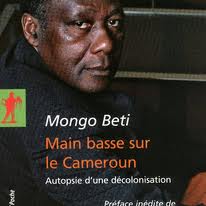
“Main basse sur le Cameroun…” de Mongo Beti
‘Wanted’ in the colony because of his sharp writings, and his connections to the UPC of Ruben Um Nyobé, Mongo Beti stayed in France. Ruben Um Nyobe’s murder by the colonial administration in 1958, truly shook Beti to his core; he fell silent and did not publish any book for the following decade. In 1971, he finally wrote “Main Basse sur le Cameroun, autopsie d’une décolonisation” (Cruel hand on Cameroon, autopsy of a decolonization) which was censored upon its publication by the French Ministry of the Interior Raymond Marcellin on the request, brought forward by Jacques Foccart, of the Cameroon government, represented in Paris by the ambassador Ferdinand Oyono. This essay perhaps sprang from frustration and rage at the collapse of the UPC rebellion and the public execution of its last leader, Ernest Ouandié, in 1970. It was a devastating critique of the authoritarian regime of Cameroon, and asserted that Cameroon and other colonies remained under French control in all but name, and that the post-independence political elites had actively fostered this continued dependence. The 1970s also saw two of his most passionately political novels, “Remember Ruben“ and “Perpetue et l’Habitude du Malheur,” both published in 1974.
In 1978 he and his wife, Odile Tobner, launched the bimonthly reviewPeuples Noirs. Peuples Africains (‘Black People. African People‘), which was published until 1991. This review chronicled and denounced tirelessly the evils brought to Africa by neo-colonial regimes. During this period were published the novels La Ruine presque Cocasse d’un Polichinelle (1979), Les deux mères de Guillaume-Ismael Dzewatama (1983), La revanche de Guillaume Ismaël Dzewatama (1984), also Lettre ouverte aux Camerounais ou la deuxième mort deRuben Um Nyobé (1984) and Dictionnaire de la Negritude (1989, with Odile Tobner). Frustrated by what he saw as the failure of post-independence governments to bring genuine freedom to Africa, Beti adopted a more radical perspective in these works.
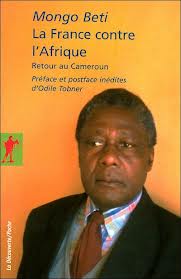
‘La France contre l’Afrique’ de Mongo Beti
Mongo Beti returned to Cameroon in 1991 after 32 years of exile. In 1993 he published La France contre l’Afrique, Retour au Cameroun, a book chronicling his visits to his homeland. After retiring from teaching in 1994, he returned to Cameroon permanently. He opened the Librairie des Peuples noirs (Bookstore of the Black Peoples) in Yaoundé and organized agricultural activities in his village of Akométam. However, his return did not leave the government silent: he was subjected to police aggression in January 1996 in the streets of Yaoundé, and was subsequently challenged at a demonstration in October 1997. In response he published several novels: L’histoire du fou in 1994 then the two initial volumes Trop de Soleil tue l’Amour (1999) et Branle-bas en noir et blanc (2000), of a trilogy which would remain unfinished. He was hospitalized in Yaoundé on October 1, 2001 for acute hepatic and kidney failure which remained untreated for lack of dialysis. Transported to the hospital in Douala on October 6, he died there on October 8, 2001. Some critics noted the similarity of his death to that of his heroine Perpetua, who also died while awaiting treatment in one of the country’s overburdened hospitals.
‘Trop de Soleil tue l’Amour’ by Mongo Beti
As I write about him today, I feel very sad that we, in Cameroon, don’t honor our heroes. No one can even fathom the depth of Mongo Beti’s work. It is immense, and his service to Cameroon’s history is beyond our imagination. At a time when everybody was scared of the regime (and rightly so, after the ‘maquis‘ years), he dared to write. From afar, yes, one might say from the safety of France and not Cameroon, he continued his mission of informing, and enlightening us. How many contributed like Mongo Beti to our knowledge of Ruben Um Nyobé? I am sure Mongo Beti’s book “Main basse …” is one of the rare written accounts of Ernest Ouandié. The African writer, Boubacar Boris Diop wrote: “Sans jamais se courber devant personne, il [Mongo Beti] a réussi à faire d’un simple pseudonyme un cri de ralliement. Sa vie durant, il a haï l’hypocrisie, le vain folklore et les faux-fuyants. Il est resté fidèle, jusqu’au martyre, à sa passion de la liberté.” (Without ever bending to nobody, he [Mongo Beti] succeeded in turning a pseudonym into a rallying cry. Throughout his life, he hated hypocrisy, vain folklore, and subterfuge. He remained faithful, up to martyrdom, to his passion for freedom.) Your work, O Mongo, is a true treasure in the archives of Cameroon. Peace be with you Mongo, you are not just a son of the Beti, but rather a son of Cameroon… Peace to you Mongo Cameroon.
During Kwame Nkrumah‘s state funerals in Conakry on 13 – 14May 1972, Amilcar Cabral gave this great speech titled: “Le Cancer de la Trahison,” (The Cancer of Betrayal) on May 13, 1972, which I posted earlier in French. I have now translated his speech to English, and would like all to enjoy. I will later add the captions to the video on youtube as well.
=========
In his last public speech in Conakry, at the funeral of the former Ghanaian president Nkrumah, Amilcar Cabral had denounced the cancer of betrayal that eats up African movements. His comments today take a strange resonance in Guinea as in Angola, and Mozambique, where many movements are demanding power which the Portuguese have not yet abandoned.
Amilcar Cabral
“… What to say? but we must speak otherwise at this point, if we don’t talk, our hearts may burst. Our tears should not infiltrate the truth.We, freedom fighters, we do not mourn the death of a man, even a man who was a comrade and an exemplary revolutionary, because as President Ahmed Sekou Toure often says ‘what is man in front of the infinite being and transgressing of the people and of humanity?’ We do not mourn the people of Ghana scoffed in its most beautiful realisations, in its most legitimate aspirations.We are not crying for Africa, betrayed. We are mourning, yes, of hatred towards those who were able to betray NKRUMAH to serve the ignoble imperialism… Mr President, Africa by requiring through the voice of the people of the Republic of Guinea, as always fairly represented by President Ahmed Sekou Toure, whom NKRUMAH had put in his right place on the Kilimandjaro’s highest summits of the African revolution, Africa rehabilitates itself and through history. President NKRUMAH, which we honor is primarily the great strategist of the struggle against classic colonialism, he is the one who created what we call African positivism, what he called “positive action”, affirmative action. We pay tribute to the declared enemy of neocolonialism in Africa and elsewhere, the strategist of economic development in his country. Mr President,we praise the freedom fighter of the African people who always gave his full support to national liberation movements, and we want to tell you here that we, in Guinea and Cape Verde islands, even though it is true that the most important factor for the development of our struggle outside our country was the independence of the Republic of Guinea,the heroic ‘no’ of the people of Guinea on 28 September 1958. It is also true thatif we went through the struggle regenerated, it was essentially due to the concrete support of Ghana and particularly of President Nkrumah …
Mr. President, we should however in this moment remember that all coins in life have two faces, all realities have positive and negative sides… to all positive action, is opposed a negative action. To what extent is betrayal’s success in Ghana linked to problems of class struggle, from contributions to social structures, from the role of party or other instructions, including armed forces as part of a new independent state. To what level, we shall ask ourselves, is betrayal’s success in Ghana linked to a correct definition of this historical entity and craftsman of history that is the people and their daily work, in defending its own independence conquests? Or to what extent is betrayal’s success not linked to the major problem of the choice of men in the revolution? My idea on this question will allow us to better understand the greatness of Nkrumah’s work, to understandthe complexity of problems he had to face so many times alone… problems that will allow us to conclude that, as imperialism exists, an independent state in Africa should be a liberation movement to power or it would not exist. Let no one tell us that Nkrumah died of a cancer to the throat or some other disease; no, Nkrumah has been killed by the cancer of betrayal that we should uproot… by the cancer of betrayal, that we should root out of Africa if we really want to definitely crush the imperialist domination on this continent. But, we, Africans, firmly believe that the dead continue living by our sides, we are a society of dead and living.Nkrumah will resuscitate each dawn in the hearts and in the determinations of freedom fighters, in the action of all true African patriots. Our liberation movement will not forgive those who betrayed Nkrumah, the people of Ghana will not forgive, Africa will not forgive, progressive mankind will not forgive!”
Translated from French by Dr. Y., afrolegends.com (12 October 2012)
Please enjoy this pure jewel of history… President Kwame Nkrumah‘s speech proclaiming the independence of Ghana at 12:00AM on 6 March 1957. So much to praise, the joy and hope that this new state’s birth brought. Find below the written part of the speech, and watch to hear Kwame Nkrumah deliver this great speech.
=================
At long last, the battle has ended! And thus, Ghana, your beloved country is free forever!
And yet again, I want to take the opportunity to thank the people of this country; the youth, the farmers, the women who have so nobly fought and won the battle.
Also, I want to thank the valiant ex-service men who have so cooperated with me in this mighty task of freeing our country from foreign rule and imperialism.
And, as I pointed out… from now on, today, we must change our attitudes and our minds. We must realize that from now on we are no longer a colonial but free and independent people.
But also, as I pointed out, that also entails hard work. That new Africa is ready to fight its own battles and show that after all the black man is capable of managing his own affairs.
We are going to demonstrate to the world, to the other nations, that we are prepared to lay our foundation – our own African personality.
As I said to the Assembly a few minutes ago, I made a point that we are going to create our own African personality and identity. It is the only way we can show the world that we are ready for our own battles.
Kwame Nkrumah
But today, may I call upon you all, that on this great day let us all remember that nothing can be done unless it has the purport and support of God.
We have won the battle and again rededicate ourselves … OUR INDEPENDENCE IS MEANINGLESS UNLESS IT IS LINKED UP WITH THE TOTAL LIBERATION OF AFRICA.
Let us now, fellow Ghanaians, let us now ask for God’s blessing for only two seconds, and in your thousands and millions.
I want to ask you to pause for only one minute and give thanks to Almighty God for having led us through our difficulties, imprisonments, hardships and sufferings, to have brought us to our end of troubles today. One minute silence.
Ghana is free forever! And here I will ask the band to play the Ghana National Anthem.
Reshaping Ghana’s destiny, I am depending on the millions of the country, and the chiefs and the people, to help me to reshape the destiny of this country. We are prepared to pick it up and make it a nation that will be respected by every nation in the world.
We know we are going to have difficult beginnings, but again, I am relying on your support…. I am relying upon your hard work.
Seeing you in this… It doesn’t matter how far my eyes go, I can see that you are here in your millions. And my last warning to you is that you are to stand firm behind us so that we can prove to the world that when the African is given a chance, he can show the world that he is somebody!
We have awakened. We will not sleep anymore. Today, from now on, there is a new African in the world!
Few men on the continent have had the aura of President Kwame Nkrumah, one of the greatest pan-africanist of the continent and the first president of Ghana. Kwame Nkrumah was born on 21 September1909 in Nkroful, Gold Coast (the pre-independence name of Ghana) the world’s largest cocoa producer. Hailing from a modest traditional family, He trained to be a teacher at the Achimota School in Accra from 1927 to 1930. For the following five years, he then taught in elementary schools across the Gold Coast. He later on attended Lincoln University in Pennsylvania, where he graduated with a BA in theology in 1942. He went on to attend the University of Pennsylvania, where he earned a Master of Science in education, and a master of arts in philosophy in 1943. During his time in the US, he preached at black Presbyterian churches in Philadephia, and New York city. Moving to London after World War II, Nkrumah helped organize Pan-African congresses, linking the emergent educated groups of the African colonies with activists, writers, artists, and well-wishers from the industrial countries. It was a time of great intellectual ferment, excitement, and optimism. Gandhi and India‘s achievement of independence in 1947 stirred dreams of freedom for the other colonies. “If we get self-government,” Nkrumah proclaimed, “we’ll transform the Gold Coast into a paradise in 10 years.”
Flag of the Gold Coast
In 1947, Nkrumah was invited to serve as the general secretary of the United Gold Coast Convention (UGCC), exploring paths to independence of the Gold Coast from British rule. After the riots of February 1948, and arrests of UGCC leaders by British rule, Nkrumah emerged as the party leader upon release. He proclaimed that the Gold Coast needed “self-government now,” and built a large power base including cocoa farmers, women (at a time when women were not invited in the political process) and trade unions. On 12 June 1949, he organized a new political party based on these groups: the Convention People’s Party (CPP). Within two years the CPP had won limited self-rule elections, and Nkrumah became “Leader of Government Business” in 1951 after a landslide CPP win in the first general election– a de facto prime minister, responsible for internal government and policy. He set his sights firmly on independence. No amount of autonomy or self-rule, he argued, could match the energy, commitment, and focus of a government and people in a truly independent country. It was a precondition for growth. He summarized his philosophy in a slogan that became famous and influential across Africa: “Seek ye first the political kingdom, and all else shall be added unto you….”
Map and Flag of Ghana
As a leader of this government, Nkrumah faced many challenges: first, to learn to govern; second, to unify the four territories of the Gold Coast; third, to win his nation’s complete independence from the United Kingdom. Nkrumah was successful at all three goals. Within six years of his release from prison, he was the leader of an independent nation. At 12 a.m. on 6 March 1957, Nkrumah declared Ghana independent. The country became independent as a Commonwealth realm. He was hailed as the Osagyefo – which means “redeemer” in the Twi language.
On 6 March 1960, Nkrumah announced plans for a new constitution, which would make Ghana a republic. On 19, 23, and 27 April 1960 a presidential election and plebiscite on the constitution were held. The constitution was ratified and Nkrumah was elected president over J. B. Danquah, the UP candidate, 1,016,076 to 124,623. In 1961, Nkrumah laid the first stones in the foundation of the Kwame Nkrumah Ideological Institute created to train Ghanaian civil servants as well as promote Pan-Africanism. In 1964, all students entering college in Ghana were required to attend a two-week “ideological orientation” at the Institute. In 1963, Nkrumah was awarded the Lenin Peace Prize by the Soviet Union. Ghana became a charter member of the Organization of African Unity in 1963.
Kwame Nkrumah on Cedi notes
The Gold Coast had been among the wealthiest and most socially advanced areas in Africa, with schools, railways, hospitals, social security and an advanced economy. Under Nkrumah’s leadership, Ghana adopted some socialist policies and practices. Nkrumah created a welfare system, started various community programs, and established schools. Nkrumah’s time in office was successful and ambitious (could you blame him? With a newly independent country, there was so much to build), with forestry, fishing, and cattle-breeding expanded, production of cocoa (Ghana’s main export) doubled, and modest deposits of bauxite and gold exploited more effectively. The construction of a dam on the Volta River (launched in 1961) provided water for irrigation and hydro-electric power, which produced enough electricity for the towns as well as for a new aluminum plant. Government funds were also provided for village projects in which local people built schools and roads, while free health care and education were introduced. Ghana adopted the Ghana Cedi (GHC) as a currency in 1965; the word “cedi” being the Akan word for cowry shells, which were used as currency in the old days.
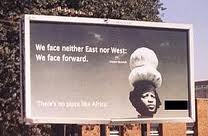
Billboard in Lusaka, Zambia, with Kwame Nkrumah’s famous quote for non-alignment
He generally took a non-aligned Marxist perspective on economics, and believed capitalism had malignant effects that were going to stay with Africa for a long time (and rightly so, we can all see the effects of IMF, and World Bank policies in Africa today: poverty to the grave). Nkrumah argued that socialism was the system that would best accommodate the changes that capitalism had brought, while still respecting African values. At a time when there were East & West blocks from the cold war, and where Africa was stuck in the middle, with no way out but to bend to some of the East-West politics (which could not work for us), Nkrumah believed in non-alignment. He made a famous quote on non-alignment which said: “We face neither East nor West; We face forward.” To show that we, as Africans, could not be forced to adhere to politics or economics which had no respect for us as human beings and for our cultures.
Celebrating the birth of the OAU
In Africa Must Unite(1963) Nkrumah called for the immediate formation of a pan-African government. Later he sat on a unification movement that emanates from the base, while anti-imperialist governments and between the Western-backed “puppet regime” could be no common ground. He was a true visionary to have seen that Africa needed to unite in order to survive, because as it stood divided in 50-something states it was an easy prey to Western imperialists. Nkrumah’s biggest success in this area was his significant influence in the founding of the Organization of African Unity (OAU).
Nkrumah’s sculpture at the Kwame Nkrumah Mausoleum in Accra
Truth be told, Nkrumah was too big for his own good. He wanted Ghana and Africa to be truly independent: politically, and economically. He was a strong advocate for pan-Africanism, and the true instigator and founder of the Organization of African Unity (now African Union) whose goals were to raise Africa, and promote unity and strength across the continent. He also helped several independent movements in Africa, such as those from Rhodesia (Zimbabwe). He was ousted in February1966 by a military coup, while on state visit to Vietnam.
After the coup, Nkrumah lived in exile in Conakry, Guinea, as the guest of President Ahmed Sekou Toure who made him honorary co-president. He read, wrote, corresponded, gardened, entertained guests, and continued to push for his vision of African unity. 50 years later, Kadhafi who was trying to revive, and reinvigorate the African Union, and almost succeeded, was also brought down by Western Imperialism; and his country, the beautiful Libya (one of the few countries in the world without debt) bombed and brought down in flames.
Centenary of Kwame Nkrumah
Nkrumah died in 27 April1972 of skin cancer in Romania. One can tell the greatness of the man by the number of universities who carry his name during his lifetime. If you are ever in Accra, visit the Kwame Nkrumah Mausoleum which is a true piece of art, as well as the Kwame Nkrumah University of Science and Technology in Kumasi. Check out Nkrumah.net to learn more about this great African leader, and read some of his speeches. Check out this great video which talks about Kwame Nkrumah’s fight for Ghana’s independence, as well as his struggle to maintain his vision for an independent Ghana (check out all parts 1-4). Don’t forget to read some of his books: Africa Must Unite (1963), Neo-colonialism: the Last Stage of Imperialism (1965), African Socialism Revisited (1967), Dark Days in Ghana (1968), Handbook of Revolutionary Warfare (1968), I Speak of Freedom (1973), and many more.
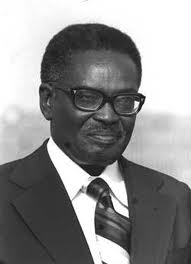
Angolans are marking this Monday the National Heroes’ Day, in homage to the country’s first president, the late Dr. Agostinho Neto, who was born on 17 September 1922 in Kaxicane locality. Celebrate with me Angola’s National Heroes’ Day by enjoying a poem by Angola’s greatest poet, and its first president.
Criar
Criar criar criar no espírito criar no músculo
criar no nervo criar no homem criar na massa criar criar com os olhos secos Criar criar sobre a profanação da floresta sobre a floresta impúdica do chicote criar sobre o perfume dos troncos serrados criar criar com os olhos secos Criar criar gargalhadas sobre o escárneo da palmatória coragem nas pontas das botas do roceiro força no esfrangalhado das portas violentadas firmeza no vermelho sangue da insegurança criar criar com os olhos secos
Criar criar estrelas sobre o camartelo guerreiro paz sobre o choro das crianças paz sobre o suor sobre a lágrima do contrato paz sobre o ódio criar criar paz com os olhos secos Criar criar criar liberdade nas estradas escravas algemas de amor nos caminhos paganizados do amor sons festivos sobre o balanceio dos corpos em forcas simuladas criar criar amor com os olhos secos.
Create
Create create create in mind create in muscle
create in nerve create in man create in the masses create create with dry eyes Create create over the profanation of the forest over the shameless fortress of the whip create over the scent of sawn trunks
create create with dry eyes Create create laughter over the scorn of the palmatoria courage in the tips of the planter’s boots strength in the splintering of battered-in doors firmness in the red blood of insecurity create create with dry eyes Create create stars over the warrior’s sledge-hammer peace over children’s weeping peace over the sweat the tears of forced labour peace over hatred create create peace with dry eyes
Create create create freedom on slave highways manacles of love on the paganised
paths of love festive sounds over bodies swinging on simulated gallows create create love with dry eyes.
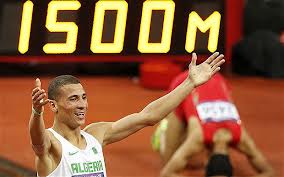
Taoufik Makhloufi after winning the 1500 m (source: telegraph.co.uk)
I just wanted to give you an update on all our African medalists at the 2012 London Olympics.
Taoufik Makhloufi, of Algeria, won Gold in the 1500m Men yesterday, after a display of courage and determination. He was disqualified on Monday for not putting enough effort in the Men’s 800m qualifiers, and then later on reinstated, and went on to winning Gold in the 1500m. Such drama! Abdalaati Iguider of Morocco won the bronze in the 1500m Men, after Taoufik.
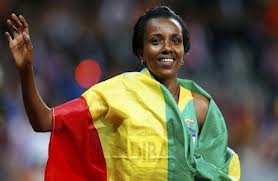
Tirunesh Dibaba, the baby face destroyer, destroyed her competitors on the 10,000m women’s race. It was lovely to watch her sprint to the finish. We long for a repeat on the 5,000m women’s race which will take place this Friday. The Kenyans Sally Kipyego and Vivian Cheruiyot won silver and bronze respectively.
On the men’s 10,000m, Kenenisa Bekele disappointed us. Frankly all Africans top runners disappointed us. It was mostly a show of African top runners elbowing each other to stop the other from winning (Kenyans, Ethiopians, and Erythreans) and cornering Kenenisa… and that’s how the British-Somalian Mo Farah won. Basically, our brothers just went for the ‘crab’ politics. Disappointing! Tariku Bekele, Kenenisa’s brother, saved the day by winning the bronze medal.
Tirunesh Dibaba, after winning the 10,000 m race in London 2012
The Men’s 3000m Steeplechase was won by Ezekiel Kemboi of Kenya who took gold, while another compatriot, Abel Kiprop Mutai took the bronze. In the women’s 3000 m Steeplechase, Sofia Assefa of Ethiopia won the bronze medal.
The Women’s marathon was won by Tiki Gelana of Ethiopia who set a new olympic record, and was followed by Priscah Jeptoo of Kenya with silver.
In swimming, Tunisian Oussama Mellouli took Bronze in the Men’s 1500m freestyle. South African Chad le Clos took Silver in the Men’s 100m butterfly, and gold in the Men’s 200m butterfly. Cameron van der Burgh, another South African, won the gold medal in the Men’s 100m breaststroke.
There are so few female scientists in the world, and particularly in Africa, that I had to talk about Sameera Moussa, the world-renowned Egyptian nuclear scientist. Sameera Moussa held a doctorate in atomic radiation, specializing on making the medical use of nuclear technology affordable to all. She organized the Atomic Energy for Peace Conference and sponsored a call for setting an international conference under the banner “Atom for Peace,” where many prominent scientists were invited. The conference made a number of recommendations for setting up a committee to protect against nuclear hazards, for which she strongly advocated.
Sameera was born in the Gharbia Governorate in Egypt in 1917. After she lost her mother to cancer, she vowed to study how to better medicine through science. She went on the join the faculty of Sciences at the University of Cairo, where she earned a BSc in Radiology in 1939, with first class honors. She became a remarkable faculty, and the first woman to hold a university post. Being the first to obtain a Ph.D. degree in atomic radiation, she earnestly sought to make nuclear treatment to everyone. She used to say: “I’ll make nuclear treatment as available and as cheap as aspirin.” She worked hard for this purpose and throughout her intensive research, she came up with a historic equation that would help break the atoms of cheap metals such as copper, ultimately paving the way for a cheap nuclear bomb. Sameera also volunteered to help treat cancer patients at various hospitals especially since her mother went through a fierce battle against this disease.
Sameera Moussa at the University of Cairo
Later on, Sameera received a Fullbright scholarship to study at modern research facilities at the California University. In recognition for her pioneering nuclear research, she was given permission to visit the secret US atomic facilities. The visit raised vehement debate in the United States Academic and Scientific circles since Sameera was the first “alien” to have access to such facilities.
She turned down several offers that required her to live in the United States and be granted American citizenship, saying “Egypt, my dear homeland, is waiting for me.” On August 5th, 1952 after her first visit to America she intended to return home, but was invited on another trip. On the way, the car rushed down from a height of 40 feet, which killed her immediately. The mystery surrounding her accident, since the invitation to California, made people suspicious and many believe that it was a planned assassination.
Today, Sameera has been awarded several prizes (the 1953 honor by the Egyptian Army, and the 1981 Order of Science and Arts by , but most importantly she has paved the way for Egyptian and African women scientists. It feels so great to know that back in the 1930s, and 1950s, when there were people likeEnrico Fermi, Albert Einstein, Maria Goeppert-Mayer, there was alsoSameera Moussa, an outstanding Egyptian Female scientist who thought of ‘Atoms for Peace’ and wanted cheap treatments for all.