Egusi Ice Cream Anyone? Caterpillar Ice Cream? … What about African Flavors in Ice Cream?

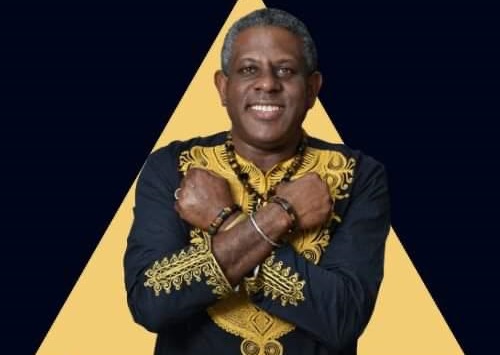
Tapiwa Guzha, founder of Tapi Tapi (Source: sossegodaflora.blogspot.com)

Can you imagine having Egusi ice cream? or dried fish or edible clay or caterpillar or Chin Chin ice cream? … well… think no further! In 2020, Zimbabwean postdoctoral student Tapiwa Guzha who emigrated to South Africa for studies, had the idea of creating an ice cream parlor that represented African foods, flavors, and cultures. He thought of sharing his love of science, his specialty being plant biotechnology, to educate others with flavors from the continent. Thus was born Tapi Tapi, which means sweet sweet in the Shona language of Zimbabwe. Guzha mixed in typical traditional African flavors from all over the continent into his ice cream. To date, he has made over 900 different flavors from some of the most amazing African spices, nuts, seeds, fruits, flowers, clay, and even caterpillar. Tapi Tapi‘s sugar cones are made with millet, cassava, sorghum, maize, and plantain flour.. Enjoy, and if you are ever in Cape Town, don’t be shy… go and try out these amazing African flavors! Excerpts below are from the Guardian! Please also check out this very good article from TravelEssenceMag, and another from CNN.

======

Baobab ice cream (Source: Tapi Tapi)

Caterpillars, dried fish and clay are not what you would expect to find in ice-cream, but one Cape Town cafe with a mission to celebrate African foods and culture has used all three as ingredients in its frozen desserts.

Handcrafted, authentic African ice-cream,” reads a sign at the entrance to Tapi Tapi. Inside, the counter is filled with ice-creams in various shades of beige and brown. They look underwhelming, but the blackboard listing the flavours suggests differently.

Tshego Kale, a 22-year-old student and part-time worker in the cafe, explains the menu. “First up is prekese and kei-apple jam. Prekese is a spice from west Africa, sometimes used in soups,” she says. “Kei apple is a sour fruit, but the ice-cream is sweet with a bitterness coming through.” Rooibos, fermented pineapple and lime is next: “It’s sweet, not as dense; good for hot days.”

There are three ice-creams containing chin chin – a fried snack from west Africa. One is paired with African bird’s eye chilli, and has “a kick that comes towards the end”. Another one features clay as the second ingredient: “It has an earthy flavour, very mellow and smooth with a biscuity texture.”

Egusi, a combination of seeds used in west African cuisine, is mixed with pumpkin, cinnamon and nutmeg in another ice-cream. “People from overseas have said this one tastes like Christmas,” says Kale.

Rooibos

Tapi Tapi and its African ice-cream is the brainchild of Tapiwa Guzha, who first came to Cape Town as a student from Zimbabwe. In the two years since it opened, he has created about 900 flavours.

Each tub he makes is unique and never repeated. His aim is to use ice-cream as a vehicle for educating and inspiring people about African flavours. When making a new flavour, Guzha thinks of an ingredient and what he wants to achieve by using it.

He explains: “What point am I trying to make by creating that flavour? Am I trying to showcase something new that people don’t know about? Am I trying to teach people about a cooking technique that turns out certain dishes or flavours? Or am I looking at a cultural icon?”

The idea for Tapi Tapi came in 2018, when Guzha was doing post-doctoral research in plant biotechnology but wanted a change. “I was looking for ways of communicating about science without having to rely on the scientific process – journal publishing, conferences and keeping knowledge in academic spaces,” he says.

Guzha had been making ice-cream for 10 years with dry ice that was delivered to his research labs, after seeing how it was done on a cookery show. One day, it dawned on him that he had never made a specifically African ice-cream. “I realised there was something faulty in the system. The moment you taste a flavour that connects you to home, your culture, your land – it’s a different experience.”

King Shaka’s Warriors

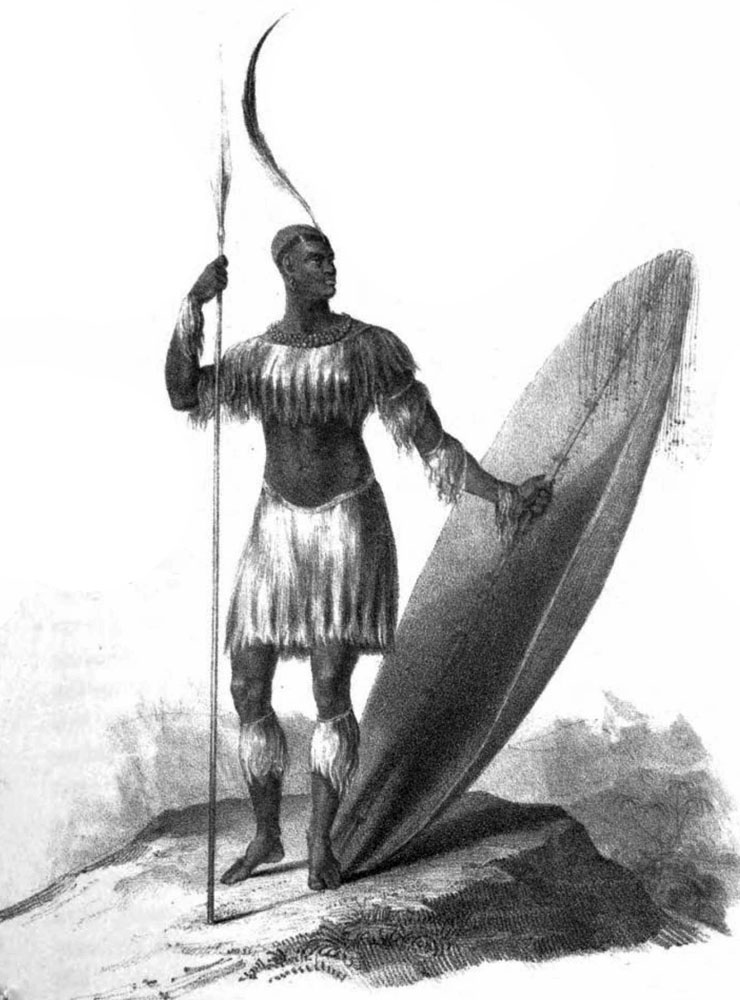
Sketch of King Shaka from 1824 (found in Nathaniel Isaacs’ book ‘Travels and Adventures in Eastern Africa,’ published in 1836)

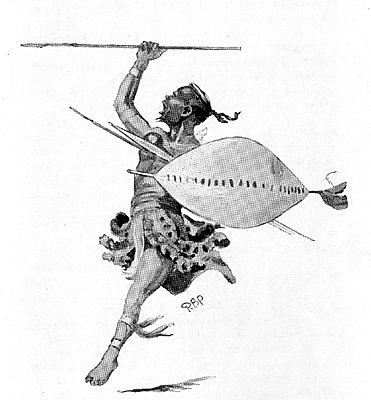
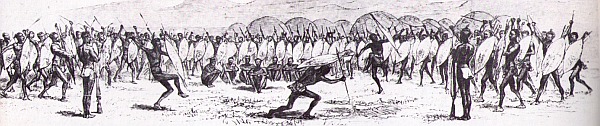
Below is a description of King Shaka’s warriors. King Shaka is known for the military and social innovations he brought to the Zulu people unifying them into a formidable empire admired by some, and feared by others. What stands out is the great discipline of his warriors.  The Zulu army or Zulu impi was the most powerful war machine the British ever faced in Southern Africa.  The Zulu combat strategy was perfected by King Shaka himself, who added great organization and discipline to the traditional qualities of courage and mobility cultivated within African armies.  During the battle, the Zulu army would organize itself as an arc facing the adversary. This arrangement was known as the “bull horn” formation. At the center (known as the chest in Zulu) were found the most seasoned regiments; on the wings (or horns) were found the regiments of younger warriors.  The latter used their speed and agility to outflank the enemy by attacking him on the flanks while trying to encircle him, while the chest warriors engaged him in the front.  Behind the chest, and with their back turned so as to keep their calm, were the veteran regiments (also known as the kidneys) who will wait as reserves, intervening only to switch the battle to victory. Every man knew his place, moves, and maneuvers with extreme precision. Shaka’s methods reached their high point during the Zulu victory at Isandhlwana against the British forces in 1879.

Zulu warrior in 1913

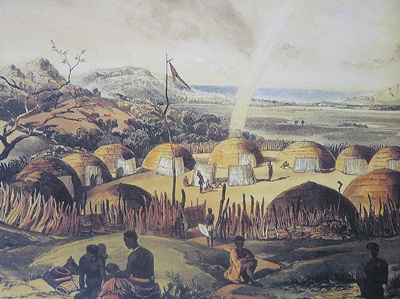
Although Isaacs’ account below of his visit to Shaka’s palace is a biased view from a European who saw everything African, Black, as inferior, it is still good to note the number, the order of the troops, the strength of the king (who was not just complacent, but an active member of his troops), and much more. This also gives a better idea of the dressing of the warriors and girls, as well as the living structure in the kraal. This account can be found in N. Isaacs, Travels and Adventures in Eastern Africa volume 1.

=====

Reception of the Zulus for Chaka from Isaacs’s book Travels and Adventures in Eastern Africa. Descriptive of the Zulus, their manners, customs, with a sketch of Natal.

This morning three regiments of boys arrived to be reviewed. There appeared to be nearly 6000, all having black shields. The respective corps were distinguished by the shape and ornament of their caps. One regiment had them in the shape of Malay hats, with a peak on the crown about six inches high, and a bunch of feathers at the top. Another wore a turban made of otter-skin, having a crane’s feather or two on each side ; and the third wore small bunches of feathers over the whole head, made fast by means of small ties. Thus accoutred and distinguished, they entered the gate, ran up the kraal, halted in front of the palace, and saluted the king.

Zulu kraal near Umlazi in Natal 1849

One boy stepped in front and made a long harangue. When the orator had concluded, the whole of his comrades first shouted, and then commenced running over the kraal, trying to excel each other in feats of agility and gesture, regardless of order, regularity, or discipline. After this exhibition, which lasted three hours, a regiment of men arrived with white shields, having on them one or two black spots in the center; they saluted Shaka, then retired to put away their shields, and assembled again in one body to dance. They formed a half circle; the men in the center and the boys at the two extremities. The king placed himself in the middle of the space within the circle, and about 1500 girls stood opposite to the men three deep, in a straight line, and with great regularity. His majesty then commenced dancing, the warriors followed, and the girls kept time by singing, clapping their hands, and raising their bodies on their toes. The strange attitudes of the men exceeded anything I had seen before.

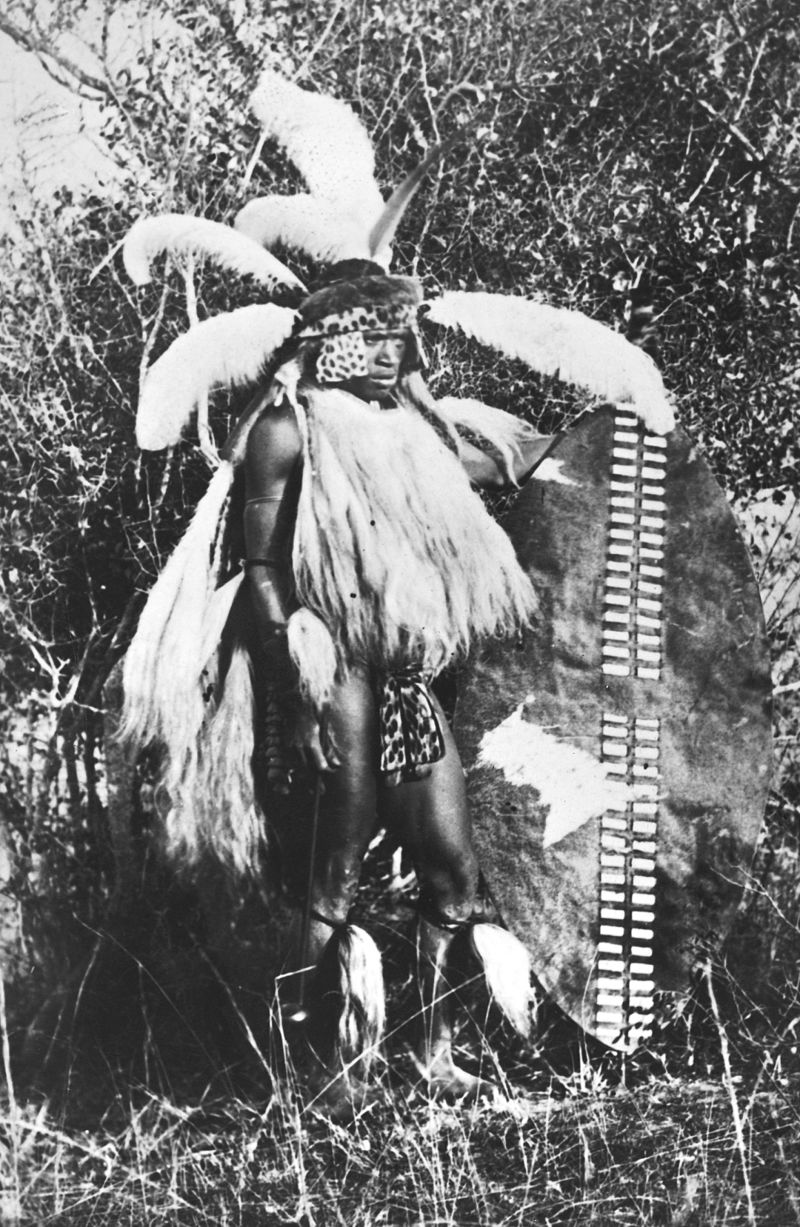
Zulu warrior in full regalia 1860: carrying the large isihlangu war shield. The upper body is covered in cow tails, the kilt is of spotted cat, genet or civet skin and the shins are decorated with cowtails. The elaborate headdress consists of a browband and face-framing flaps of leopard skin with another band of otter skin above. There are multiple ostrich feather plumes and a single upright crane’s feather.

The king was remarkable for his unequaled activity, and the surprising muscular powers he exhibited. He was decorated with a profusion of green and yellow glass beads. The girls had their share of ornaments, in addition too they had each of them four brass bangles round their necks, which kept them in an erect posture, and rendered them as immovable as the neck of a statue. This ceremony was performed with considerable regularity, from the king- giving, as it were, the time for every motion. Wherever he cast his eye, there was the greatest effort made, and nothing could exceed the exertion of the whole until sunset, when Shaka, accompanied by his girls, retired within the palace, and the warriors to their respective huts. Many, however, first went to the river and performed their evening ablutions.

Nowadays We will Respond in Kind

Colonel Abdoulaye Maiga speaking at the UN General Assembly (Source: DW – South Africa)

I have listened to the Malian Prime Minister’s speech at the UN again and again. Colonel Abdoulaye Maïga stated quite a few things which are not only worth restating, but also mark the beginning of a new era for relationships with Africa. For me the clear message was that, faced with the West’s insults, defamations, and aggressions, we will no longer respond with fear, we will stand up and respond in kind; we deserve respect and will be treated as such! France, the west, uses Africa to become 4th world gold producer (without a single mine), yet France walks on Africans, and insult us… the era when our backs were broken, and we held back how we felt by fear of retaliations, or by fear of the master, that era is long gone! We will respond in kind. We are human beings too, we are proud sons and descendants of long generations of great kings, we deserve respect, and we will fight to be treated respectfully. Abdoulaye Maïga honored Malians, and Africans as whole; he said openly what we have all been feeling in the depth of our bellies.

In his speech, Maïga called France’s government, a junta, which by the way is how the French government has been referring to the Malian government… but I ask you, is it not what France’s troops and allies have been doing in Mali? in the DRC? in Libya? That is nothing new for France’s behavior (and the West) in Africa. Isn’t neighboring Ivory Coast a recent example? He added, “The French junta has damaged universal values and betrayed its long tradition of humanistic thought,” … [Paris has acted] “in service of obscurantism” and engaged in “neocolonial, condescending, paternalistic and revanchist” politics.

Move on from the colonial past and hear the anger, the frustration, the rejection that is coming up from the African cities and countryside, and understand that this movement is inexorable,” Maïga said, addressing France.

Your intimidations and subversive actions have only swelled the ranks of Africans concerned with preserving their dignity,” he said. Why, because Africans have all had enough! How can anybody understand that Africa is funding Europe! up to 500 billion Euros per year goes to France through the  FCFA, and yet France leaves abject poverty in its wake? and then France (and the West) treats Africa with the greatest condescension? We are not looking for love in these relationships… we just want what is owed us, respect and dignity!

At the United Nations, Outstanding Speech by Mali PM who Slams France, Praises Russia Ties

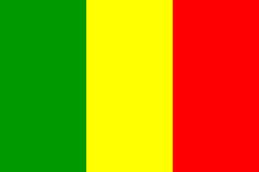
Flag of Mali
Flag of Mali

Last week, Mali new interim Prime minister Abdoulaye Maïga gave a speech at the United Nations’ Tribune. It was an amazing speech detailing Mali’s battle for its freedom and its struggle against France and its commies. Excerpts below are from Al-Jazeera.

=====

Abdoulaye Maiga lashes out at the former colonial ruler, the UN as he praised the ‘exemplary’ cooperation with Russia.

Mali’s military-appointed prime minister has lashed out at France and the United Nations in a grievance-filled address over his nation’s deteriorating security situation while praising the “exemplary” cooperation with Russia.

Map of Mali with its capital Bamako

Addressing the 77th session of the UN General Assembly on Saturday, Abdoulaye Maiga slammed what he called France’s “unilateral decision” to relocate its remaining troops to neighbouring Niger amid deteriorating relations with Mali’s two-time coup leader Assimi Goita.

… “Move on from the colonial past and hear the anger, the frustration, the rejection that is coming up from the African cities and countryside, and understand that this movement is inexorable,” Maiga, who was appointed prime minister last month, said.

Your intimidations and subversive actions have only swelled the ranks of Africans concerned with preserving their dignity,” he added.

The Malian prime minister also offered a grim assessment of the UN peacekeeping mission, known as MINUSMA, while openly praising the “exemplary and fruitful cooperation between Mali and Russia” and the influence of mercenaries from the Wagner Group.

… “We must recognise that nearly 10 years after its establishment, the objectives for which MINUSMA was deployed in Mali have not been achieved,” Maiga said. “This is despite numerous Security Council resolutions.”

A Praise to the Great King Shaka, the Founder of the Zulu Empire

Sketch of King Shaka from 1824 (found in Nathan Isaacs’ book ‘Travels and Adventures in Eastern Africa,’ published in 1836)

To celebrate South Africa’s Heritage Day which used to be known as ‘Shaka Day‘ before 1996, we share with you this beautiful praise for the great king. KwaZulu (“Place of the Zulu” in Zulu)-Natal is an important province of South Africa, and the birthplace of the Zulu kingdom.  It is the second-most populous province in South Africa, after Gauteng, and the land of the Zulu people. Before 1996, 24 September was known as Shaka Day, in commemoration of the Zulu King, Shaka, on the presumed date of his death in 1828. Shaka kaSenzangakhona (Shaka, son of Senzangakhona) was the Zulu King who played an important role in uniting disparate Zulu clans into a cohesive nation; he is known as the founder of the Zulu Empire. . Each year people gather at King Shaka’s grave to honor him on this day.

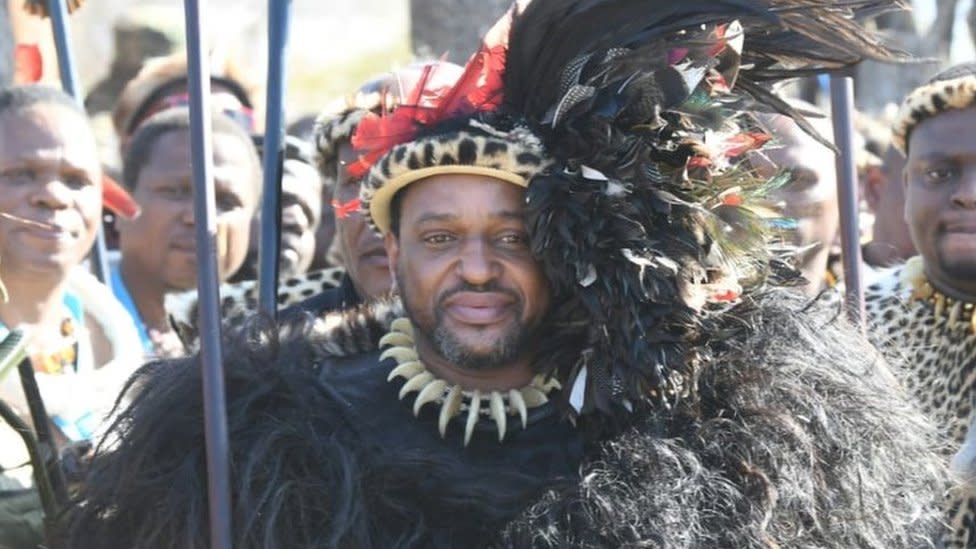
King Misuzulu ka Zwelithini (Source: yahoo news)

King Shaka was murdered by his two half-brothers Dingane and Mhlangana at kwaDukuza in 1828—one date given is September 24. Dingane assumed the throne after the assassination. Thus, September 24 is known as Shaka Day, and nowadays has become ‘Heritage Day’. This year’s celebration will mark the official public coronation of the new Zulu King, Misuzulu Siqonbile ka Zwelithini, who inherited from his father, King  Goodwill Zwelithini ka Bhekuzulu (Traditional Coronation of a New Zulu King).

Shaka Zulu

He is Shaka the unshakeable,
Thunderer-while-sitting, son of Menzi
He is the bird that preys on other birds,
The battle-axe that excels over other battle-axes in sharpness,
He is the long-strided pursuer, son of Ndaba,
Who pursued the sun and the moon.
He is the great hubbub like the rocks of Nkandla
Where elephants take shelter
When the heavens frown…

Traditional Zulu praise song, English translation by Ezekiel Mphahlele

Portrait of Shaka, the Great Zulu King

Sketch of King Shaka from 1824 (found in Nathaniel Isaacs’ book ‘Travels and Adventures in Eastern Africa,’ published in 1836)

King Shaka, Shaka kaSenzangakhona (Shaka son of Senzangakhona), or Shaka Zulu, is known today as the founder of the Zulu Empire or Zululand. He ruled from 1816 to 1828, and was one of the most influential monarchs of the Zulu, responsible for re-organizing the Zulu military into a formidable force via a series of wide-reaching and influential reforms; thus he was responsible for uniting small Zulu clans to form an impressive Empire which was a real threat to European advances in the region. Shaka was a master military strategist who revolutionized the Zulu military by dividing his army into components, sometimes on the basis of age and fighting strength. For example, he tasked young boys, perhaps in their early teens, with transporting military supplies. This allowed his fighting machine to move very quickly during raids or conquests. When Shaka first became king, the Zulu were a cluster of tribes of less than 2000 people; by the end of his reign, the population was 250,000 people, an impressive growth for a 12-year reign.

Nathaniel Isaacs, a British explorer met King Shaka. Below is a portrait he made of King Shaka found in N. Isaacs, Travels and Adventures in Eastern Africa Vol I, 1836.

=====

Reception of the Zulus for Chaka from Isaacs’s book Travels and Adventures in Eastern Africa. Descriptive of the Zulus, their manners, customs, with a sketch of Natal.

“In the evening, at the request of the king, we joined in their amusements, and could not … avoid singing: we commenced with ‘God save the King.’ On our explaining its literal meaning, Chaka was highly pleased; in fact, there was nothing but good humour to be observed in the countenances of every one present. The party broke up at a late hour; and, as is usual, in the morning we paid the king an early visit. We now expressed a wish to see him in his war dress; he immediately retired, and in a short time returned attired: his dress consists of monkeys’ skins, in three folds from his waist to the knee, from which two white cows’ tails are suspended, as well as from each arm; round his head is a neat band of fur stuffed, in front of which is placed a tall feather, and on each side a variegated plume. He advanced with his shield, an oval about four feet in length, and an umconto, or spear, when his warriors commenced a war song, and he began his maneuvres. Chaka is about thirty-eight years of age, upwards of six feet in height, and well proportioned: he is allowed to be the best pedestrian in his country, and, in fact, during his wonderful exercises this day he exhibited the most astonishing activity.”

Blaise Compaore Apologizes for Thomas Sankara’s Death?

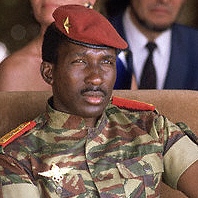
Thomas Sankara
Thomas Sankara a Ouagadougou

Yes you are not dreaming, nor am I joking. Blaise Compaoré, the past president of Burkina Faso, the one who murdered his friend and comrade President Thomas Sankara, has ‘apologized’ to his family. Is it for real? What is going on? Is Compaoré dying? Why the sudden regrets? or is he hoping to come back in power with the new military ruler? Should we applaud for him? NO! We are candidly interested in your apologies… but brother Compaoré, you need to pay! Tell us how you did it! Give us details! Tell us, who helped you; tell us where our brothers, mothers, sisters, fathers bodies are, and share some of the wealth you have acquired illicitly on our backs for the many years of regression and suffering at your hand. And what about Norbert Zongo [May 3rd: World Press Day – Norbert Zongo]? And then, the message read by the speaker goes, “I hope that we can move forward from now on …” Wait a second, so you can send a letter read by someone else, and you expect us to clap and just turn the page? Oh, I am so sick of people saying words, no actions, and expecting us to just forget, and move on! Actions speak louder than words! As you read, do you think Compaoré is really sorry? Excerpts below are from the BBC.

=====

Flag of Burkina Faso

Burkina Faso’s ex-President Blaise Compaoré has apologised to the family of Thomas Sankara, his charismatic predecessor who was shot dead during a coup in 1987.

In April, Mr Compaoré was sentenced in absentia to life in prison for his role in the assassination. He had always described the death as an accident [Verdict Guilty: Blaise Compaoré Guilty of the Murder of Thomas Sankara].

Mr Compaoré has lived in exile in neighbouring Ivory Coast since 2014 when he was ousted in a popular uprising after 27 years in power [Who/What did we Celebrate in Africa in 2014?].

I ask the people of Burkina Faso to forgive me for all the acts I committed during my term of office, especially to the family of my brother and friend Thomas Isidore Noël Sankara,” Mr Compaoré said in a statement.

I take responsibility and deplore, from the bottom of my heart, all the sufferings and dramas experienced by all the victims during my mandates at the head of the country and ask their families to forgive me. I hope that we can move forward from now on to rebuild our common destiny on the land of our ancestors.

The message was delivered to military ruler Paul-Henri Sandaogo Damiba, who took power in a coup in January, by an Ivorian delegation accompanied by the former president’s daughter Djamila Compaoré.

Patrice Lumumba’s Remains Land in Congo and His Last Letter to His Wife

Patrice Lumumba

As the remains, the golden tooth, of Patrice Lumumba is finally getting returned to his family and his nation after over 60 years, I felt it was necessary to share here Patrice Lumumba’s beautiful letter to his wife which happens to be his last letter. Although it is a sad letter, it is full of hope at the thought that one day Congo will be free. Roland Lumumba, his son, said in his interview to France24, “Only the dead can forgive, the living do not have the right to forget.” Entirely true… Lumumba would not allow us to forget his fight for the Congolese freedom, just as he would not want us to forget those who died at the hands of King Leopold II in the rubber plantations of Congo (King Leopold II and the Congolese genocide)… it is part of our history. As we fight for our freedom, we need to remember, and get inspired from the fight of those who came before us.

Almost a decade ago, I published the letter here on Afrolegends.com, and it has gained in significant popularity since then. La Dernière Lettre de Patrice Lumumba / Patrice Lumumba’s Last Letter. Enjoy!

Ma compagne chérie, Je t’écris ces mots sans savoir s’ils te parviendront, quand ils te parviendront et si je serai en vie lorsque tu les liras.  Tout au long de ma lutte pour l’indépendance de mon pays, je n’ai jamais douté un seul instant du triomphe final de la cause sacrée à laquelle mes compagnons et moi avons consacré toute notre vie.  Mais ce que nous voulions pour notre pays, son droit à une vie honorable, à une dignité sans tache, à une indépendance sans restrictions, le colonialisme et ses alliés occidentaux—qui ont trouvé des soutiens directs et indirects, délibérés et non délibérés, parmi certains hauts fonctionnaires des Nations, cet organisme en qui nous avons placé toute notre confiance lorsque nous avons fait appel à son assistance—ne l’ont jamais voulu.

Ils ont corrompu certains de nos compatriotes. Ils ont contribué à déformer la vérité et à souiller notre indépendance.  Que pourrai je dire d’autre ? 

Que mort, vivant, libre ou en prison sur ordre des colonialistes, ce n’est pas ma personne qui compte.  C’est le Congo, c’est notre pauvre peuple dont on a transformé l’indépendance en une cage d’où l’on nous regarde du dehors, tantôt avec cette compassion bénévole, tantôt avec joie et plaisir.  Mais ma foi restera inébranlable.  Je sais et je sens au fond de moi même que tôt ou tard mon peuple se débarrassera de tous ses ennemis intérieurs et extérieurs, qu’il se lèvera comme un seul homme pour dire non au capitalisme dégradant et honteux, et pour reprendre sa dignité sous un soleil pur.

Nous ne sommes pas seuls.  L’Afrique, l’Asie et les peuples libres et libérés de tous les coins du monde se trouveront toujours aux côtés de millions de congolais qui n’abandonneront la lutte que le jour où il n’y aura plus de colonisateurs et leurs mercenaires dans notre pays.  A mes enfants que je laisse, et que peut-être je ne reverrai plus, je veux qu’on dise que l’avenir du Congo est beau et qu’il attend d’eux, comme il attend de chaque Congolais, d’accomplir la tâche sacrée de la reconstruction de notre indépendance et de notre souveraineté, car sans dignité il n’y a pas de liberté, sans justice il n’y a pas de dignité, et sans indépendance il n’y a pas d’hommes libres.

Ni brutalités, ni sévices, ni tortures ne m’ont jamais amené à demander la grâce, car je préfère mourir la tête haute, la foi inébranlable et la confiance profonde dans la destinée de mon pays, plutôt que vivre dans la soumission et le mépris des principes sacrés.  L’histoire dira un jour son mot, mais ce ne sera pas l’histoire qu’on enseignera à Bruxelles, Washington, Paris ou aux Nations Unies, mais celle qu’on enseignera dans les pays affranchis du colonialisme et de ses fantoches.  L’Afrique écrira sa propre histoire et elle sera au nord et au sud du Sahara une histoire de gloire et de dignité.

Ne me pleure pas, ma compagne.  Moi je sais que mon pays, qui souffre tant, saura défendre son indépendance et sa liberté.

Vive le Congo !  Vive l’Afrique !

Patrice Lumumba

My beloved companion, I am writing these words not knowing whether they will reach you, when they will reach you, and whether I shall still be alive when you read them.  All through my struggle for the independence of my country, I have never doubted for a single instant the final triumph of the sacred cause to which my companions and I have devoted all our lives.  But what we wished for our country, its right to an honourable life, to unstained dignity, to independence without restrictions, was never desired by the Belgian imperialists and their Western allies, who found direct and indirect support, both deliberate and unintentional, amongst certain high officials of the United Nations, that organization in which we placed all our trust when we called on its assistance.

They have corrupted some of our compatriots and bribed others.  They have helped to distort the truth and bring our independence into dishonour.  How could I speak otherwise? 

Dead or alive, free or in prison by order of the imperialists, it is not myself who counts.  It is the Congo, it is our poor people for whom independence has been transformed into a cage from whose confines the outside world looks on us, sometimes with kindly sympathy, but at other times with joy and pleasure But my faith will remain unshakeable.  I know and I feel in my heart that sooner or later my people will rid themselves of all their enemies, both internal and external, and that they will rise as one man to say No to the degradation and shame of colonialism, and regain their dignity in the clear light of the sun.

We are not alone.  Africa, Asia and the free liberated people from all corners of the world will always be found at the side of the millions of Congolese who will not abandon the struggle until the day when there are no longer any colonialists and their mercenaries in our country.  As to my children whom I leave and whom I may never see again, to be told that the future of the Congo is beautiful and that their country expects them, as it expects every Congolese, to fulfill the sacred task of rebuilding our independence, our sovereignty; for without justice there is no dignity and without independence there are no free men.

Neither brutality, nor cruelty nor torture will ever bring me to ask for mercy, for I prefer to die with my head unbowed, my faith unshakable and with profound trust in the destiny of my country, rather than live under subjection and disregarding sacred principles.  History will one day have its say, but it will not be the history that is taught in Brussels, Paris, Washington or in the United Nations, but the history which will be taught in the countries freed from imperialism and its puppets.  Africa will write its own history, and to the north and south of the Sahara, it will be a glorious and dignified history.

Do not weep for me, my dear wife.  I know that my country, which is suffering so much, will know how to defend its independence and its liberty.

Long live the Congo!  Long live Africa!

Patrice Lumumba

The Only Remain of Lumumba Finally Returned, 61 years after His Assassination

Patrice_Lumumba_official_portrait
Patrice Lumumba

In 2020, Patrice Lumumba’s Children asked the Belgian King Philip for their Father’s Remains in an open letter. Today, Lumumba‘s golden tooth has been returned to his family and country 61 years after his assassination. For the history, Patrice Lumumba was the prime minister of Congo in 1960, and was assassinated by a coalition led by Belgium, and the US in 1961. At the time of his assassination, it was decided that no trace would be left of his body; thus Belgian officer Gerard Soete and his team dug up and, with a saw dismembered the corpse of Lumumba and his comrades Joseph Okito and Maurice Mpolo, and dissolved them in sulfuric acid while the bones were ground and scattered. We know this from a documentary which aired in 2000 where Soete showed two teeth which he said had belonged to Lumumba. He had taken Lumumba’s teeth as souvenir.  In 2016, Ludo De Witte, author of the book “The assassination of Lumumba,” lodged a legal complaint against Soete’s daughter after she showed a gold tooth, which she said had belonged to Lumumba, during an interview with a newspaper. De Witte’s work has been essential in shattering the official Belgian government silence regarding the assassination of Lumumba.

I cannot imagine what Lumumba’s children, grandchildren, and great grandchildren and all children of mother Congo must feel… it is so painful! It is like the beginning of some closure for the family. Is what was done to Lumumba not considered a crime against humanity? Is returning Lumumba’s tooth supposed to be enough?

Below are some excerpts from the BBC article, “Patrice Lumumba: Why Belgium is returning a Congolese hero’s golden tooth.”

=====

DRC_Lumumba_Children_tooth returned 20220620
Lumumba’s Children during the return of his tooth in Belgium (Source: TheBusinessExecutive.net)

A gold-crowned tooth is all that remains of assassinated Congolese independence hero Patrice Lumumba.

Shot dead by a firing squad in 1961 with the tacit backing of former colonial power Belgium, his body was then buried in a shallow grave, dug up, transported 200 km (125 miles), interred again, exhumed and then hacked to pieces and finally dissolved in acid.

The Belgian police commissioner, Gerard Soete, who oversaw and participated in the destruction of the remains took the tooth, he later admitted.

He also talked about a second tooth and two of the corpse’s fingers, but these have not been found.

The tooth has now been returned to the family at a ceremony in Brussels.

Soete’s impulse to pocket the body parts echoed the behaviour of European colonial officials down the decades who took remains back home as macabre mementoes.

For Lumumba’s daughter, Juliana, the question is whether the perpetrators were human. What amount of hatred must you have to do that?” she asks.

This is a reminder of what happened with the Nazis, taking pieces of people – and that’s a crime against humanity,” she told the BBC.

Nevertheless, there seemed to be a personal element to the way Lumumba was vilified and pursued. The total destruction of the body, as well as a way to get rid of the evidence, seems like an effort to obliterate Lumumba from the memory. There would be no memorial, making it almost possible to deny that he existed at all. It was not enough just to bury him.

But he is still remembered.

[Juliana Lumumba] recognises that her father “belongs to the country, because he died for Congo… and for his own values and convictions of the dignity of the African person.

She acknowledges that the handing over of the tooth in Belgium and bringing it back to the Democratic Republic of Congo is symbolic “because what remains is not really enough. But he has to come back to his country where his blood was shed.”

The tooth will be taken around the vast country before being buried in the capital.

….

Life in Walata in 1352: an Ancient City of the Ghana Empire

Ghana_empire_map_c300-c1200
Map of the Ghana Empire ca 300 -1200

In the past, we have talked about the great Ghana Empire of West Africa whose main center of trade was Koumbi Saleh, and whose economy was based around gold, salt, copper, and other goods. The imports included textiles, ornaments, and other materials. Many of the handcrafted leather goods found in old Morocco also had their origins in the Ghana Empire. Several strong cities of the Ghana Empire are today on the UNESCO World Heritage List, such as Koumbi Saleh, OuadaneChinguetti,or Oualata. The historian and scholar Ibn Battuta visited Oualata in 1352, and gives an amazing report of the people of Oualata (Walata). Enjoy! These can be found in the Travels of Ibn Battuta called A Gift to Those Who Contemplate the Wonders of Cities and the Marvels of Traveling, better known as the Rihla (or “travels”). In Oualata, Ibn Battuta mentions his amazement that the society is matrilineal which he had not seen before anywhere in the world except among Indians of Malabar, and notices the importance of women in the society, and how they are well-treated, and mutual respect between men and women. A lot of these traditions are still be observed throughout Africa today.

=====

Ghana Empire_Oualata old town and new ruins can be seen
Aerial view of Oualata which was north west of Koumbi Saleh, and part of the Ghana empire. Ruins of the ancient city can be seen (Wikipedia)

My stay at Iwalatan [Walata] lasted about fifty days; and I was shown honour and entertained by its inhabitants. It is an excessively hot place, and boasts a few small date-palms, in the shade of which they sow watermelons. Its water comes from underground waterbeds at that point, and there is plenty of mutton to be had. The garments of its inhabitants, most of whom belong to the Massufa tribe, are of fine Egyptian fabrics.

Their women are of surpassing beauty, and are shown more respect than the men. The state of affairs amongst these people is indeed extraordinary. Their men show no signs of jealousy whatever; no one claims descent from his father, but on the contrary from his mother’s brother. A person’s heirs are his sister’s sons, not his own sons. This is a thing which I have seen nowhere in the world except among the Indians of Malabar. But those are heathens; these people are Muslims, punctilious in observing the hours of prayer, studying books of law, and memorizing the Koran. Yet their women show no bashfulness before men and do not veil themselves, though they are assiduous in attending the prayers. Any man who wishes to marry one of them may do so, but they do not travel with their husbands, and even if one desired to do so her family would not allow her to go.

Ghana Empire_Trans-Saharan routes early
Ghana Empire and its Trans-Saharan trade routes (Wikipedia)

The women there have “friends” and “companions” amongst the men outside their own families, and the men in the same way have “companions” amongst the women of other families. A man may go into his house and find his wife entertaining her “companion” but he takes no objection to it. One day at Iwalatan I went into the qadi’s house, after asking his permission to enter, and found with him a young woman of remarkable beauty. When I saw her I was shocked and turned to go out, but she laughed at me, instead of being overcome by shame, and the qadi said to me “Why are you going out? She is my companion.” I was amazed at their conduct, for he was a theologian and a pilgrim [to Mecca] to boot. I was told that he had asked the sultan’s permission to make the pilgrimage that year with his “companion”–whether this one or not I cannot say–but the sultan would not grant it.