Today, I will be talking about Bangui, the capital of Centrafrique or the Central African Republic (CAR). Bangui is commonly known to locals as “Bangui, la coquette“, or “Bangui, the coquette“. Before its independence on August 13 1960, Centrafrique was known as “Oubangui-Chari” (in English: Ubangi-Chari) because its border in the south is formed by the rivers Oubangui (which is the border with the democratic republic of Congo) and Mbomou, while at its northern border is the Chari river which also runs into Chad. When the French first colonized the area in the 19th century, they adopted the name Oubangui-Chari, since the country is located in the Oubangui-Chari basin. Thus the city Bangui is located on the right bank of the Oubangui river. The city was started (I will not use the more common word ‘founded’ as I disagree with its use here) on 26 June 1889 during French colonization, to serve as a base for French expansion in Central Africa.
Downtown Bangui in 1950s
At its creation, it was part of the then French colony of Haut-Oubangui (Upper-Ubangi). The city grew thanks to its proximity to a French military post (which still exists there today), and became the center of the French colonial administration in the area. At first, from 1889 to 1912, the population was mostly centered near the river Oubangui; later on, it grew on the northern side. It is also good to mention that the city-center is dominated by the Gbazabangui hills, inside which there is a special forest reserve.
During Kwame Nkrumah‘s state funerals in Conakry on 13 – 14May 1972, Amilcar Cabral gave this great speech titled: “Le Cancer de la Trahison,” (The Cancer of Betrayal) on May 13, 1972, which I posted earlier in French. I have now translated his speech to English, and would like all to enjoy. I will later add the captions to the video on youtube as well.
=========
In his last public speech in Conakry, at the funeral of the former Ghanaian president Nkrumah, Amilcar Cabral had denounced the cancer of betrayal that eats up African movements. His comments today take a strange resonance in Guinea as in Angola, and Mozambique, where many movements are demanding power which the Portuguese have not yet abandoned.
Amilcar Cabral
“… What to say? but we must speak otherwise at this point, if we don’t talk, our hearts may burst. Our tears should not infiltrate the truth.We, freedom fighters, we do not mourn the death of a man, even a man who was a comrade and an exemplary revolutionary, because as President Ahmed Sekou Toure often says ‘what is man in front of the infinite being and transgressing of the people and of humanity?’ We do not mourn the people of Ghana scoffed in its most beautiful realisations, in its most legitimate aspirations.We are not crying for Africa, betrayed. We are mourning, yes, of hatred towards those who were able to betray NKRUMAH to serve the ignoble imperialism… Mr President, Africa by requiring through the voice of the people of the Republic of Guinea, as always fairly represented by President Ahmed Sekou Toure, whom NKRUMAH had put in his right place on the Kilimandjaro’s highest summits of the African revolution, Africa rehabilitates itself and through history. President NKRUMAH, which we honor is primarily the great strategist of the struggle against classic colonialism, he is the one who created what we call African positivism, what he called “positive action”, affirmative action. We pay tribute to the declared enemy of neocolonialism in Africa and elsewhere, the strategist of economic development in his country. Mr President,we praise the freedom fighter of the African people who always gave his full support to national liberation movements, and we want to tell you here that we, in Guinea and Cape Verde islands, even though it is true that the most important factor for the development of our struggle outside our country was the independence of the Republic of Guinea,the heroic ‘no’ of the people of Guinea on 28 September 1958. It is also true thatif we went through the struggle regenerated, it was essentially due to the concrete support of Ghana and particularly of President Nkrumah …
Mr. President, we should however in this moment remember that all coins in life have two faces, all realities have positive and negative sides… to all positive action, is opposed a negative action. To what extent is betrayal’s success in Ghana linked to problems of class struggle, from contributions to social structures, from the role of party or other instructions, including armed forces as part of a new independent state. To what level, we shall ask ourselves, is betrayal’s success in Ghana linked to a correct definition of this historical entity and craftsman of history that is the people and their daily work, in defending its own independence conquests? Or to what extent is betrayal’s success not linked to the major problem of the choice of men in the revolution? My idea on this question will allow us to better understand the greatness of Nkrumah’s work, to understandthe complexity of problems he had to face so many times alone… problems that will allow us to conclude that, as imperialism exists, an independent state in Africa should be a liberation movement to power or it would not exist. Let no one tell us that Nkrumah died of a cancer to the throat or some other disease; no, Nkrumah has been killed by the cancer of betrayal that we should uproot… by the cancer of betrayal, that we should root out of Africa if we really want to definitely crush the imperialist domination on this continent. But, we, Africans, firmly believe that the dead continue living by our sides, we are a society of dead and living.Nkrumah will resuscitate each dawn in the hearts and in the determinations of freedom fighters, in the action of all true African patriots. Our liberation movement will not forgive those who betrayed Nkrumah, the people of Ghana will not forgive, Africa will not forgive, progressive mankind will not forgive!”
Translated from French by Dr. Y., afrolegends.com (12 October 2012)
Please enjoy this pure jewel of history… President Kwame Nkrumah‘s speech proclaiming the independence of Ghana at 12:00AM on 6 March 1957. So much to praise, the joy and hope that this new state’s birth brought. Find below the written part of the speech, and watch to hear Kwame Nkrumah deliver this great speech.
=================
At long last, the battle has ended! And thus, Ghana, your beloved country is free forever!
And yet again, I want to take the opportunity to thank the people of this country; the youth, the farmers, the women who have so nobly fought and won the battle.
Also, I want to thank the valiant ex-service men who have so cooperated with me in this mighty task of freeing our country from foreign rule and imperialism.
And, as I pointed out… from now on, today, we must change our attitudes and our minds. We must realize that from now on we are no longer a colonial but free and independent people.
But also, as I pointed out, that also entails hard work. That new Africa is ready to fight its own battles and show that after all the black man is capable of managing his own affairs.
We are going to demonstrate to the world, to the other nations, that we are prepared to lay our foundation – our own African personality.
As I said to the Assembly a few minutes ago, I made a point that we are going to create our own African personality and identity. It is the only way we can show the world that we are ready for our own battles.
Kwame Nkrumah
But today, may I call upon you all, that on this great day let us all remember that nothing can be done unless it has the purport and support of God.
We have won the battle and again rededicate ourselves … OUR INDEPENDENCE IS MEANINGLESS UNLESS IT IS LINKED UP WITH THE TOTAL LIBERATION OF AFRICA.
Let us now, fellow Ghanaians, let us now ask for God’s blessing for only two seconds, and in your thousands and millions.
I want to ask you to pause for only one minute and give thanks to Almighty God for having led us through our difficulties, imprisonments, hardships and sufferings, to have brought us to our end of troubles today. One minute silence.
Ghana is free forever! And here I will ask the band to play the Ghana National Anthem.
Reshaping Ghana’s destiny, I am depending on the millions of the country, and the chiefs and the people, to help me to reshape the destiny of this country. We are prepared to pick it up and make it a nation that will be respected by every nation in the world.
We know we are going to have difficult beginnings, but again, I am relying on your support…. I am relying upon your hard work.
Seeing you in this… It doesn’t matter how far my eyes go, I can see that you are here in your millions. And my last warning to you is that you are to stand firm behind us so that we can prove to the world that when the African is given a chance, he can show the world that he is somebody!
We have awakened. We will not sleep anymore. Today, from now on, there is a new African in the world!
Few men on the continent have had the aura of President Kwame Nkrumah, one of the greatest pan-africanist of the continent and the first president of Ghana. Kwame Nkrumah was born on 21 September1909 in Nkroful, Gold Coast (the pre-independence name of Ghana) the world’s largest cocoa producer. Hailing from a modest traditional family, He trained to be a teacher at the Achimota School in Accra from 1927 to 1930. For the following five years, he then taught in elementary schools across the Gold Coast. He later on attended Lincoln University in Pennsylvania, where he graduated with a BA in theology in 1942. He went on to attend the University of Pennsylvania, where he earned a Master of Science in education, and a master of arts in philosophy in 1943. During his time in the US, he preached at black Presbyterian churches in Philadephia, and New York city. Moving to London after World War II, Nkrumah helped organize Pan-African congresses, linking the emergent educated groups of the African colonies with activists, writers, artists, and well-wishers from the industrial countries. It was a time of great intellectual ferment, excitement, and optimism. Gandhi and India‘s achievement of independence in 1947 stirred dreams of freedom for the other colonies. “If we get self-government,” Nkrumah proclaimed, “we’ll transform the Gold Coast into a paradise in 10 years.”
Flag of the Gold Coast
In 1947, Nkrumah was invited to serve as the general secretary of the United Gold Coast Convention (UGCC), exploring paths to independence of the Gold Coast from British rule. After the riots of February 1948, and arrests of UGCC leaders by British rule, Nkrumah emerged as the party leader upon release. He proclaimed that the Gold Coast needed “self-government now,” and built a large power base including cocoa farmers, women (at a time when women were not invited in the political process) and trade unions. On 12 June 1949, he organized a new political party based on these groups: the Convention People’s Party (CPP). Within two years the CPP had won limited self-rule elections, and Nkrumah became “Leader of Government Business” in 1951 after a landslide CPP win in the first general election– a de facto prime minister, responsible for internal government and policy. He set his sights firmly on independence. No amount of autonomy or self-rule, he argued, could match the energy, commitment, and focus of a government and people in a truly independent country. It was a precondition for growth. He summarized his philosophy in a slogan that became famous and influential across Africa: “Seek ye first the political kingdom, and all else shall be added unto you….”
Map and Flag of Ghana
As a leader of this government, Nkrumah faced many challenges: first, to learn to govern; second, to unify the four territories of the Gold Coast; third, to win his nation’s complete independence from the United Kingdom. Nkrumah was successful at all three goals. Within six years of his release from prison, he was the leader of an independent nation. At 12 a.m. on 6 March 1957, Nkrumah declared Ghana independent. The country became independent as a Commonwealth realm. He was hailed as the Osagyefo – which means “redeemer” in the Twi language.
On 6 March 1960, Nkrumah announced plans for a new constitution, which would make Ghana a republic. On 19, 23, and 27 April 1960 a presidential election and plebiscite on the constitution were held. The constitution was ratified and Nkrumah was elected president over J. B. Danquah, the UP candidate, 1,016,076 to 124,623. In 1961, Nkrumah laid the first stones in the foundation of the Kwame Nkrumah Ideological Institute created to train Ghanaian civil servants as well as promote Pan-Africanism. In 1964, all students entering college in Ghana were required to attend a two-week “ideological orientation” at the Institute. In 1963, Nkrumah was awarded the Lenin Peace Prize by the Soviet Union. Ghana became a charter member of the Organization of African Unity in 1963.
Kwame Nkrumah on Cedi notes
The Gold Coast had been among the wealthiest and most socially advanced areas in Africa, with schools, railways, hospitals, social security and an advanced economy. Under Nkrumah’s leadership, Ghana adopted some socialist policies and practices. Nkrumah created a welfare system, started various community programs, and established schools. Nkrumah’s time in office was successful and ambitious (could you blame him? With a newly independent country, there was so much to build), with forestry, fishing, and cattle-breeding expanded, production of cocoa (Ghana’s main export) doubled, and modest deposits of bauxite and gold exploited more effectively. The construction of a dam on the Volta River (launched in 1961) provided water for irrigation and hydro-electric power, which produced enough electricity for the towns as well as for a new aluminum plant. Government funds were also provided for village projects in which local people built schools and roads, while free health care and education were introduced. Ghana adopted the Ghana Cedi (GHC) as a currency in 1965; the word “cedi” being the Akan word for cowry shells, which were used as currency in the old days.
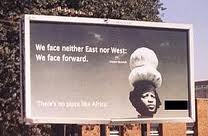
Billboard in Lusaka, Zambia, with Kwame Nkrumah’s famous quote for non-alignment
He generally took a non-aligned Marxist perspective on economics, and believed capitalism had malignant effects that were going to stay with Africa for a long time (and rightly so, we can all see the effects of IMF, and World Bank policies in Africa today: poverty to the grave). Nkrumah argued that socialism was the system that would best accommodate the changes that capitalism had brought, while still respecting African values. At a time when there were East & West blocks from the cold war, and where Africa was stuck in the middle, with no way out but to bend to some of the East-West politics (which could not work for us), Nkrumah believed in non-alignment. He made a famous quote on non-alignment which said: “We face neither East nor West; We face forward.” To show that we, as Africans, could not be forced to adhere to politics or economics which had no respect for us as human beings and for our cultures.
Celebrating the birth of the OAU
In Africa Must Unite(1963) Nkrumah called for the immediate formation of a pan-African government. Later he sat on a unification movement that emanates from the base, while anti-imperialist governments and between the Western-backed “puppet regime” could be no common ground. He was a true visionary to have seen that Africa needed to unite in order to survive, because as it stood divided in 50-something states it was an easy prey to Western imperialists. Nkrumah’s biggest success in this area was his significant influence in the founding of the Organization of African Unity (OAU).
Nkrumah’s sculpture at the Kwame Nkrumah Mausoleum in Accra
Truth be told, Nkrumah was too big for his own good. He wanted Ghana and Africa to be truly independent: politically, and economically. He was a strong advocate for pan-Africanism, and the true instigator and founder of the Organization of African Unity (now African Union) whose goals were to raise Africa, and promote unity and strength across the continent. He also helped several independent movements in Africa, such as those from Rhodesia (Zimbabwe). He was ousted in February1966 by a military coup, while on state visit to Vietnam.
After the coup, Nkrumah lived in exile in Conakry, Guinea, as the guest of President Ahmed Sekou Toure who made him honorary co-president. He read, wrote, corresponded, gardened, entertained guests, and continued to push for his vision of African unity. 50 years later, Kadhafi who was trying to revive, and reinvigorate the African Union, and almost succeeded, was also brought down by Western Imperialism; and his country, the beautiful Libya (one of the few countries in the world without debt) bombed and brought down in flames.
Centenary of Kwame Nkrumah
Nkrumah died in 27 April1972 of skin cancer in Romania. One can tell the greatness of the man by the number of universities who carry his name during his lifetime. If you are ever in Accra, visit the Kwame Nkrumah Mausoleum which is a true piece of art, as well as the Kwame Nkrumah University of Science and Technology in Kumasi. Check out Nkrumah.net to learn more about this great African leader, and read some of his speeches. Check out this great video which talks about Kwame Nkrumah’s fight for Ghana’s independence, as well as his struggle to maintain his vision for an independent Ghana (check out all parts 1-4). Don’t forget to read some of his books: Africa Must Unite (1963), Neo-colonialism: the Last Stage of Imperialism (1965), African Socialism Revisited (1967), Dark Days in Ghana (1968), Handbook of Revolutionary Warfare (1968), I Speak of Freedom (1973), and many more.
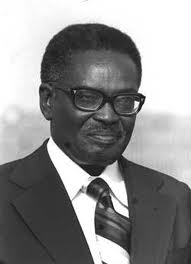
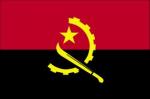
Angolans are marking this Monday the National Heroes’ Day, in homage to the country’s first president, the late Dr. Agostinho Neto, who was born on 17 September 1922 in Kaxicane locality. Celebrate with me Angola’s National Heroes’ Day by enjoying a poem by Angola’s greatest poet, and its first president.
Criar
Criar criar criar no espírito criar no músculo
criar no nervo criar no homem criar na massa criar criar com os olhos secos Criar criar sobre a profanação da floresta sobre a floresta impúdica do chicote criar sobre o perfume dos troncos serrados criar criar com os olhos secos Criar criar gargalhadas sobre o escárneo da palmatória coragem nas pontas das botas do roceiro força no esfrangalhado das portas violentadas firmeza no vermelho sangue da insegurança criar criar com os olhos secos
Criar criar estrelas sobre o camartelo guerreiro paz sobre o choro das crianças paz sobre o suor sobre a lágrima do contrato paz sobre o ódio criar criar paz com os olhos secos Criar criar criar liberdade nas estradas escravas algemas de amor nos caminhos paganizados do amor sons festivos sobre o balanceio dos corpos em forcas simuladas criar criar amor com os olhos secos.
Create
Create create create in mind create in muscle
create in nerve create in man create in the masses create create with dry eyes Create create over the profanation of the forest over the shameless fortress of the whip create over the scent of sawn trunks
create create with dry eyes Create create laughter over the scorn of the palmatoria courage in the tips of the planter’s boots strength in the splintering of battered-in doors firmness in the red blood of insecurity create create with dry eyes Create create stars over the warrior’s sledge-hammer peace over children’s weeping peace over the sweat the tears of forced labour peace over hatred create create peace with dry eyes
Create create create freedom on slave highways manacles of love on the paganised
paths of love festive sounds over bodies swinging on simulated gallows create create love with dry eyes.
Soundiata Keita a l’Assemblée constitutive de l’empire du Mandé avec les chefs de guerre (Source: Wikipedia.fr)
Le Kouroukan Fouga fut la constitution de l’Empire du Mali (1235 – 1645), et officiellement la plus vieille constitution républicaine en Afrique, et au monde. Le Kouroukan Fouga réuni officiellement la fédération des clans Mandingues sous un seul et unique gouvernement. Cette constitution régit la vie de l’empire à travers des lois auxquelles tout le monde doit obéir. Mansa (Empereur) Soundiata Keïta présenta ce document en 1236 après la célèbre bataille de Kirina, dans l’actuel cercle de Kangaba, et dès lors cette constitution a été léguée de générations en générations par les griots ou djeli. Les griots ont conservé une grande partie de l’histoire de l’empire du Mali, y compris ses rois, les batailles, et le système gouvernemental. Decouvrez avec moi la première constitution républicaine mondiale, et appréciez le génie de nos ancêtres. Si seulement nous, africains, pouvions tous adaptés celle-ci, et non perdre le temps avec ces constitutions importées de l’occident. (For English, click here).
Article 1er : La Société du grand Mandé est divisée en seize (16) porteurs de carquois, cinq (5) classes de marabouts, quatre (4) classes de Nyamakalas (1) une classe de serfs (esclaves) (Mofé molu)
Chacun de ces groupes a une activité et un rôle spécifiques
Article 2 : Les Nyamakalas se doivent de dire la vérité aux chefs, d’être leurs conseillers et de défendre par le verbe les règles établies et l’ordre sur l’ensemble du royaume.
Article 3 : Les Morikandas lolu (les cinq classes de marabouts) sont nos maîtres et nos éducateurs en islam. Tout le monde leur doit respect et considération.
Article 4 : La société est divisée en classe d’âge. A la tête de chacune d’elles est élu un chef. Font de la classe d’âge les personnes (Hommes ou Femmes) nées au cours d’une période de trois années consécutives.
Les Kangbès (Classe internationale entre les jeunes et les vieux) doivent être conviés pour participer à la prise des grandes décisions concernant la société.
Assemblée constitutive de l’empire du Mandé lors de la charte du Kouroukan Fouga (Source: Wikipedia.fr)
Article 5 : Chacun a le droit à la vie et à la préservation de son intégrité physique. En conséquence, tout tentation d’enlever la vie à son prochain est punie de la peine de mort.
Article 6 :Pour gagner la bataille de la prospérité, il est institué le Kongbèn Wölö (un mode de surveillance) pour lutter contre la paresse et l’oisiveté.
Article 7 : Il est institué entre les Mandenkas, le Sanankuya (cousinage à plaisanterie) et le tanamanyoya (forme de totémisme. En conséquence, aucun différent né entre ces groupes ne doit dégénérer, le respect de l’autre étant la règle.
Entre Beaux-frères et Belle-sœur, entre grands parents et petits, tolérance et le Chahut doivent être le principe.
Article 8 : La Famille est désigné famille régnante sur l’empire
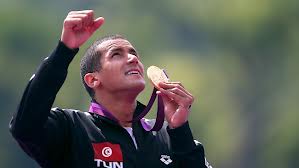
Oussama Mellouli of Tunisia won Gold in the 10 km marathon open water, to become the first swimmer to ever win olympic medals in both the pool and open water. He had also won bronze in the 1500m freestyle in London, and was the Beijing Gold winner for 1500m freestyle.
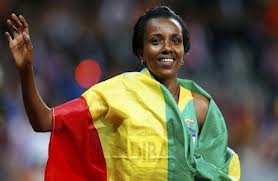
Tirunesh Dibaba, the baby-face destroyer, took Gold in 10,000 m run to retain her title, and bronze in the 5000m. I will take this opportunity to salute her for running in the 5000m even after suffering a harmstring the day before the 5000m run. Kenyans Sally Kipyego and Vivian Cheruiyot won silver and bronze respectively in the 10,000m. Meseret Defar took the gold in the 5000m, reclaiming back the gold medal she had won in 2004 during the Athens Olympics, but had lost in 2008 to Tirunesh Dibaba. Kenyan Vivian Cheruiyot took the silver home in the 5000m, followed by Tirunesh Dibaba.
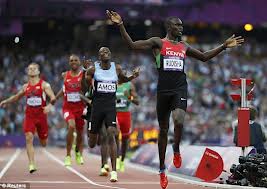
David Rudisha of Kenya, became the first man to break a record at the London Olympics, in the 800m. He ran the 800 m with such majesty and speed, he almost looked like an impala, very graceful. Nijel Amos won a silver medal to offer Botswana its very first Olympic medal; while Timothy Kitum of Kenya took home the bronze medal.
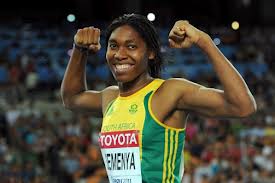
Caster Semenya of South Africa won a silver medal in the women’s 800m run. Watching her run, one could already see the potential, and had she not started far in the back, I believe she would have won the gold medal.
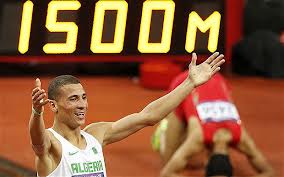
Taoufik Makhloufi of Algeria stunned us by getting disqualified from the olympics because of ‘not trying hard enough’ (whatever that means) in the men’s 800m, getting reinstated, and then going on to win the gold medal by a huge margin, in the 1500m. He definitely made us proud… telling us that one can always beat all the odds. MoroccanAbdalaati Iguider took home the bronze medal.
South Africa is the African country who won the most medals at the London Olympics, with three gold, two silver, and one bronze medals. Swimmers Chad le Clos and Cameron van der Burgh both won gold in 200m butterfly and 100m breaststroke respectively. Chad also took home the silver medal for the 100m butterfly. Sizwe Ndlovu, John Smith, Matthew Brittain, and James Thompson of South Africa won gold in the men’s lightweight four.
UgandanStephen Kiprotich claimed the gold medal in the men’s marathon, making it Uganda’s first gold medal since 1972. He was followed by two Kenyans who won silver and bronze: Abel Kirui and Wilson Kipsang.
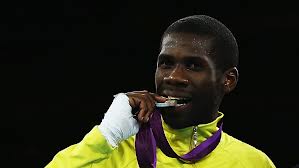
Anthony Obame won Gabon’s first ever medal, by claiming the silver medal in taekwondo.
Alaeeldin Abouelkassem of Egypt won silver in fencing, becoming Africa’s first medal in fencing.
Overall, although I was quite disappointed by the performance of the Kenyan and Ethiopian athletes, particularly that of Kenenisa Bekele, I salute those who raised our flags high and made us proud of being Africans. I am sure children in Botswana would now take to running like Nijel Amos, and I am sure children in Gabon will join taekwondo’s clubs like Obame, while Tunisians will learn to swim as well as Oussama Mellouli who made them all extremely proud.
Taoufik Makhloufi after winning the 1500 m (source: telegraph.co.uk)
I just wanted to give you an update on all our African medalists at the 2012 London Olympics.
Taoufik Makhloufi, of Algeria, won Gold in the 1500m Men yesterday, after a display of courage and determination. He was disqualified on Monday for not putting enough effort in the Men’s 800m qualifiers, and then later on reinstated, and went on to winning Gold in the 1500m. Such drama! Abdalaati Iguider of Morocco won the bronze in the 1500m Men, after Taoufik.
Tirunesh Dibaba, the baby face destroyer, destroyed her competitors on the 10,000m women’s race. It was lovely to watch her sprint to the finish. We long for a repeat on the 5,000m women’s race which will take place this Friday. The Kenyans Sally Kipyego and Vivian Cheruiyot won silver and bronze respectively.
On the men’s 10,000m, Kenenisa Bekele disappointed us. Frankly all Africans top runners disappointed us. It was mostly a show of African top runners elbowing each other to stop the other from winning (Kenyans, Ethiopians, and Erythreans) and cornering Kenenisa… and that’s how the British-Somalian Mo Farah won. Basically, our brothers just went for the ‘crab’ politics. Disappointing! Tariku Bekele, Kenenisa’s brother, saved the day by winning the bronze medal.
Tirunesh Dibaba, after winning the 10,000 m race in London 2012
The Men’s 3000m Steeplechase was won by Ezekiel Kemboi of Kenya who took gold, while another compatriot, Abel Kiprop Mutai took the bronze. In the women’s 3000 m Steeplechase, Sofia Assefa of Ethiopia won the bronze medal.
The Women’s marathon was won by Tiki Gelana of Ethiopia who set a new olympic record, and was followed by Priscah Jeptoo of Kenya with silver.
In swimming, Tunisian Oussama Mellouli took Bronze in the Men’s 1500m freestyle. South African Chad le Clos took Silver in the Men’s 100m butterfly, and gold in the Men’s 200m butterfly. Cameron van der Burgh, another South African, won the gold medal in the Men’s 100m breaststroke.
Chad le Clos during the final 200 m butterfly at the 2012 Olympics
Yesterday, July 31st, South African Chad le Clos defeated the great Michael Phelps (19 times olympic medalist – with 16 gold medals thus far – cited as being the Greatest olympian of all times) in Men’s 200 m Butterfly, and won the Gold medal.
Alaaedin Aboulkassem, after qualifying for the final for fencing at the 2012 Olympics
Last Sunday, July 29th, South African Cameron van der Burgh won Gold medal in Men’s 100 m Breaststroke.
Watch out for Alaaedin Abouelkassem of Egypt who qualified yesterday for the final in Fencing, and will get either a Gold or a Silver medal in Fencing!
With the start of the 2012 London Olympics, I thought about giving you a hint as to who to look out for, and who are those brilliant athletes representing the continent at the Olympics. Here is a list of some of the outstanding ones… There is no particular order. If I have missed a big one, please send me his/her name.