In order to remember the 16 June 1976 Soweto uprising, I decided to share with you these images and song from the movie Sarafina! which focused on the 1976 Soweto riots. It is simply beautiful! The character says: “They fear you because you are young, they fear you because you are the future; How fearful they must be that they shoot you children? How powerful you must be that they fear you so much. You are powerful because you are the generation that will be free. The violence, the beatings, the torture, the killings, all this is the bad pain of our free nation. … Freedom is coming tomorrow!” In essence, this is a message for all the youth around the world: You are the future, you are strong, take hold of it, and do the best!
Today, the whole world will be transported to the land of the Matryoshka dolls, and the entire globe will vibrate at the start of the biggest planetary sport event … Yes today, the 2018 FIFA World Cup will start in Russia, and 32 of the best soccer nations will compete at this great event. This will be one month of soccer, pure joy, fun, and above all talent. Zabivaka, the mascot’s name means “the one who scores” in Russian, and we are looking forward to great goals and top scorers. This month, legends will be made, new talents discovered, and dreams will take off.
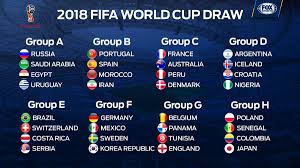
Five African teams will grace the tournament: Egypt, Nigeria, Morocco, Senegal, and Tunisia. We do hope that at least one African team will advance into the round of 16, and beyond. Here are some of the African stars to watch out for.
The Pharaohs of Egypt are among Africa’s best teams, being 7th time African Cup of Nations champions. This year, the big star is Mohamed Salah who, with his Premier League Golden Boot award and more prowess, has become a legend in his home country. Egypt is in a relatively easy group with the home team Russia, Saudi Arabia and Uruguay. Their goalkeeper, Essam El-Hadary, at 45 is also the oldest player at the World cup this year, and has been a favorite to watch during all the African Cup of Nations, in par due to his charisma, discipline, and sheer determination.
Morocco’s Lions of the Atlas are in group B with Spain, Portugal, and Iran. The group looks tough with Spain and Portugal, but we do wish them the very best. This is their first participation in 20 years, Medhi Benatia and his teammates do hope to have a great world cup.
Throughout the years, I have placed high hopes on African teams and have been often disappointed. I might once again be disappointed. However, this is a planetary tournament, and the fun of it makes one root for any good team. To make for a fun event with great home support, we hope that the host team, Russia, makes it to the second round. For the world cup winner, Germany, the previous winner has as strong squad, as well as a pool of great talents, and they will be eyeing their 5th world cup. We hope the Mannschaft is very well-oiled, because there are 31 good teams to contend with! Overall, let the world cup start, with all the fun, and may the best team win!!!
For this year’s Mother’s Day celebration, I introduce you to another African classic: Elvis Kemayo – Mama. Elvis Kemayo hails from Cameroon, and is particularly well-known for this song, and ‘Cameroun, berceau de mon enfance (Cameroon, craddle of my childhood)’ Enjoy ‘MAMA’, and do remember to cherish your mother!
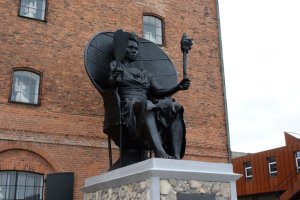
Sculpture of Queen Mary in Copenhagen (Source: NY Times – Nick Furbo)
If you are like me, you probably did not know that Denmark (and Norway) was involved in slavery in Africa, and that Denmark had several colonies, and forts in Africa, and exported slaves to its colonies in the Americas. Just last week, Denmark erected its first public statue of a Black woman, a rebel Queen, in Copenhagen; this was the statue of Queen Mary, a Black slave who led the slave uprising in the Virgin islands. The sculpture was inspired by Mary Thomas, known as one of “the three queens.” Thomas , along with two other female leaders Agnes and Matilda, unleashed an uprising in 1878 called the “Fireburn.” Fifty plantations and most of the town of Frederiksted in St. Croix were burned, in what has been called the largest labor revolt in Danish colonial history.
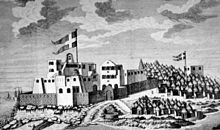
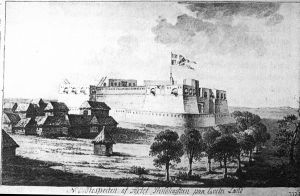
Fort Christiansborg (now Osu Castle in Ghana)
Denmark was one of the Signatory Powers to the Berlin Act of26th February, 1885 (No. 17), as well as to the Brussels Act of 2nd July, 1890 (No. 18); she has also entered into Treaty Arrangements with the Congo Free State (No. 45).
By a Convention dated 17th August, 1850, ‘the Danish forts and Possessions on the Gold Coast were ceded to Her Britannic Majesty for the sum of £10,000.
The following are extracts from that Convention:—
Preamble.
“ HIS Majesty the King of Denmark having offered to cede to Her Majesty the Queen of the United Kingdom of Great Britain and Ireland all the forts and Possessions belonging to the Crown of Denmark, situated on that part of the coast of Africa which is called the Gold Coast, or the Coast of Guinea, and Her Britannic Majesty having resolved to accept that offer, their said Majesties have named as their Plenipotentiaries to conclude a Convention for carrying such cession into effect, that is to say :”
[Here follow the names of the Plenipotentiaries.]
Cession of Danish Forts and Territorial Rights on the Gold Coast, or Coast of Guinea.
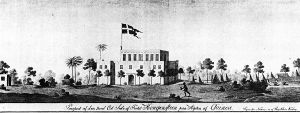
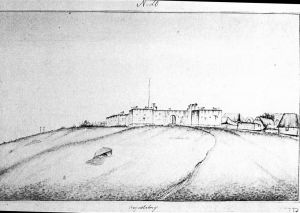
Fort Kongensteeen
“ART. I. In consideration of the sum of£10,000sterling, to be paid by Her Majesty the Queen of the United Kingdom of Great Britain and Ireland to His Majesty the King of Denmark, on the exchange of the Ratifications of the present Convention,+‘
Fort Prindsensteen
His Danish Majesty cedes to Her Britannic Majesty, to be possessed by Her Britannic Majesty, her heirs and successors, in full property and Sovereignty, all the forts belonging to the Crown of Denmark, which are situated on that part of the Coast of Africa called the Gold Coast or the Coast of Guinea, and which comprise Fort Christiansborg,1Fort Augustaborg,2Fort Fredensborg,3 Fort Kongensteen,4 and Fort Prindsensteen,5 with their appurtenances and all the guns and stores contained therein, together with all other Possessions, property, and territorial rights whatever belonging to His Danish Majesty on the said coast.” The exact extent of the Possessions thus ceded was not at that time clearly defined; but, on the9th May, l887, the Kings and Chiefs of the country of Aquamoo signed a Declaration acknowledging that they and their country formed part of the Protectorate of Her Majesty the Queen of Great Britain and Ireland on the Gold Coast, and that they were subject to the jurisdiction and authority of Her Majesty, and declaring that they had that belief inasmuch as their country of old enjoyed similar protection from His Majesty the King of Denmark, who, they said, they understood had ceded his right and title to their country to the British Crown in1850.
Fort Augustaborg
On the1st July, 1890, an Agreement was entered into between Great Britain and Germany, for defining their respective spheres of influence on the Gold Coast and in other parts of Africa (No. 129); and on the14th April, l893, a further agreement was entered into between the two countries for defining the limits of their respective spheres from the Gulf of Guinea into the Interior (No. 131).
Below is the notification by Alfred-Amédée Dodds from the French Republic stating that the Kingdom of Dahomey is now under the Protectorate of the French Republic, with the exception of Whydah and certain other territories, which were declared by a French Notification issued on the 3rd December, 1892, to be annexed to France.
The following is a Translation of that Notification :—
(Translation)
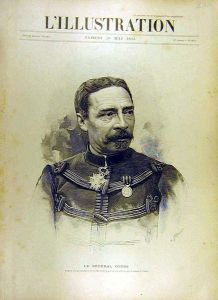
le general Alfred-Amedee Dodds
“In the name of the French Republic:
“We, Brigadier-General, Commander-in-Chief of the French Settlements of Benin, Knight Commander of the Legion of Honour.
“In virtue of the powers conferred upon us,
“We declare :
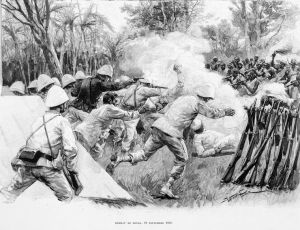
“That KingBéhanzinAhy-Djerehas been deposed from the throne ofDahomey, and has been banished for ever from this country.
Behanzin, the Last King of independent Dahomey
“That the Kingdom ofDahomeyis, and remains, placed under the exclusive Protectorate of France, with the exception of the Territories of Whydah, Savi, Avlékété, Godomey, and Abomey-Kalavy, which constituted the ancient Kingdoms of Ajuda and Jacquin, which are annexed to the Possessions of the French Republic. The limits of the annexed Territories are: to the west, the River Aheme; to the north and to the east, the River Savi and the north-east frontiers of the Territory of Abomey-Kalavy; to the south, the AtlanticOcean.”
The world celebrates men. Men can be ambitious, they can work to liberate their countries, they can be revolutionaries, and lead people. No one is against that. The world applauds these men. But when women fight for the liberation of their countries, they are vilified; they are called all sorts of names. It’s as if the world suffers from selective amnesia. We have a woman who is at the same level as all the world revolutionaries, Winnie Madikizela-Mandela.
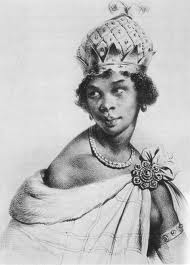
Just taking a look back at history, men, white supremacy, and patriarchy do not like strong women, and particularly strong black women. For instance, in the 1660s, white men described (and it can still be read in history books) the great Angolan warrior Queen Nzingha who fought for her people’s freedom and fought the Portuguese against slavery, as an angry, power-hungry, and over-sexed woman who would sleep with one new soldier every night, and have him killed the next morning. Such absurdity! Wouldn’t that diminish her troops, troops strongly needed to fight against the Portuguese?
Queen Nzingha of Angola
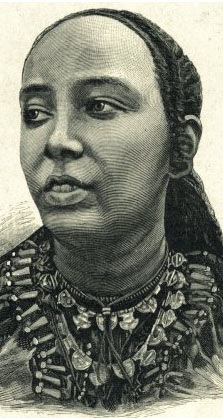
Next, we have the great queen Taytu Betul, the queen without whom there would have been no Battle of Adwa, where Ethiopia defeated Italy, the first victory of an African nation on a European one. There again, European historians describe Queen Taytu Betul as a man-eater, a woman with a black heart, manipulative, hateful, and conniving.
Empress Taytu Betul of Ethiopia
In both cases, the truth is that they are afraid of the power of the Black woman; these historians vilify Black women. The patriarchal and white supremacy system hatesWinnie Madikizela-Mandela because she fought like no other, like no man would have. She was strong, and brave, and a woman of principle. To them, she was a woman, she should have stayed home, and not joined and fought tirelessly for freedom.Even though she was cleared of the murder of Stompi, she is hated while Nelson Mandela is sanctified, but everybody forgets that Nelson Mandela was once the leader of Umkhonto we Sizwe the armed branch of the ANC. We do not hate that fact, because we know that, that was what was needed at the time for the apartheid regime to fall. So why do people applaud Nelson Mandela, and honor him, while they hate Winnie Madikizela-Mandela who kept his name alive while he was in jail 27 years, and fought like not many human beings (not even him) would have fought? The world applauds him, because he is a man. The world should also celebrate her, Winnie Madikizela-Mandela.
Stop the sexist history, the patriarchist history, the racist history. Winnie Madikizela-Mandelais a world revolutionary, and should be applauded for her stance all those years, for her hard work, her determination, her principle, and her love of her people. She should be celebrated. Please do watch what EFF leader Julius Malema has to say about it.
Here is Winnie Madikizela-Mandela’s last interview. She goes over parts of her life, the apartheid era, the transition, and the difference between political vs economical power. She also talks about the current leadership, and the need for a re-evaluation of the ANC, and the need for a new vision. A note: the leadership of Ghana had a delegation there with EFF leader Julius Malema to send their last goodbyes to Mama Winnie. Also the light has been shed on the truth about the fact that Winnie never killed Stompi! Enjoy!
“They think because they have put my husband on an island that he will be forgotten. They are wrong. The harder they try to silence him, the louder I will become!” – 1962
“I will not allow the selfless efforts of my husband and his friends to be abandoned. I will continue the struggle for a free and equal South Africa.” – 1962
“To those who oppose us, we say, ‘Strike the woman, and you strike the rock‘.” – 1966
Winnie Madikizela-Mandela during her exile in Brandfort, 1977 (Source: Timeslive.co.za)
A flavor of the harassment and trauma of a typical raid [under the apartheid regime]: “…that midnight knock when all about you is quiet. It means those blinding torches shone simultaneously through every window of your house before the door is kicked open. It means the exclusive right the security branch have to read each and every letter in the house. It means paging through each and every book on your shelves, lifting carpets, looking under beds, lifting sleeping children from mattresses and looking under the sheets. It means tasting your sugar, your mealie meal and every spice on your kitchen shelf. Unpacking all your clothing and going through each pocket. Ultimately it means your seizure at dawn, dragged away from little children screaming and clinging to your skirt, imploring the white man dragging Mummy away to leave her alone.” – 1960s
Up until the 1970s, the years of constant police harassment, jail time and intimidation had done absolutely nothing to quash Winnie’s revolutionary spirit; indeed, her conviction had only become stronger. Her message to the authorities was clear: “you cannot intimidate people like me anymore.” – 1970s
‘491 Days Prisoner number 1323/69’ by Winnie Madikizela-Mandela
“It is only when all black groups, join hands and speak with one voice that we shall be a bargaining force which will decide its own destiny.” – 1976
“If you are to free yourselves you must break the chains of oppression yourselves. Only then can we express our dignity, only when we have liberated ourselves can we co-operate with other groups. Any acceptance of humiliation, indignity or insult is acceptance of inferiority.” – 1976 (similar to President Thomas Sankara’s words, 8 years before he uttered them).
“We have no guns – we have only stones, boxes of matches and petrol. Together, hand in hand, with our matches and our necklaces, we shall liberate this country.” – 1986
Winnie Mandela during a rally (Source: Business Insider South Africa)
“There is no longer anything I can fear. There is nothing the government has not done to me. There isn’t any pain I haven’t known.” – 1987
“I am the product of the masses of my country and the product of my enemy.” – 1996
“I was not made by a racist media and I will not be unmade by a racist media. What matters is what I mean to my people…without economic power, freedom is worthless.”
Winnie Madikizela-Mandela
“I’m not sorry. I will never be sorry. I would do everything I did again if I had to. Everything.”
“All what we fought for is not what is going on right now. It is a tragedy that he lived and saw what was happening, we cannot pretend like South Africa is not in crisis, our country is in crisis and anyone who cannot see that is just bluffing themselves.”– 2017
Nelson and Winnie Mandela, on Nelson’s release from prison on 11 Feb. 1990
It is with great sadness that I learned of the passing ofWinnie Madikizela-Mandela, the mother of the Nation. My eyes still remember that pivotal day, ofFebruary 11, 1990, whenWinnie Madikizela-Mandelawalked hand-in-hand with her husband Nelson Mandela as he was coming out of jail after 27 years, and raised her fist to the entire world, to a reception of hundreds of supporters and thousands around the globe. We had all prayed for that day, and that day came because of Winnie’s selfless battle against apartheid.
Winnie Madikizela-Mandela
The incredibly dignified and beautiful Winnie Mandela fought like no other, and I can truly say today that without her constant fight to keep her husband’s name and fight alive during those27 yearshe spent in jail, nobody would have remembered Nelson Mandela, and the history of South Africa and the1994rainbow democracy would have been different. For it is because of Winnie Madikizela-Mandela that we all know Nelson Mandela to the extent that we know him today. While he was in jail 27 years, furthering and refining his law studies and other things, she was out there tirelessly working for the freedom of her people, keeping his name alive, and fighting the apartheid system. Winnie fought, and endured so many hardships: brutalized by the police, constantly forced to lose her job by the apartheid system, single-handedly raising her 2 children, repeatedly thrown in jail for her values, harassed, beaten, and humiliated by the system, her children constantly thrown out of school or denied admission because of who she was, exiled/banished to a very racist white-only community for years, and so much more. At one point she was thrown in jail for 17 months, and spent most of that time in solitary confinement, where she had no formal contact with another human being at all aside from her interrogators, among which were notorious torturers.
Winnie Mandela, wearing her khaki slacks, helps bereaved comrades carry the coffin of an apartheid victim (SA History.com)
Part of what kept Winnie motivated during her banishment (exile), and even throughout her life, was her exceptional ability not to become demoralized and her inexhaustible tenacity to keep busy. While she was living out her banishment she established a local gardening collective; a soup kitchen; a mobile health unit; a day care center; an organisation for orphans and juvenile delinquents and a sewing club.
Winnie Madikizela-Mandela at an ANC rally (Source: Reuters)
Sadly,while she waited 27 years for Nelson Mandela, it took him 4 years after coming out of prison to get rid of her! Really? Seriously? I guess women are supposed to keep the candle up and be loyal, while men are not held to the same standards. Any man who would have gone through 27+ years of what theapartheid system did to Winnie would have cracked, but not Winnie, she fought the fight, she fought for her people, and in 2009, the people re-elected her to the parliament in great fanfare. In January 2018, the University Council and University Senate of Makerere University, Kampala, Uganda, approved the award of an honorary Doctor of Laws (LLD) degree to Winnie Nomzano Madikizela-Mandela, in recognition of her fight against apartheid in South Africa. Julius Malema, the leader of the EFF, said last June: “She [Winnie Madikizela-Mandela] should have been the first female president (of the country)‚ a real president who was not going to be a front for male leadership.”
Winnie Madikizela-Mandela celebrating her 80th birthday surrounded by Julius Malema and Cyril Ramaphosa (Source: Timeslive.co.za)
Please readSA Historywho celebrated the life of OUR HEROINE the gorgeous and strong Winnnie Madikizela-Mandela, the mother of the nation (do not forget to read what I said aboutAfrican Women and Revolution); also read her book, Part of My Soul Went with Him.We, Africans, have to write our own history, and celebrate our heroes. Winnie Madikizela-Mandela was a hero like none other. Without Winnie Madikizela-Mandela, the world would not have known Nelson Mandela! If anybody has earned their place in history and in the hearts of her people, it is definitely Winnie Madikizela-Mandela! She was a woman of principle, and of great love for her people!
Here is the trailer to the movie celebrating the life of King Mkwawa, the Hehe leader who inflicted the German Schutztruppe their first defeat on African soil. I salute King Mkwawa and the Hehe people who fought for their freedom and resisted the Germans for over 7 years. 17th August 1891 marks the first defeat of Germans colonial forces, and also the victory of King Mkwawa and the Hehe people. A lot can be said about a king whose people loved him dearly to the point that no one within his ranks were willing to betray him for money. The fact that the return of his skull was part of the Treaty of Versailles also denotes his great aura. This, however, makes us wonder how many more of our treasures, statues, and even skulls of our great warriors and kings may still be exposed or hidden in Western museums and galleries. We demand their return; these belonged to our ancestors, thus they belong to us and are a part of identity! Enjoy!


 Throughout the years, I have placed high hopes on African teams and have been often disappointed. I might once again be disappointed. However, this is a planetary tournament, and the fun of it makes one root for any good team. To make for a fun event with great home support, we hope that the host team,







 African Heritage