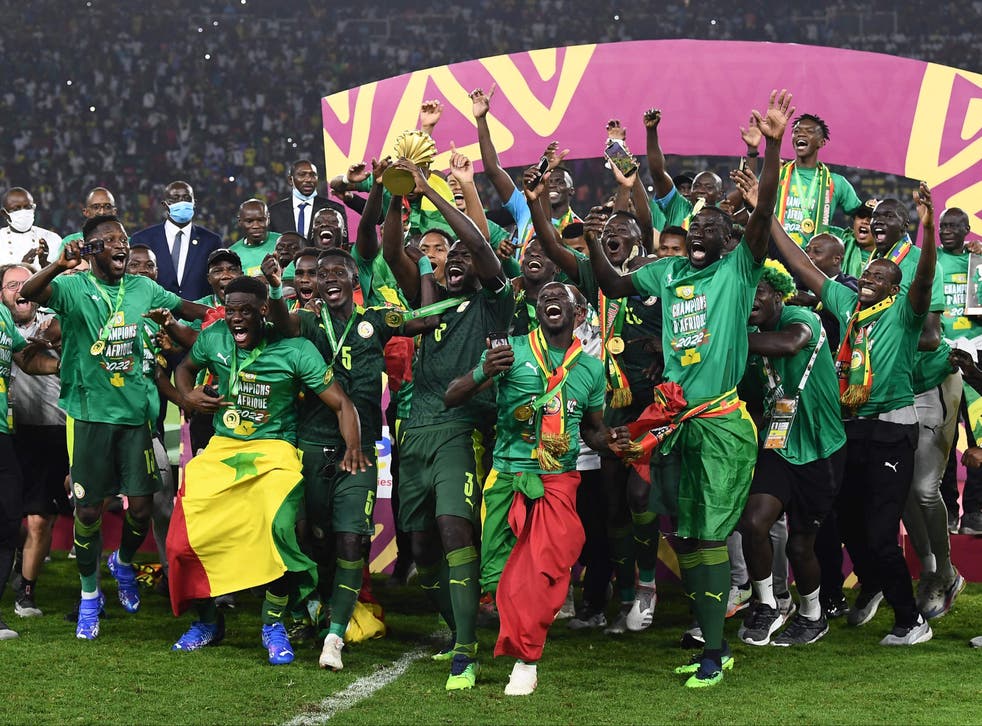
Senegal Lions of Teranga celebrate winning the AFCON 2021 (Independent.co.uk)
Yesterday February 6th, Senegal won the 2021 African Cup of Nations against the Pharaohs of Egypt to become the new champions. This was their first win in the history of the game. To be awarded the trophy after so many years of getting so close is a real joy. They came second at the last edition CAN 2019 missing the trophy against the Fennecs of Algeria. I am happy that with their Senegalese coach (not many African teams have African coaches these days), Senegal made us really proud.
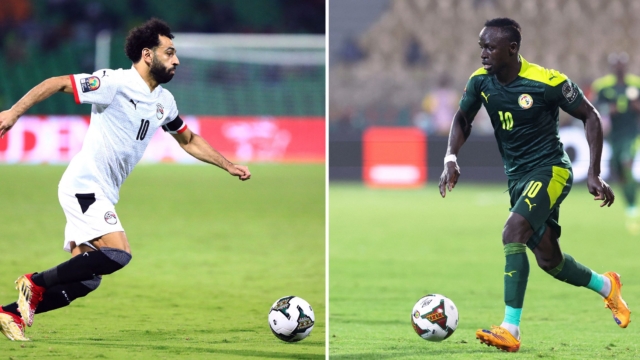
Egypt’s forward Mohamed Salah in Garoua (Left) on January 15, 2022; and Senegal’s forward Sadio Mane in Yaounde on February 2, 2022 (Right). (Photo by Daniel BELOUMOU OLOMO and Kenzo TRIBOUILLARD / AFP via Getty Images)
The game opposed some of the biggest football players in the world Sadio Mané of Senegal and Mohamed Salah of Egypt, both of Liverpool FC. Sadio Mané, scored the winning penalty in the shootout against Egypt, having seen a first-half spot-kick saved as Sunday’s game ended in 0-0 after extra time. “It’s the best day of my life and the best trophy of my life,” the 29-year-old Liverpool forward said. “I won the Champions League and some [other] trophies but this is the special one for me. This is more important for me. … I am happy for myself, my people and all of my family.” Mane credits his team-mates with giving him the strength to return in the shootout, where he sealed a 4-2 triumph. “When I missed the first penalty, it was a big blow for me,” he said. “But my team-mates came to me and said ‘Sadio, we lose together and we win together. … The trophy belongs to the whole Senegal team – everyone deserves it.”
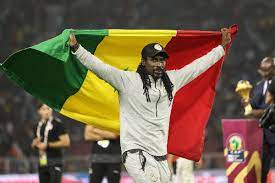
For Senegal’s coach Aliou Cissé, this marks a victory at his third attempt in the Nations’ Cup final. The 45-year-old captained the Teranga Lions when they finished as runners-up in 2002 – missing the decisive penalty in the shootout against Cameroon – and coached Senegal when they lost against Algeria in 2019. He dedicated the 2022 victory to his countrymen before his post-match press conference was interrupted by his squad for celebrations. … He said, “[this] really proves the mental strength of this generation. We are very happy, we dedicate this victory to the Senegalese people, because since independence until now we are running after this first star. … Today, we will also have a star on our shirt.”
As a result of their win, Senegal has declared Monday a national holiday to celebrate winning its first ever Africa Cup of Nations! It is also good to note that the Lions of Teranga of Senegal won against the Pharaohs of Egypt in the Stade Ahmadou Ahidjo in Cameroon. Many locals have claimed that the late Cameroonian President Ahidjo who is still buried in Senegal (story for another day), had been watching over the Senegalese team and blessing them, given that Senegal has been good to the previous president and his entire family.
Tensions are escalating between France and Mali as the French ambassador was expelled from Mali and given 72 hours on Monday to leave the country. How did we get here? In reality, Mali has been in disarray since Libya fell in 2011… and has never recovered since then (“Le Mali en miettes. A qui le tour?” de Chems Eddine Chitour – “Mali in pieces. Who is next?” by Chems Eddine Chitour). France came in to “offer” her support to fight the djihadists in the north of the country. Today, as a result, the country is split into pieces, countless Malians have died, and France is now world producer of gold… mind you that France does not have an ounce of gold on her territory, but rather has been pillaging the mines of Mali, disrupting the peace in the region, and getting the “International community” to support her efforts in the plundering of the golden Mali (Africa is funding Europe!). Remember that Emperor Kankan Musa of the Empire of Mali, which encompassed part of modern-day Mali, distributed so much gold during his pilgrimage to Mecca in 1324 that it took a decade for the Egyptian economy to recover.
Map of Mali with its capital Bamako
Mali has been in pieces… after the coup that got rid of France’s puppet IBK (Bye Bye IBK: Mali Coup), and the military coup that brought the Colonel Assimi Goita to power. Faced with 80% of its territory occupied by foreign forces and terrorists, and in order to regain the sovereignty of its lands, Mali has sought the partnership of Russia, which France has screamed against – remember The 11 Components of the French Colonial Tax in Africa which denies Africans the right to other military or economic partners without France’s approval? Well, France is angry that Mali has turned to Russia for help in regaining its territory… The time for us being doormats is over France… We have the right to our dignity! We have the right to choose the partners that can help us in our visions, a vision which seeks the well-being of our communities.
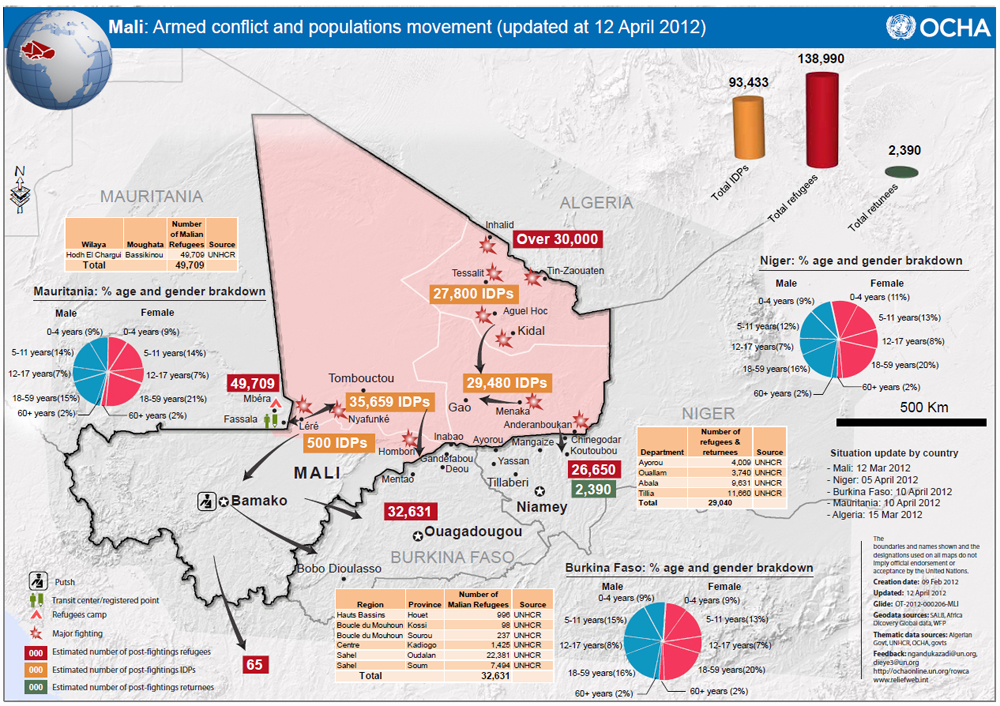
Mali conflict map
Just last week, France’s puppet organization that is ECOWAS (CEDEAO) placed unbelievable sanctions on Mali, closing borders, banking, etc… How can an African organization act in such a way against a sister country, if it is not serving the interest of the enemy?
I live you here with a more recent timeline published on Al-Jazeera. Bear in mind that it is not told from the eyes of a Malian or an African, so it is biased. For the full timeline, please go to Al-Jazeera.
====
Colonel Assimi Goita
On August 18, 2020, a group of Malian soldiers led by Colonel Assimi Goïta overthrew elected President Ibrahim Boubacar Keïta, who was facing angry protests over the government’s failure to stem the violence. The coup is seen as a blow to French President Emmanuel Macron, who had supported Keïta and sought to improve relations with former colonies in Africa.
On March 30, 2021, in a rare criticism of French forces in Mali, United Nations investigators accused the French military of being responsible for the killing of at least 19 civilians at a wedding party in central Mali in an air raid three months before. France denied the findings, saying its forces targeted an “armed terrorist group” and that it had “numerous reservations about the methodology used” in the UN investigation.
On May 25, Goïta pushed out a civilian-led government appointed to oversee a transition period, plunging the country into further uncertainty. He was named interim president on May 28.
In reaction to the power grab, France suspended its joint military operations with Malian forces on June 3 “awaiting guarantees” that civilians return to positions of power.
Conflict map of Mali with internally displaced populations (blog.amnestyusa.org)
On June 10, French President Emmanuel Macron announced a major “transformation” and drawdown of France’s military presence in the Sahel where about 5,100 soldiers – across Burkina Faso, Chad, Mali, Mauritania and Niger – operate under its Barkhane operation [no wonder France can afford to have 35-hour week for its workers, or even confine them forever… their riches come from Africa].
France decided on July 3 to resume its military operation in Mali, as well as its advisory missions.
On September 14, France warned Mali against a deal with Wagner as reports emerged the country’s military government was close to hiring 1,000 mercenaries.
A spokesperson for the Malian defence ministry said his country wanted to “diversify its relationships” on security grounds.
French flag
On October 5, Macron called on Mali’s military to restore state authority in large areas of the country. “It’s not the role of the French army to fill in for the ‘non-work’, if I may describe it, of the Malian state,” he told French media. …
Mali’s Prime Minister Choguel Kokalla Maiga said on October 8 that he had evidence that France was training “terrorist” groups operating in the country. Maiga said French troops had created an enclave in Kidal, a town in the desert region of northern Mali, and handed it over to a “terrorist group” known as Ansar al-Din, allegedly linked to al-Qaeda.
On December 15, French forces left the city of Timbuktu, marking the scaling down of France’s intervention in northern Mali which had started in 2013 when it helped beat back groups advancing towards Bamako.
France and more than a dozen countries condemned on December 24 the deployment of Wagner mercenaries [i.e. the international community = gang of thieves] – one of the first official acknowledgements by Western capitals of the stationing of fighters from the Russian firm. Mali’s government has denied this, saying the Russian troops are in the country as part of a bilateral agreement.
… On January 7, Russian soldiers were deployed to Timbuktu to train Malian forces at the base vacated earlier by French troops.
On January 9, the Economic Community of West African States (ECOWAS) imposed a trade embargo on Mali after the military government postponed elections for up to five years, despite promising to hold a vote by February [ECOWAS = puppet arm of France in Africa].
Two days later, on January 11,France, the United States and the European Union backed the West African bloc’s sanctions [of course… the United Nations of thieves]. With borders closed, the military government branded the sanctions an “extreme … and illegal embargo against our people” and organises mass protests. …
Denmark sent 105 military personnel to Mali on January 18 to join a European special forces mission, known as Takuba, that was set up to help Mali tackle armed groups [see… International Gang of Thieves]. It said its troops had deployed after a “clear invitation” from Mali.
On January 24, the Malian government called on Denmark to “immediately” withdraw its contingent of special forces deployed alongside French and international troops. Denmark’s withdrawal was a headache for France, which had staked much on “Europeanising” its Sahel intervention.
On January 27, French Foreign Minister Jean-Yves Le Drian lashed the [Mali] military transitional cabinet’s “irresponsible” decision, calling it “illegitimate”. And in remarks published on January 30 in the Journal du Dimanche newspaper, the French foreign minister accused the Wagner group of plundering Mali’s resources in exchange for protecting the military government [the pot calling the kettle black]. “Wagner uses the weakness of certain states to implant itself … to reinforce Russia’s influence in Africa,” Le Drian added.
But Mali’s Foreign Minister Abdoulaye Diop hit back saying France was not defending democracy and was angry only because “we have hurt their interests” [we have dared go against The 11 Components of the French Colonial Tax in Africa].
On January 31, Mali said it was expelling the French ambassador because of “hostile statements” by French officials.
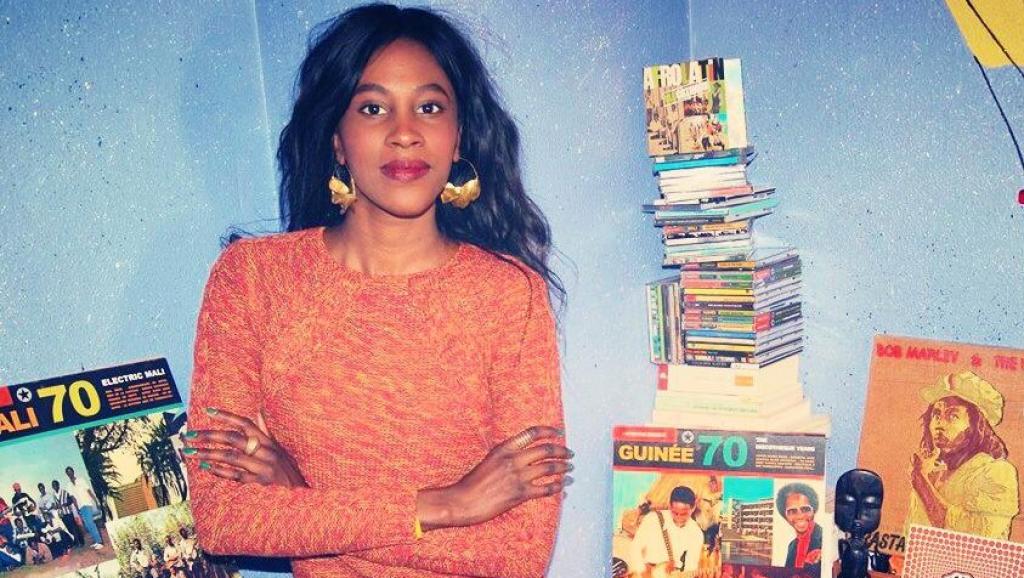
I recently heard about the Syllart Records, a music records label which many considered to be the equivalent of the African continent’s Motown records. The record label leader is Binetou Sylla, the daughter of the founder, the late Senegalese producer Ibrahima Sory Sylla. The label owns the largest African music catalog in the world, spanning the last sixty years of music creation. Its founder, Sylla’s impact on African pop music and its global influence is really wide. Imagine the hard work, the quality, the authenticity, and innovation that went on in his studios! Yet, I had never heard of his name. However, I had heard about some of the artists produced under his label, and danced to their music, such as Ismael Lo, Salif Keïta, Empire Bakuba, Sam Mangwana, Gadji Celi, M’Pongo Love, Tshala Muana, M’bilia Bel, Oumou Sangare, Pépé Kallé, Miriam Makeba, Papa Wemba, or Africando, and so many others.
Binetou Sylla of Syllart Records (Source: Panafricanspacestation.org.za)
Today, his daughter is working on digitizing all that hard work, and trying to find ways to give rights to the musicians. She says of her father on OkayAfrica, “[My father] preferred to let his work, his music speak for him. He was an ambassador for African music. … [He] excelled at scouting new talent and used Syllart as a launching pad for many who would rise to global stardom.” Enjoy her recent interview to BBC. Check out the Syllart Records YouTube channel.
Fellow readers, we are writing here to wish you all a HAPPY 2022! May this new year mark the beginning of new endeavors, the continuation of current ones, and/or the end of old ones. May this new year be filled with health, prosperity, joy, love, happiness, abundance, harmony, and peace! 2021 was quite a year, and many are hoping for something better. Let us turn the 2021 page, and start the 2022 chapter ready to take off for this new year, never losing altitude during this flight, and trusting for better.
Happy 2022
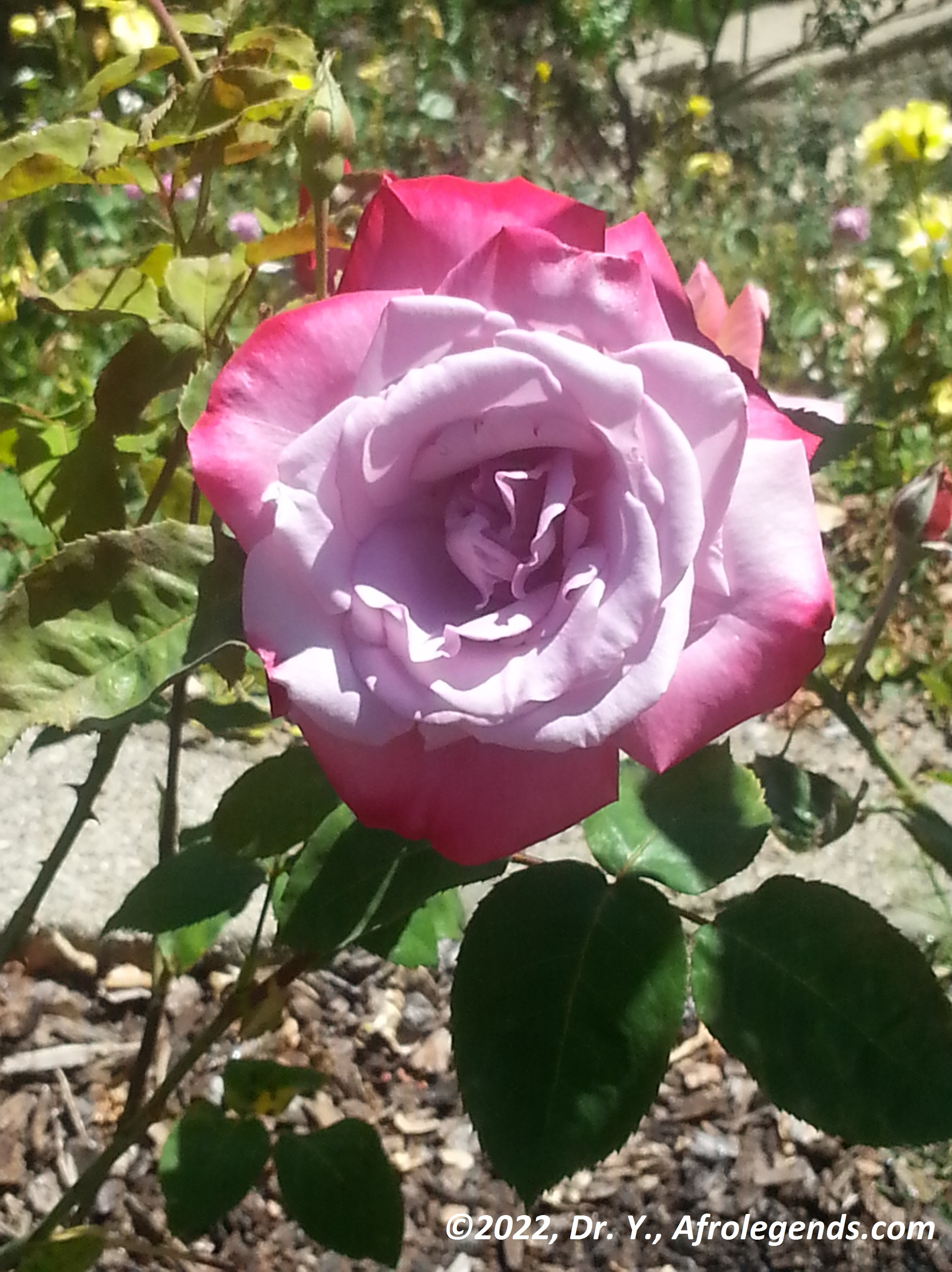
The top 5 posts of the year 2021 are listed below: an old-time favorite “My Name” by Magoleng wa Selepe took first place as the most read post of the year. We, at Afrolegends.com, would like to express our profound gratitude for your constant support, as your readership has carried us forward. Keep on visiting, sharing, and commenting. We wish you a full and amazing new year, rich in blessings and greatness. Keep your heads up, and may your year be as beautiful as the petals of this flower! As you can see, everything about this flower is unique, the outer red color and the inner purple which mark a difference that is beautiful to see, thus may 2022 be the beginning of: a new start, a new life, and a new joy! As always, like Agostinho Neto said, “A luta continua … a vitória é certa!”
Although 2021 has globally been a tough year, there are still events that lend to celebration. As we turn the page of 2021 and delve into 2022, it is good to note that in 2021, a lot of “firsts” have taken place on the African continent. Below are a few of the events that brought joy. There are many more, of course, but I selected 11. Enjoy, and add in the comments other celebratory events that have marked the continent this year.
In May, a Malian woman gives birth to 9 babies (from natural conception). This marks the first single birth and survival of nonuplets in the world. Halima Cisse, a Malian woman, has given birth to nonuplets, 5 girls and 4boys, in a hospital in Morocco [World Record: Malian Woman gives Birth to Nine Babies].
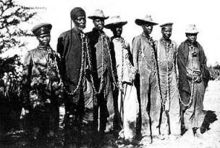
Chained Herero men
Germany agrees to pay Namibia €1.1bn over historical Herero-Nama genocide in May of this year. This is historic, late, and probably not enough compared to the loss in human lives… yet it is important! The money will be paid over 30 years in aid programs… (probably a way to siphon money back to Germany, while appearing to be giving something), and pales in comparison to the billions worth of Namibian diamonds and cobalt mine that will profit German companies in fine print [Germany in Namibia: the First Genocide of the 20th Century].
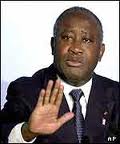
Laurent Gbagbo
In June, after 10 years of imprisonment, and over 20 years of persecution, Laurent Gbagbo, the former president of Cote d’Ivoire finally lands home amidst celebrations from his supporters in the country and abroad [Laurent Gbagbo is Back in Cote d’Ivoire]. Although there have been subsequent disappointing actions on his part, it is nonetheless a victory over the International Court of Justice, and all the persecution Blé Goude (How long shall they kill our prophets…?), him, and countless others have gone through, and remains a major cause for celebration, as it shows that, for a just cause,perseverance and determination always bear fruits.
In June, Petra Diamonds pays Tanzanians for its abuse [Petra Diamonds pays £4.3m to Tanzanians ‘abused’ by its contractors]; this is significant as it shows that it is not impossible to demand reparations from these giant companies that pollute our lands and abuse us. It sets a precedent.
Tokyo 2020 Olympics logo (Olympics.com)
Late July marks the start of the Tokyo 2020 Olympics after one year of postponement, and Africa wins new victories. Tunisian Ahmed Hafnaoui offers the African continent its first medal of the games, by winning gold in the 400m freestyle swimming; Hugues Zango of Burkina Faso gives his country its first ever medal at the Olympics by winning the bronze medal in the men’s triple jump; while Eliud Kipchoge successfully defends his Olympic title at the marathon becoming the 3rd person in the history of the games to win successive marathons [African Wins at the Tokyo 2020 Olympics].
In October, Tanzanian writer Abdulrazak Gurnah is awarded the Nobel Prize of Literature, making him the fifth African to win the illustrious prize [Tanzanian Abdulrazak Gurnah awarded Nobel Prize of Literature]. As you can see, the African literary scene is flourishing.
100 years after René Maran, an African wins the prestigious French Prix Goncourt. The award was given to Senegalese writer Mohamed Mbougar Sarr. This is the first time that a Sub-saharan African person wins the prize, and the third time for a Black person in the almost 120-years history of the title [100 years after René Maran, An African wins the Prestigious Prix Goncourt], even though people of African descent make up so much of the French population over the past century.
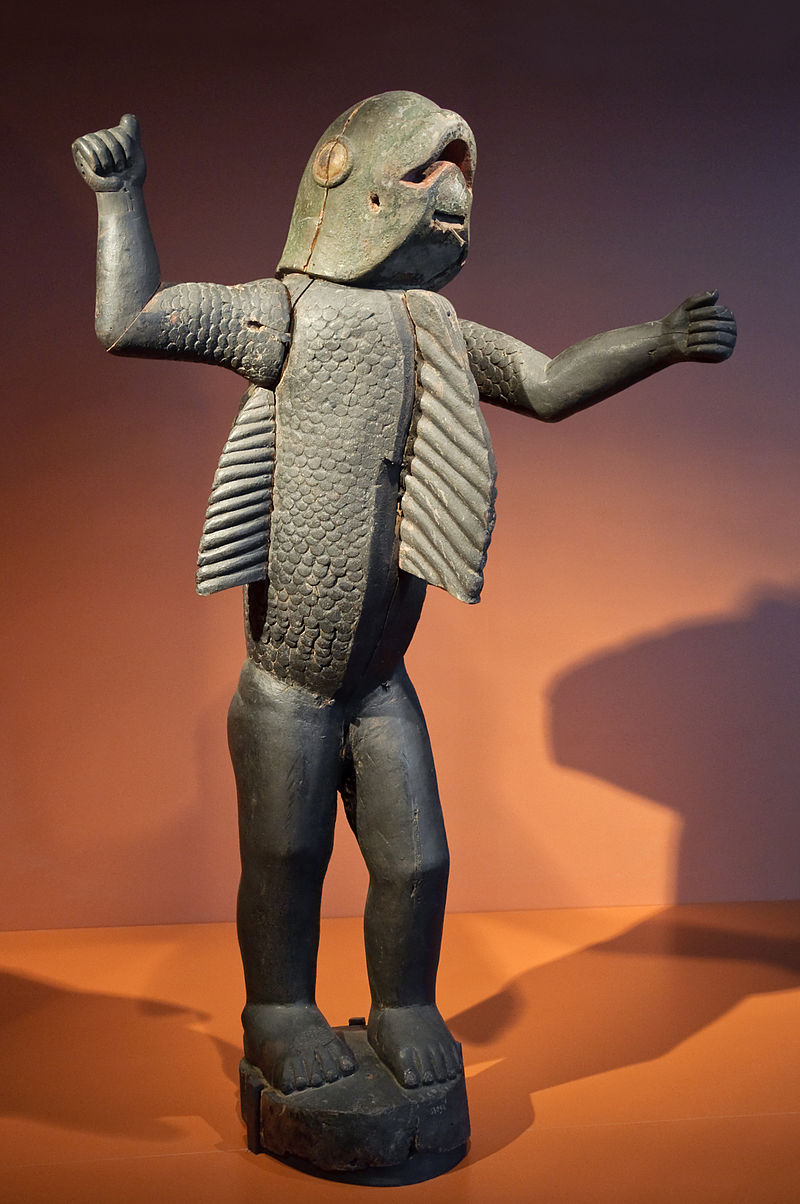
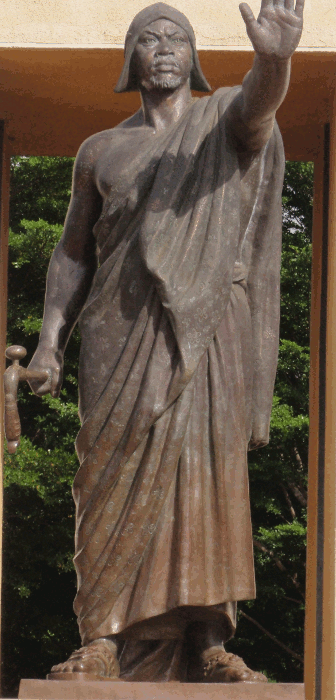
Benin Fon statue symbolizing Behanzin man shark (Musee du quai Branly – Jacques Chirac)
Congolese Rumba has been recognized as a UNESCO Intangible World Heritage. Congratulations to both Congos, the Republic of Congo and the Democratic Republic of the Congo (DRC) for working together. We do hope that this is just the first step in a collaboration that will extend to other domains including economic success and beyond [Congolese Rumba Wins UNESCO Protected Status].
Now, there are a lot more such as David Diop winning the International Booker prize for his book “At Night All Blood is Black” which focuses on Tirailleurs Senegalais; or the Senegalese influencer Khaby Lame being ranked number 2 on Tik Tok for his wordless humor which transcends language barriers and cultures (he is the fastest growing Tik Tok influencer with 120 million followers); or even Madagascar’s secretary of police, Serge Gelle, swimming for about 12 hours to reach shore after his helicopter crashed in the Indian Ocean off the northeast coast of the country. When rescued, Gelle said “My turn to die has not yet come, thank God.” So let us all be grateful for this year, and for the people and events who have brought joy to our lives, and let us move forward to a new year.
2021 was no doubt a tough year the world over, with a continued global pandemic, stressed economies, and much more. What a year! Africa said goodbye to quite a few people, events, and more. Below are a selection of 10 events of 2021. I am sure that I have left quite a few out…
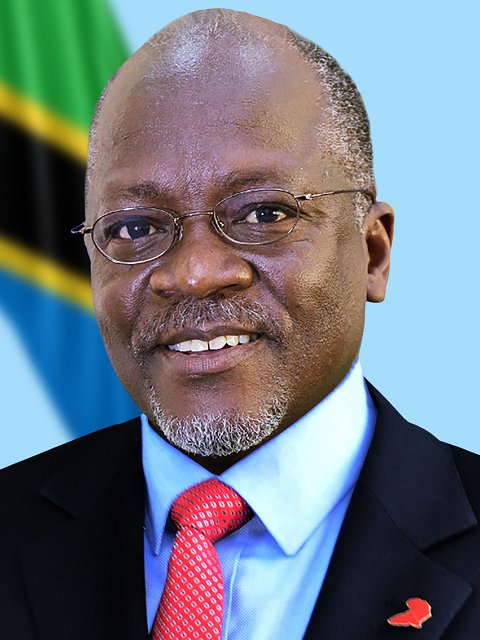
President John Magufuli of Tanzania
In March, President John Magufuli of Tanzania changed dimensions. It was heartbreaking to see someone who had done so much for his country go away so suddenly. Nicknamed the “bulldozer” he had a reputation to be incorruptible [So Long to President John Magufuli of Tanzania: The Bulldozer], and under his leadership Tanzania saw growth and development. Magufuli was focused on Tanzania’s economic success and sought to implement ambitious projects that would lift more of his people out of poverty. Under his reign, he expanded free education, and rural electrification. Tanzania was one of the fastest-growing economies in the world, thanks to his hard work [President John Magufuli in His Own Words].
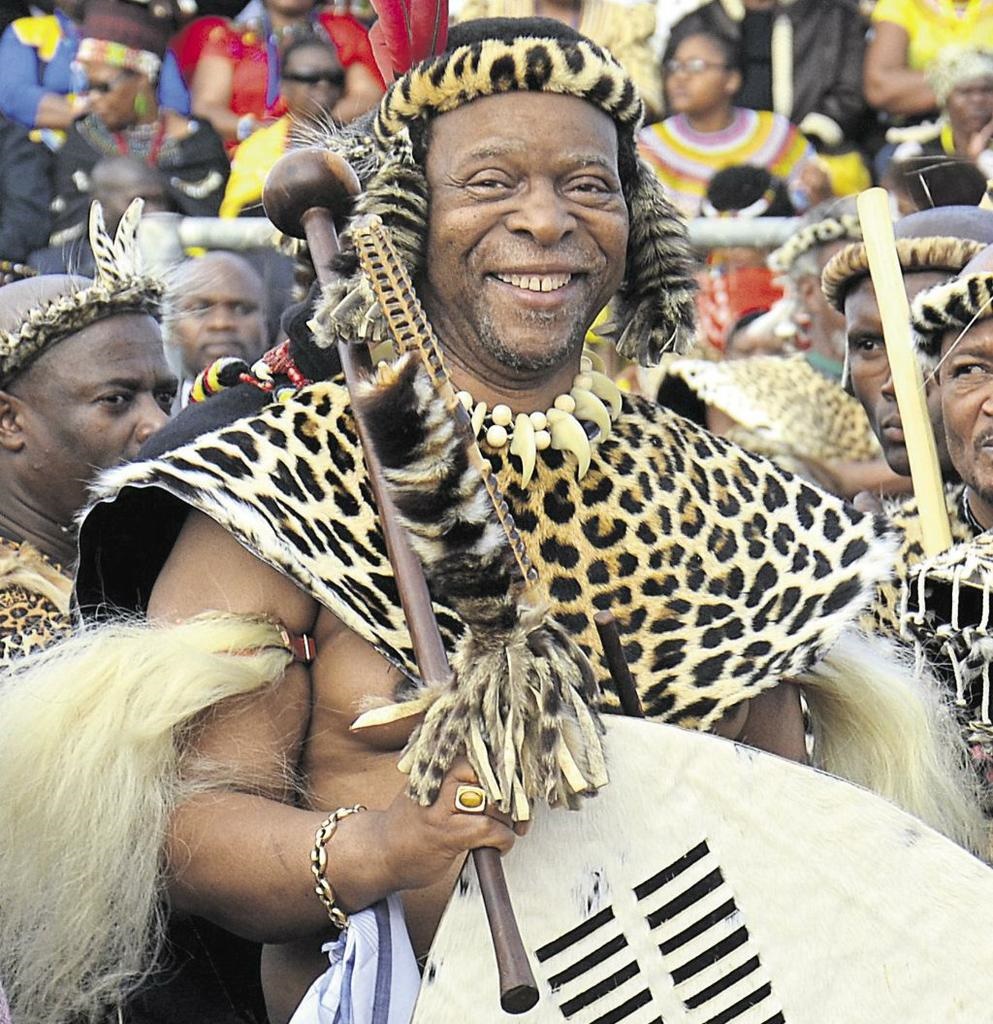
King Goodwill Zwelithini (Source: sahistory.org.za)
In March, King Goodwill Zwelithini of the Zulu people of South Africa passed away. He had been king of the Zulu for over 50 years, since 1968 when he had succeeded his father, King Cyprian Bhekuzulu. Over these 50 years, he saw his country change from the apartheid regime to the Rainbow nation. At the time of his passing, the King’s Great Wife, Queen Mantfombi Dlamini was appointed as interim leader of the Zulu Nation under the title of queen regent from March 2021 to April 2021, when she passed away suddenly. King Goodwill Zwelithini was succeeded by his son King Misuzulu Zulu.
In June, the very popular Nigerian pastor T.B. Joshua departed from this planet. He was a legendary charismatic pastor who was visited by presidents, and people from around the world; it is said that his church was Nigeria’s biggest tourist attraction.
Kenneth Kaunda
In June also, Kenneth Kaunda of Zambia, first president of Zambia joined his ancestors. At 97 years old, he was one of Africa’s last surviving liberation leaders. To a generation of Africans, he epitomized the Africa struggle for independence. Affectionately known as Mzee, Kaunda worked tirelessly towards the freedom of the whole of Southern Africa from white rule; he supported the fight of other countries against repressive, racist regimes in South Africa, Malawi, Namibia, Angola, Mozambique and Southern Rhodesia (Why the name: Zimbabwe?). It took several years, but his support never faltered.
In September, Sultan Ibrahim Mbombo Njoya of the Bamun people of Cameroon perished at the hands of the virus which has paralyzed the planet. He was the 19th reigning monarch of the Bamun Kingdom in the Western province of Cameroon. He had succeeded to his father, the sultan Seidou Njimoluh Njoya in 1992. He has been succeeded by his son Nabil Mbombo Njoya. At 28, Nabil Njoya is now the 20th in the Nchare Yen dynasty of the Bamun people.
In November, F.W. De Klerk, former president of South Africa, and last president of the Apartheid era, passed away. He is known for releasing Nelson Mandela from prison, after 27 years, disassembling the apartheid system, and sharing the 1993Nobel Peace Prize with Mandela.
Flag of Ethiopia
Ethiopia’s Tigray crisis started bringing tears to our hearts… Not sure how to explain the Nobel Peace prize given to Ethiopia’s prime minister Ahmed Abiy in 2019, when I see him choosing the war path instead of peace now. He is presiding over a protracted civil war that by many accounts bears the hallmarks of genocide. This leads to skepticism towards these “prizes” handed over by the “international” community. It has been over a year now that Abiy ordered a military offensive in the northern Tigray region with the promise to have it resolved quickly. Thousands are now dead, 2 million people displaced, and much more.
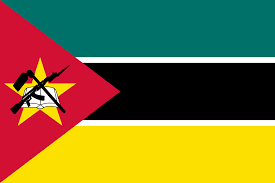
Flag of Mozambique
Loss of peace in Mozambique. Last year, I told you about this amazing oil fields and precious minerals found in Mozambique, and all of sudden the presence of Islamic insurgencies [seriously?… Islamic insurgencies… I think these people probably take us for idiots] starting there right after Total signed one of the biggest contracts ever for over $14 Billions, and the united nations of thieves [seriously check it out, banks for Japan, EU, France, India, US, etc…] descended on the country [Who/What did we say goodbye to in Africa in 2020?].
King Kêfa Sagbadjou Glèlè, monarch of the once-powerful Dahomey kingdom, in the country of Benin, has joined his ancestors. Bear in mind that King Kêfa descended from the Agoli-Agbo line, the one installed (not the rightful bearers of the traditions) by the French after King Behanzin was deported to Martinique and then Algeria.
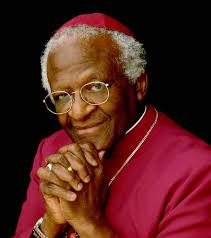
Archbishop Desmond Tutu (Source: The Namibian)
Just the day after Christmas, we learned that Desmond Tutu, the 1984Nobel Peace Prize winner and iconic anti-apartheid fighter was deceased on December 26. As the tributes pour in from around the world, Kenya’s president Uhuru Kenyatta said, Tutu had “inspired a generation of African leaders who embraced his non-violent approaches in the liberation struggle.” At 90, Archbishop Tutu had lived a long fruitful life, battle-tested by life under apartheid. The plans include two days of lying in state before an official state funeral on 1 January in Cape Town.
Last Wednesday, on November 11, 2021, artefacts that had been looted by France 130 years ago were finally returned to Benin. As you recall, on November 17, 1892, the colonel Alfred-Amédée Dodds led a French expedition into the Kingdom of Dahomey. The colonizing troops broke into the palace of King Behanzin at Abomey, and looted a huge number of royal objects, ancient statues, royal thrones, sacred altars, and much more. Upon the troops’ return home, Colonel Dodds donated the stolen objects to the Musée d’Ethnographie du Trocadero in Paris; they have been housed at the Musée du quai Branly – Jacques Chirac since the 2000s. It took 130 years for them to be returned to the homeland. So you can imagine the joy of the people and celebrations that followed. The collection – known as the Abomey Treasures – will remain in a room at the Benin presidency while the museum is in construction. As a slight note, only 26 colonial-era artefacts have been returned at this point, as you can imagine these represent only a fraction of the 90,000 artefacts from Sub-Saharan Africa still held in French museums.
Benin Fon statue symbolizing Behanzin man shark (Musee du quai Branly – Jacques Chirac)
This is nonetheless a step forward, albeit small, and Benin President, Patrice Talon, said, “The stars have been aligning for Benin for some time now. The symbolism of the return to Benin is about our soul, our identity – to use a word that is easier to put on it to understand. This return is testimony of what we’ve been. The testimony of how we existed before.”
For more information, check out the articles on Euronews, and ABC. Enjoy!
First page of the Treaty of Bardo, signed on 12 May 1881
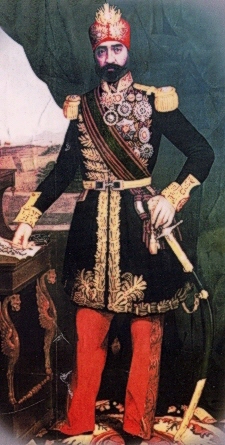
Today, we will talk about the Treaty of Bardo or Treaty of Ksar Said which established a French protectorate over Tunisia. It was signed on 12 May 1881 between representatives of the French Republic and the Tunisian bey Muhammad III as-Sadiq, thus placing Tunisia under the control of France from 1881 until World War II.
As always, the treaty, like so many signed by the French on African soil, allowed France to extend its control over a large area of North Africa, and also to “protect” the Bey from internal opposition. Right… remember how they placed most African countries under “protectorates” to protect them? from who? Often, it was always claimed that it was protection from internal opposition or external invaders, etc, when in reality, it was to protect from them, the French, because face it, they were usually the ones arming the invaders and opposition.
Portrait of the bey of Tunis, Muhammad as-Sadiq
The name of the treaty originated from the site of the residence of the Tunis court, Le Bardo, where the Husainid beys had established themselves in the early 18th century. What is a bey you may ask? Well the bey of Tunis was the monarch of Tunis who reigned from 1705, when the Husainid dynasty acceded to the throne until 1957 when the monarchy was abolished.
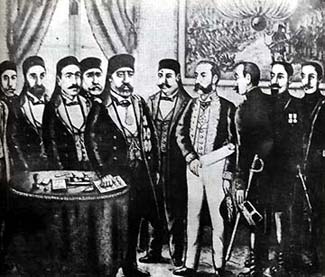
Signature of the Treaty of Bardo – Reproduction of a drawing showing the signing of the treaty of Bardo, from left to right: Mohamed Larbi Zarrouk, Mohammed Aziz Bouattour, Mustapha Ben Ismaïl, Mohammed Khaznadar, Sadok Bey (Muhammed as-Sadiq), the general Élias Mussali, Théodore Roustan, general Bréart, general Pierre Léon Maurand and the translator Amard Tirage
How did the treaty come to be? As always France used a pretext: a raid on Algeria by the Tunisian Khroumir tribe served as a pretext for France to invade Tunisia in April of 1881. Remember the French pretext of an argument on the river Oueme to attack the King of Dahomey, Béhanzin? Well, for the occasion, the French foreign minister, Jules Ferry, deployed an expeditionary force of approximately 36,000 troops to defeat the Khroumir tribe (as you can see, 36,000 troops sounds quite a lot for a tribe, it looks more like an invasion of the territory beyond the Khroumir’s, which was the rest of Tunisia). As you can imagine, the French troops were met with very little resistance, and they kept going until they reached Bardo (a suburb of Tunis). On May 12th, 1881, the French army arrived in proximity of Bardo, where the palace of the bey was located, and handed him a treaty of 10 articles for which he had less than 2 h to examine and sign. The bey, Muhammad III as-Sadiq had no choice but to sign the treaty in his palace of Ksar Said, where he handed over the foreign affairs, the defense of his territory, and the reform of his administration to France. His country was thus placed under the “protection” of France, even though it was only until 8 June 1883 that it officially became a protectorate of France after the signing of yet another treaty, known as the Conventions of La Marsa.
The African film festival, FESPACO, is back this year after the pandemic, the lockdowns of the past year and half, and an 8-months delay (the biennial event was originally scheduled for February 27 – March 6, but had to be postponed because of the Coronavirus pandemic). It is back in Ouagadougou amidst the health situation and also the security issues that have surfaced in the Sahel region, and particularly in Burkina Faso, in the past few years.
The Festival Panafricain du cinema et de la television de Ouagadougou (FESPACO) is the Panafrican Film and Television Festival of Ouagadougou, which happens to be the largest African film festival. It is held biennially in Ouagadougou, the capital of Burkina Faso. First established in 1969, and boasting some of Africa’s greatest writers and filmmakers (like Ousmane Sembene), the FESPACO offers a chance for African filmmakers and professionals to showcase their work, exchange ideas, and meet other filmmakers, and sponsors.
This year’s FESPACO started on October 16thand will end on October 23rd. It promises to be great with filmmakers from around the continent coming to Ouagadougou to celebrate African cinema. After over a year of confinement, with life and particularly travel almost coming to a grinding stop, the festival promises to bring some much needed entertainment and joy.
The Golden Stallion of Yennenga
Over 200 films made by Africans and mainly produced in Africa have been selected for the week-long event. The official selection will see 17 feature-length films compete for the festival’s top prize, the Golden Stallion of Yennenga.
Among them is Burkinabe Boubacar Diallo’s comedy Les Trois Lascars (The Three Lascars), Chadian Mahamat Saleh Haroun with Lingui, les liens sacrés (Lingui, the sacred links), Congolese Dieudo Hamadi with documentary En route pour le milliard (On the roadfor the billion), Ivorian Philippe Lacôte with his much appreciated La nuit des rois (The night of the kings), Senegalese Aissa Maiga with Marcher sur l’eau (Walking on water), Algerian Hassane Mezine with Fanon hier, aujourd’hui (Fanon yesterday, today), Tunisian Leyla Bouziz with Une histoire d’amour et de desir (a story of love and desire), Cameroonian Narcisse Wandji with Bendskins (Moto-taxis), Namibian Desiree Kahikopo-Meiffret with The White Line, Tanzanian Ekwa Msangi with Farewell Amor, … It will be impossible to list here all that the festival has to offer, but know that it is quite extensive and everybody will have its fill. Enjoy FESPACO 2021!!!
We all know who killed Thomas Sankara… and we all know that it was an international affair with Blaise Compaoré at the center, France, Felix Houphouet-Boigny of Cote d’Ivoire and even Liberians… we all know… but with all the cover-ups, and the powerful owing the justice, will we, citizens of Burkina Faso and Africa ever get justice for Thomas Sankara and his family? Well, the trial started this past Monday in Ouagadougou, without the main actor Blaise Compaoré, the coward previous president of Burkina Faso who got Ivorian citizenship to avoid getting extradited to face his crimes against the people of Burkina Faso… really a coward… how could someone like that have ever governed people? Excerpts below are from the BBC. Enjoy!
====
Thirty-four years, almost to the day, since the shocking killing of Burkina Faso‘s then President, Thomas Sankara, 14 men are going on trial, accused of complicity in the murder of the man known as “Africa’s Che Guevara”.
The charismatic Pan-Africanist was shot dead aged 37 by soldiers during a coup on 15 October 1987, which saw his close friend, Blaise Compaoré, come to power.
Four years previously, the pair had staged the takeover which saw Sankara become president.
Mr Compaoré is among the 14 accused but he is currently in exile in neighbouring Ivory Coast, where he fled after being forced to resign during mass protests in 2014. He has repeatedly denied involvement in Sankara’s death and is boycotting the trial.
“I’ve been waiting for this for a long time,” the former president’s widow Mariam Sankara told the BBC. “I want to know the truth, and who did what.”
Sankara remains something of an icon across Africa – … across the continent in South Africa, radical opposition leader Julius Malema cites him as one of his inspirations.




















 African Heritage