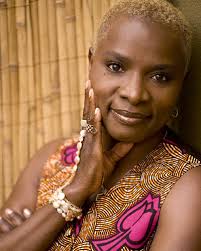
“Don’t let anyone define you from what you live through and everything that they think you stand for. Just be proud of who you are.” Angélique Kidjo

A Heritage of great writers & filmakers
“Don’t let anyone define you from what you live through and everything that they think you stand for. Just be proud of who you are.” Angélique Kidjo
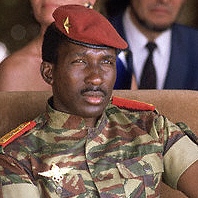
Today marks the 30-year anniversary of the death of Thomas Sankara, our African Che. The first article I ever wrote on this blog was on Thomas Sankara, Thomas Sankara, The African Che. To me, Thomas Sankara is one of the most charismatic, selfless, dedicated, and beautiful African leaders of all times. And I love his sense of humor, and humility. He may not have had a perfect time in power, but what I am certain of, is the deep love he had for his country, his people, and for the whole of Africa. Imagine, someone who renames his country and people to empower them, from Haute Volta to Burkina Faso, the land of the upright man. I would also like to thank the people running the website entirely dedicated to his memory, thomassankara.net; I raise my hat to them, and their tireless work throughout the years.
Here is a summary of Thomas Sankara‘s actions in his 4 years of power. These are taken from thomassankara.net. For the full article, check out Full facts about Thomas Sankara in Burkina Faso . Enjoy the video below!
========
After renaming his country Burkina Faso, here are Thomas Sankara’s accomplishments, [after] ONLY 4 YEARS in power (1983–87).
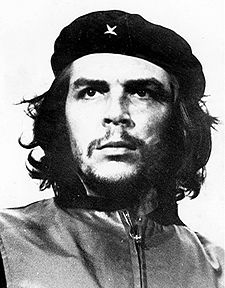
Thomas Isidore Noël Sankara (21 December 1949 – 15 October 1987) was a Burkinabé military captain, Marxist revolutionary, pan-Africanist theorist, and President of Burkina Faso from 1983 to 1987. Viewed by supporters as a charismatic and iconic figure of revolution, he is commonly referred to as “Africa’s Che Guevara.”
– He vaccinated 2.5 million children against meningitis, yellow fever and measles in a matter of weeks.
– He initiated a nation-wide literacy campaign, increasing the literacy rate from 13% in 1983 to 73% in 1987.
– He planted over 10 million trees to prevent desertification
– He built roads and a railway to tie the nation together, without foreign aid
– He appointed females to high governmental positions, encouraged them to work, recruited them into the military, and granted pregnancy leave during education.
– He outlawed female genital mutilation, forced marriages and polygamy in support of Women’s rights

– He sold off the government fleet of Mercedes cars and made the Renault 5 (the cheapest car sold in Burkina Faso at that time) the official service car of the ministers.
– He reduced the salaries of all public servants, including his own, and forbade the use of government chauffeurs and 1st class airline tickets.
– He redistributed land from the feudal landlords and gave it directly to the peasants. Wheat production rose in three years from 1700 kg per hectare to 3800 kg per hectare, making the country food self-sufficient.
– He opposed foreign aid, saying that “he who feeds you, controls you.”
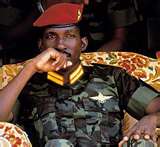
– He spoke in forums like the Organization of African Unity [Thomas Sankara Speech on Debt and Unity] against continued neo-colonialist penetration of Africa through Western trade and finance. • He called for a united front of African nations to repudiate their foreign debt. He argued that the poor and exploited did not have an obligation to repay money to the rich and exploiting.[Thomas Sankara’s Speech at the United Nations / Discours de Thomas Sankara aux Nations Unies]
– In Ouagadougou, Sankara converted the army’s provisioning store into a state-owned supermarket open to everyone (the first supermarket in the country).
– He forced civil servants to pay one month’s salary to public projects.
– He refused to use the air conditioning in his office on the grounds that such luxury was not available to anyone but a handful of Burkinabes.

– As President, he lowered his salary to $450 a month and limited his possessions to a car, four bikes, three guitars, a fridge and a broken freezer.
– A motorcyclist himself, he formed an all-women motorcycle personal guard.
– He required public servants to wear a traditional tunic (the Faso Dan Fani), woven from Burkinabe cotton and sewn by Burkinabe craftsmen. (The reason being to rely upon local industry and identity rather than foreign industry and identity)
– When asked why he didn’t want his portrait hung in public places, as was the norm for other African leaders, Sankara replied “There are seven million Thomas Sankaras.”
– An accomplished guitarist, he wrote the new national anthem himself.
“There is no easy walk to freedom anywhere, and many of us will have to pass through the valley of the shadow of death again and again before we reach the mountaintop of our desires.” Long walk to freedom by Nelson Mandela, 1994
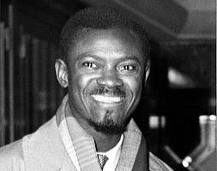
The 30 June 1960 marks the independence of the then Congo-Belge (Democratic Republic of the Congo (DRC)) from Belgium. We will celebrate DRC’s independence today with a poem by one of Congo’s proud sons, none other than its first democratically elected Prime Minister Patrice Lumumba, “Pleure, Ô Noir Frère bien-aimé (Weep, beloved black brother)”. This poem was published in the journal INDEPENDANCE, organe du M.N.C., en septembre 1959 (Cf. La pensée politique de Patrice LUMUMBA, textes et documents recueillis par Jean VAN LIERDE, Présence Africaine, 1963, p. 69-70). Translated to English by Lillian Lowenfels and Nan Apotheker.
| Pleure, O Noir Frère bien-aimé
O Noir, bétail humain depuis des millénaires
|
Weep, Beloved Black Brother
O black man, beast of burden through the centuries,
|
I share with you a poem by the late Congolese writer Tchicaya U Tam’si, “Vos yeux prophétisent une douleur”/”Your Eyes Prophesy a Pain.” Gérald-Félix Tchicaya is mostly known by his pseudonym Tchicaya U Tam’si, where U Tam’si means ‘the one who speaks for his country‘. Born in Mpili in the former French Congo (Republic of Congo), he was a poet, journalist, and an activist. He is considered by many as one of the greatest poets of his generation.
U Tam’si’s poetry uses symbolism, dark humor, and surrealist, corporeal imagery to explore cultural identity in a politically unstable society. A member of the Congolese independence movement, a friend of Patrice Lumumba, U Tam’si creates work on the nature of African identity that is sometimes connected to Aimé Césaire’s Negritude movement, which advocated for the protection of a distinct African culture in the face of French colonialism and European exploitation.
To me, the pain U Tam’si talks about in this poem is that of slavery, of colonialism, of neo-colonialism, of tribalism. He talks as if he was in the 1600s, during slavery times, and predicting more pain. What do you think? What pain is U Tam’si talking about? The original poem was published in Anthologie Africaine: Poésie Vol2, Jacques Chevrier, Collection Monde Noir Poche, 1988; the English translation is brought to you by Dr. Y., Afrolegends.com.
| Vos yeux prophétisent une douleur…
Comme trois terrils, trois collines de cendres! Mais dites-moi de qui sont ces cendres? La mer obéissait déjà aux seuls négriers Des négres s’y laissaient prendre Malgré les sortilèges de leurs sourires On sonnait le tocsin A coups de pied au ventre De passantes enceintes: Il y a un couvre-feu pour faisander leur agonie Les feux de brousse surtout donnent de mauvais rêves Quant à moi Quel crime commettrais-je ? Si je violais la lune Les ressusciterais-je ? Quelle douleur prophétisent vos yeux ? |
Your eyes prophesy a pain … As three heaps, three hills of ashes! But tell me, from whom are those ashes? The sea already obeyed only the slave ships Niggers were being captured Despite the spells of their smiles The tocsin was sounded Through kicks in the belly Of pregnant passers-by: There is a curfew to intensify their agony Bushfires especially give nightmares As for me What crime would I commit? If I raped the moon Will I resuscitate them? What pain do your eyes prophesy? |

President Kwame Nkrumah, the great, and first president of Ghana once wrote a poem on Ethiopia. Kwame Nkrumah was the mind behind the creation of the Organisation of African Unity (Organisation de l’Union Africaine) which has become the African Union (Union Africaine). He believed in the unity of Africa, not just economic, but in the cooperation within the different states, and their independence. So here is his poem entitled ‘Ethiopia shall rise‘. Remember that Ethiopia is the only African country which was never colonized by Europeans, and as such is the siege of the African Union. Here is his entire speech followed by his poem. In reality, in his eyes, Ethiopia symbolizes the whole of Africa, and his wish is for Africa to rise again! Enjoy!
=========
Addis Ababa, May 25, 1963
YOUR; IMPERIAL MAJESTY, MR. CHAIRMAN, YOUR EXCELLENCIES BROTHERS AND FRIENDS,

We have come to the end of a historic and momentous Conference. The decisions we have taken here have made African Unity a reality and we can see clearly a Union Government of Africa in the horizon.
This is the goal which we set ourselves when we struggled in our separate States for Independence. It is also the compelling force which brought us together in Addis Ababa.
As I have said over and over again, the independence of our separate State is meaningless, unless the whole of Africa becomes free and united.

The resolutions we have made here are a symbol of our determination to become united and to remain united in an African Community with common aspirations and common objectives. Freedom Fighters in all parts of our Continent can now be assured that they are not alone in their struggle. The whole weight and power of a united Africa is behind them.
After centuries of colonial exploitation and domination, Africa has been re- born. We have discovered our common identity, a force with which we can re-assert our African personality.
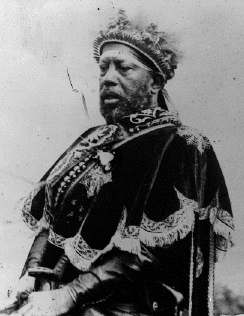
We shall from now on think, plan and work together for the progress and development of our great Continent. In this way, we shall eliminate completely the handicaps, set-backs and humiliation we have suffered under colonialism and imperialism.
We should be happy that at long last, by the adoption of this Charter, we have seen the end of the various groupings and regional blocs. It only remains for me, Your Majesty, on behalf of my colleagues to convey to the Government and people of Ethiopia especially to His Imperial Majesty, my sincere expression of gratitude for a happy and memorable stay in Addis Ababa.
The ancient Greeks identified Ethiopia with the Black Race. I would therefore like to leave with you a little poem on this:
Ethiopia shall rise
Ethiopia, Africa’s bright gem
Set high among the verdant hills
That gave birth to the unfailing
Waters of the Nile
Ethiopia shall rise
Ethiopia, land of the wise;
Ethiopia, bold cradle of Africa’s ancient rule
And fertile school
Of our African culture;
Ethiopia, the wise
Shall rise
And remould with us the full figure
Of Africa’s hopes
And destiny.
Kwame Nkrumah
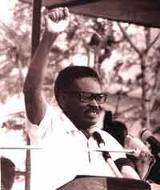
Today, I would like to share a poem by one of Angola’s most prolific writer and its first president, Agostinho Neto. This poem, “Havemos de Voltar” / “We Shall Return“, speaks to all people, and all times.
 Back when this was written from his prison cell in Lisbon, the poem symbolized the return of lost sons, of exiles, of freedom fighters, and the return to their homeland, their loved ones, and the re-attribution of their resources back to them. Today, the message means pretty much the same: a return to liberty (African countries’ freedom from the oppressors), economic freedom (FCFA, the slave currency), and even freedom to all immigrants around the globe who run away from their country because of poverty, war, etc. So to all those seeking a return to peace, to love, a return home, here is Agostinho Neto‘s message.
| Havemos de voltar
Às casas, às nossas lavras ÀS nossas terras Às nossas minas de diamantes Aos nossos rios, nossos lagos À frescura da mulemba À marimba e ao quissange À bela pátria angolana Havemos de voltar |
We shall return
To the houses, to our crops, To our lands To our mines of diamonds To our rivers, our lakes To the shade of the mulemba To the marimba and the quissange To our beautiful Angolan homeland We shall return |
From Sacred Hope – Poems by Agostinho Neto, published by the Angolan Writers Union, 1986, sponsored by the National Bank of Angola. Translated to English by Marga Holness.
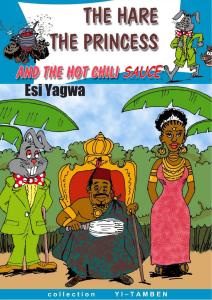
Tis’ the season of blessing, joy, happiness, and merry-ness. I would like to share with you a book which will make you all laugh to tears. A king, a beautiful princess, and a pot of hot chili sauce… the combination is bound to make you laugh. Enjoy this book, an African Children’s book, for young and young at heart, perfect for Christmas and to spice it up the African way! It is on kindle e-book. Enjoy and Happy Holidays!
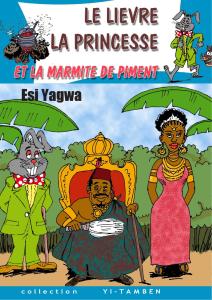
Que de couleurs, que de rires, que d’astuces, que d’intelligence dans ce livre! Le Lièvre, la Princesse, et la marmite de piment est un livre véritablement adapté a toute période enjouée! Je vous garantis qu’il vous fera passer de bons moments. C’est sur Amazon Kindle. Bonnes fêtes de fin d’année!
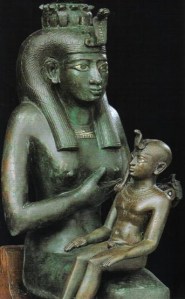
I am sure every African child has read either the entire book or excerpts of ‘L’Enfant Noir‘, ‘African Child‘ by the Guinean author Camara Laye . It is a school classic. When we were in school, the teacher will often give us dictations from this book. The book focuses mostly about Camara Laye ‘s childhood and was written in the 1950s at a time when most African writers were talking about independence, negritude, panafricanism, etc. This earned Laye’s some tough remarks from Cameroonian author Mongo Beti and others about his lack of interest in panafricanism and African independences. Today, I present to you this poem, ‘A ma mère / To my mother‘ of Camara Laye to his mother (published in Coup de Pillon), which is in reality an ode to all African women, and all mothers around the globe. Good to note his mentioning of blacksmiths in this poem, especially given that Camara Laye’s family was Malinke and he was born into a caste that traditionally worked as blacksmiths and goldsmiths. The English translation is by Deborah Weagel. Enjoy!
| A ma Mère
Femme noire, femme africaine, Femme des champs, femme des rivières Ô toi Daman, Ô ma mère, Femme simple, femme de la résignation, Femme noire, femme africaine, |
To my Mother
Black woman, African woman, O mother, I think of you … Woman of the fields, woman of the rivers, woman of the great river, O O Dâman, O mother, who wiped my tears, Simple woman, woman of resignation, O mother, I think of you.
|


 African Heritage